The Philadelphia Cricket Club is hosting the 9th U.S. Amateur Four-Ball Championship from May 25 – 29. The USGA sanctioned event consists of 128 two-man teams that will face two rounds of stroke play. The lowest 32 teams will then advance to five rounds of match play for the winning team to emerge. Both the Militia Hill and Wissahickon courses will be played on for qualifying, then all match play rounds will take place at Wissahickon. There’s nothing quite like the Four-Ball as it pertains to USGA championships. Amateurs of an index of 5.4 and lower are able to try and qualify with a partner of their choosing; there is no requirement that partners belong to the same golf club, country or school. Brothers, friends . . . enemies; whatever team dynamic it takes to reach the championship, the qualifying format is largely democratic and takes all comers.
The Four-Ball always utilizes two courses for its tournaments. With seven total rounds and 256 golfers playing the first two days, there is certainly plenty of opportunity for a variety of styles of play to flourish over the 36 holes. This unique format is even more intriguing this year as Philadelphia Cricket is the first host since Pinehurst in 2017 (Nos. 2 and 8) that provides a stark contrast in design eras of the two courses. The Wissahickon course is the beloved classic design by A.W. Tillinghast that was faithfully restored by Keith Foster about ten years ago while Militia Hill is a modern layout by Dr. Michael Hurdzan and Dana Fry, which opened for play in 2002 – more than eighty years after Wissahickon came on the scene. The designs of the two courses are qualitatively different in their structure of play, which will make for an intriguing qualifying segment as the teams try to manage the strategic dance of Wissahickon and the sporty Militia Hill with its high-speed greens. A complete game will do; the teams must think just as much as they will need to execute in order to make it to the field of 32.
Here are the yardages for each course at the moment:
THE PHILADELPHIA CRICKET CLUB (WISSAHICKON)
| Hole | 1 | 2 | 3 | 4 | 5 | 6 | 7 | 8 | 9 | Total |
| Par | 4 | 4 | 3 | 4 | 3 | 4 | 5 | 4 | 4 | 35 |
| Yards | 424 | 423 | 118 | 487 | 200 | 475 | 553 | 365 | 370 | 3,415 |
| Hole | 10 | 11 | 12 | 13 | 14 | 15 | 16 | 17 | 18 | Total |
| Par | 3 | 4 | 5 | 4 | 4 | 3 | 4 | 4 | 4 | 35 |
| Yards | 172 | 419 | 546 | 447 | 435 | 217 | 426 | 449 | 487 | 3,598 |
THE PHILADELPHIA CRICKET CLUB (MILITIA HILL)
| Hole | 1 | 2 | 3 | 4 | 5 | 6 | 7 | 8 | 9 | Total |
| Par | 4 | 4 | 5 | 4 | 3 | 5 | 4 | 4 | 3 | 36 |
| Yards | 412 | 405 | 538 | 391 | 188 | 578 | 447 | 404 | 244 | 3,607 |
| Hole | 10 | 11 | 12 | 13 | 14 | 15 | 16 | 17 | 18 | Total |
| Par | 4 | 3 | 4 | 4 | 5 | 3 | 4 | 5 | 4 | 36 |
| Yards | 420 | 162 | 397 | 475 | 529 | 200 | 394 | 585 | 435 | 3,597 |
Golfadelphia has reviewed each course for more insight. Wissahickon – https://golfadelphia.com/2020/12/09/the-philadelphia-cricket-club-wissahickon-course/; Militia Hill – https://golfadelphia.com/2022/08/09/the-philadelphia-cricket-club-militia-hill/.
The amateur game is certainly more relatable to us mortals and in recent years, I have found myself drawn more and more to watching it. Of course it is nice to watch the professionals play their elevated game and marvel at their talent but one seems to learn much more about the course when seeing how the competitive amateur takes it on. The Curtis Cup at Merion in 2022 was imminently enjoyable for that reason and the Four-Ball should be no different. The team dynamic adds another interesting component to how the players plot their shots, all of it course and competition dependent. As it relates to the two courses, let’s examine some key characteristics of each and how they could impact play.
Wissahickon
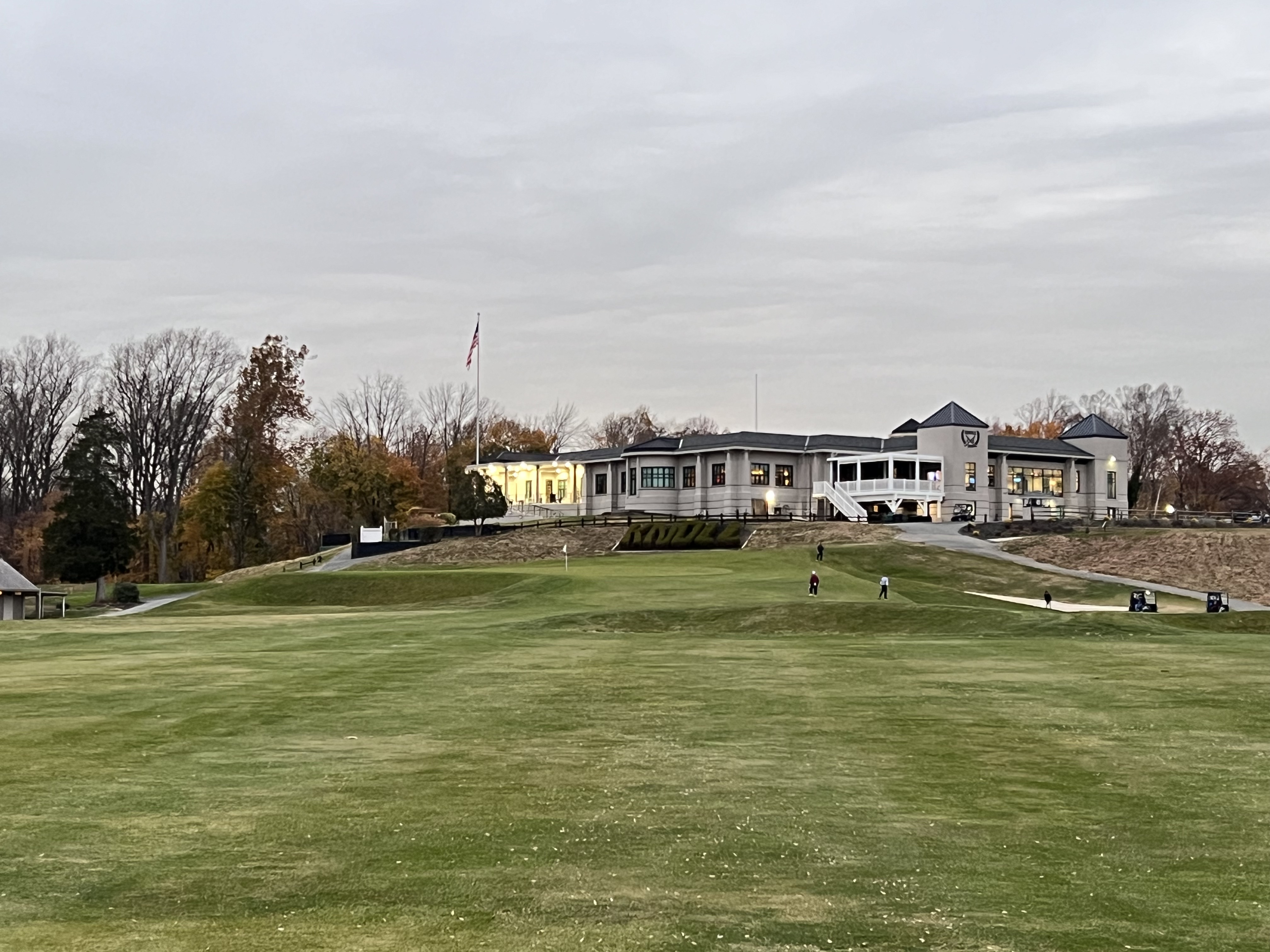
Wissahickon hosted the 2016 Constellation Senior Players Championship but changed the routing for the tournament. The as-is routing will remain in place for the Four-Ball. This will allow the course to preserve its remarkable balance between bold and brawny par 4’s and more intimate shorter holes. The routing will also instill its ability to keep the golfer off kilter, intended to keep the challenge fresh and prevent him from getting all that comfortable. Very much a driving course, the golfers will be challenged off the tee with an array of decisions and angles while the approaches will vary in distance and type. This all comes to a head at the Eighteenth, where the most challenging and strategic tee shot awaits, which leads to an approach that is either survival out of position or an opportunity to close out the round one less stroke. It is one of the best closing holes in the Philadelphia area.


Green movement will reverberate to the tee shots. There are greens with a dominant back to front movement (1, 2, 3, 5, 6, 7, 11, 13, 14, 16) that may seem simple in backing the ball to the pin but those coming in from the sides will find a more challenging calculation as the lateral movement all of a sudden comes into play which will move the ball towards the bunkering or short grass areas typically surrounding the greens. There are greens with particular challenge that move from front to back (4, 9, 10, 14), requiring more finesse in cozying up to the pin. Shot control and knowledge of how the quadrants of each green move in conjunction to the hole will be paramount for the golfer. While many greens with front to back movement reward approaches that land at the rear, that is not the case at Wissahickon; those shots would simply move off the back side. The golfer will need to use the lateral movement of these greens to counteract the front to back movement.
Of course, the approaches into these greens will run the gamut of distances, as Wissahickon revels in dancing between short and long holes. The tufts of fescue will likewise come into play with those out of position and along with well placed bunkers, will often allow a chance at recovery even if the degree of difficulty seems to sky rocket in spots. The short par 3 Third fits right in with the trend of challenging short par 3’s seen at the recent U.S. Opens of LACC and Brookline. The Third typifies the difficult recoveries awaiting those who miss the green, whom will need to make it through the bushels of fescue gracefully in order for the green to be receptive. In contrast, the Fifteenth par 3 should allow varying degrees of challenging recovery shots for those off the green and some remarkable saves should be in store with the left side well below the hole. Indeed, very few shots will suffer the fate of a lost shot. Most shots, no matter how unsavory, will remain in play whether the golfer likes it or not. Regardless, this allows the golfer a chance at redemption, no matter how grim.
The brilliance of Tillinghast should produce thrilling play as the teams will need to gauge their position immediately off the tee and tap into a wide array of thought as well as execution, all of it under the unique pressure of competition.
Militia Hill
For the qualifying rounds, the teams will be faced with a much different structure of play than Wissahickon. Militia Hill relies a bit more on distance (marked approximately 200 yards longer than Wissahickon) and an overall slippery sleekness. The greens are mostly set on hillsides with expansive short grass surrounds, which will send the ball darting in varying directions unless the golfer figures out how to harness that speed to his advantage. A more decidedly penal course in spots, there are some forced carries and temptation to lure the golfer out of his comfort zone (the tee shot at the Fourth in particular) while the Eighteenth follows in the footsteps of Wissahickon as a brutal closing examination for the golfer. The tee shot and approach will need exacting precision while at least a half shot penalty awaits those who fail to execute. Overall, the contrast with modern design components should yield a longer, more penal, yet more straightforward challenge where the golfer will need to showcase length with steely nerves in handling the furtive movement prevailing throughout.
Most of the challenge will be around the green, as the design is generous on most tee shots so as to provide an opportunity for the golfer to try and set up their approach. Pin positions will no doubt impact the shots before it with the anticipated green speeds. Most of the holes are straight yet how they are placed about the hills provides a fair amount of variety of play. Recoveries should be manageable out of the sand yet those harrowing shots off of the expanses of short grass with the quick contours and undulations should provide ample excitement. How these teams handle the Eighteenth will be particularly interesting, while the downhill short par 4 at the Twelfth, the short par 4 Sixteenth, the tee shots at the Fourth, and par 5’s in general should be similarly entertaining watching these high-skilled lads figure out how to go about it.
For those able to head down in the next few days and watch play on either or both courses, I would urge you to do so. The designs will be on full display for a tournament with a much more relatable yet elevated style of play that is certain to showcase brilliant golf.
The next article will get into the actual play of the courses, some of the teams and possibly the preparations unique for the tournament. I’ll see you over there.



You must be logged in to post a comment.