6,520 yards, 136 slope from the Blues
Donald Ross designed enough courses that there are various ways one can sort them into some kind of order. One of those manners of assortment is by scale. I prefer thinking of his courses by scale because it oftentimes coincides with function and purpose. There are smaller scale Ross designs such as Misquamicut, Essex County and Siwanoy while there are larger scale such as Oakland Hills South, Aronimink and Oak Hill East. The Pinehurst area itself holds such a contrast in scale; there are the smaller with Pinehurst 3, Southern Pines and Mid Pines while larger are with Pinehurst 2, Pine Needles and Pinehurst 4. I’m the first to admit this is a matter of feel more than anything else. This feel tends to equate intimacy with smaller scale and range with larger scale. There are times, however, where feel and actual scale may blur any well defined lines. Smaller scale designs can feel more large scale because of the width and options of play and yes, larger scale designs end up playing much more intimate than the terrain may let on.
Scioto certainly toyed with my scale sense. I was anticipating a more smaller scale, then my initial gaze across the landscape convinced me it was large scale yet as we played our way through the round, I realized the course fell into rare company. It was both at the same time. Yes there are courses that dance between large and small scale but every now and then Ross was able to exude an array of scale energies that transcend the mood of the terrain. There is the freedom in the structure of play here usually more associated with larger scale yet the amount of comfort and knowledge the player can absorb with each shot garners the closeness typically associated with smaller scale. This accomplishment with scale also comes from retaining the classic style design while shunning the temptation of allowing modern game components from seeping in. This emphasizes a more wily, clever strategic play over hulk smash length and high spin wedge shots able to sit right next to the pin. This largely comes from the routing and how the fairways caress the land with meticulous hazard placement complementing in the right places yet the green complexes are what really set Scioto apart as a special Ross design. The distinct character of each is hauntingly delightful, enhanced by the ability to approach them in so many manifold styles of play. The course certainly made an impression. A reaffirmation of Ross’ brilliant simplicity and a recognition of Andrew Green’s restoration mastery, here is among his best.
Scioto is a well known course for many reasons, among them being where Jack Nicklaus grew up learning the game. Its history is rich, opening in 1916 and then hosting the U.S. Open ten years later, which Bobby Jones won. The course then hosted the Ryder Cup in 1931, where the U.S. team was captained by Walter Hagen and were victorious over Great Britain 9 – 3. It then hosted the PGA Championship in 1950. In 1968, it hosted the U.S. Amateur, as well as the U.S. Senior Open in 1986 and 2016. It is scheduled to host that tournament once again this coming year in a few months while it will host the U.S. Amateur again in 2036. Its history as a championship venue is impressive, more so because it does not seem to be making any compromises in its Ross pedigree to chase, or ensure it continues to host. This is not the case at every Ross course but here, it is refreshing. The classic structure emphasizing the hilly and ridgy terrain with its strategic cadence and exam on deftness of touch is very much intact without compromise.
Much of the vintage design feel is the result of Andrew Green’s restoration of the course in 2022. The mission of that project was to return the course back to its 1916 iteration, which hosted the U.S. Open and Ryder Cup. The primary source material relied upon was, of all things, a cartoon illustration by Dudley Fisher, Jr. titled, “As the Dodo Bird Views the Scene of the National Championship 1926.” This illustration, along with some photos from the 1931 Ryder Cup program, guided Green and his team for historical truism. Green endeavored to return a lot of the greens and fairways back to grade, which consisted of removing a lot of the fill that was built up in prior renovation projects (mainly Dick Wilson in the 1950’s). This resurrected the lively ground game the terrain is capable of. The objective was to return these design elements without a while lots of improvisation, yet there was some minor compromises made for fairway bunker placement which is inevitable nowadays. Tree removal was a big component of the project, both to restore the playing corridors and approach angles as well as to mimic what was in the illustration. One of the under discussed elements of any restoration project is how the club handles the newfound course once the course re-opens. Some courses will start tinkering in-house based on member input while others will retain the architect as a consultant and discuss any considered changes with them. Scioto has done a tremendous job of staying the course after the project, which has benefited the Columbus golf scene as well as Ross enthusiasts of all walks. I found it to be one of the more impressive Ross restorations I have come across.

It was a rough re-entry after Scotland with respect to my swing. I couldn’t find a good rhythm and all the things that seemed to have to worked over there weren’t working over here. It was just a matter of finding consistency. Some times exemplary design has a way of inspiring my game. I remember finding refuge in the design at Scioto as we walked those opening holes. I remembered finally saying to myself, “don’t think.” Step up to the ball, get set and hit. Throw all the swing thoughts out of the window. The course responded favorably. Chips fell in, rolls were fortuitous, the ball sprung with the vibrant life of Spring and bounded with purpose. I started remembering that swagger I had in Scotland and it all came back. It came back in the way it started over there. Stop thinking, stop caring and be in the now, the rest will take care of itself. Often said but always better to feel and experience. The wonder of the design and revitalization of the game converged for a memorable round of golf.
The First is a 410 yard par 4 (from the Blues). A decision must be made from the start. Take on the bunkers on the left of lay up short of them. For those going full bore off the tee, consider the trees on the right as well. Those whom are successful will be left with a nice short approach in but those unsuccessful will likely be left with a tough recovery. The green has width but falls off on the back, so much so that hedging short altogether is not an insane proposition. There is no gentle opener here, we are in it from the get go.


The Second is a 420 yard par 4. Staying on the perimeter of the property, the tee shot must utilize the wide fairway or be left in dire suspense as it drops off on both sides. The second shot will likely be on the longer side and uphill to the green. The green grabbed my attention for its scale and how the surrounds branched out from it. The sunken bunker on the right gives the complex definition while the Third tee melds right into the rear. Dan Jenkins considered this one of the best holes in America and even without knowing that, the hole made me realize something remarkable laid in wait.


The Third is a 370 yard par 4. Still on the perimeter with the right side continuing to be out of bounds if one strays too far. There is space on the left but one must account for the drop off down the hill if too far over. With these considerations in mind, there is a center line bunker about 300 yards from the tee. The tee shot needs to stay within the aforementioned confines. This leads to a manageable approach although the green is a bit squirrely. Pushed up after the center line bunker, the slope off the right and left side trench bunker come into play if there is too much roll on the approach, with a general back to front and right to left movement upon it.


The Fourth is a 180 yard par 3. A long par 3 made even longer when the wind is howling like it was for us standing at the tee. Bunkers slightly pinch the entry point and sit below the green, which moves from left to right. The miss is right if one must. It is not left or off the rear, both will leave irreconcilable situations.


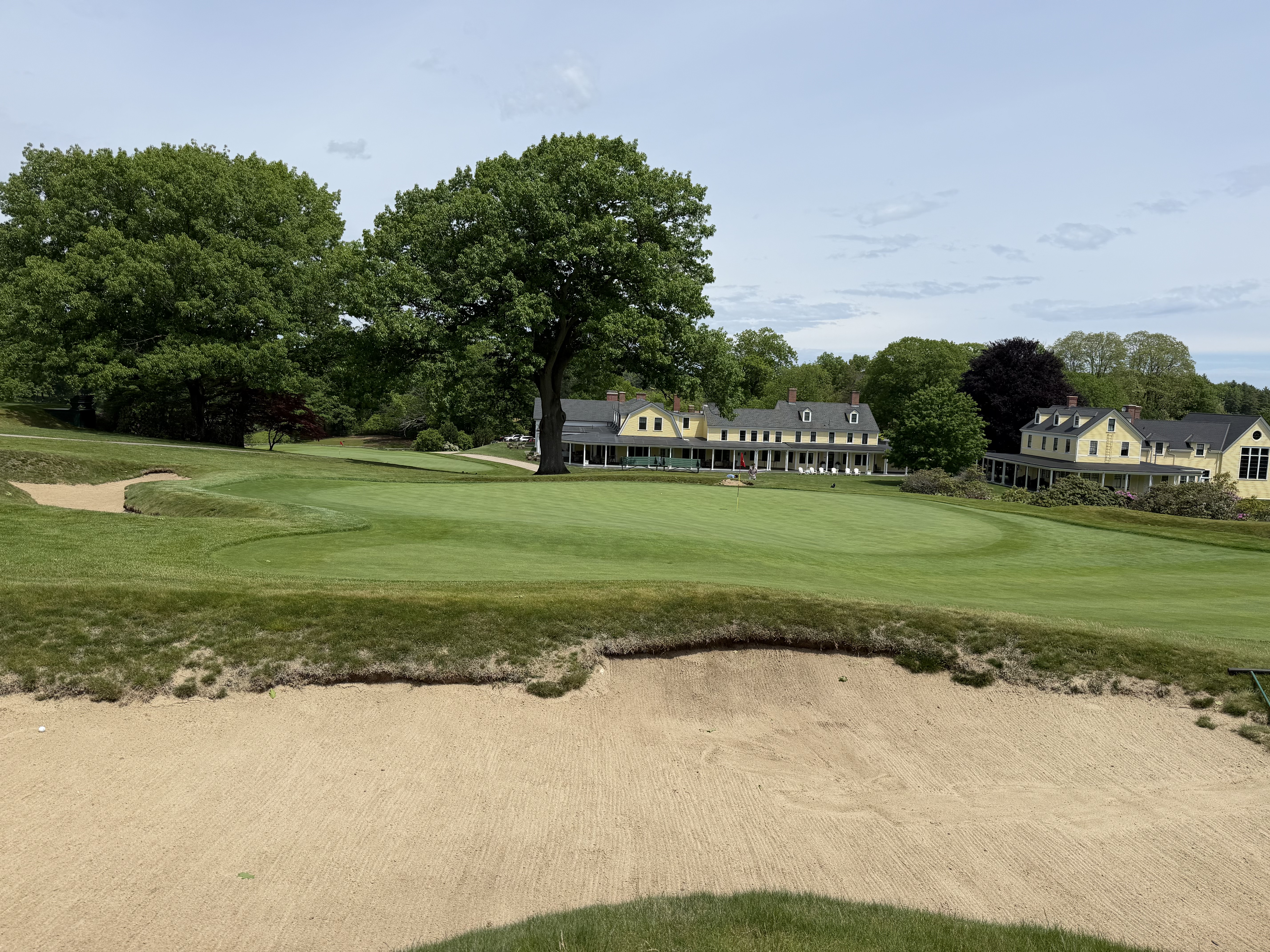
The Fifth is a 425 yard par 4. The tee shot moves down into the valley and the trees play with the golfer’s sense of depth perception. Dead straight is the order here while those needing the second shot to recover will be facing some tough scenarios. The green was among my favorite although Ross confessed he ignored his own design dictates of not creating overly severe greens. It cascades from back to front, is protected by hummocks on the right while falling off to an expansive short grass area to the left. And for goodness sakes, do not go long. A poor fellow in our group found him in that exact situation and it was tough going for him as seen below.


The Sixth is a 490 yard par 5. It happens on occasion but this is one of the rare times it had an impression on me. My group all hit our tee shots in wildly various directions and I didn’t see any of them until we re-congregated at the green. A dog leg left that climbs back out of the valley where favoring the right side off the tee is preferred. A miss to the left could mean the golfer needs to recover out of the valley while the more grievous misses to either side bring some hardwoods into the picture. The jagged shaping of the green complex and bunkers is worthy of note, all it sitting slightly above the fairway.


The Seventh is a 365 yard par 4. Moving uphill to a corner of the property, a center line bunker menaces the tee shot. Does one favor one side of it or the other, lay up short of it, or throw caution to the wind and try to cover. It must be avoided one way or another and the closer the tee shot gets to it or past, the more advantageous the approach. The green complex is another terrific one with an inviting entry point but bunkers on either side below.


The Eighth is a 485 yard par 5. Moving back across the property, A slight dog leg left with a complicated tee shot which moves back down into the valley but the burn and water on the left make it much tougher than it looks. The second shot then needs to manage on a narrower fairway that slopes slightly to water to the left. The green is diamond shaped and runs from left to right, towards the water. The first two shots are more precarious for how they need to negotiate the terrain and hazards while the approach must confront the movement of the terrain, which starts from the high right rear corner. A challenging yet fun par 5.


The Ninth is a 150 yard par 3. The golfer hits his tee shot here and expects to see his ball bounce and roll on the green yet is mystified when the ball doesn’t appear. Bobby Jones never hit the green here in the 1926 U.S. Open. The hill cleverly masks the movement of the green and position of bunkers. The fact of the matter is it is anything but a straightforward uphill shot. Bunkers actually surround the green complex, which is nice and wind and fraught with hollows and mounding. One can get behind the rear bunkers on short grass if the shot is overly energetic and that presents a harrowing recovery back to the green. It was fascinating how it revealed itself as one climbs further up the hill. Brilliant use of the hill for a memorable par 3.


The front nine covers the southern portion of the property, starting off with challenge and intrigue which quite honestly doesn’t let up yet never feels stressful. Many of the holes are strong and I liked them all. I would rank them 2, 9, 5, 8, 7, 1, 3, 6, 4.
The back nine starts with the 400 yard par 4 Tenth. Moving back into the valley, the tee shot does well to stay on the left side as the right pulls downwards in the direction of the Eighth. Some would argue that a tee shot could go too far here as the fairway eventually sweeps down and to the right in the rough. Mounding is also on the right side for those who hedge short yet miss over on that side. The green is on the other side of the creek, which moves down the left and front sides of it. Right to left movement here is prevalent at the green while the greenside bunker on the right is one to especially avoid, as recoveries out of it will face a green running straight to the water. This hole is just one example of the course showing us tee shots are not giveaways for more engaging approaches. The driving game is varied here and occasionally, a bit demanding.


The Eleventh is a 350 yard par 4. We head to the same corner as the Seventh but do so from a further left angle. One of the shorter par 4’s of the course, the tee position determines how much the center bunkers near the green come into play. This could be any where from 280 – 300 yards, uphill. Most of us should be fine but it is definitely a consideration when setting up the approach. The green is pushed up with bunker pools on either side, expansive sand that fluctuates with respect to where it is gathered. Most approaches will be aerial to carry the sand and with the run off to the left where the next tee resides, over aggressive approaches will face either wily chips from that short grass or from the bunkers.


The Twelfth is a 505 yard par 5. Back to the perimeter with the right side out of bounds, the tee shot needs to do its best to bound up the hill and stay out of the bunkers on the left. The second shot will most likely be blind as it finishes the job of moving up the hill towards the green. The approach is to yet another one of my favorite greens of the course. A slight bend to the left on approach, the green is set at an angle with respect to the fairway. Narrow yet deep at that angle, the approach must navigate two bunkers at the front and two at the rear corners. Coming in from the right side allows the golfer a bit more roll out while those coming in from the left may need to shape their shots accordingly. There is a good amount of short grass to work with off to the right as well. Yet another hole where every shot is engaging and for different reasons.


The Thirteenth is a 420 yard par 4. Moving in the same direction, the fairway breaks downhill to the green. There is a long fairway bunker on the left and a smaller one across from it perpendicular to the fairway. Tee shots need to avoid both of these and take advantage of some of the downhill. The green is of modest size compared to the others yet runs deep and is surrounded by bunkers on all sides except the rear. Despite appearing downhill, the green has some rear to front movement, flummoxing most golfers. It’s the number 2 handicap hole because anything other than two well hit shots simply will not do and the degree of difficulty on recoveries grows quite quickly based on where the golfer is out of position.


The Fourteenth is a 200 yard par 3. An uphill tee shot with a prevailing left to right movement, the hillside with its gravitational pull. The forward bunkers give a false front kind of feel, the apron before the green is beset on both sides by bunkers itself. This apron is certainly an option for those on the conservative side. Further ahead is the green and the bunker on the lower right is one of the deepest on the course. The green is expansive with proper undulations on the broad shouldered end of the spectrum. A very good long par 3.


The Fifteenth is a 380 yard par 4. A dog leg right where three bunkers are on either side of the fairway off the tee at the turn. Longer hitters may want to try and carry those on the right while conservative players may want to lay up to those on the left. I ended short of the right bunkers and felt that was a fine approach spot, you just have to carry a good amount of bunkers to reach the green. After the turn and bunkers, the green is raised above the fairway with an inviting entry point front and center and a bunker at each front corner. Gary Player three putted this green to lose the 1986 U.S. Senior Open. I’m at least in good company as I three putted as well, baffled with the teasing movement of my ball as each putt felt true. It’s a mischievous green to be sure, I look forward to another bout with it soon.


The Sixteenth is a 405 yard par 4. Moving downhill from the tee, there are three bunkers on the left that should be avoided at all costs. Favoring the right side off the tee is fine but mind the rough and trees off fairway on that side. The fairway ultimately ends at a creek, then starts up again on the other side, moving up to the green. Once the golfer sees the green and what is needed, he realizes just how important it is to get the tee shot right. An expansive short grass area with a single bunker at the front right corner, the ball will roll in tune with the land. In general this movement is back to front and right to left but the rear half of the green will start moving off the back towards the next tee. Positional strategy is of the utmost on each shot here. The green complex as a whole was among my favorites, although this is becoming a common refrain since they all struck me favorably.


The Seventeenth is a 140 yard par 3. Ross always made sure there was a shorter par 3 on his courses. I thought it might have been the Ninth here but this one is shorter and possibly more menacing. A smaller green abutting a creek on the right and rear sides with bunkers surrounding the rest of it, the sliver of green provides a little bit of depth running towards the left rear. The golfer should be well warmed up for this tee shot that demands precision in order to hit the green. For those who miss, it is time to bring the sharpest short game skillset to keep par in play.


The Eighteenth is a 425 yard par 4. We move out of the valley and up to the clubhouse in one fell sloop. A bevy of bunkers are on either side of the fairway for the tee shot, first on the left, then the right. Navigate those and the golfer is likely left with a mid to long approach to one of the largest greens of the course. Also bear in mind that a tee shot targeting the left to cover the bunkers could hit a downslope and propel towards the green. A bunkers resides at both front corners but there is plenty of room beyond them. Right to left movement is suggestive on the right side but becomes more insistent the further left one proceeds on the green. The golfer could be left with quite the lengthy putt depending on pin position, yet that is preferable to some recoveries off green or off fairway.
My putt fortuitously rolled in for birdie, one of the best ways to finish a round. The game feeling renewed and grateful for the opportunity to experience more Ross brilliance, my stride was certainly more lively walking off the last than it was stepping to the First. That is one of the ideal points of the game, after all.


The back nine is covers the opposing half of the property than the front with a little more undulation and outright challenge. The par 4’s are exceptional while the 5 and 3’s similarly fascinate. I would rank them 12, 18, 10, 16, 11, 13, 14, 15, 17.
This restoration age is resplendent for its countless stories of historical redemption. Some times the best course possible is its design by the original architect. Our current age has shown increasing adeptness at getting at original intent so that it translates to exemplary golf in the modern era. Scioto accomplishes this wonderfully. The structure of play is strategic exploration of the heaving terrain with subsets of adventures at the greens and recovery territory. The variety comes with the changes in the terrain, angles produced with configurations of tee to fairway to green and the remarkable green complexes exuding a wealth of individual character. The sophisticated notes of scale are impressive, as is the steadfastness of adhering to classic tenets without tempting compromise to modern facets. Scioto is a shining beacon of Ross’ legendary routing and green sites and now shines just as bright for Green for his uncanny ability to resurrect. The course is a fantastically artful strategic challenge that keeps the golfer in the right frame of mind with its endless recovery opportunities. Its use of hardwoods is also notable, reminding us that parkland designs can mesmerize with trees at the proper measure and placement. The parkland feel with the hills, valleys and streams just wouldn’t be the same pleasant stroll it is without them. Don’t walk; run.
Clubhouse/Pro Shop: Stately yet unimposing, the history of the club can be felt throughout with its displays and various rooms. Spacious with a good deal of light, it fits in nicely with the hillscape. The pro shop takes up a section close to the First tee with a notable insignia.


Practice area: The driving range is at the far end of the parking lot, a short game area is at the far end of the driving range while a chipping area is at the near end, and a putting green abuts the Eighteenth green.



You must be logged in to post a comment.