6,472 yards, 131 Slope from the Blues
Endless dusk. Those late fall days where the sun hangs low for eons as we lose count of the golf holes coming one after another. There is all kinds of golf but I enjoy the solo kind. It’s where I do my best thinking. It’s where I do my best golfing. It’s also where I’m allowed to focus on the design as much as I care to. The round was a gift. I was in the area for work and things ended much earlier than anticipated. I had enough time for a round but it had to be relatively close. A quick check and I was apparently ten minutes away from Knoll. A call inquiring about availability and sure, I was free to head out if I could get there within the hour. Done and done. There is a welcoming cool chill that greets us in the early spring and late fall. It sits in the air and with a vest or long sleeve shirt, one is comfortable the majority of the day. The low sun plays its golden streaks through the trees, the shadows and clouds. The stillness is silently clamorous. We’re invited to enjoy for a few more occasions before the winter dull sounds its Feng gong.
A round that was never meant to be, snuck in like spies across the border. I played quickly with purpose yet realized early on there was something special here. It was a Banks with grace, with . . . maturity. It was designed in 1929 and would become his fourth to last course before his death two years later in 1931. Many decades later, an owner of a dry cleaner became a member here. His name was George Bahto. Bahto was a minor league ball player for the Philadelphia Athletics before joining the Navy during the Korean War. After returning and settling down, Bahto became a member at the Knoll. The clubhouse was involved in a fire in the 1980’s and along with it, the original blueprints for the course. Bahto went to the nearby USGA museum to see if he could find anything on the design. And so began Bahto’s journey into the golf course architecture. He started realizing the origins of the template holes and educating other members on it that at some point, Parsippany Township commissioned him to wrote a book on the course. This uncovered a lot of research on Raynor, who there wasn’t a lot written about since Raynor was too reserved for all that much writing and preferred to let his work do it for him. Ultimately, Bahto is responsible in large part for a re-discovery of Raynor in the latter part of the twentieth century with his research, writing and consulting work in course design. That started at the Knoll, where he eventually led some restoration efforts in 2000. The course had been mostly preserved over the years because of neglect and a lack of resources, which allowed the restoration to focus on a lot of the finer points.
The course showed sophistication and relied on much more than bombastic templates and flashy sharp edges most might associate with Banks at first blush. Some might say it was a perfect course for one of those times of endless dusk. Stolen time upon well crafted land. Banks designed for a brief time yet his work is legendary. For its boldness, memorability and degrees of intimidation. Knoll West went beyond those themes, attempting to capture a bit more contemplation from the golfer. The greens are drop down magnificent. Yes there are templates and I include them but even beyond those, the movement and shaping is spectacular. Their scale also has a lot to do with it, which goes for the rest of the course. That was the second surprise here for me. It has to be one of the more expansive pieces of land Banks was able to use, which was nicely routed. The tee shots and approaches all had variety and interest while there was a good amount of deception in the bunker placement I had not seen so well since Forsgate. The elegant style of the round captivated my attention and I would place this among Banks’ best work.
Knoll CC is a semi-private facility. There is also an East Course, designed by Hal Purdy in 1961. The East is available to the public at any time while the West is reserved for the members but the public is allowed play at times. It is certainly worth the effort of figuring out an opportunity to play the West. It is among the top tier of NJ courses, private or public.
The First is a 402 yard par 4 (from the Blues). An elevated tee shot opens up the round from the hill upon which the clubhouse is set. This hill is used as a prominent convergence point during the round with a total of six tees and greens. The fairway is straightaway with a large bunker on the right then one on the left closer to the green. This one on the left in the distance is greenside and this is a Road hole template green, so that bunker is snug against the front left side and the green runs around it. A long trench bunker runs at the angle at the rear to act as the road while one of its variations is at the green, where two long mounds run through the green. An opener meant to impress, which it does.


The Second is a 412 yard par 4. Moving back in the direction of the clubhouse, the tree lines and left bunker in the distance are the issues to handle off the tee. The entry point is wide and favors the left while the green is a double plateau with a slight gully in the middle and higher raised wings off to the side. Putting from side to the other is always going to take the golfer’s best stroke to end up close to the pin. A really cool green and this refrain will likely appear for a lot of the holes.


The Third is a 191 yard par 3. This is the Redan, the green position at an angle so the right front is closest and runs away to the left rear as the furthest point from the tee. The green moves in that direction as well and the subtle mounding and hollows on the green impart some randomness to spice up the general right to left movement. The left front bunker may not be the worst place to end up but it is rather deep below the green. A nice Redan rendition, especially with the elevated tee so the golfer can see his ball run and bounce about.


The Fourth is a 398 yard par 4. Now heading out away from the clubhouse, the fairway tips off to right after the tee shot. The prominent bunker on the right should be carried off the tee, as the further one is on the right of the fairway, the more the green opens up and avoids the larger bunker on the left. While the entry point is rather open, there is no room at the rear and a bunker at the rear right. The green cants left to right with some subtle interior contours to learn over time. A settling in hole if you will.


The Fifth is a 514 yard par 5. Just a note we have another par 5 at the Fifth. The left side remains out of bounds as the hole slightly but constantly bends to the right all the way to the green. There is a good deal of bunkering to negotiate off the tee yet the golfer may not pick up on that at first blush since they’re all below grade, some slight mounding their only indication. Left center is a proper line yet account for some roll out to avoid the tree line on that side. There is enough fairway for the golfer to decide on his own how to plot along to the green. Once again there is a wide entry point but the below grade bunkers continue around the green. Its size accommodates just about any shot in, which then places appropriate pressure on the putting.


The Sixth is a 168 yard par 3. This is likely the Short template. The bunkers act almost like a moat below and around the oval green that is wider more than it is shallow. There is so much intricacy at the greens that landing on them is the first part of the battle. That is some what the case here, where the more modest size makes the length a little easier to manage.

The Seventh is a 369 yard par 4. The Macdonald/Raynor/Banks trio diversified their bunkering throughout the course. Sinewy or thin strips either curving with or remaining at a rigid straight angle are typically found near the green while larger, below grade bunkers were used sparingly yet effectively typically about the fairways. The fairway bunkers vary with respect to their visibility to the golfer. These bunkers are typically angular or perpendicular to the fairway and some times appear in succession one right the other, like an accent mark struck a few times for effect. As we see at the Seventh, the fairway oftentimes pools before these fairway bunkers, allowing the golfer a lay up if carrying it is too much to bear. The green side bunkers could also match the larger scale seen at the fairways, especially with Banks who liked to deepen them as if he were trying to breach the clouds of hell. Always, the bunkering is selective and strategic with notes of deception with the play on visuals. Much of the structure of play similarities to links comes from their bunkering in all its forms.
The left fairway bunker is all that is needed to challenge the golfer on this hole. The fairway is on the narrow side and the green is surrounded below yet shallow sand on either side.


The Eighth is a 411 yard par 4. This hole appears to follow the Narrows template at least in part, of Fifteenth at National Golf Links of America fame, derived from the original at Muirfield’s Fifteenth. While the tree lines on either side provide visual effect for such narrowness, it is the twin bunkers on either side that pinch the fairway that follow the template concept. The second component of the Narrows template does not seem to be present here or at least was changed at some point. A center line bunker near the green is intended to deceive the golfer into thinking an aerial approach is the only option while the golfer that knows better will use the ground after the bunker and before the green to his advantage. Here, the fairway is wide open to the green. There is some undulation so that further out, it appears to the golfer that there would be some dramatic push of his ball to the right if he ended up short so perhaps that is the aerial deception component. The twin bunker place at the fairway is uncanny, however, and indeed places most of the pressure on the tee shot to stay in scoring range here.


The Ninth is a 378 yard par 4. The front nine is essentially a clockwise loop around the perimeter of the property, which finishes up on the left side of the foothill to the clubhouse. There’s a fairway bunker to the right but is fairly close to the tee and should not be too much of a bother. In fact, making it a point to carry that bunker off the tee is good strategy to avoid the left bunker further up. The green is well raised from the fairway on the base of the hill while the bunker on either side sit below in grand fashion. Interior contours abound amidst a general back to front movement while the rear is framed with banked mounding. Missing the green on approach will likely mean trudging downwards, the green appearing as a cliffside bluff in the heavens.


The front nine starts strong before mellowing into a nice strategic rhythm. I enjoyed them all considerably. I would rank them 2, 1, 9, 3, 5, 7, 8, 4, 6.
The back nine starts with the 379 yard par 4 Tenth. The back nine starts gently as the golfer is able to hit away towards the green without too much concern until the greenside bunker on each side, which ate relatively deep. The green movement and its intricacies are the main interest here.


The Eleventh is a 392 yard par 4. The tree lines are a bit menacing on either side off the tee but otherwise it bears similarity to the hole prior for allowing the tee shot to proceed unobstructed. The greenside bunker on the left and right are likewise similar yet not as deep and the green is a bit larger.


The Twelfth is a 370 yard par 4. Things start to simmer with this dog leg left. Hardwoods here are used to frame the turn and vex the golfer, who must decide how to maneuver between them, accommodate the turn and avoid the fairway bunkers, two on the inside and one on the out. The fairway ascends to the green after the turn, just slightly. Banks most always have inviting, generous entry points to the green that typically span the size of the green. Those entry points are usually enjoyed by those who are able to execute their tee shots in proper fashion. Here, the entry point will likely present itself to the golfer at some kind of angle, unless the tee shot is a superb one. It’s important here because approaches that come in from the sides will need to carry the left front bunker and avoid bouncing/rolling in the ones on the right. The rear is also covered with a strip bunker. The right to left movement of the green certainly helps with the approach.


The Thirteenth is a 216 yard par 3. The simmer gets hotter and puffs of smoke start in, the course is cooking with the Biarritz. A grand affair with a deep green the golfer faces from the tee head on. Sand on either side run down the entire length of the green. This is romping fun. The tee shot is fun, putting all over the green is fun, even recovering from off the green is fun. A handsome Biarritz green that is intended to make an impression certainly does just that.


The Fourteenth is a 406 yard par 4. The hole is straightaway but feels like it turns some to the right, but this is only because of the green placement. There is a small bunker on the left side of the fairway and the tree lines close in around its location as well. The green appears unassuming at approach but the sunken bunkers do well to ensure only altruistic shots remain on the green while others pay the toll in the sand. This has mostly to do with their angle placement with respect to the fairway. The left to right movement is strong enough to favor the left side on approach as well. The green is in fact a Road Hole green flipped in reverse.


The Fifteenth is a 503 yard par 5. A slight dogleg right with staggered bunkering as one proceeds to the green, starting on the right, then left and so on. The left side ensures a clear approach from the tree line and the green is of bit smaller than we’ve grown accustomed, its horseshoe contour just coming up enough to notice.


The Sixteenth is a 370 yard par 4. A shorter par 4 where the short right fairway bunker brings focus to the tee shot, especially in terms of setting up the approach. The green is on the smaller side and the entry point is on the right. The left green side bunker is shallow and expansive while the linear one on the right accompanies that entire side. As we saw at the Twelfth, there’s a concern with left sided approaches carrying that bunker only to bounce and roll into the right one. With the smaller green and more stringent entry point, the golfer may have no choice but to look too aerial options on the approach. Those who confront the fairway bunker and carry over it will be left with a lot more favorable approach options.


The Seventeenth is a 166 yard par 3. A bit of deception here from the tee as the golfer is unable to see what lies between a mound running across the width of the hole and the green. Mounds and bunkering await, the first pair of bunkers before a front apron of mounding, then the greenside bunkers splay out to the sides. There’s a lot of room to work with after that mound while going for the pin may be the best strategy to ensure clearing all of it.


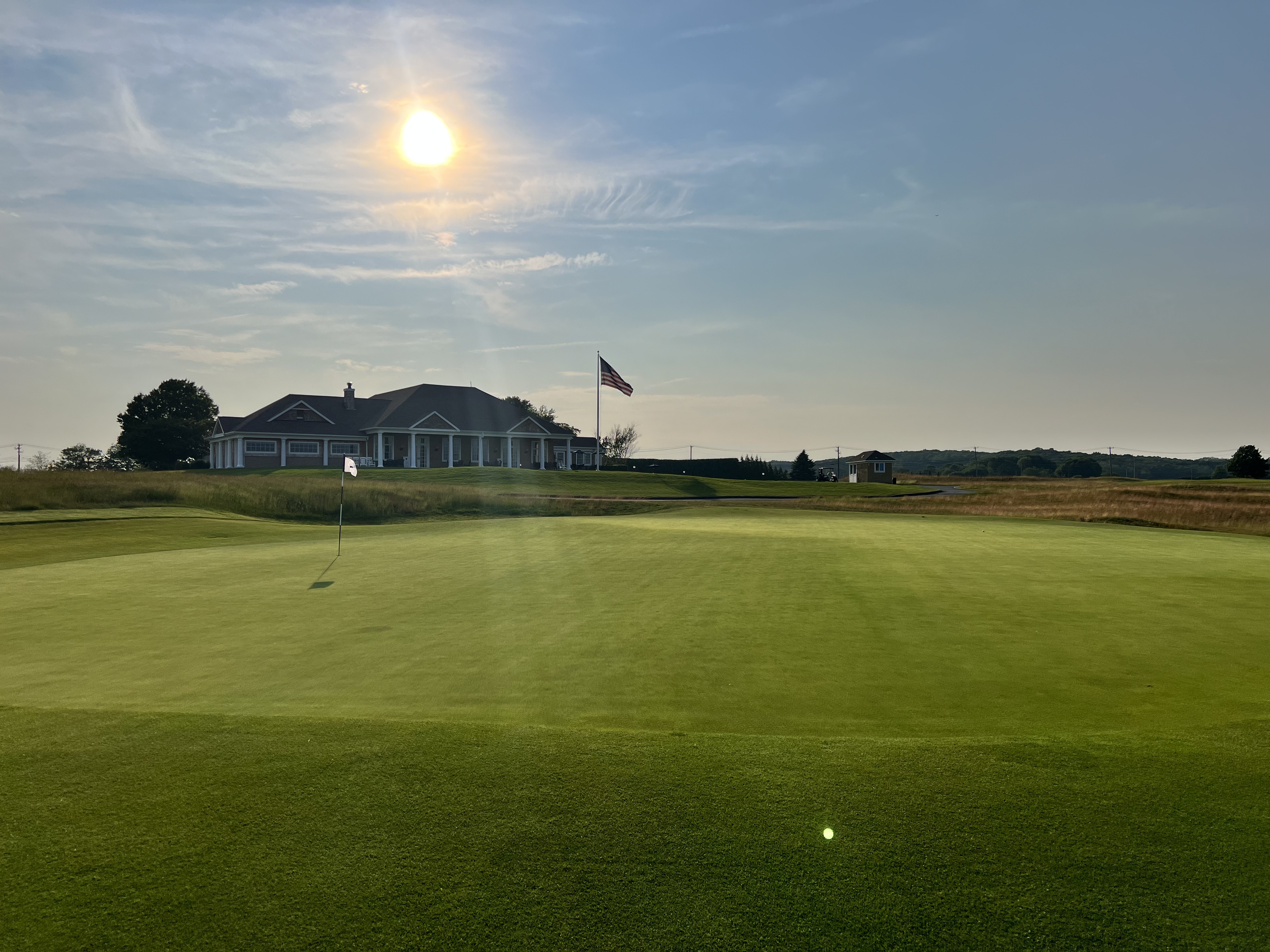
The Eighteenth is a 427 yard par 4. A rare two shot Redan is the final hole here, the green up on the hill of the clubhouse. The deep center line bunker is in play off the tee and should be avoided at all costs for those interested in their score. The green is well raised from the fairway set on that hillside and moves right to left. The left lower bunker is entrenched while the upper right rear bunker is even more treacherous even if it doesn’t look it. A two-shot Redan allows the golfer to decide his own angle into the green, a nice closing benefit to the round.


The back nine gets interesting quickly, then lets up a smidge before a strong finish. I would rank them 18, 13, 12, 14, 17, 11, 10, 16, 15.
Generally, Knoll West is a great Banks design that sets itself apart with its scale, greens and routing. There is a nice amount of elegance to the rhythm of the round, the golfer managing fairways and precise approaches is able to dance with the greens while the golfer toiling about has plenty of options to recover and cut in. The templates are used in various manners less encountered, refreshingly so, while the bunkering is strategically layered. There is much more restoration that Bahto intended and while the current course is a worthy representation of Banks, the possibility that it could be better gives us hope of potential realized at some point. Some courses suffer from template overload while others try to garner too much attention with grand and sharp features that look unique yet interfere with refinement. Here, there’s a subdued knowing where templates are used selectively and the structure of play more smoothed over. This is more my speed and more in line with the core virtues of Raynor and Macdonald.
Clubhouse/Pro Shop: Fairly large set atop the hill with the pro shop on the side of the First tee.

Practice area: There’s a driving range, putting green and the short game area is off to the left of the Eighteenth.




You must be logged in to post a comment.