750 yards, 73 Slope from the Quattrone tees
Many many moons ago, I wanted to practice my putting. I wanted to practice putting a lot, so that those four to five footers would feel routine sinking in. I had just started really trying to get better at the game and had read some where it all starts with putting. Unlike driving ranges though, I wasn’t really sure where I could go to practice putting. Most courses around me were private so they were out, there was a practice green at a driving range about twenty minutes away but the green was too slow and it was too far away besides. FDR Golf Course used to have a great short game and putting green and that was what I was looking for. FDR was too far away now that I had moved out of the city and has since shuttered. So it was that I decided on Cobbs Creek. The practice green was always in good shape and it was usually empty, so I would go down there and practice my putting for as long as I wanted. It became a routine and after a while, I looked forward to my time at that putting green. It was quiet save for the groups teeing off the First, kind of in its own secluded enclave. Every now and then a father would take his son there, some times a few kids would share a putter amongst them and other times there were guys like me putting in some time. At some point I stopped going. My putting was much better and I probably started going to the driving range more but just knowing that green was there any time was comforting. Any time. For me, my son, other kids, really anyone interested in putting.
Then there was the driving range. There were actually two; there was the range for those playing either golf course and there was the City Line Sports Center. I spent a lot of time at City Line. The cast of characters that would come through that place is the stuff of legend. I saw it all. From middling pros going through sessions with their wives watching and taking notes, hustlers betting shot for shot, guys with stacks of jumbo buckets ready to go at it for hours, those talking about the swing like they had it all figured out yet would never hit a shot in front of anyone, it was a scene. It was two minutes from my house, so I went a lot. We need something from Lowe’s? Stop by the range first. I’ll meet everyone at the soccer game. Range time. Dinner in an hour? Range time. It came to be I knew the guys working by first name and which were my favorite stalls (fourth from the right). Even as the place deteriorated, I didn’t care. The batting cages stopped working. The mini golf course became more and more unsightly, then unplayable altogether. The stalls on the second story became permanently closed. I could have sworn there used to be lighting but at some point there was none. It didn’t matter as long as I could go through the door, order a large bucket and swing into the meadow as the traffic on City Line hummed and buzzed.
These were the places that allowed me to become more versed in the game, to become better acquainted with it. They were close, they were affordable and above all else, they were inviting. These places allowed me to become more comfortable on the course, which is one of the bigger obstacles for any beginning golfer to overcome. There are no bunny hills out there. Everyone plays the same course and at some point, even the novice needs to jump in the deep end. Being as equipped as possible when that happens is vital for those to want to continue on with the game.
It was quite something to walk on to the grounds of the Q School course and find what else but a putting green. And that putting green was full of children, practicing their putting. Yet again Cobbs can be one of those places for anyone to get comfortable with the game. Instead of simply being one of those places, it appears Cobbs is aiming to become some what of a beacon of public golf. With the history of Cobbs Creek and what it stands for, it all seems fitting. As the place on its last legs of a prior iteration did for me, its renewal will be able to do for countless others in starting them along the rewarding journey of our game. It brings a smile to my face every time I step foot on the property.
The journey of Cobbs Creek continues. The driving range, pro shop, grill and now short course are all open. The Olde course is scheduled to open next year, followed by the nine hole Karakung course the year after that. I have already been there a handful of times and photos/write up of the range/pro shop/grill are here: https://golfadelphia.com/2026/01/20/the-parade-of-new/. On an early Spring day, I was finally able to visit the short course. The history of the project is a long and thrilling tale, too long to cover here but at some point, Tiger Woods joined in and a TGR Learning Lab is on the property. Woods named one of his children for Charlie Sifford, the first Black player to get his PGA Tour Card, and Tiger has always made clear the project is of personal interest to him. Sifford moved to Philadelphia when he was 17 years old and frequented Cobbs Creek, which did not restrict players based on race, ethnicity or gender. Sifford had a storied golf career, which included winning the Los Angeles Open in 1969, The Greater Hartford Open in 1967, as well as the USGA’s National Negro Open six times, which included four consecutive wins. Sifford is also the subject of one of the best golf photos ever taken, which is the one of him in a red sweater with a cigar (in the link above). Incidentally another iconic golf photo is Ben Hogan with a cigarette. Apparently tobacco is necessary to really break into the upper echelon of golf portraits. Tiger Woods’ TGR design firm laid out the short course, a nine hole par 3. The beginning holes start on a rise about the hills, cutting along the ridge a couple times before ultimately falling down to the far corner and returning on the lower side. There is dominant horizontal and elevational tilt that varies throughout the round, along with strategically placed bunkers and well calculated greens. The greens have intelligent contours with the right amount of balance to facilitate engaging putting without overblown features. The round typically takes a little under an hour yet the golfer is able to sharpen his or her skill set with the wedges and flat stick. The holes are distinct in the decisions the golfer must make and how they are situated upon the topography. Importantly, most if not all of the holes can be played with a putter, showcasing its universal appeal. Indeed, the Q Course is a wonderful addition to that concept of setting all of us in the right direction of charting our adventure into this game.

The First is an 86 yard par 3 (from the Quattrone tees). The Tiger Woods hole. An uphill tee shot, the fairway leading up the left side to the green, which then moves around the front right bunker. The back right is the highest point of the green so getting from the back right to the left front or vice versa will make for a challenging putt. The left front, or just short of it, is a manageable bail out area.


The Second is a 79 yard par 3. The Butch Wheeler hole. Moving uphill but a bit steeper than the hole prior, the right greenside bunker now marks the end of the green on that side. The green bears a similar dog leg that we saw at the First but here, the turn is higher uphill and on the left side. Pin positions are tough to access from the tee with the hills and contours but plotting for a manageable second putt instead is a better option for most.


The Third is a 75 yard par 3. The Thelma Cowans hole. Now moving down the hill towards the latter holes, the green is pushed up enough to complicate matters for those who have visions of rolling their ball on. A bunker resides at the left of the green, below the surface. Rear of the green runs down to an adjoining fairway. The right side has a slope where the ball might rest on and recovering from that side is favorable. The green is deeper than it seems from the tee.


The Fourth is a 71 yard par 3. The Hugh Wilson hole. A bit of contemplation from the tee here as we move back uphill and to that left corner of the property. A bunker at the front right encourages the golfer to favor the left off the tee but a left rear bunker ensures that any hedging off to that side is pulled off with sufficient touch so as not to move too far into it. The center of the green between the bunkers would be a well executed shot for any pin position while those want to get closer to the pin must do so with an increasing need for precision as the aim moves further towards the sides. A well designed, thinking man’s hole.


The Fifth is a 73 yard par 3. The Ben Sayers hole. We are now at the upper left corner of the property, moving downhill to the lower route leading back to the clubhouse. One could putt his ball from the tee and reach the green if the mood strikes. The green also moves front to back, so even shots in the air will need to consider the terrain and roll out towards the rear of the green. The left to right cant should also enter the consideration of roll out. Lots of fun here.


The Sixth is a 92 yard par 3. The Carl Kauffmann hole. The green is above the tee so plays slightly longer than its stated yardage. The green moves right to left with a large bunker on the left side. The green pivots around the bunker so favoring the right side off the tee is good strategy. Shots with too much gusto, however, will stay up on the right side and putts back down the hill to the hole will be harrowing. Aim to stay on the left side of the pin at any cost.


The Seventh is a 106 yard par 3. The Joe Coble hole. The longest hole of the course is downhill from tee to green. There’s a swale in the green very much like a biarritz with a prevailing right to left tilt. There’s all the room short one could hope for and like the hole prior, endeavor to get to the left and below the hole for the most favorable putting scenarios.


The Eighth is a 87 yard par 3. The William Flynn hole. Now at the lower front corner, we move towards the interior of the course before the finish. The green is uphill and has two defined tiers; the upper rear and lower front. The left to right movement gravitates towards the bunker on the lower right side. The tee shot needs to consider what tier the pin is located on, then consider the later movement, all before getting into address. The rest of the hole is quite the adventure.


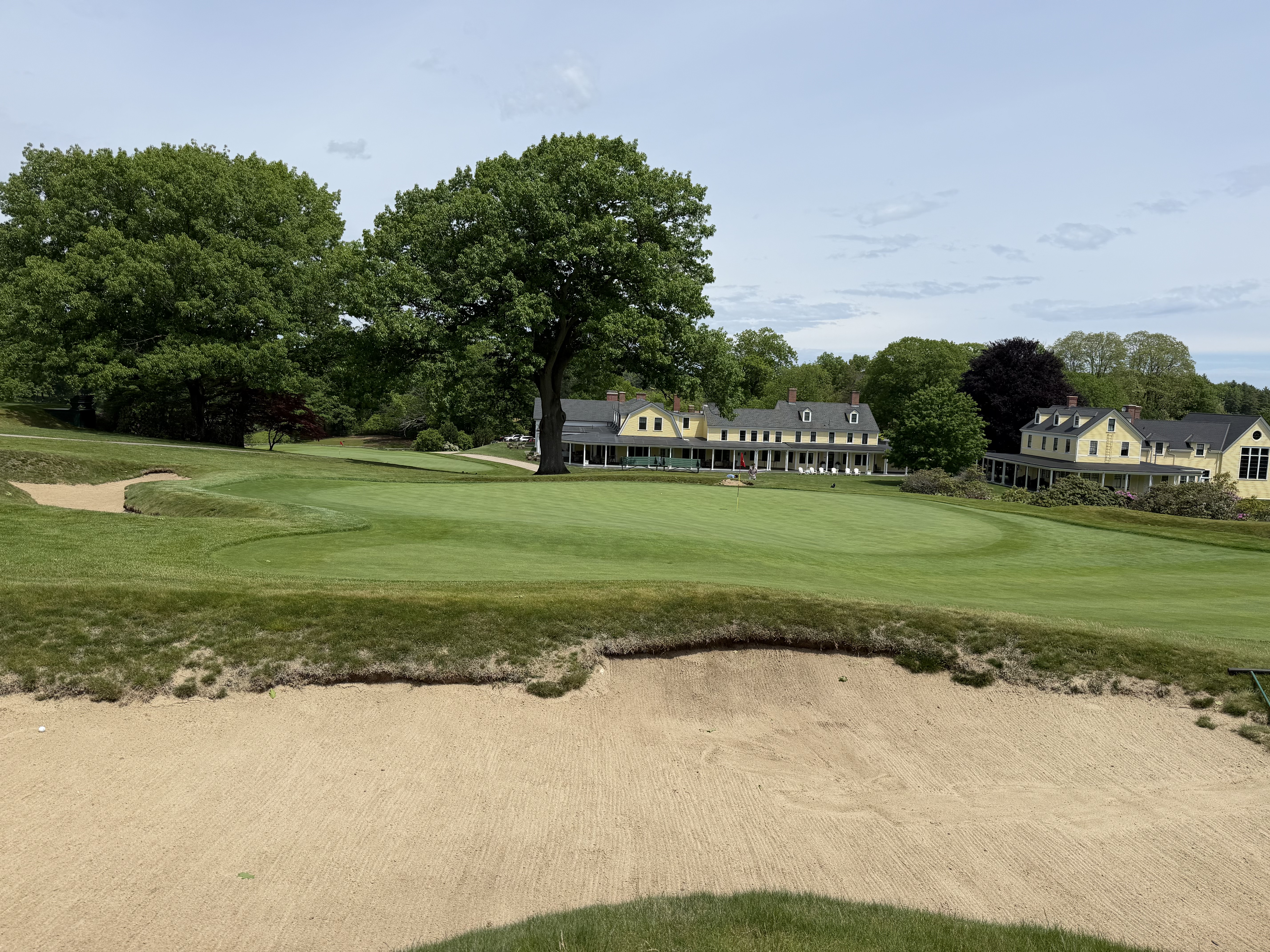
The Ninth is a 81 yard par 3. The Charlie Sifford hole. The tee faces the TGR Learning Lab. There are plaques for each person of which the hole is named. Read them, especially the one for Sifford. As the plaque for Sifford indicates, he led an extraordinary life. The game of golf provided him such opportunity and in those instances where opportunity was closed out to him, he did what he could to open it up. Cobbs Creek is an extension of that opportunity and potential the game can provide. All of us could take a page from Charlie Sifford. The green is wide open with trouble at either side. Close the round out well and knock it on, then putt in for the bird.
No excuses for missing. There’s a putting green a few paces away if you need to practice.


Generally, Q School is a substantive short nine hole that has the golfer strategizing and dealing with an array of short game situations. It is engaging for any class of golfer. The contours follow the undulations, which sparks a meaningful ground game as well. I would rank them 7, 4, 8, 5, 6, 2, 1, 9, 3.
Practice area: The putting green is just before the First tee. Early and often.




You must be logged in to post a comment.