6,361 yards, 139 Slope from the Long tees
Two guys step on the First tee. The first is nearing 50, shirt neatly tucked in, is walking the course, hit about twelve shots at the range and spent more time at the putting green before getting to the tee with driver in hand as soon as his tee time was called. He is pleased to be at the course and take it all in before heading to his second round of the day, after which he’ll go meet his family down at the beach. He loves course architecture. The second is in his mid 30’s, shirt tucked in really only when he knows he has to, is feeling no where near 100% after the long night him and his buddy pulled off after the day prior’s golf. He has fits of decent golf but is still something like a 17 index. Unsure of his game, yet he really likes how he feels out on the fairways and learning about course design. After the round, he will go to one of the pizza places he’s heard so much about in New Haven and will have a couple beers with his buddy before getting home. The round will ultimately motivate him to pursue more architecturally notable courses. Yes, they’re both me. Thirteen years between the younger me and older me stepping on the opening tee at Yale. The same guy in some ways, different in others. This is a Redux record, the longest period of time between rounds. It will be a tough one to break.
The golf course has certainly changed during that time. My experience, perspectives and outlook have certainly changed over that time. One of the main points of the Redux is to take stock of the course with repeat play and over the course of time. With such change between rounds, it is tough to think of another course that is ripe for a Redux than Yale. The course was famously closed the last two and a half years so that Gil Hanse and Jim Wagner (along with Ben Hillard, Tanner Guyer, Brent Vest and Russ Myers) could complete a $25M restoration that would help return the course back to its components of scale and strategy that were in place at the time the course opened in 1926. Yale was designed by C.B. Macdonald and Seth Raynor during the college course explosion of the 1920’s and 1930’s. As can be seen in the original review photos from 2013, https://golfadelphia.com/2013/06/30/yale/ the course had taken on trees and there were opportunities to enhance the character of the design, especially at the fairways and greens. The overall comprehensiveness of the project, the regard of the course design and the popularity of Macdonald and Raynor brought a lot of attention on to it. As written in the course openings article earlier this year, https://golfadelphia.com/2026/01/29/the-parade-continues/: “[P]ersonally, Yale was an important course for my progressing interest in course architecture. It was the first Raynor design I played and one of those eye opening moments of how uncharted the universe of course design was to me, even though this site had been in operation for a couple years at that point. At any rate, I have yet to return since that maiden voyage 13-14 years ago yet I suspect this will be the year that changes. Gil Hanse and Jim Wagner have undergone an extensive restoration that includes bringing back the immense scale of the original design, bringing the greens to USGA specification and generally, everything else. Tree work, irrigation, drainage, bunkers and tees. With original design plans and an arsenal of archived historical material, Hanse/Wagner’s overarching mission is restorative, which will include restoring the position of the green at the Third to its original site near the pond. Yale characterizes the restoration as, “scrupulously faithful.” Having played several Raynor designs since that Sunday all those years ago, as well as countless Hanse-restored courses, the excitement and anticipation level for this re-opening is astronomical.”
Scrupulously faithful. That’s an exciting phrase for course architecture enthusiasts. Historical integrity taking precedent in any restorative project is always preferable because it typically means design character is the priority. It bears mentioning, however, the course lengthened to just over 7,000 yards. Yet restoration certainly took precedence here, with such material as aerial photographs from the 1930’s, original hole descriptions by Charles Banks (who was an associate of Raynor on the project), original construction progress reports and the Yale archives as the guide. The tees, bunkers and fairways were all expanded to as close to historical specifications. Greens were likewise expanded with some reshaping to original contours. The greens were never completely rebuilt so Hanse and company were able to examine the soil layers and determine the material used to originally finish the surfaces. This also enabled them to restore the contours of each. The double fairways at the Third and Eighteenth were restored. The two inverted bunkers at the Sixth were also resurrected. A tree removal program was also implemented, opening up all sorts of playing corridors that had been lost over time. What’s important to understand about the project is it was not an overhaul. It was more of an intelligent sharpening to wring out the most precise historical and architectural character possible.
Comparing the photos from the 2013 review to those below, a lot of project brought out the natural pleasantries of the land. Tree clearing certainly helped in this regard but there’s also more comprehensive definition. Bunkers were squared off when needed, the degree of their faces emphasized as intended. Raynor and Macdonald implemented individual face slopes to their bunkering depending on their position and strategic role. The rolls of the terrain are highlighted and accentuated. And of course, the greens. They were improved upon. Look no further than the Redan as an example. The right to left movement is not as simple as heaving the tee shot off to the right and watching it fall towards the hole. The contours are more sophisticated than that, mainly requiring an intention of where along the slope the shot should be corresponding to where the ball will end up. The project produced a more authentic Raynor/Macdonald design that plays wonderfully.
This is a great Redux since I have played many other Raynor and Macdonald courses since walking off the Eighteenth here those many years ago. In comparison to those courses, I would have no problem declaring Yale among the top platform of their courses. The land with its transitions from rocky mountaintop to meadows is pleasantly volatile, which the routing captures superbly. There is some jagged rising and crashing down, as well as teasingly baffling blind shots and even some strategic zero sum game scattered within. It is not meant to be gentle. It is flowing but the structure of play matches the craggy terrain. The routing certainly grabbed my attention this time around and I maintain is one of Raynor’s more underrated talents. The bunkering was also a highlight. Well positioned and judicial in their severity, their shaping is now much more varied and in tune with the natural character of the setting. The course bears some similarity to Piping Rock in setting and structure, some Rock Spring as well. There are a good amount of worthy templates that many should get excited about. How the course plays in tune with the land and its transitions as sharpened with its newfound changes from Hanse and Wagner, however, puts it in that top echelon.
The peak of summer was upon us. One feels it. The two rounds that day would be at its height and anything after it would be on its backside. It comes and goes every year. The course looked and felt different as I drove in and walked up to the clubhouse. The excitement of anticipation, however, was the very same it was all those years ago. One excites and learns just as much as time goes by. And it was time to get some of that Ivy League indoctrination of course architecture in several forms.
A bit different Redux format. The hole descriptions will address the changes of the recent restoration as well as other notables not mentioned in the original review. Final comments are all current as well.
The First is a 396 yard par 4 (from the Long tees). “Eli.” Trees on either side were cut back, not eliminated. The greenside bunkering on the left is the biggest change. Deepset with a high face up to the green and rather large, the approach needs to clear or move up the entry point down the center to right side. The green is even larger than it was prior and sets the tone for how defined the rugged contours pronounce themselves. There is a lot of room to end up on the approach yet those who are not close to the pin will need to put in some short game or putting work to finally finish. It’s an opening hole that is more concerned with an introduction to the structure of play than any kind of gentle introduction.


The Second is a 364 yard par 4. “Pits.” The left bunker before the fairway was installed from the project. Like the First, the trees have been scaled back, especially on the left side. The pit now has a much more elaborate bunker. Before, there was an oval bunker at the bottom bit now, the bunker expands all along the base of the hill. As similar strategy to the First, one can take on the bunker side of the green to get close to the pin on approach or conservatively approach away from it on the right, leaving a more challenging chip or putt over the swales to the pin.


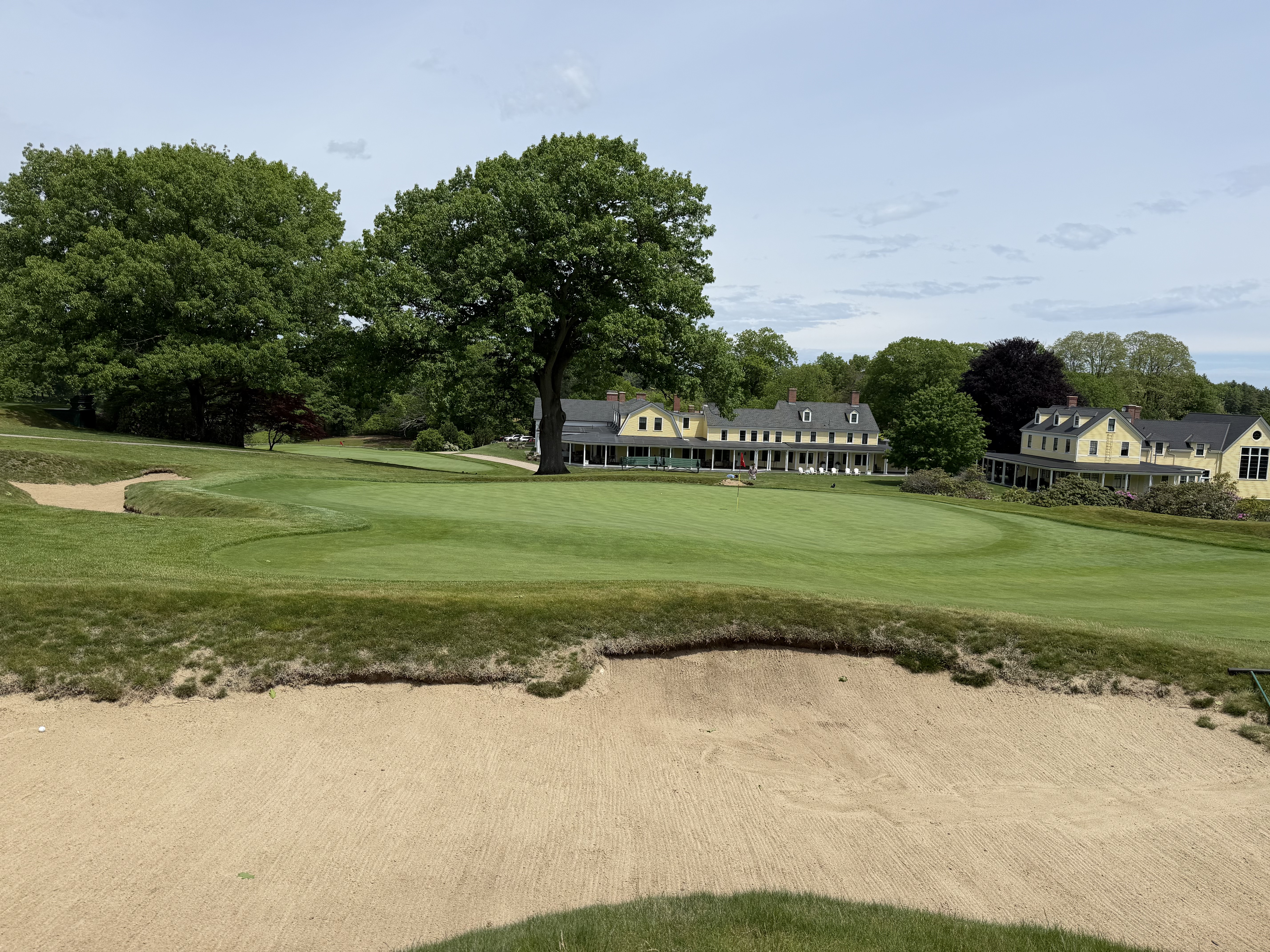
The Third is a 303 yard par 4. “Blind.” One of the biggest changes from the projects was this hole, re-establishing all the characteristics of this Alps hole with a double punchbowl green. The original design had a section of fairway that fed into the green from over the Alps mound. This section was a strategic option to negotiate the mounds, yet was lost over time with vegetative overgrowth. This original strategic intent was restored. The original green was eliminated at some point in the mid twentieth century for unknown reasons. Hanse and company performed investigative excavation, learning that the replacement green of the original was three to four feet above the original surface. They were able to uncover a lot of original green as well as the bunker on the right. This excavation work was used in conjunction with the historical source material mentioned above to piece together the original contours and green surrounds. The fairway and green work has made this hole one of the better examples of the Alps-Punchbowl template within the same tones as the Fourth at Fishers Island. Like that hole, the tee shot is much more about finesse and placement than anything else while the blind approach takes a good amount of knowledge to negotiate properly. Quite simply restoration at its finest.


The Fourth is a 415 yard par 4. “Road.” So well done here using the natural features. The pond in front of the tee moves off to the right with the grove of trees, forming a natural barrier serving as the hotel for the tee shot. Like the Road hole, hugging that right side provides a shorter approach in. Those listing to the left will have the longer approach and the left greenside bunker, which is now restored and runs along that entire side. It’s not as dire as the Road bunker but the green runs away from those hitting out of it. A great example of sharpening up what was mostly in place before.


The Fifth is a 139 yard par 3. “Short.” The green expanded as is the surrounding bunkering below. The green contours now shine and placement on the green is almost more important than simply landing on it. The movement shifts in places with complexity.


The Sixth is a 449 yard par 4. “Burnside.” The challenge at the inside of the turn is now much more pronounced and features one of the inverted bunkers while the other is at the front left of the green. The flatness is used so well in creating temptation off the tee. One wants to get over the inside of the turn, needs to get over it. Many may do better skirting by its right side instead. The green is inviting but really should be landed upon instead of missed. The bunker on the right could make for a longer pitch out and the left side is full of natural vegetation no one should want a part of. Even a lay up to the front or short of the green is not fully safe from the vagaries of the design.


The Seventh is a 360 yard par 4. “Lane.” This might be one of the least changed holes, the fairway ramping up to the green just like before. The bunker near the green and green itself were certainly expanded and sharpened. The green expansion helps with the approach, which is likely on the longer side, yet there is no where to miss off the green. The left side especially, where the ball will fall off the edge of the planet. Putting off the front of the green and watching the ball move downhill a hundred yards is certainly a reasonable possibility.


The Eighth is a 372 yard par 4. “Cape.” Like the Seventh, a lot of what was before remains. This is one of Gil’s under discussed talents. Leaving along what’s worth leaving alone in pursuit of the best course possible. The tee shot is blind as the ridge is used to shield the entirety of the fairway on the other side. One can cut the turn and flirt with the dangerous lower left side yet I would say to what end. A well belted tee shot down the left center will still leave a shorter approach in. The only advantage of taking on the risk of further left is wanting that approach angle into the green. The green has steep drop offs on either side into bunkers, making it one of the most Banks-esque greens on the property.


The Ninth is a 206 yard par 3. “Biarritz.” The splendor of the hole cannot be denied. I had no idea it existed until we came upon it and wish everyone was able to discover it with such wonder. It was a formative moment for me, realizing just how thrilling course architecture could be. Back then, I hit a 3 wood and was elated it got to the other side. The bunkers are now more elaborate and the green a bit more outstretched. The swale remains mighty.


The front nine does well in showing off the distinct personality of each hole. That was something I recognized last time and it remains. The variety of par 4’s matching the terrain impressed much more this time while the pair of par 3’s come within that design theme in remarkable fashion as well. Every hole is very good. Last time, I ranked them 9, 5, 8, 1, 4, 2, 3, 7, 6. I would now go 2, 6, 3, 9, 8, 1, 7, 5, 4.
The back nine starts with the 408 yard par 4 Tenth. “Carries.” This hole is one that has been seared into my memory all these years. Each shot is blind and the bunkers set into the ridge off the tee are new. The tee shot needs to carry the ridge to reach the fairway on the other side just to be confronted by another blind shot into an uphill green. The approach is what I remember most. The hill is steep and one can only make out the top of the flag, which gives the appearance of the green floating in the sky. The green is quite deep and shows off bold contours about the front. The blind shots reward course knowledge while taking extra club on the approach is a fine strategy to deal with come what may on the green. It remains one of my favorite holes of the course.


The Eleventh is a 337 yard par 4. “Valley.” More of a sharpening up here with noticeable changes at the green. The fairway is indeed a valley running down to the green. The tee shot is a broad spectrum of choices that depends on the type of approach the golfer would like into the green. The entry point is more on the left for those looking for the ground option while the bunker configuration compels an aerial approach for most. It’s a deceptive tee shot in challenging placement, which is almost outcome determinative of the rest of the hole.


The Twelfth is a 388 yard par 4. “Alps.” Hopefully you enjoyed watching your shots on the hole prior because we are back to blind shots here. The tee shot is all uphill yet rather straightforward while the approach has a bit more complexity to it. Like the Tenth, one is able to rely on more club to ensure clearing the alps and bunker before the green but will be faced with more challenging putts from the back of the green. The green is wide yet shallow, comparatively speaking, so favoring the side of the of the green the pin is on gives the golfer more advantage that he probably thinks. This means paying attention to the placement provided near the tee. Otherwise, the golfer could face a putt up to fifty yards across that would also need to navigate the substantial contours and elevation changes within.


The Thirteenth is a 209 yard par 3. “Redan.” A cleaner view, more definition and a much more complex green movement. A ridge at the short right runs towards the center of the green and complicates the right side of the green as a result. The golfer cannot heave his ball at the hillside and expect it to obediently roll down to the hole. The ridge will send shots off to the right when they fall short of the ridge while those that clear it will move left down towards the hole. The Redan was always intended to closely defend the green and this one does just that. With the the larger green, the inclination might have been to dramatize the tilt or features but here, the strategic innuendo helps focus the challenge.


The Fourteenth is a 369 yard par 4. “Knoll.” Tee to green is relatively unchanged save for some more defined fairway contours. A slight dogleg right and the tee shot should focus on where the approach should come in from. At its core, the Knoll template relates to the green being placed on top of a hill sloping off of all sides. The green does that well now all with a dominant left to right slope. The approach is most definitely aerial and a good amount of touch should be imparted to it.


The Fifteenth is a 188 yard par 3. “Eden.” I have been singing the praises of the Eden par 3 for quite some time. Leave it to me that when I was at the Old course and kept referring to the par 3 as the Eden hole, the caddies would look at me blankly. That’s because it is not called the Eden hole; the River Eden sits behind the green. You learn something new everyday, no matter if it’s common knowledge to everyone else. The tees were shifted to the left and front bunkering deepened. There are a variety of bunkers that comprise the Eden and some do a better job of portraying each than others. Here, the Strath, Hill and Shell bunkers about the front are nicely presented but the rear Eden bunker may not be present. Similar to the Knoll, accuracy and precision are the exam here.


The Sixteenth is a 501 yard par 5. “Lang.” There was a hearing back of the trees to widen the fairway corridor downhill to the green. With the longer shots needed here, the width was well needed. The undulations from tee to green provide a variety of lies and looks while the green is deep to sufficiently receive the longer shots coming in. The prevailing ridge should be cleared with the second shot so that the approach has full view of the green.


The Seventeenth is a 423 yard par 4. “Nose.” The otherworldly finish starts here with the blind tee shot forced carry over water uphill. Know that the fairway is as wide as the gap between the trees beyond. Back when I first played here, I loved the approach into this green, calling it back then one of the most interesting approach shots of the round. That remains my opinion. The fairway leads downhill to the green, which sits at grade. The Principal’s Nose bunker takes up most of the fairway close to the green but there is room off to the right for those that would like to run their ball on. There is about sixty yards between the Principal and the green, all of it short grass. Running the ball on comes in handy at times, especially since the green keeps moving away from the golfer. A flatter approach that clears the Principal then runs out to the green is one of the better ideas, as some shots in going for pin locations could ends up not holding. A great hole.


The Eighteenth is a 570 yard par 5. “Home.” While an original hole, the high road/low road format shows up every so often. Just not on this scale or indifference to the comfort of the golfer. The first two shots are blind. The tee shot needs to deal with the hill directly in front by either carrying it or shying to the left. The second shot faces an even steeper hill and the golfer needs to decide at this point whether he will take the higher left side or lower right side. The high left allows a drop shot into the green that will shorten the approach a bit while the lower right is tougher to land on but provides a better angle and view into the green. It will likely be shorter than the left since so much yardage is spent simply climbing the hill. I went with the left since I went with the right last time. The green is large with back to front and left to right movement. It is an enjoyably tough finish.


The back nine is the more lively of the two sets, using the more volatile and hilly land. The par 4’s stand out as does the Redan and Home holes yet they are all strong. I would rank them 17, 18, 10, 12, 13, 11, 14, 16, 15.
Restoration is a fine art replete with degrees of attention. The reason behind the restoration, the period restored to and decisions whether and when to rely on historical source versus interpretation are all an influential balancing act in pursuit of improving the course in some way. Hanse, Wagner and team have proven adroit at pulling all of the levers in the right place, knowing what and when to emphasize and perhaps more important and impressively, knowing when to impart a light touch. This largely stems from restraint and accepting the best restorations mean no one should notice you were there in the first place. That is a tough truth for some to take yet a talent in which Hanse has excelled. One may expect a total transformation at Yale yet it was never really in need of that type of work. Instead, the project revitalized what was lost before while accentuating what worked all along. The definition of the fairways and greens, sharpness and impressive scale of the bunkering, as well as the renewed width has done much to resurrect the breadth of strategic challenge here. Yale became my favorite course played when I first laid eyes upon it. Now, after all these years and more experience, the project has elevated the course to one of the better Macdonald/Raynor designs out there. Hopefully it inspires more of us to delve deeper into the fascinating realm of course architecture just like it did with me that lifetime ago.
Clubhouse/Pro Shop: The clubhouse has also changed, or at least it has since I was last here. It’s on the hill overlooking the Third with the bulldog club in snout on various apparel in the pro shop.


Practice area: Full driving range, short game area and putting the green. The buckets one could aim for at the range are gone, however.




You must be logged in to post a comment.