7,190 yards, no slope rating, from the Back tees
Extraordinary art takes the reader or observer some where else. I felt like I was on the raft with Huck Finn and the ship in the Odyssey. My thoughts wander in all kinds of directions looking at the Jackson Pollack in the Philadelphia Museum of art. I feel like I’m on the field looking at the church with that one Monet. I wonder how the breeze was that day in time and whether people were walking by, and what they were doing. I forget where I actually am. I feel the intensity of Prometheus Bound. Art is supposed to challenge the mind. It is supposed to make you feel. It takes you places. It shows you more of the world. More of yourself. It can do so in various ways. And it’s usually different for us all.
Golf course architecture is certainly a form of art. Interactive art if you will. There’s an array of emotions through this interaction and there’s different ways in how that is accomplished. Then there is the golf course evoking some sense of place. Setting, scenery and solitude are all relied on to various degrees contribute but exuding such a sense of place is inherently difficult since golf is an imposition on the land. Most every course focuses on some sort of serenity or beauty to emphasize a sense of place. It can be pleasant, so long as the architect appreciates that how a course plays is completely separate from how it looks. There are rare exceptions where the course, inherits the land. Where it carries on the attributes of the land for ensuing generations. Seamlessly, as if it was there in the first place and never there to begin with. The sense of place is so transcendent that one is subsumed within it like they would be with any other exquisite work of art. Sand Hills comes to mind. Fishers. That might be it, at least from my travels.
We walked the dusty trail to the lone house on the ridge looking down a bit. No one came to greet us and we didn’t really know where to go but quite honestly only walked towards the house because there was no where else to walk. A few people were outside on the porch. Some were inside. The only noise was the taps of steps on the porch and those opening and closing the door to go in or out on occasion. I stood on the porch and looked out to the valley and hills. There was a pervading golden brown that first caught my attention. It stacks on with the shades of avocado green. Then I noticed the fairways. Whether intentional or not, their color drew me in. Yes, that has a lot to do with it. The course and land looked as one and having not walked upon it yet, it was impossible to tell where one ended and the other began. Northern California is rich land, diverse and vast. We were in a sea of redwoods earlier in the morning yet now were in an inland valley marked with surrounding foothills. Regardless of where you are in Northern California, it is nurturing, relaxed and still. I haven’t been able to find any where in the world like it. It has to be especially challenging to ingratiate the land without disrupting its special expansive peace. Standing there on that porch staring out, memories flooded back. Of walking similar foothills as a kid and seeing that same golden brown as pastures, cows grazing nearby without a care in the world. Of that road trip in college around the time I discovered Kerouac and driving the smaller roads inland through the farms of darker green and then into those hills of golden brown. There was a freedom back then, a freedom of discovery and promise of what’s to come. Of the time roaming the hills with my wife. The trees stood out that time, the oak in particular. I grew up with an oak tree outside my bedroom window and it always comforts some what, probably for that reason. It came back, all of it. I moved on inside.
With most courses, sense of place gets caught up with beauty and, memorability. The golfer looks to features that they can anchor their thoughts to the design. The problem with this is even if these out of the ordinary features are natural, the whole exercise can defeat the purpose of minimalism in the first place, at least in a technical sense. Then, it’s easier for minimalism to make an impact because the land is sensational and/or so are the views. This can detract the golfer from the land altogether. A true of sense of place must come from something deeper than mere landforms or atypical naturel. The golf course must search deeper. Then there is the structure of play. A course can exist in perfect sense of place but without an engaging structure of play, it won’t matter. While memorability can fool the golfer into thinking they’re engaged, it’s really the structure of play and what the course is making the golfer think and do during the round that truly defines this. When the structure of play lines up with what the sense of place is evoking, the course truly inherits the land and achieves the rarity of profoundness in design.
Brambles joins upper echelon company in courses that exemplify the excellence of pure minimalism design. Its rawness and restraint likely make it the best pure minimalist design since Sand Hills. This is simply because how vividly it captures the spirit of the land it is upon. Its sense of place as well as structure of play are harmonious with the land in remarkably rare fashion. There is no attention grabbing. No boldness. Only a unified focus on existing within the soul of the terrain and inviting the golfer to join. Conceptually, minimalism is a celebration of the land, of its character. That’s the whole point. Seeing the land for what it is and interacting with it, thinking about it. Relying on the broad shouldered contours of the topography and occasional windy creek, the natural variety of the round is almost automatic as the golfer walks the land. A deceptive driving course with let up on most of the second shots on the longer holes, Coore and Crenshaw are smart with the use of width. The expanse is not simply freedom to belt the ball about; while the golfer will likely find most misses, there is significant advantage to finding and bounding the fairways while avoiding whatever well placed hazards there are. The topography demand attention and the golfer can use it as needed, with most of the freedom of width at the approach by allowing an array of shots into the larger greens. The subtle contours work the with large scale tilt to place a premium on putting. This is an important design that sets itself apart from most newer designs for its indifference to eye candy and instead, staying true to the land, the region and imparting wise, sophisticated subtlety that is there in spades for those looking for and willing to learn from it.
Thinking back to my time at Brambles, I remember the holes and a little about my play but what remains most vivid is the land. Where the hills bow in, the creek meanders, the horizons. How the sun and shadows stretched the expanse. The raw and relaxed nature of the place that already has a sense of knowing and patience that the land itself has possessed for centuries. The course will age, mature and evolve, which it seems to embrace as it slowly conjoins with the land more and more. At the end of the day, I returned to that porch and stood there once again as the sun began fading into haze, letting the rustic restfulness settle in my being. I drifted away at some point.
The First is 531 yards (from the Back tees). “A romantic notion for the right group of people” is how the club describes itself. This notion includes no designated pars for any of the holes. There are more important things to focus on while at Brambles. The round starts a few steps from the clubhouse. The fairways falls away from the tee and glides off to the left, leaving the golfer trying to figure out how much of the turn he can take off while making sure he doesn’t move off into the gulley on the right side. The second shot is either recovering from the missed tee or deciding how close to get to the green. A creek runs across and at the sides of the green, so the decision will come down to whether the creek should be confronted or not. The green is large and has a generous run off at the rear. The fairways and greens consist of Zoysia, which adds to the flowing feel of the course as one naturally moves into the other. For the golfer, this means deciding between putting and chipping options around the green, all while accounting for the seemingly endless roll.


The Second is 450 yards. Heading towards the foothills, the vista starts to settle within the golfer. There’s a vastness here that gives the place an unbridled spectrum. Most every course has fences, tree lines or cliff edges that clearly delineate the playing ground but not here. It facilitates that romantic notion I believe the club is referring, where there’s a connection with the natural surrounds instead of simply playing golf around it. The tee shot heads straight out but there is a creek the golfer hopefully accounted for, deciding whether to carry or stop short of. The fairway gracefully moves to the green on the other side. Set a bit on the left, the contours are mischievous and it becomes apparent knowing the mood of the Zoysia is advantageous yet takes more time to figure out than would be imagined.


The Third is 155 yards. The green sits above the teeing area with well positioned bunkers around it. This is the first time bunkers have some primary attention and the green is a bit more heaving. Pin position dictates a lot of how the golfer should go about it as the green movement demands strict attention. The ball will roll and with the high right side and general back to front movement, there is plenty of opportunity for the golfer to become vexed at where the ball ends up going.


The Fourth is 471 yards. The foothills are close yet we still continue closer. The fairway heads off to the green at an angle from the tee, so the opening shot needs to hit the fairway in the right place, carrying the barranca on the left and all the native curtilage that is in between. There’s a center line bunker and of course the right side that come into play much quicker than the golfer may believe at first glance. A subtle driving course indeed. Heading up the left side is riskier yet more direct while the right side is safer yet of significantly more length. The green is at the top of the gentle hill leading to it. There’s an oak grove behind and to the left of the green, which will come into play for those too far over to the left on approach. Plenty of room to use the terrain after the center line bunker up to the green.


The Fifth is 335 yards. We now straddle the top ridge at the base of the foothills. The tee shot is blind over a hill and immediately falls hard left after the crest. There are holes that breed creativity and this is one. I couldn’t help but remark out loud to my friend as I addressed my approach, opting for a low punch aimed at the high right side that we watched come down and settle within the cradle of the green. There is a rather deep bunker on the left side of the green which should be avoided at all costs. Yet another reason why I liked the punch there; I could aim even further away from it.


The Sixth is 493 yards. I had to double and triple check the yardage for this hole, as it certainly does not feel close to it. This is mostly due to each shot being set up for a good deal of room. The tee shot moves into the hillside and will roll back towards the center and green while the approach is at if not below grade, inviting short approaches in that will careen to the green and hopefully settle advantageously. The contours of the land is the heart of the matter. Simply be sure to avoid the left fairway bunkers to stay on agenda.


The Seventh is 611 yards. The longest hole of the course, the tee shot concerns itself with clearing the trees on the right while braving the terrain movement leftwards. The next shot heads along the ridge line, taking care to avoid the heavier vegetation on either side. The fairway narrows as one gets closer to the green, as does the volatility of the ground. All of it necessitates understanding how and where to finally approach the green and perhaps even just as important, where not to miss.


The Eighth is 182 yards. Now back down off the foothills, contours rule the day once again with this green slight below the tee. There’s right to left movement occupied by subtle and pronounced mounding the golfer need to address whether on the green or off of it. The hole is at its widest at the rear.


The Ninth is 399 yards. There have been a good number of recent holes taking inspiration from the Thirteenth at North Berwick. This is one of them. The fairway cants from right to left, which makes the ideal line left to left center yet brings in the long grass off to the left more into play. Those who try to simply hedge to the right will see their ball bounce and roll into the long grass on the right side. A well hit tee shot favoring the left side is the best and perhaps only option, which will moves forward as well as a touch right. A ditch runs along the left side and continues on, ultimately crossing the fairway and bristling by the right side of the green. The green is to the left of the ditch and has a bunker at the front left that’s reminiscent of the Road bunker at the Old Course. It’s a testing approach, even for the best hit tee shots. Lovely homage.


The front nine takes its time getting to the foothills, staying along them before coming down. There is excitement, there is subtlety and there is strategy, all very much within the land and its simple features. I would rank them 7, 6, 5, 2, 9, 3, 4, 8, 1.
The back nine starts with the 441 yard Tenth. Similar to the Fourth in its direction towards the western foothills and with a middling center line bunker to contend with. Also similar in strategy; left of the bunker reveals a more direct route to the green while right of the bunker is an easier play yet the golfer will need to stretch out on the approach. This is one that felt much longer than the above yardage, likely the result of the uphill and wind making its presence known. The green moves back to front and has an upper rear and lower front tier. It hardly resigns itself tee to green and the golfer should be at his sharpest on all strokes.


The Eleventh is 336 yards. Another driver’s challenge as the golfer needs to decide between the left and right fairways. The left fairway requires a shorter club yet is the stouter of the fairways. The approach, however, is a forced carry over the long marsh grass. The right fairway moves much closer to the green. Almost right up to it, in fact, where a creek meanders just in front. The golfer can take advantage with a much shorter approach yet the fairway is a bit more slender with a cant towards the right. The green is wide with some back to front movement yet interior contours detour putts in directions the golfer will only pick up over time. Pin position could determine the more ideal angle that moves to the decision off the tee.


The Twelfth is 206 yards. There is a growing trend towards brilliant restraint. The Tree Farm is a notable example, here is another. It’s a movement away from over relying on bunkers. This is of course terrain dependent but one could argue that there are many more instances where golf is more versatile and challenging without bunkers. Bunker placement is as much skill as it is an art and there many exceptional examples of such bunker use leading to excellent strategic golf. Yet there has been a ramp up in the last couple decades of bunker use to enhance visuals or even attempt to establish the character of the course. At any rate, it is refreshing to see newer course design explore alternate features beyond bunkers. This hole is a great example. Bunkerless, yet a longer one-shotter with a brief carry over some long grass to a larger broad-shouldered green complex. It moves left to right in general and landing some where upon it is only the beginning. Calculating the movement and speed of the contours makes the hole grow smaller and smaller. With the skew towards aerial pitches at the last few holes prior, such engagement comes at the right time during the round.


The Thirteenth is 513 yards. Coore and Crenshaw love the longer hole with a smaller green, uphill. It’s a template of sorts and this one reminded very much of the Seventeenth at The International. Uphill and a slight dog leg right, the fairway gets slender at the turn. This essentially compels the golfer to decide whether his tee should should be before or after the turn. The second shot is likely one to set up the approach, which will depend on desirable approach angle according to pin position. The green is draped on to the hillside and even though small in size, its surroundings meld in to the terrain so much it almost feels like part of the green. Back to front and left to right, yet diagonally to be more apt about its movement. This make short and to the right a good play in even if the fairway leads the golfer down the left side suggestively.


The Fourteenth is 325 yards. The green is below the tee and in view. Wind will be the first indicator and if it’s helping, many will go for the green as a matter of principle. Just the same, there is plenty of fairway before the green just sitting there to use. A shorter club would even do the trick. It’s not sexy, it’s not romantic but it’s there for those who know. A couple bunkers guard the green at the front, then pesky one at green level to the left, small but effective. The green is reachable from the tee yet there is a lot more trouble and comes up quicker the closer one gets to the green. There’s not all that much trouble at the fairway, which is of good size. And it’s just sitting there. Also, of course I hit driver.


The Fifteenth is 448 yards. A blind tee shot to a fairway that strongly cants from left to right. There’s a prominent mound on the right that the golfer must either avoid or try to carry altogether. The mound runs perpendicular to the fairway and there’s a bunker running the width of its base. A good amount of room to get by it on the left. The green is ahead and uphill, a bunker at the front right and a couple on the left. The green actually moves over and beyond the bunker so clearing it altogether is the primary concern. The green moves back to front but as we’ve learned, it’s never as simple as that as the subtle undulations have their say.


The Sixteenth is 242 yards. Just as there are occasions when bunkers are overused, some times they are placed just right. That is the case here at the longest one-shotter. Its face rises up and conceals the green, demanding most of the attention off the tee. The right to left movement of the green means the golfer should favor the right side and right of the bunker. The green is deep, yet the rear and right side fall off so that overly aggressive shots will likely roll right off for a tricky pitch back on. The green moves and as a result, tee shots will vary depending on the wind and other elements. The man who knows the terrain best as well as its quirks will win out more often than not. A superb hole.


The Seventeenth is 542 yards. We’re heading for the hills once again, but these are northwards. You heard it here first, this is a driver’s course. The first and second fairway play with the golfer’s temptation. The divide between them is far enough out that only a well belted tee shot will reach the second. A creek comes in from the high left and crosses the fairways, separating them out in the first instance. Reaching the second fairway is really only a consideration if the golfer is looking to reach the green with his second shot. Otherwise, the first fairway is too smart of an option to pass up. The green is uphill of the second fairway. Two large deep bunkers are about fifty yards short of it. The message is clear. The second or third shot needs to get past the bunkers and Glider Port Road for that matter. If the golfer isn’t certain his shot can clear, then lay up. The green is deep and moves back to front, gently at first, then all at once.


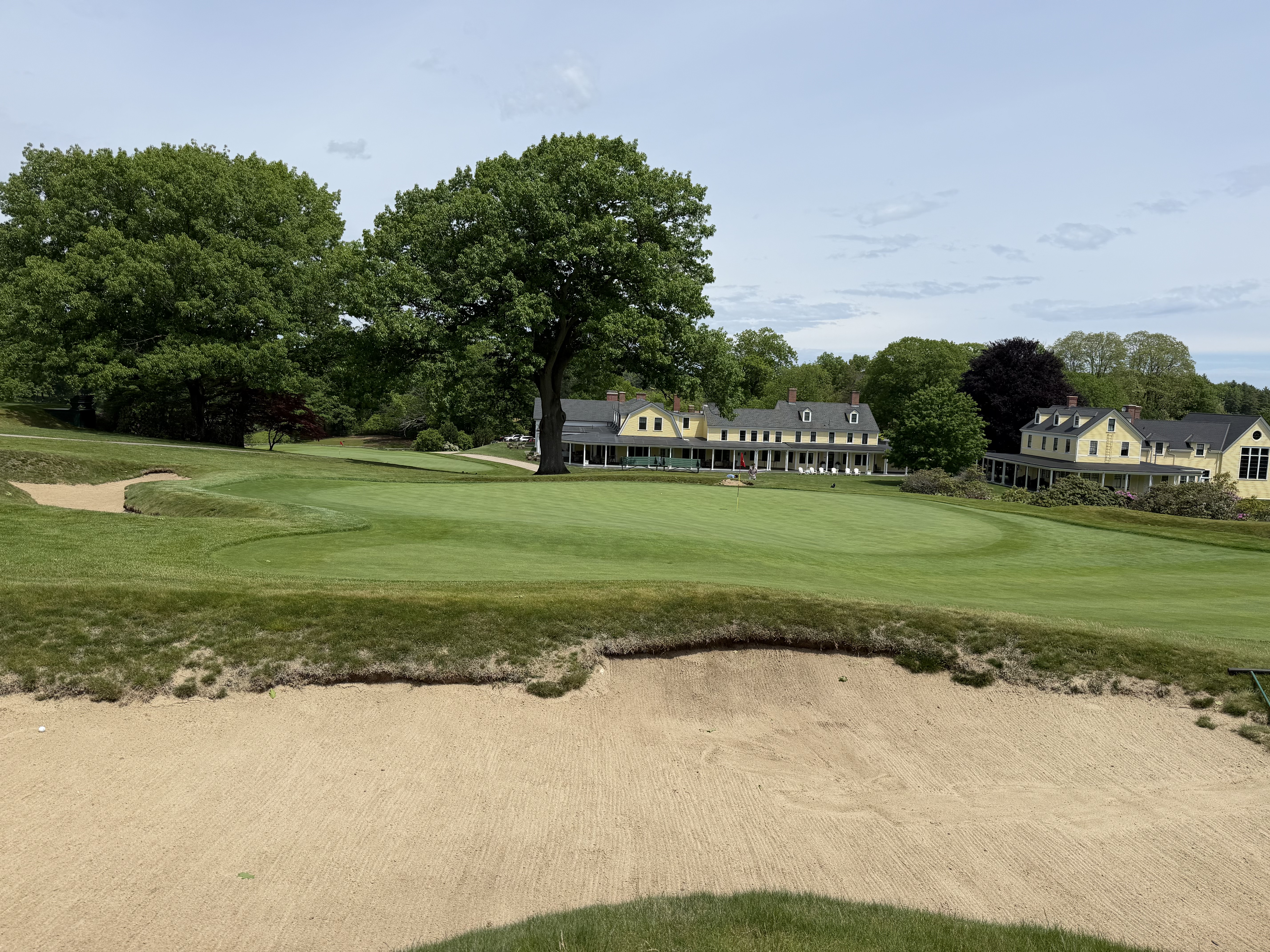
The Eighteenth is 510 yards. The clubhouse appears on the horizon from the tee. The tee shot needs to clear the long grass and the more left one goes, the longer tee shot needs to be to clear it. The green is uphill, directly adjacent to the clubhouse. The hill tells the golfer the terrain is pulling left to right. Once again, the golfer needs to decide if his second shot can climb up the hill and clear the bunkers. It’s the kind of Home hole one considers ideal. The clubhouse is calling and the land is inviting. The only trouble is at the very edges and the base of the hill upon which the green is on. The green is on the same terrace as the clubhouse. Back to front and a little right to left. The hills and valleys splay out before the golfer during his final putts, affirmation and reminding him one last time.


The back nine is a bit more spirited than the front with a very strong closing sequence. I would rank them 18, 16, 15, 14, 17, 11, 12, 13, 10.
There are are periods to every career and certainly every writer, director and artist. One can only surmise in what ways Coore and Crenshaw have matured and refined their design style at the tail end of their career but Brambles is the type of expression whose brilliance will likely not be fully realized for a while, which is certainly intentional. The course will be allowed to evolve, to age, mature, peaking with the culmination of such growth. The same could be said of Coore and Crenshaw, a culmination of sorts with so much accumulated time and experience. The site is not sand-based like Sand Hills, which is one of the reasons for the restrained use of bunkers (there are only about 35 of them). Zoysia was used to counteract the clay heavy soil to more acutely reflect the power of the terrain. There is no artificial mounding here for definition of holes or hole separation as used at Streamsong Red. The playing field is seemingly infinite, just as it seemed eons ago for any one walking through or atop one of the foothills. The meadow floor is the main feature of the design, which does much to unify the structure of play to the sense of place. Someone once told me it takes a lot of work to make something look natural. It took a lot of work here yet also a lot of vision, confident knowledge along with wisdom of how to coordinate all of it symphonically so that the course resides within the landscape. A confluence of the right circumstances with the vision and commitment of the client, James Duncan, along with the brilliance of Coore and Crenshaw, the right landscape and the right time tracks of all involved resulted in Brambles. A progression in minimalism showing true symbiosis between man and nature that just so happens to yield extraordinary golf. The land and setting are captured perfectly, which resounds compellingly with the golfer. It certainly did for me. In some ways, I’m still on that porch looking out to the great expanse.
Clubhouse/Pro Shop: Small, simple and perfect.




You must be logged in to post a comment.