6,644 yards, 126 slope from the Blue/White tees
It’s been a while. During the formative stages of Golfadelphia, I had a core list of courses I had played before that I reviewed, then made a list of courses to visit. Royal Manchester was on it, which was sadly almost fourteen years ago. At the time, the course had just opened (2010) and the water cooler talk was fairly glowing. Tim Freeland was the architect, his only work in Pennsylvania. Freeland worked under Gary Player for a while (as did Rob Collins), then did work for Raspberry Golf Management and a couple of his other courses include Old Hickory in Virginia and Olde Beaufort in South Carolina. At this site in Mt. Wolf, PA, a golf course was planned, started then paused a few times and some greens as well as a routing was in place when Freeland came on the scene but he took over and designed the rest of the course to completion.
Things happen for a reason and perhaps I was meant to wait before finally getting to the fairways of Royal Manchester. One thing that really stood out to me was when the course opened. Coming out of the economic problems a couple years before, golf was starting to find its footing again. Long gone were the days of the late 1990’s and 2000’s where most public courses billed themselves as “high end” and did their best impression of a country club. Interesting and engaging play was becoming more popular as well as a focus on cost and sustainability. While Coore and Crenshaw, Doak and Hanse led the way on this path so to speak, it was interesting to see how such a movement made its way much further down the totem pole. Enter Royal Manchester, a course constructed with the local community in mind. There is a clubhouse and a good enough space for the Nineteenth hole but the focus is on the course. The golf is what most spoke about and for those that relied on the public courses in the area for their golf, word spread quickly of something a little different than any where else. With all the time it took me to get here, the course has shifted from the shiny and new to more of a study piece at a transition point in the world of golf course architecture.
Royal Manchester followed in the ranks of places like Lederach and Raven’s Claw in new and different designs (all public). They didn’t fit into the standard modern mold before them, instead insisting on a refreshing uniqueness that resurrected some age old design principles. I remember the center line bunkers at Lederach being controversial because at the time, the common adage was if you hit it straight, you should be rewarded. Kelly Blake Moran had to explain that the center bunkers forced the golfer to think about whether to go around or lay up, which was a lot more strategy than asking him to simply hit it straight. And so it is at Royal Manchester. There are some blind shots that I’m sure many groused about initially, or the mounding about the hills, but these are traits taken from Irish links as the course tried to stay connected to the land. The days of trying to produce some trophy championship layout dominating the design landscape were over. Course architecture was moving in different directions and Royal Manchester is an early example of this shift.
The course indeed strives for distinction. With the hills of Mount Wolf at its disposal, the golfer is moved about them in various degrees of playful gallivanting. Some times it’s climbing faced with a succession of blind shots, other times it’s relying on the hills to bounce and roll the ball towards the hole, while other times it’s needing to carry across some ravine or valley to get from one hill to the other. It’s a spirited round yet those more fun holes are interspersed with a lot of traditional fare to level things out, slowly and methodically introducing the finer points of sharp drop offs, firm and fast as well as dramatic blind shots. It stands out as a solid public option.
The First is a 393 yard par 4 (from the Blue/White tees). The opening tee shot is to an uphill fairway with hills on either side almost funneling towards center. There are no fairway bunkers and only one greenside at the right front. The green kind of leans into the bunker but has a lot of room, especially at the rear. A nice waddle into the water.


The Second is a 178 yard par 3. The routing takes us down to the lower portion of the hill where we run alongside it for a couple holes. The green is wide and shallow, standing above the the bunker on the right side. The utmost priority is to hit the green, even at the expense of going long. Otherwise, the ball will plummet down into a well tucked crevice near the cart path making for a difficult recovery. The green runs towards the entry point at the left.


The Third is a 526 yard par 5. The opening trio goes 4-3-5 so we get the first of every par right off the bat. The tee shot dog legs right and then straightens out to the green from there. Once again, no fairway bunkers to speak of; the golfer is free to mess about the fairway and contours as he sees fit. The green is at the top of the hill with a bunker on either side of it. Deep yet narrow and a center ridge that creates lower front and upper rear tiers to contend with. So really, the objective is to navigate the hills and don’t go criminally sideways.


The Fourth is a 410 yard par 4. The course grabs your attention here. The columns in the distance are from Brunner Island and they happen to be a nice aiming line off the tee. The fairway is straight for the first 250 yards before it dog legs right downhill. The green will be completely blind for most but is off to the right with a sharp drop off before it. Some may use the front contours to coax the ball close to the hole while others may want to hit the approach a bit longer for the rear of the green to more level ground. Whatever the golfer decides, the more he knows the hole and how it responds to the shots made upon it, the better. A real fun hole.


The Fifth is a 370 yard par 4. Indeed, the course becomes more rambunctious all of a sudden. The tee shot must get to the narrow fairway while avoiding the left side that significantly drops off and leaves a blind approach. The margin of error is much smaller than in holes past. Just like the tee shot, the approach needs to hit the green or is subject to a lot of trouble and tougher spots off the green. Accuracy is the name of the game here for sure.


The Sixth is a 164 yard par 3. Moving to the other side of the road, we get our second par 3 where the green is downhill of the tee. A long front bunker requires the golfer to carry it to reach the green, which boomerangs around it. This creates movement away from center at the edges while the center is more of a back to front.


The Seventh is a 380 yard par 4. Yet another hole with no fairway bunkers. In fact, there are no bunkers at all to speak of. They really aren’t needed here as the hillside is used extremely well and provides all that is needed in the way of challenge. The tee shot needs to carry a ravine and reach the hill on the other side. Those that really know what they’re doing can get their tee shot to hit the downhill on the other side and get a lot of run towards the green. The tee shot must be pulled off in the right way and those too far left will get their shots falling much further away from the green. The green sits downhill from the fairway. It’s wide and some what shallow, so the golfer must take care not to have the hill take the approach well past. Using the hill to deliver the shot to the green is much preferred all around. Yet another really fun hole.


The Eighth is a 394 yard par 4. We have looped around to the clubhouse but now go out and back to complete the front nine. The tee shot moves uphill and the left side is our friend. You guessed right, there are no fairway bunkers and yes, there really is no need for them. There is a center bunker at the green which the green moves around as well. Sure this seems to be a refrain for the greens but there’s not enough boomerang greens out there. We find that the tee shot makes or breaks the hole, which has also become a common refrain thus far.


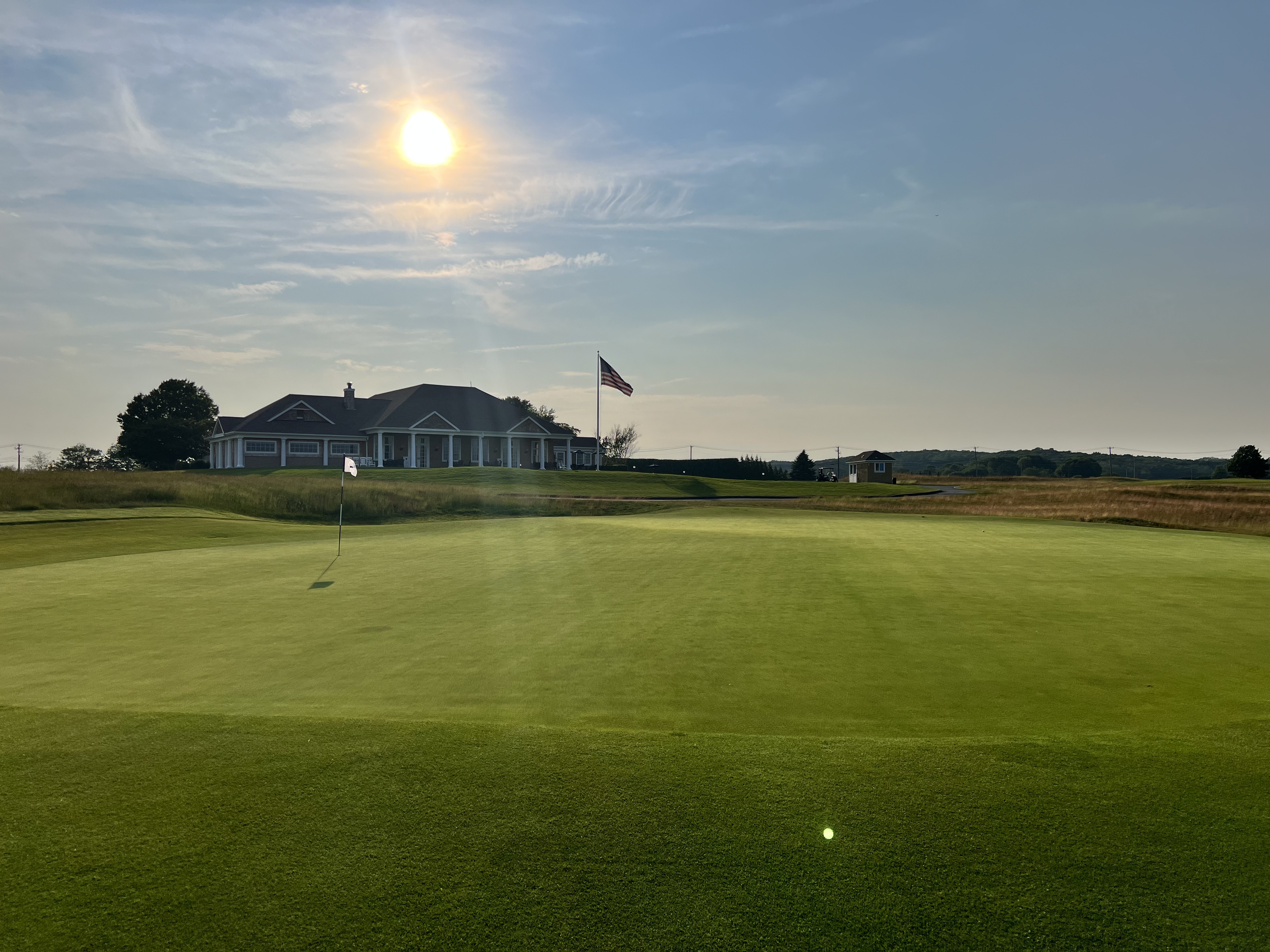
The Ninth is a 495 yard par 5. A short par 5 that moves downhill back towards the clubhouse. Fairway bunkers on both sides come into play off the tee and the longer hitters will be able to take advantage of the downhill. Water guards the green and demands an aerial approach, so those going for it in two need to make sure they can comfortably cover. It’s also worth noting the green is shallow with a run off down hill to a collection area on the left. Any shot into the green needs to stop rather abruptly. The right to left movement of the green is also very insistent.


The front nine is a nice collection of fun holes that focus on the contouring more than anything. I would rank them 4, 7, 8, 5, 9, 1, 3, 6, 2.
The back nine starts with the 394 yard par 4 Tenth. Things start off a little friskier yet emphasis on the tee shot remains. The fairway is on the narrow side and eventually crooks to the right, the throat of the green allowing ground game options even though we’re moving a bit uphill. Again, however, the tee shot rules all.


The Eleventh is a 149 yard par 3. Tucked in at the corner of the property, the green stays low profile among the mounds. A front bunker must be cleared to reach the green while a rather shallow right side bunker covers a lot of ground on that side. With the green running back to front in general, a center to rear shot is in order.


The Twelfth is a 540 yard par 5. On the lower side of the property on the side from the front, the hillside moves right to left throughout. In fact, the left side is no good altogether and the golfer would do well to pretend it’s not even there. Favor the right and negotiate the narrower point at the second shot. The green is on the larger side and set at an angle with a bunker running on either side and plenty of room in front and before.


The Thirteenth is a 350 yard par 4. A dog leg right around a gathering of bunkers on that side. The fairway has plenty of width before it starts turning and most would do well by taking their tee shot into this area. The fairway running next to the bunkers up to the green is narrow yet those who decide on going there off the tee will have a nice wedge into the green. The tee shot once again remains vital and here, there are plenty of options to navigate the bunker field on the right.


The Fourteenth is a 382 yard par 4. We now face a dog leg left where the tee shot is semi blind. The golfer knows he has to hit it left and needs to avoid the bunker in view but at some point, he will lose sight of his tee shot and have to trust it will all end well. The golfer can’t see how wide the fairway is and there’s lots of room to set up a comfortable approach in with some meddling mounding at the edges.


The Fifteenth is a 177 yard par 3. Another corner par 3 with a dominating left to right movement. There is some room to miss off the right but the play is to favor the left and let the terrain pull it back to the right, ideally closer to the pin.


The Sixteenth is a 518 yard par 5. A little bit of a routing miscue here has us moving almost the length of a hole to the tee and then essentially playing to a green adjacent to the one we just played. Regardless, the tee shot must favor the right side and once it starts bending to the left, moves downhill to the green. A bunker on the right before the green is a good target to carry for a shorter approach in. The left side is actually a better angle into the green, so the second shot can be used to get over there if once is so inclined. The bunkers on either side of the green are quite expansive while the green is on the smaller side, so setting up an ideal approach becomes important.


The Seventeenth is a 391 yard par 4. Above all others, this hole reminded me of something you might find on the Irish links. Perhaps it’s the simplicity of the mounds and fescue leading up to the green or the jagged edges of the fairway and green but it conjured that type of feeling for whatever reason. It’s an uphill dog leg right at its core, lone left fairway bunker needs to be avoided. The green is free is bunkers and instead relies on the terrain for its intricacies, the larger green even a bit subtle in how it moves. One of the better holes of the course in its simplicity and subtlety.


The Eighteenth is a 433 yard par 4. A downhill hole where the tee shot needs to stay on the fairway for an aerial approach over water to the green. The better the tee shot, the easier the approach. Those out of position off the tee will need to decide if they need to take an extra stroke to set up the carry over the water or go for it. The green is plenty wide but not all that deep, so soft landings are encouraged.


The back nine has some fun to it in its own right yet the best hole of the bunch is much calmer and graceful in its presentation at the Seventeenth. I would rank them 17, 16, 13, 10, 11, 15, 12, 14, 18.
Generally, Royal Manchester is a sound public option that is fun, slightly strategic and varied. The structure of play shies away from aggressively penal consequences and instead, almost encourages the golfer to learn the land and use it to their advantage. No, it’s not actually a links but more along the lines of Wyncote in that trees are not incorporated into the design except for the property boundaries. Instead, off fairway is comprised of fescue, mounding and in a couple instances, water. I enjoyed the round and the questions asked of me on most of the shots. Those in the area are fortunate while anyone else that happens to be visiting looking for a round, this would be a great option.
Clubhouse/Pro Shop: The has a nice indoor area for food and drinks while the pro shop is in the same structure and well stocked.
Practice area: Driving range and short game area are across Board Road yet close to the clubhouse.



You must be logged in to post a comment.