The Parade of New continues. Part I is here, which touches on new courses, new short courses and notable new international courses. https://golfadelphia.com/2026/01/20/the-parade-of-new/. That really boring band came through and we made the most of it by grabbing another coffee. Let us sit back down and watch the rest of it march by, which will be all of the renovations, restorations, re-designs, hybrid restorations/renovations, sympathetic restorations, purposeful renovations, quasi-restovations and all the other names we come across for plain old meaningful work taking place on existing courses. Time to get comfortable, we’re not going any where for a while.


RENOVATIONS, RESTORATIONS, RE-DESIGNS AND ANY OTHER RE’S
Yale
Personally, Yale was an important course for my progressing interest in course architecture. It was the first Raynor design I played and one of those eye opening moments of how uncharted the universe of course design was to me, even though this site had been in operation for a couple years at that point. At any rate, I have yet to return since that maiden voyage 13-14 years ago yet I suspect this will be the year that changes. Gil Hanse and Jim Wagner have undergone an extensive restoration that includes bringing back the immense scale of the original design, bringing the greens to USGA specification and generally, everything else. Tree work, irrigation, drainage, bunkers and tees. With original design plans and an arsenal of archived historical material, Hanse/Wagner’s overarching mission is restorative, which will include restoring the position of the green at the Third to its original site near the pond. Yale characterizes the restoration as, “scrupulously faithful.” Having played several Raynor designs since that Sunday all those years ago, as well as countless Hanse-restored courses, the excitement and anticipation level for this re-opening is astronomical.

Seminole
Hanse and Wagner are endeavoring to return the course to its original Ross character in the largest project in the club’s 96 year history. Last summer, the front nine was completed and this Summer they will take on the back. The work is comprehensive, addressing design character and infrastructure. The design character work addresses the greens, which were significantly shrunk during a reconstruction project led by Dick Wilson in the late 1950’s. Green expansion (an average of an additional 1,525 square feet per green) and re-contouring is returning the greens to their original Ross design. For example, the Fourth was designed as a four-corner with a central hollow, which is now back in place. Work also work moved back towards the fairways, which repositioned bunkers and re-surfaced undulations to rejuvenate the ground game, tee shot roll out and ensure strategic approach angles were recaptured. The infrastructure work includes raising the overall height of the course so to speak to address the rising water table issue. Bunker restoration is also a prevalent component of the project, especially since the sand is subject to the coastal wind and rain that exact a heavy toll. The overall heightening of the course and a near complete resurfacing aims to ensure Seminole will showcase and fortify Ross’ intended character in perpetuity moving forward.


The Patch
You probably thought we were done discussing Tom Fazio but no, we are not. He and Beau Welling are re-designing the eighteen holes of Augusta Municipal Golf Course, which was initially designed by David Ogilvie. Ogilvie helped design the Hill course at Augusta Country Club, then designed Augusta Municipal in 1928. After a few false starts in a complete overhaul this century, Augusta National, the local First Tee and Augusta Tech are joining forces to develop a comprehensive golf facility promoting the game and community. Fazio and Welling are teamed up for the first time and eleven of their holes will pay homage to the original course. Playing areas will be expanded by 20%. Tiger Woods will also design a nine hole short course, which will be called The Loop.
These types of projects are becoming more frequent, which is a very promising trend. Community hubs that are able to attract golfers of all abilities and experience, as well as promote the game in the right way to youth who may not otherwise be able to get such exposure immensely elevates the potential of public golf. And any time I can mention Tiger I will do so, as his commitment to this project, Cobbs Creek and others is admirable. An opening is targeted just before Masters Week.

Swope Memorial
A Tillinghast design that opened in 1934, Swope is a public classic in Kansas City that is in the process of being restored by Ron Whitten and CE Golf Design. Tillinghast made the plans in early 1934, then left an assistant in charge for construction while he continued his tour around the country visiting various courses on behalf of the PGA. Tilly returned in 1936 and told a reporter his plans were not carried out. The routing was as planned but not much else. With aerials from 1940, hole photos from 1935 and original routing plans, Whitten and CE Golf intend to restore the course so that it showcases much more Tillinghast character from his plans yet recognize all the modern aspects of the game nowadays means a complete or pure restoration is not possible. The work includes new greens, bunkers, tees, cart paths, drainage, irrigation and tree work. Greens will be expanded in line with Tilly’s plans. Likewise, bunkers will return to their original flashed design while will improving visibility, as originally designed. The Sixth hole will become a par 4, a carry bunker at the Seventeenth will be restored while a carry bunker at the Eleventh will be created and mounding about the green complexes that was lost during a 1990’s renovation will be brought back. Indeed, Dolomites, which Whitten refers to as, “miniature mountain ranges,” will be emphasized a good amount and likely associated with the course identity. The most famous example of Dolomites can be found at Somerset Hills, so Swope is certainly in good company. Another example of a rejuvenated classic that will benefit the Kansas City community and attract traveling course enthusiasts alike.

Country Club of Charleston
Kyle Franz initially began restoration work here in 2016, using aerial photos to return bunkering and other course features back to Raynor’s design character. Franz primarily focused on six holes for the two years of work, which was then in fighting shape to host the 2019 U.S. Women’s Open. Franz returned in the fall of last year and will be working for most of this year on additional restorative work to the course, likely continuing along the same lines as his first project. There is not much information out there at present but as the year progresses, we should be hearing much more, with an expected opening at the tail end of the year.
Detroit Golf Club North
Aldrich Potgieter of South Africa raised the trophy at the Rocket Mortgage Classic last June at the Detroit Golf Club. Once he departed the podium, the fanfare followed and the course eventually emptied, then the stands were broken down and removed, the course once again in relative stillness. That did not last long, as Tyler Rae’s restorative project began in earnest at that time, spanning all facets of the course with an estimated $16 million budget. The project will focus on instilling Ross’ bold design plan, which included hummocks, mounds, angled drainage ditches and perched greens. All greens will be reshaped and rebuilt as well, using Ross’ 1914 design plan. Rae also noted Ross’ bunker scheme at the North was distinct from a lot of his designs in the northern U.S. because they feature a higher sand flash with concaved bottoms, intended to release shots away from the edge and face. Rae will likewise re-work the teeing grounds, adding locations yet focusing on bringing much more consistency to them. Drainage and irrigation will also be upgraded. The PGA Tour visiting classic courses has become the exception more than the norm, so this tour stop will now shine in its renewed splendor and hopefully broaden the fascination with Ross’ historic design character. Rae will turn his attention to the South course next, so that both courses are completed for the club’s 125 anniversary.

Garden City Country Club
Andy Staples created a master plan for restorative work to this 1916 Walter Travis course based on aerials and extensive research. The work includes reconstruction of the existing bunkers, fairway adjustments for width and strategy, work to the teeing grounds, revisions to the Fifth and Twelfth as well as installing, “historically inspired” bunkering and mounding between the Sixth and Seventh.

Country Club of Lincoln
We oft hear of the Golden Age stalwarts but are there others that enjoyed successful careers whose work still exists? Look no further than Country Club of Lincoln, designed by William Tucker and Gregor Macmillan in 1927. Tucker was born in Surrey, England and came over to the U.S. when he was 24 years old. When all was said and done, he designed over 120 courses, which included Preakness Hills in NJ, Sand Point in WA and Hillcrest in NE. There is less info available on Gregor Macmillan but Golfpass indicates he designed University of Montana’s golf course and Cabinet View in Montana, among others in the midwest. The restoration project will resurface the greens as well as reposition a few of them, move bunkers closer to the greens, widen in spots for strategy and accessibility, bunker work will flash the sand up, as well as tree removal. The work was designed and will be carried out by Todd Quitno and Landscapes Unlimited.

Pelican Hill
The golf courses in the 1990’s are beginning to hit the period where refresh work is in order. Pelican Hill is addressing this by retaining Curley-Wagner to perform a renovation of both golf courses. The courses were last worked on by Tom Fazio (the original course architect) as part of a “re-perfection” that took place in 2005. The project will focus on bunker restoration and realignment, tee expansion and leveling and work to the green surrounds. This feature refresh will also address turf health issues borne by tree maturation. Aside from restoring and refreshing, the project will impart thoughtful changes to visuals and backdrop framing that are hallmark’s of Fazio’s design style. The courses will remain open during the work as nine holes will be addressed at a time.

Deepdale Golf Club
Scot Sherman of Love Golf Design has been leading this multi-year project that is set for completion this year. Other than a few Instagram posts with photos, there is very little out there on the work performed but it has been characterized as, “tweaks and adjustments.” Sherman’s restoration portfolio has been rising, which includes Delray Dunes, Sea Island and Camden Country Club, which he is in the middle of and will likely be completed in 2027.
Shoal Creek
The restoration/renovation explosion is not just limited to Golden Age classics but includes early and even mid-modern work as the years tick on. So it is with Andrew Green undergoing a $22 million renovation of Jack Nicklaus’ 1977 design. The project include regrassing, the greens converting to Tifeagle and fairways to Stadium Zoysia. Earth moving will be prevalent with the goals of enhancing variety and strategy in a structure of play that is known for its challenge. This also includes bunker re-shaping, repositioning and reconstruction, as well as work to the teeing grounds and a complete irrigation upgrade. This modernization is all in the direction of respecting Nicklaus’ original design model.

Annandale Golf Club
Todd Eckenrode is undertaking restorative work at this Pasadena Golden Age (a hop, skip and a jump away from the Rose Parade route) with LaBar Golf Renovations and Hertzing Management Group implementing said changes. Willie Watson routed the course in 1906 and in the 1920’s, Billy Bell was retained to redesign the bunkers and the Fourteenth through Sixteenth. The project comprises of new teeing grounds, greens, bunkers, fairways, irrigation and grass with the purpose of returning the design style back to Bell’s intent. Eckenrode called Annandale one of Bell’s, “most beautiful designs” and included with the restoration, aims to return the renown natural drainage swales while improving the visual drama and natural flow of the course. The course is closed during the work, demonstrating the comprehensiveness of the project, and is set to re-open the Spring.

Longue View
Andrew Green is performing renovations to the Pittsburgh area course originally designed by Robert White in 1922 with significant renovations by A.W. Tillinghast in 1935. Green’s work can best be characterized as broad strokes of tweaks to enhance the strategy, complexity and yes, even recovery character of the course. Some of these features are restorative in nature, like the long greenside bunker which will now be along the right side of the Ninth green (photo below). The newly polished Longue View has the second round of work commencing this year, with a re-opening towards the tail end of 2026.

False River
Just outside Baton Rouge is a nine hole course around since the 1960’s that decided to extend to eighteen holes this year. Nathan Crace has led the re-design, a veteran of mostly southern courses including renovating Ole Miss Golf Club and Copper Mill Golf Club (which earned him Best Renovation for Affordable Public Golf in America). Crace has been in the business since he was eleven years old, when he designed and constructed a three hole par 3 course in his backyard. Crace built a homage to Golden Age design focusing on Macdonald and Raynor, which includes not one but two iterations of the Biarritz green. Exciting times for those who enjoy False River on a regular basis and those who may find themselves in the area looking for a round.

Patterson Club
Jaeger Kovitch is starting to amass an eclectic portfolio of projects, many of which include renovations to established modern courses. These renovations have struck a wonderful balance between honoring the original design tenets while instilling sophistication and complexity that enhance and elevate the course. Cedarbrook just outside Philadelphia and Manhattan Woods just outside NYC are examples I have recently come across and in both instances, I found the new versions outstanding. Kovitch has developed a master plan for the Patterson Club, a RTJ design from 1946 that was renovated by his son Rees from 2007 – 10, which included work to the tees, bunkers, and rebuilding of the greens at the Sixth and Eighteenth. Kovitch has focused on restoring and maintaining RTJ’s design concepts while improving strategy and enjoyability. This will include a partial re-routing and re-shaping at fairways and greens, among other aspects of the work. Based on the history of the club and thoughtful design detail Kovitch is known for, this is one project we will be following with enthusiasm.

Hollywood Beach Golf Club
North of Miami lies a course that has always been attributed to Donald Ross from 1924. Richard Mandell now leads a complete rebuild just over a century later, proclaiming that Ross was not involved but rather an unattributed design plan from 1923 may have been developed by Willie Park, Jr. Mandell is using the design plan as his source of the re-design, which includes reimagine its topographical character, re-working greens and ensuring the course is much more resilient in the face of rain and rising flood plain issues. At a compact 100 acres and within the cityscape of Hollywood, this is an intriguing project that is set to open in the early tones of the year.

Hillcrest Country Club
In Kansas City, Missouri, Donald Ross designed Hillcrest in 1916, which is now in the middle of a $30 million renovation that aims to restore the original Ross design character. Tripp Davis is leading the charge while the Donald Ross Society will be consulting as well. The club transitioned to public play just before closing for the project and intends to return to a private structure upon opening this year. Along with the newly restored course will be a new clubhouse and practice facility. The course is on the highest point of Jackson County with views of downtown Kansas City. During construction, Ross quipped Kansas City would have, “the greatest course in the world.” The course has an extensive history that underwent significant changes and transitions over the years but the current ownership seeks to return it back to its splendor. This is yet another strong suit of the design trend we now find ourselves in is courses such as Hillcrest now more than ever have the opportunity to retain their past glory from the historical foundation and design structure that has never left. Yet another project of intriguing scheduled to open this year.

Somerset Country Club
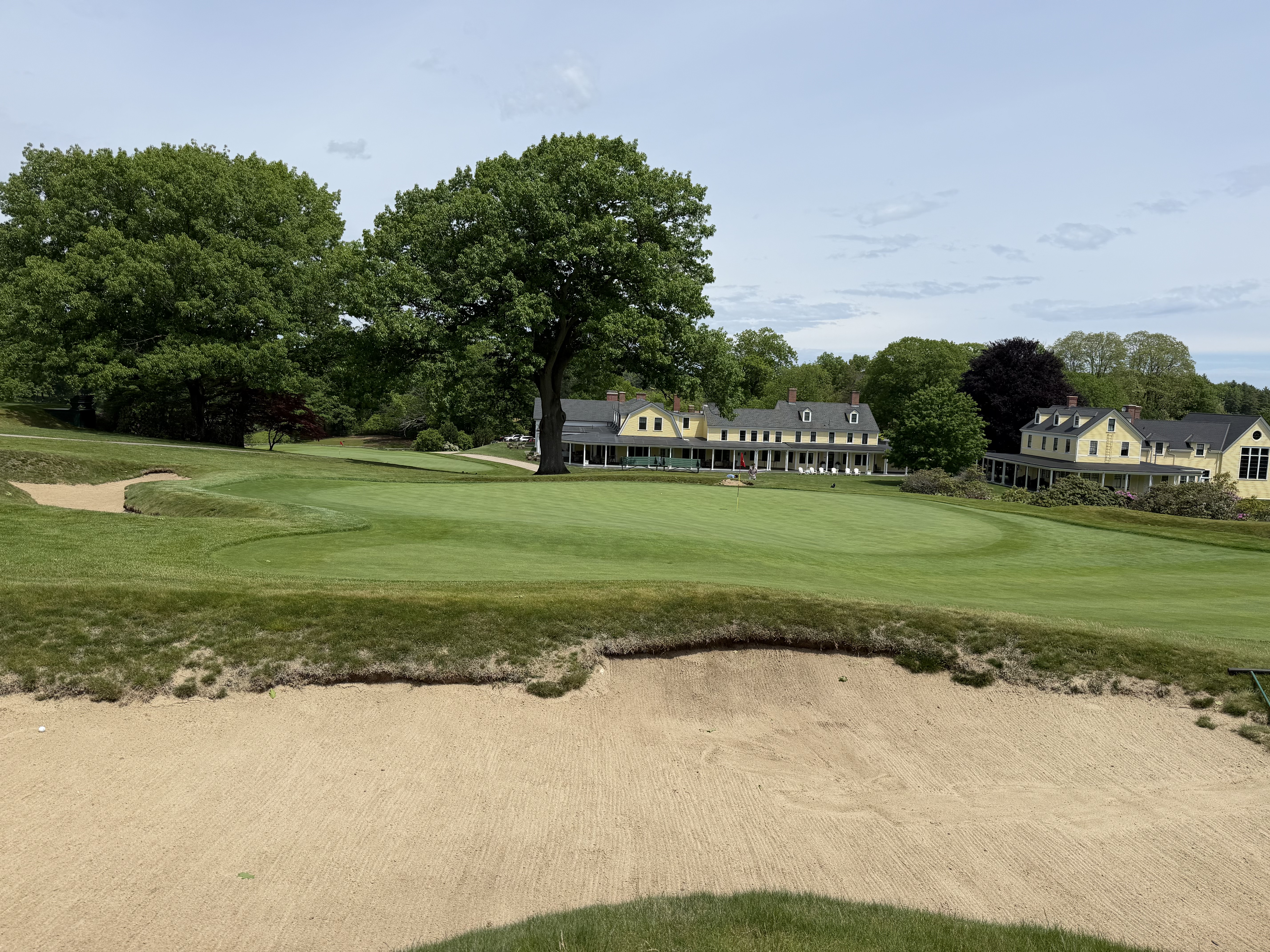
I had the fortune to come across Somerset a few years ago and found it to be a very engaging Raynor design with unique shades of character from the variety of architects that had laid their hands upon it, which include Stanley Thompson, Robert Bruce Harris, George Cobb, Geoffrey Cornish, Brian Silva, Rees Jones and Stan Gentry. J.H. Duncan has been working with the club most recently and has focused on revitalizing the template holes, which include the Alps, Short, Redan, Punchbowl, Eden, Cape, Biarritz, Long and a Double Plateau that is actually, “upside down” with two low sections and one high. The work may have finally completed late last year or the final touches will be done this year, but either way the recent work is worth spotlighting this Raynor gem.

Old Dane
Trevor Dormer’s first solo project comes at a nine holer in Sioux City, which he Weill re-rout and re-design into a twelve hole course situated with three courses within a course; a three hole, six hole and full course loop. Set on relatively flat terrain, Dormer intends to build up and shape with approximately 40,000 cubic yards of fill form the newly dug irrigation pond. The course is owned by the Anderson family, who own public course darling Landmand. Dormer worked on the Landmand project and is now a name partner with King Collins. Dormer is making an impression with the bold features, which include a 15 foot high Volcano hole at the Eleventh and shared fairways throughout that will significant expand. The driving range is being eliminated to make rooms for the extra holes on the 93 acre site. The Anderson family aim to bring more engaging golf to the community while hoping to continue to attract others to make the journey. Old Dane is shaping up to be an impressive maiden project for Dormer.

Crag Burn
Another RTJ design, this one coming later in his career in 1974 in Buffalo, Tyler Rae worked closely with director of grounds Terrance DiLoreto for three years on the details of the restoration. Restoring the magnificent bunkering was at the forefront, along with green and fairway expansions. This allowed the bunkers to cozy up to the greens more closely, all of which broadens the strategic and challenge characteristics of it. Drainage was also upgraded. We are seeing more and more restorations of modern courses. What’s refreshing is the architects performing these restorations are doing so not from the approach that the designs should be wiped off the face of the planet, but rather striking a balance of recognizing the value of design in that era and conjoining it with the strategy and engaging characteristics that rule today’s trends. Credit should go to Gil Hanse for embracing this approach, which is a much wiser and holistic approach to the past than the, “they did it wrong back then but we’re correcting things now” mantra. Crag Burn reveals its newer self this season.

Stowe Country Club
Beau Welling dips into the renovation scene at this 1950’s William Mitchell design with tree clearing, expansion of tee landing areas and a more strategic and varied bunkering scheme. Welling is also re-shaping greens and rebuilding the teeing grounds. This falls into the best course possible project and Welling’s touch should elevate several facets of the course.

Wayzata Country Club
The club just outside Minneapolis closed last Summer to embark on a $15 million renovation that will look to Jackson/Kahn for changes to the course. An eighteen hole putting course will also be installed. The renovation work includes the teeing grounds, regrassing the course with 007 bent, reshaping the greens and updating irrigation. Jackson/Kahn are focusing on opportunities to enhance variety and fun with the project, including distinct character. The course was originally designed by Robert Harris in 1958. This is a pure renovation, where Jackson/Kahn is imparting changes as they see fit as the club seeks the best course possible. With Jackson/Kahn at the helm, there is little doubt that will be achieved.

Lakewood Country Club
Westlake, Ohio is the site of a 1921 Tillinghast design that Keith Foster is now restoring. The Wissahickon Course at Philadelphia Cricket Club and Brook Hollow are two prior Tilly courses Foster has restored in the past and both are command rounds for the course architecture enthusiast. The ten month renovation looks to enhance its strategic character while restoring Tillinghast features, such as the bold bunkering, thought provoking angled approaches, the Great Hazard and Lion’s Mouth green. Greens and tees were also expanded. While the course technically opened late last year, the project is noteworthy and one to visit should the opportunity arise.

Storm King
One of the cooler names for a golf course also comes up with the kind of innovation we love to see. In New York fairly close to West Point, the original design by Willy Norton and George Low opened as a nine holer in 1894. The course was purchased in the early 2020’s and the new owner sought to reimagine the course. Chris Gray was retained to the lead the re-design effort, which he did by reconstructing the course into five distinct nine hole routings, 225,000 square feet of greens, and over thirty multi-directional tee options. In all, there are over fifty golf holes out there. There is also a nineteen hole par 3 course. The course will be maintained mostly with GPS driven drones and automated lawnmowers. Available to groups (by invitation), who will be able to utilize the space and decide on how to go about moving about. The creativity and utilization of space is promising and the playing concept set up for inevitable fun.

QUICK HITS
Naples Grande is undergoing a complete renovation of their infrastructure, which includes a rehab of the golf course by Beau Welling. It also appears Welling is simultaneously undergoing a transformative master plan renovation at Hurricane Creek just north of Dallas that is a complete re-design. We’re not done with Welling yet; he also completed a renovation at Greenville Country Club’s Chanticleer course that opened late last year, which was designed by RTJ in the 1960’s, which included flipping the nines, reshaping the greens and regrassing. Just to the west of Minneapolis is Burl Oaks, a 1970 design by Mark Mitchell that Jay Blasi is renovating, which will include the addition of a nine hole short course. The Quail Course at Hogan Park in Midland, Texas is part of a $10 million renovation project at this 36-hole municipal facility led by architect Trey Kemp. The course is being “reimagined” yet will remain in many ways its earlier iteration. Fairways will also be regressed to TiffTuf bermuda and a complete upgrade to its irrigation and drainage. The Tuckahoe Creek Course at Country Club of Virginia in Richmond is a Joe Lee original design that underwent bunker renovations by Lester George a few years ago and now will undergo a redesign of the Fifth and Sixth and further transformative work. Broadmoor Golf Links is an Asheville pubic course that sustained significant damage from Hurricane Helene a year and a half ago but is now re-opening after Carlton Marshall reconstructed the course, which includes three new holes. Miami Lakes just underwent a $12 million renovation of the redesign kind by Bruce Hepner. The public course could not be in better hands considering Hepner’s track record, especially with the public scene. Striving for a course that can be anything to anybody while achieving a level of distinction that will enhance its sense of character, Hepner regrassed the greens to TiffEagle Bermuda, sodded and reshaped all eighteen holes. The course opened late last year but is noteworthy for its focus on public golf tenets, endeavoring to create an iteration of the course that makes the game a more intriguing and exciting experience for all.

NOTABLE INTERNATIONAL RE’S
St. Andrews Old
In preparation for the 155th Open in 2027, the Old Course is indulging in a few adjustments worthy of note by Mackenzie & Ebert. These include new tees for six holes in a lengthening effort to 7,445 yards (148 yards longer than the 2022 version), bunkering at the Second repositioned further away from the tee to come into play off the tee, as well as at the Sixteenth, where the fairway will be expanded to the left of the Principal’s Nose bunker and a couple new bunkers will be installed on the perimeter of the expansion.

Royal Birkdale
Mackenzie & Ebert are implementing changes ahead of the course hosting this year’s Open. These changes include upgrading the bunkering and teeing ground, as well as a new par 3 at the Fifteenth, restructuring the Fourteenth (entirely new par 5) and redesigning the Fifth (more bunkers) and Seventh (will become a short par 3 with an elevated green). The work is intended to add to the strategically challenging nature of the course while improving the flow of the round. The hope is that the tread is careful here. Open Doctor type work has been prevalent on the Open rota of courses and the hope is considerations such as historic preservation, engagement and accessibility for all, as well as maintaining interest and complexity above sheer lengthening and ramping up difficulty. I do not know where the changes to Birkdale fall in this spectrum but this is yet another project where brand new holes are replacing existing and the project itself was unpopular with a section of locals. In the words of The Trap Draw, we are monitoring the situation closely.

Wentworth East
A 1924 Harry Colt design, the East course has been receiving a multi-year makeover that is to bring it back to Colt’s original design character and reinstate its heathland roots. European Golf Design is leading these efforts, whom will rely on historic aerials from the club’s archives. Such work includes bunkering reshaping, re-mounding while some of the greens and fairways will be re-defined along with tree clearing. A new comprehensive practice area is also in the works. For a club known that hosts the BMW Championship each year, their efforts with the East in highlighting the historic Colt glory is delightful to see.

Monifieth Golf Links
Conor Walsh of CJW Golf International was brought in to establish a fresh feel to the Medal course, which he did primarily with work to the 27 bunkers, which restored much of the strategic elements that had faded over the years. This bunker work created a “Valley of Sin” at the Thirteenth, as well as other strategic creativity throughout. It appears a lot of this work was completed last year.

Hillsdale Golf Club
Hillsdale is a 36-hole club just outside Montreal designed by Howard Watson, who worked with Canadian course design legend Stanley Thompson. Whitman, Axland and Cutten have been retained to reconfigure the courses into one eighteen hole course, a nine hole course and new practice facilities. This falls into the re-design category and an entirely new course and facility should be expected. The pedigree of the architecture firm and opportunity for them to create a fairly new design of their own is reason enough to spotlight this opening later this year.
Yering Meadows Golf Club
Known as one of the more difficult Australian courses, the Clayton, DeVries and Pont architectural firm as well as Kruse Golf were retained to provide more dimensions to that challenge so that the lesser skilled find an engaging round while the course tightens in difficulty the more skilled the golfer is. Clayton notes this type of structure is in place at Royal Melbourne, which is being followed to some extent with this project. The project will simultaneously move away from Royal Melbourne similarity by changing the bunker character from the traditional Sandbelt flashed up thin edges to a more Golden Age style inspired by Seth Raynor that is more suited for the Yarra Valley’s heavier soils. The project will also include widening, using the vast available acreage more to its advantage. The project shows ambition in returning Yering Meadows to the forefront of golf options in Victoria.

EPILOGUE
The dizzying array of work yields patterns and trends if one looks at it long enough. Resorts and high end luxury housing developments dominate the platform for new courses. Most of these are in Texas outside Austin and Dallas/Fort Worth. They are literally creating the community upon which the course is centered and most often doing a much more sophisticated job of it than the same model from 20 – 40 years ago. Some of these luxury housing communities are following the remote destination model and with much more capital, are able to find wonderfully naturally situated sites for golf. Attention to craft and authenticity is across the board, yet mileage varies or at least the jury is out on if or how these courses are distinguishing themselves from each other or the era of courses from which they came. This gets a little muddled because it depends on what crop of openings one focuses on and the promise of very good to excellent golf is all but guaranteed. Again, however, the uniformity of style is something to pay attention to, especially as the designs may rely too much on the terrain in each instance. There are styles of naturalism and even minimalism and we’re all better off when the architect seeks to define that style with the right touch of guidance to the land. There are growing examples of designers doing just that and purposefully breaking out of that uniformity for distinction. That is innovation to some degree.
Where innovation really shines at the moment is with short courses. These range wildly. From taking the cap off the bottle and letting the imagination run free to fairly short hops among quick sets of zany greens, designers are more prone to throw architecture norms out the window with the short course. Brevity is the soul of wit and all that. Storm King, The Commons; even Saddle and Cycle, demonstrate ingenuity and explore some of the joyous fringes of the game that hopefully have more impact than originally intended.
Then there is the work to existing courses. This certainly comprises the majority of projects, which includes a growing number of modern and even early modern designs. The modern restorations are approached in relatively similar fashion with a combination of respecting the original design concepts while instilling their own measure of architecture. The classics range from all encompassing extensive projects such as Yale and Seminole to rebuilds such as Wayzata and Hurricane Creek. Then there is the public golf uprising. Swope Memorial, Hillcrest, Hollywood Beach and Miami Lakes are all exciting and intriguing projects that are completely transforming the existing canvas in one way or another. Full of return to past glory or reimagining a better iteration, massive budgets for public courses are becoming more frequent and the resources are being used astoundingly well. With a more robust public scene, we all win.
Innovation will become increasingly more valuable as the business models grow and seek ways to differentiate themselves into some kind of pecking order. You can only have so many designs by the well established set and you can only have so many of a particular design before they all start blending and it becomes more difficult to figure out their individuality. Just like one giant parade. It has been fun but after a while, it is enough. It will become tougher and tougher for a course of the current style to be memorable no matter how well crafted. Those accounting for this risk of sameness in some way and the degree of innovation to which they rely and in what fashion will help show the next few paving stones on the path to our next era.


You must be logged in to post a comment.