6,622 yards, 136 Slope from the Hybrid tees
Up until last year, Long Island National was the youngest golf course on the island. This seems wild, especially for an island so suitable for golf, spanning approximately 118 miles lined with coastland and sandy soil. Land values, wetland regulations and rigid commercial and residential zones are well known obstacles to newer golf development but the fact remains Long Island’s golf scene is abounding with well established courses that have been around a century give or take. There are a good amount of these behemoths of the game, which cast their shadows with discerning expanse. Within this context of comparison and across a broad spectrum of history, it takes time, patience and pretty much elite design for any newer course on Long Island to garner rightful attention.
I thought about it all after my round here while sitting at the bar for dinner at Tweed’s nearby. Cozy, a bit dark with a proper bar selection, it was my kind of place. Bison burger before me which was spectacular by the way, pondering the course. There are a handful of renowned modern designs on Long Island I could think of and their styles vary. Some of these include the venerable Friar’s Head, the Bridge, Atlantic Golf Club, Sebonack, Laurel Links (not too far from Long Island National) and Harbor Links. I have only played some of these and their impact on the Long Island golf scene varies just as much as their style, which oftentimes can be traced back to their club intent at inception. For example, Sebonack always intended on commanding instant recognition, from its location, architects and funding. On the other end of the spectrum, Harbor Links is a newer public course for the island, utilizing a reclaimed gravel mine. Finally looking up and taking in the scene at Tweed’s as more of the dinner crowd rolled in, I knew I liked Long Island National and it made an impression. The more I kept thinking, however, the more I started wondering how the course fares if it was some where else altogether. Like San Diego, for example. A gorgeous place with some good golf but much more opportunity to assert itself within the scene. And then again, forget about location. What if it’s just a good course end stop? And what if it’s among the best expressions of RTJ2’s design philosophy? The rest surely flows from that in due time. Martinis, steaks and bison burgers were dancing about as I paid the bill and got up to leave. I knew one thing at least. It wouldn’t be my last time coming through. For the golf, or the bison.
Long Island National was borne from an old potato farm just to the north of Riverhead. Its original intent was to become the premiere daily fee course in Long Island. Robert Trent Jones, Jr. (referred to by me as Bobby or RTJ2), designed the course. Bobby grew up in New York and this is only design in the state. Well into his design career and knowing how rare it was to have the opportunity to create a new course on Long Island, the project certainly had special meaning to him. His design intent was to create the strategic presentation and feel of the more well known Long Island courses in his own original style. RTJ2 had vast experience working within environmentally sensitive areas and focuses on the course fitting naturally within the landscape while favoring shaping and earthmoving over minimalism. His naturalistic style leans artistic with the occasional bold stroke and some homage to his father in heroic tones. Bobby likely knew this would be his only design in Long Island and he likely wanted to make an impression. The course opened in 1999. In 2014, new ownership converted the course to a private club. Its facilities underwent some enhancement and now with a dedicated membership to custodite the course, it has thrived ever since the conversion.
The course traipses about between links and parkland elements. The setting moves between farmland, open meadows along with some woodland and wetlands. These various settings influence the play in their own ways. There are a couple double greens, a double fairway, a few lakes and a healthy dose of fescue all within substantial elevation changes and shaping with an array of scale. It’s a challenging course that calls upon positional advantage with the contours and knowing when it is absolutely necessary to pull off the shot. The ball will roll and that’s a good part of the fun here with nice width for the freedom to use it as the golfer sees fit. It’s a smart design that challenges in like fashion, using the natural elements and a medley of subtle and not so subtle strategic components that present options and layers of recovery when out of position. There is some slight kindred to those East Hampton courses in presenting an iteration of links comfortable in its own style, the fairway corridors, bunker expanses and mounding with whispers of Shinnecock, Maidstone and Southampton but Long Island National does well asserting its own individuality that there is no contrived efforts at replication. I liked the course and the style of golf the golfer needs to play. This is the second links style course I have played by RTJ2 with Chambers Bay the other and his design style in this structure is under appreciated. There’s versatility and a depth of challenge in shades of fun and art that works well.
The First is a 392 yard par 4 (from the Hybrid tees). We start on the northwestern corner of the property. The fairway is straight out ahead, wide yet semi-blind. The bunker signifies a narrowing of the fairway before it shifts a bit left and heads to the green. There’s a slight raise to the green and once there, much more right to left and back to front movement than it looks. The green almost epitomizes the tone of the entire hole; subtle, looks and feels easy yet the contours likely doing more work than it seems.


The Second is a 426 yard par 4. The tees are very much reminiscent of RTJ and allow a good amount of versatility with the holes. Here, the tees comprise 140 yards back to front. This freedom of the tees extends out to the fairways where the golfer feels that same freedom of line selection. Some, of course, are better than others. Here, there’s a sandy waste land that takes up most of the left side. The fairway slopes towards it, most strongly on the right side. The tee shot should account for this right to left favoritism. The fairway narrows after the waste area ends, moving uphill to the green. Most approaches are semi-blind and there is a run off area off the back of the green for the overly aggressive. Unlike the green prior, this one is very clear about its movement and acceptable places it will receive shots, as well as those it will turn away.


The Third is a 403 yard par 4. An elevated tee shot and that waste area is still off to the left as we move back in the direction we came. The tee placement makes this play like a dog leg left and compels the golfer to consider just how close he wants to get to that waste area. Once again, the fairway slopes towards it but the angle of the tee shot means the golfer needs to get close so that the lands and rolls towards the green instead of due right off into the rough. The green is once again above the fairway, narrow and deep with a prevailing left to right.


The Fourth is a 528 yard par 5. The par 5’s here are downright sagas. There are are multiple paths to the green, fairways contracting and expanding, then spilling over multiple directions, then the green complexes are elaborate. One feels a sense of accomplishment simply being able to pull out the putter. Here, we get another semi-blind fairway that shows width yet only so much. The left bunker is where the fairway constricts and just past it, a chasm of long grass off to the right. The fairway then widens for a brief moment before climbing up to the green where it is widest at the rear. Positional advantage depends on the shots the golfer wants to hit while positional disadvantage is universal. The golfer must consider it all as he makes his way from tee to green. I suspect the green used to be shared with the Seventh as I know there used to be two shared greens and these now are separated with a bunker.


The Fifth is a 405 yard par 4. Heading in the same direction as the hole prior, the left side is once again no again as the boundary line looms as well as a massive waste area before it. The tee shot must either carry it or go around it to the right. And yes, the green is above us (that’s five out of five thus far) with a collection area off to the left. This is one approach the design insists the golfer take to the air.


The Sixth is a 159 yard par 3. The streak is over as the green here is slightly below the tee. Left continues to be no good yet left center is the line of charm to the green as there is a large drop off along most of the right side of the green. The green is shallower than it looks, even more so with its width. Anything off the rear drops off immediately and will be a touch pitch to stay on the green. Because of the shallowness, any recovery off the front or back will likely need to come in some degree sideways.


The Seventh is a 364 yard par 4. The green to tee transitions are worthy of mention as they all flow right into each other. The course has some elevation but nothing treacherous and along with the transitions, makes for a nice stroll. We now turn back towards the clubhouse. The tee is pointed straight at a larger mounds with bunkers and that is just before the green and to the right of it. It’s a good line off the tee as well, so long as the shot ends up short. That line opens up the green to the approach. The path to the green closer to it is fairway narrow and yes, climbs upwards. The green is on the smaller side with a collection area on the lower left.


The Eighth is a 382 yard par 4. While there appears to be width, the golfer should be in a much more precision-oriented frame of mind in plotting his shots. The fairway once again narrows at the bunkers in the distance and curtails the amount of run off the tee shot can have. The fairway remains narrower at that point running up to the green, so that the safest option is for the tee shot to take advantage of the wider area before the bunkers then fly to the green. Those looking to get past the left bunker off the tee would need to be long and fairly accurate without ending up in some hillside rough. The green makes the most of its placement on the hilltop, moving in several directions gently at first, than all at once very suddenly.


The Ninth is a 162 yard par 3. Probably a good time to mention the wind. Other than a few trees off in the distance or to the sides, there really aren’t any to speak of on the front. This means the wind comes in with reckless abandon. The design accounts for the wind movement and the golfer must as well. Here, what appears to be a relatively straightforward shot to the green is very much complicated by the wind. There is a front apron to work with but before that is sandy waste and anything even a tough left is likewise sandy waste. And no, one cannot hedge to the right in an effort to avoid the sandy waste, as getting caught up in the rough on that side or going over on the other side of the cart path requires a more expert recovery just to get back in position. This is one of those shots the golfer must simply hit or deal with the consequences. If one really wants to accept misses, then take chance out of the sandy waste.


The front nine moves well and confronts the golfer in an array of effectively simple and subtle manners that makes for a very substantial set of golf shots. Every hole was solid. I would rank them 2, 5, 4, 7, 1, 3, 6, 9, 8.
The back nine starts with the 516 yard par 5 Tenth. We’re now on the souther end of the property and the right side is out of bounds. There’s a lake well hidden from the tee to the left that is very much in play, so right center line here for me all day, especially with the fairway canting right to left. After the tee shot, the golfer has discretion as to how he wants to go about getting to the green. A center line bunker about sixty yards from the green dictates this a good deal. The second shot could go to the right of it where most of the fairway is but the approach will be tougher based on the green movement. It could go to the left that gets much closer to the water but that is where the best approach shot lines reside. Then of course one could carry it altogether if they have the length but the fairway constricts just after the bunker so there needs to be a good amount of accuracy along with the length. The green is deep albeit a bit narrow with a bunker on that lower left side. Finally, expect wind to greet you enthusiastically.


The Eleventh is a 156 yard par 3. I told you there are a few lakes and we come across all of them on the back. Here is a good old fashioned heroic carry over one of the lakes to the green, the wind likely a plus one to the party. There is room off to the right for those wanting to hedge a little and a bunker on the rear side for those a little long. Otherwise, it is relatively straightforward here. Get it over the water and hit the green.


The Twelfth is a 354 yard par 4. Water keeps inserting itself more and more into the structure of play and here, the tee shot must account for it on both sides of the fairway. Placement is vital, particularly because the fairway narrows to the green at the second lake on the left. The green is set on a ridge to the left, along the shores of the that second lake, which creates an aerial approach for just about every shot into it. The approach must be firm, those underhit will end up well below the hole with a tough chip back on. Precision wins the day here.


The Thirteenth is a 345 yard par 4. The water is not done with us yet, this time off to the right menacing the tee shot. This leaves the left side as favorable, yet those who can land it over 280 yards can try to carry the water altogether for a very favorable approach in. The green is along that line, so those that opted to move off to the left will need to come back to the right on their approach. The green is perched on a mound, its left hillside fraught with a rather large bunker. For those that went left off the tee, it comes into play and needs to be carried to reach the green. Of course, the wind complicates all of this.


The Fourteenth is a 193 yard par 3. Just as quickly as the water greeted us, it leaves us at this point. Those early holes of the back are entirely exposed and the water excites the challenge even more. We now sense a transition to the undulating parkland we encountered on most of the front with the longer par 3. The green is raised with a nice-sized apron before it and another larger bunker taking up the left hillside. I’ll take the right line all day, including any pitch if the shot misses over there.


The Fifteenth is a 367 yard par 4. Now comfortably within the interior of the course, the tee shot is blind over the ridge but the fairway widens on the other side. A rare downhill approach awaits most of us to the double green that is shared with the Seventeenth. Be mindful of missing to the right in the middle of the shared green, which gets treacherous instantly.


The Sixteenth is a 429 yard par 4. The left to right cant of the fairway rewards those who embrace that left side, even those the visuals off the tee seem to suggest right side is best. The fairway then moves uphill to the green, with mounding on both sides. The green has a nice intimate feel surrounded by the mounding and most approaches will be blind up the hill. The golfer should not underestimate the power of self-confidence, especially at this approach.


The Seventeenth is a 451 yard par 4. A monster par 4 moves back to that shared green, this time from the opposite side. One starts to notice the screws on the tee shots of the closing sequence start to tighten. One really feels it here as the fairway literally tightens about the landing area. It then slaloms about bunkers on either side, the golfer needing to know how much of the turns to take on for both shots. Missing to the either side starting about eighty yards before the green is ill advised. There is plenty of vertical space so the golfer should endeavor to stay straight above all else on the approach.


The Eighteenth is a 590 yard par 5. From the rear tees to the front is 180 yards, signifying just how many different ways the tee shot can be set up. Mounding on either side mean there are limits to the tee shot horizontally, although any such miss will likely at least be found. The first fairway bunker is on the left, followed by a much more elaborate one on the right, the fairway narrow throughout. After that right bunker, there is width for a bit until it constricts once again before the green. The waste area from the left side of the Ninth is now on the right side of this green while smaller pot bunkers are on the left. Sagas indeed. Missed shots here are treated with a bit more impunity than the golfer has grown accustomed and with the modest sized green, approaches really need to fly far and sure. It’s the final exam and if one wants to close out the round with aplomb, each shot needs to be discerning.


The back nine varies the challenge a bit more than the front and the transitions distinct. The par 5’s stood out, as did the variety of the par 4’s. I would rank them 10, 15, 12, 18, 13, 17, 16, 14, 11.
RTJ2’s portfolio is full of idyllic settings with vistas and oceanfronts in exotic locales. Here, the design is at the forefront and there is not a whole lot to distract from it. The thoughtful use of the land, transitions within the routing and multi-faceted challenge spanning strategic and heroic spectrums gives the golfer a lot to take on. It’s proper golf and the subtle themes of challenge throughout the round make it all the more substantial. If one examines the course on its own with our regard for its location or neighbors, it’s a tough yet enjoyable, balanced design. It does not possess the drama of setting like some of the more famous Long Island greats but the golfer hardly notices as he is too much engaged in the shots. Bobby’s iteration of Long Island links on moderate rolling inland farm is a solid, unique modern take, notable for its individual character as well as cohesion with the older brethren nearby.
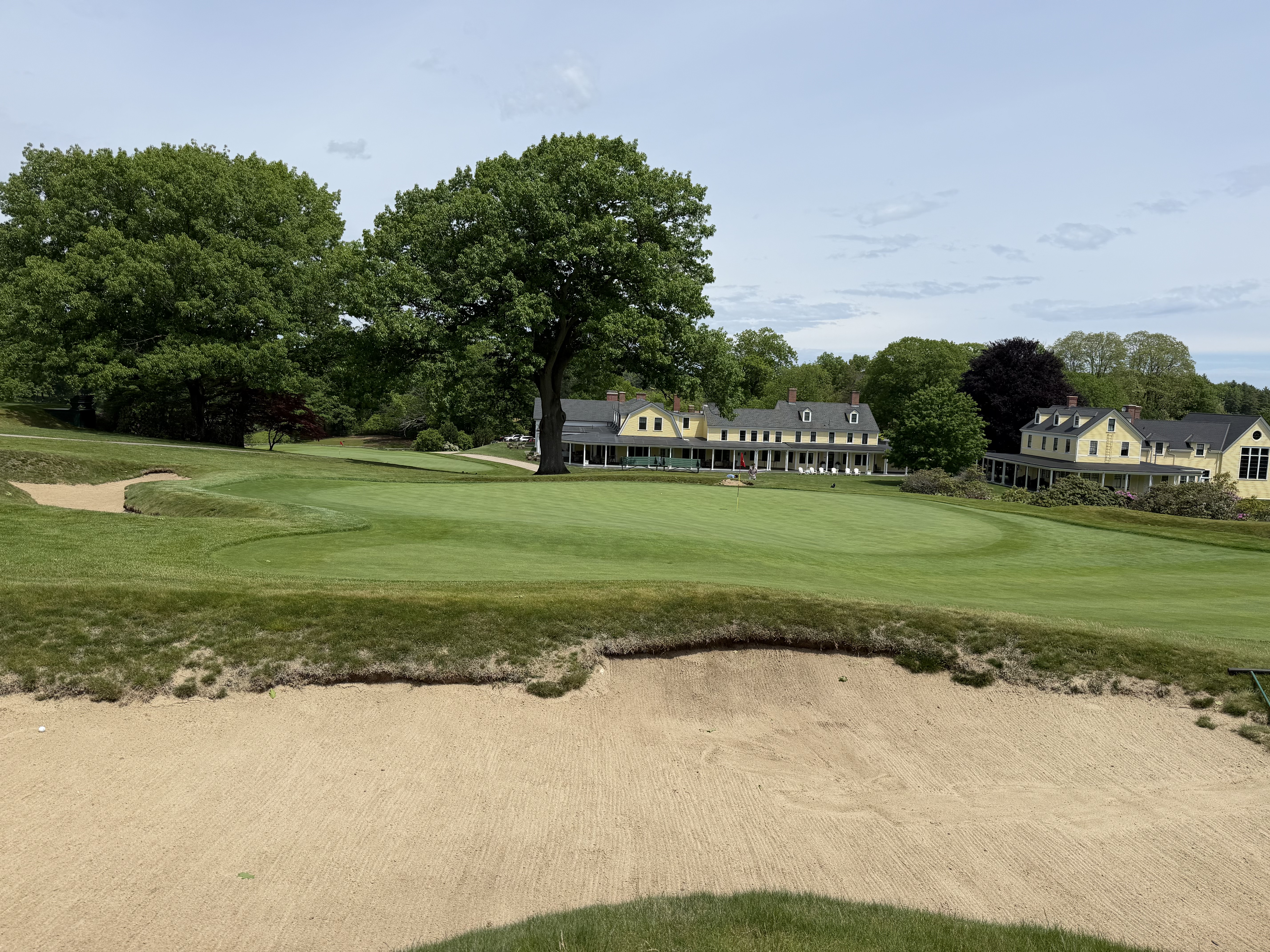
Clubhouse/Pro Shop: A nice, understated colonial revival, such style also present at the clubhouses of Garden City Golf Club and National Golf Links of America.

Practice area: Driving range and putting green from what I saw. I’m sure short game is practices some where as well.



You must be logged in to post a comment.