6,450 yards, 133 Slope from the Blues
A few months removed from all the Scotland, I started to miss those links. The endless horizon, the guessing where to hit, the freedom out there. Apparently, I’m not the only one with the longing of the links after some time in Scotland. There’s a long history of those in search of what they found there over here. Ask Findlay, ask Macdonald, ask Ross, heck even ask Dye, ask countless others. Fortunately, there are places in the States one can go and get a sense of it. Long Island is surely one of these places. The variety of links one can find along her coasts is especially fascinating. Rockaway Hunting Club is among the older courses on the island. It claims to be the oldest country club in the United States, organizing in 1878 with a clubhouse, polo field and steeplechase course. There are some inclinations as to its history in golf, with differing accounts on the club website and yardage book. Golf began at the club when Horace Hutchinson routed some holes in 1888, Then John Reid of St. Andrews Club finalized nine holes in the 1890’s. This eventually was turned into an eighteen hole course by Tom Bendelow in 1898. During the 1920’s (1916 according to the yardage book), Devereaux Emmet made significant changes to the course by re-routing and expanding on to the peninsula along Reynolds Channel that now houses the Seventh through Fourteenth. In 1926, Tillinghast re-designed Emmet’s work and created the holes on the other side of the bridge. Perry Maxwell was then retained in the 1930’s and built the Sixteenth as well as designed the current green at the Fifteenth. After the steeplechase course closed in 1939, that area was used for golf holes, which is now where the First, Second, Seventeenth and Eighteenth reside. The yardage book indicates, however, that Perry and his son Press did ongoing work here in the 1940’s and 1950’s. The course received a smart refresh in 2009 by Gil Hanse and Jim Wagner, whom restored many of features inherent in the links identity of the course. This included tree removal, expansion of waste areas, reintroduction of fescue, green expansion and renovation of the bunkers. Hanse performed further restoration work in 2016. Or 2015 according to the yardage book.
While some may yearn for Scotland, Long Island has a distinct feel of its own. That feel was prevalent here throughout the round, meaning the course could not exist any where else. The routing is extraordinary. The use of confined space, some rolling hills near the clubhouse and especially the water channels bring on a dazzling display of variety. On a relatively calm day, it was one of the rare courses I started praying for wind since I had a feeling everything including the variety is amplified tenfold when the wind is up. That was confirmed by my caddie and the members I spoke with. Recovery character is yet another area it shines. In all, it’s the kind of course I wanted to go right back out with what I learned and also just to experience the transitions in the routings. That distinct Long Island feel exudes its own kind of links that is rooted in its own history, all of it soothing and rousing the golfer in comparable tones of Scotland, yet its individuality will not be denied. That individuality hit with a sense of comfort as I was on the First tee overlooking the horizon with the tidal marsh land beyond the hole and Brosewere Bay further on. It would be a day of adventure, peace and intrigue, some where else to yearn in due time for reasons all its own.
The First is a 343 yard par 4 (from the Blues). The downhill fairway leads towards the tidal marshland and the green straightaway. It is off to the sides with the trouble, large below ground bunker complexes with surprising reach in seemingly every direction. The green is deep and moves front to back with a similar bunker scheme off to the sides and rear It seems so simple yet forces unknown make it more difficult than it really should be. Just hit it straight and account for the roll towards the bay.


The Second is a 383 yard par 4. The bunkers off to the left of the first are now in more full view to the right from the tee. It actually encroaches on the fairway, suggesting to the golfer he should move to the left off the tee or lay up short of the whole affair. Or carry all of it for heaven’s sake. Just know there is a series of them and carrying the first is not really any kind of accomplishment away from the trouble. The green is widest at its front while the below ground bunkers loom to the sides here too.


The Third is a 178 yard par 3. A smaller green surrounded by bunkers, seven of them to be exact. There’s a center line bunker at the front apron and one can find som room around it short of the green but otherwise the golfer will likely find the green or sand. With the sharper, steep lips of the bunkers, choose green.


The Fourth is a 450 yard par 4. A dog leg left coming closer to the green and a rare fairway beset by trees lining both sides. There is some bunkering on either side and then a bit more elaboration just before the green on the right but otherwise a good amount of room to maneuver with the left side opening up the green a bit more. The First and Second provided a preview of the course setting with the inland parkland holes transition yet one can’t help but think there is a build up before getting to the water.


The Fifth is a 159 yard par 3. Impressive economy of space with this green just paces behind the green prior. The tee is then off in the trees to the right of the hole prior. The slender green is on the other side of bunkering from the Fourth as well as a couple bunkers fronting this green. The green is widest in the middle, then a good amount of space at the rear. It’s a good time for precision, as the road surrounds very closely at the rear and right sides.


The Sixth is a 539 yard par 5. The horizon opens slightly as the build up to the water continues. The hole dog legs to the right off the tee, then we casually notice the left side drops in to the Woodmere Channel. The second shot brings up an assortment of decisions, mainly as to how much of the fairway to take on to the green. There’s some width but there’s water open to the left side through the green and the right side has unfavorable rough. The green has a lot of interest with the lithe bunker on the right and the one on the left interrupting the great apron running into the green on that side. The larger green may encourage golfers on that second shot to go for it but precision and position need to prevail.
As the golfer walks off the green so focused on the task at hand and at that green, he realizes the water and horizon has snuck up on him and is in full bloom, finding himself in the middle of a vast expanse.


The Seventh is a 385 yard par 4. The expanse before the golfer, he must now carry the channel to reach the fairway on the other side. How much of the channel on decides to take on off the tee depends on tolerance to risk and of course, the wind. There is a bunker on the left to avoid but otherwise hitting the fairway is paramount. A well hit tee shot means a rather straightforward approach with any trouble off to the sides, including water running down the entire right. There’s a ridge running across the middle of the green to take note of depending on pin position, as one should endeavor to get on the side of the ridge the pin is on to put the flaststick at ease.


The Eighth is a 344 yard par 4. Now officially, “across the bridge,” these are the holes that Tillinghast was primarily involved with. Water remains to the right which bears mentioning since the green is set on that side. The fairway narrows considerably just before the green, which necessitates an aerial carry on most every approach. Bunkers crowd the front of the green as well, which is deep and narrow. One can favor the left to make sure the water is not met but recoveries off the left side can be treacherously perilous with the water so close on the other side.


The Ninth is a 453 yard par 4. The holes on this side of the bridge are on a peninsula, Woodmere Channel on one side and Brosewere Bay on the others. It would be easier to lay the holes out straighter for economy but instead, the routing chose to have the holes twist and turn and triangulate, which excites the wind scenarios as well as the game of angles for most every shot. There are dog legs, then there are cat legs. A couple of the holes on the peninsula are cat legs and this is one of them. The fairway cat legs to the right while the water stands as sentinel menace on the right. Bunkering at a couple spots on the left need to be avoided while the entry point to the green is nice and inviting. Staying on the fairway while avoiding the perils of the sides is a circumstance of natural elements along with whatever mood the golfer’s swing is in.


The transitions between water and inland are a play on gradualness and suddenness while the holes remain varied at both the fairways and greens. I would rank them 6, 8, 9, 7, 2, 5, 1, 3, 4.
The back nine starts with the 317 yard par 4 Tenth. A short par 4 where decisions must be made off the tee. Driver is possible but the golfer should really favor control over anything else as it gets troublesome off to the sides very quickly. Bunkering gets more articulate near the green, while the green itself is on the smaller side. This is a shorter hole to set up a comfortable approach and then execute that shot. There is not much room or incentive to get close off the tee, unless the golfer prefers a second shot out of sand. With fescue and tufts of natives about off fairway, sensibility wins over here.


The Eleventh is a 410 yard par 4. We enter into an interesting set up and can see a fairway running across from the right. The tee shot seems like an on ramp as we do our best to merge on. An angle needs to be figured out here that accounts for length of the tee shot and roll so that the bunkers ahead are avoided. The fairway widens after the bunkers and runs right into the green, slightly uphill and a bit deep with bunkers at the sides and rear. The tee shot determines all here.


The Twelfth is a 567 yard par 5. We now use the same fairway as the hole prior but further down past the tee shot on that hole. Clever efficiency. One of the more elaborate bunkers on the course is off to the right and could pass for a Great Hazard that Tilly was so fond of, it comes into play for those who want to try and cut the bend to the right on the second shot. What sets this hazard apart from other Great Hazards out there is it can be avoided altogether if the tee shot is long enough, in which case the golfer can simply go around it. After the turn, the fairway moves straight to the narrow, deep green where a few bunkers short and at the front do their meddling. A lot of the greens here emphasize depth over width, allowing either longer shots or those utilizing the ground. This prevailing characteristic also means that the more offline the golfer is, the more exacting he will need to be with the recovery to the green. All the more reason to favor conservative control over a more reckless length.


The Thirteenth is a 391 yard par 4. Here, we head inland, the fairway cat legs to the right more than anything. One will likely notice there are no bunkers to speak of. The mounding and fescue are enough to deal with off fairway, especially if one misses to the right. The green is kind of lops over to the left but is of a nice size. Its configuration naturally favors an approach from the right, which seems counterintuitive from the tee. Those who manage to stay to the right off the tee are rewarded appropriately while those who opted for the left may need to shape their approach a bit. All dependent of course, on the wind.


The Fourteenth is a 228 yard par 3. Our time on the peninsula has come to an end, the final shot carrying the channel to the green that is on a point of sorts, surrounded by water on the left and rear. There’s a generous front apron to work with for those who want to focus on carrying the water and staying dry, along with an inviting entry point. For those going for the pin, bunkers are all on sides of the green, shrinking the window of acceptable shots even more than the water does on the out layer.


The Fifteenth is a 330 yard par 4. Another short par 4 as we start to transition back into the trees. There’s an interruption of fairway about 250 yards from the tee which forces the golfer to decide between trying to carry it or lay up short. There really isn’t much of a different whether one ends up after the interruption or before it; a short approach awaits either way. The overarching concern is landing in the fairway and bear in mind the more right one goes, the more the green opens itself up. The green runs back to front and is pushed up from the fairway. One can tell there’s some slight differences in tone with this hole compared to those on the peninsula, mainly with the character of the green. Here, the green is a bit bolder with defined contours and less subtle. A precise aerial approach is needed as well. One could say that with the transition in setting, so too is the playing style.


The Sixteenth is a 153 yard par 3. Great use of a small corner of the property and while there is a measure of space vertically, there is not much tolerance for horizontal misses. A large short grass apron is part of this, with bunkers then standing in the way of the green on the entire front. A fairly precise aerial shot is needed to clear the bunkers, land on the green and avoid Albro Lane immediately at the rear. It should be noted, however, the green gives us width, a rare gift yet we will gladly take it here.


The Seventeenth is a 440 yard par 4. Now back on the old steeplechase track and next to the driving range, the hole heads downhill then makes a long turn right to the green below. Bunkers, then the range, are on the right side and are what stand in the way of those trying to cut the turn for a shorter approach. Those opting to go straight out need only make sure that they do not run out of fairway and end up in the rough on the left. The fairway moves down and to the right to the green and the green follows that movement, all of it heading towards the tidelands. Either side of the fairway can take advantage of this movement in different ways. Those on the right can use it to move towards the green while those on the left can use it as a backboard of sorts to check their approaches in place. The tee shot is the more vital and with its blind components, wind and configuration, take a bit of learning for the golfer to calibrate to his liking.


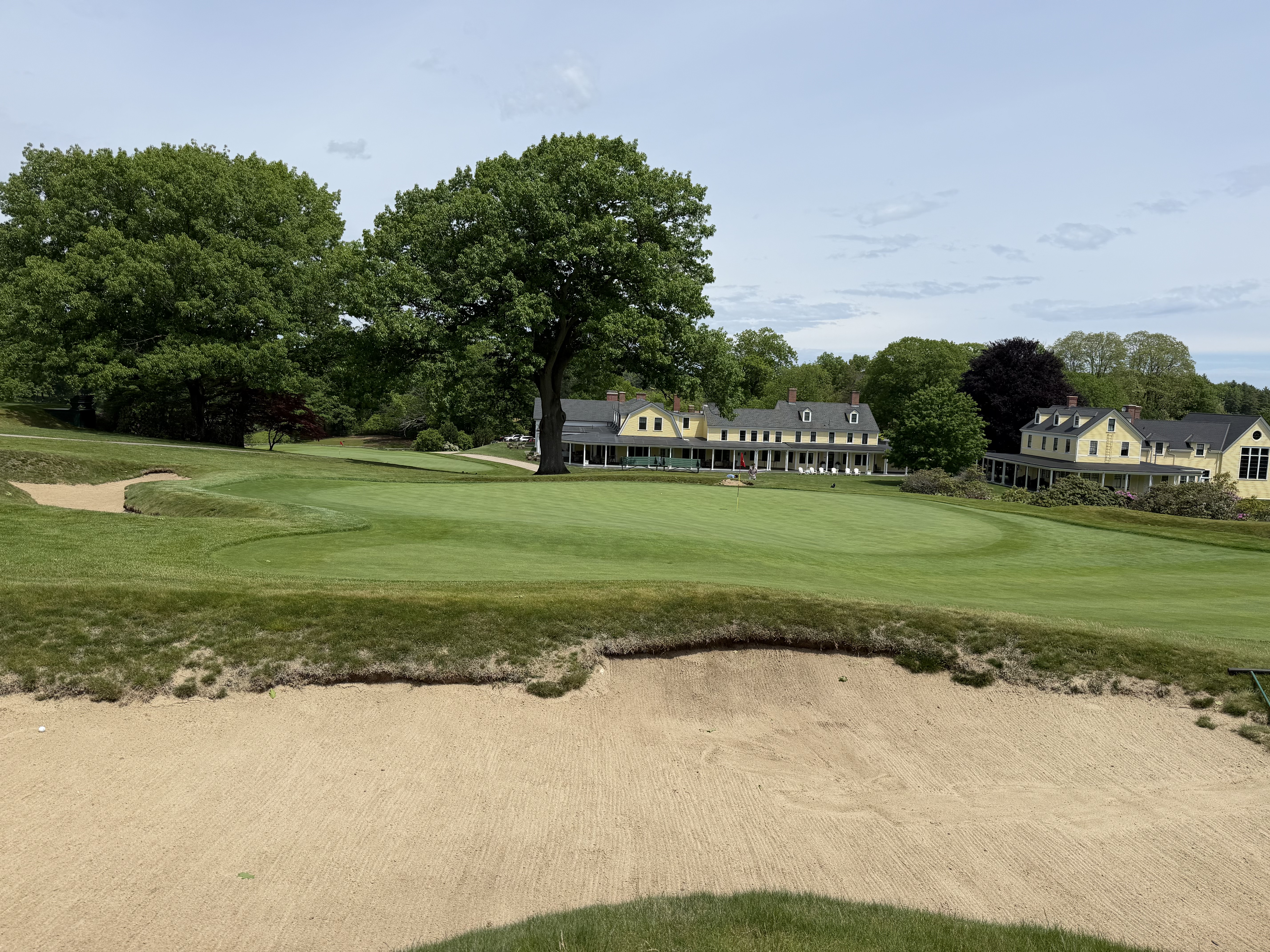
The Eighteenth is a 382 yard par 4. The routing neatly brings us back alongside the First, heading up to the clubhouse. There’s a bit of shift to the left off the tee, a bunker on either side of the fairway to contend with. After those bunkers, the fairway continues uphill straight to the green. A center line bunker protects the green at the front, then the entire rear is lined with them. Large and deep, the approach certainly should not go long. The center line bunker may goad the golfer into a more aggressive approach yet he should consider the entrances off to the sides. A bit of refreshing width to work with and one last look at the bay before the round concludes.


The back nine continues on the peninsula before finishing up the steeplechase track to the clubhouse, a nice mixture of par 3’s and 4’s fitting into their corresponding setting. I would rank them 17, 13, 12, 18, 10, 14, 11, 15, 16.
Generally, Rockaway Hunting Club melds with its surroundings, which includes its structure of play. The parkland holes favor a more precise aerial game while the waterway holes favor more strategy and options, including an array of ground shots. The variety throughout the round is striking, which is significantly amplified when the wind comes calling. All of it makes the golfer think. This includes the parkland holes, where setting up the approach comes to the forefront in priority a bit more. This design indeed exudes a distinct Long Island energy. There is the freedom of the links here in its own style along with a few more layers the golfer will face here and no where else. Faced with walking the terrain and handling each transition, it is the type of escapade the more substantial golfer searches for and appreciates.
Clubhouse/Pro Shop: Fitting in well to the landscape with its history and symphony of creaks from the wood, overlooking the bay.


Practice area: Full driving range, putting green next to the First the and short game area to the left of the Third.



You must be logged in to post a comment.