The Double Down means there’s enough happening this year for a two-part series. Part I https://golfadelphia.com/2025/01/16/double-down-on-the-new/ touches on new construction openings for the most part while Part II gets in to a lot more. On with it.
New Renovations, Restorations, Redesigns and any other Re
Cobbs Creek Golf Club
Golfadelphia has obviously been monitoring closely. My Yelp review of the course in 2009 or 2010 (I forget) was technically my first course review ever and my friend telling me he actually thought it was legitimately good was the impetus that started the ball rolling, where that thought grew and grew, until finally I started with a word document just sorting my thoughts on several courses before finally turning it into something else, Cobbs Creek is two shakes from where I live and some where I would visit often. My last round was just before the pandemic shutdown, where me and one other moved along without knowing when our next round would be. The course shut down shortly thereafter and never re-opened. It has been an eventful adventure ever since. As it stands, however, the project has three phases, each of which will open in respective years. This year will see the opening of the Tiger Woods Foundation sponsored TGR Learning Lab, a short course designed by TGR Design and a whole golf entertainment family center. 2026 is when Hanse and Wagner’s restored Cobbs Creek’s Olde Course will open, based on original design plans uncovered by Mike Cirba and Joe Bausch and reclaiming land parsed out over the years to the military and to build a second course on the property. Then in 2027, a new nine-hole course will open. I believe the Olde will be able to utilize parts of the nine hole course to stretch to sufficient distance to host professional tournaments. This will be a monumental achievement for public golf. Some call it the Public Pine Valley and they may not be wrong. There will be much much more on Cobbs but for now, ambition and anticipation are high as we wait with bated breath.
Baltusrol Golf Club – Upper Course
A.W. Tillinghast’s “dual courses” concept consisted of envisioning the Lower and Upper courses being equal in stature. The Upper would be rooted in the hills and into the side of Baltusrol Mountain while the Lower would take the lower lying terrain. The dual course concept is something Tilly felt strongly about and tried to implement at a number of his sites yet rarely succeeded in its implementation. The two courses were to be of distinct personality following the cues of the land upon which they were set, which meant the Upper would be more visually flamboyant and exciting with its more extreme undulations while the Lower is more subtle, strategic and stays deceptive until the closing duo where the challenge is much more direct. Gil Hanse has undergone a sympathetic restoration of the original design intent of Baltusrol, first with the Lower and now with the Upper. The greens now have PrecisionAire and have been expanded while the hills and slopes are now more in play for strategy and options. The restoration vision of the club will finally come full circle with the re-opening of the Upper, with the courses closest to Tillinghast’s character in a long long time.
Wilshire Country Club
Wilshire is continuing with their renovation efforts. In 2010, Kyle Phillips was retained by the club to restore the bunkering and greens much closer to their original design intent of Norman Macbeth. The project was a resounding success. Instead of standing on ceremony, however, Wilshire realizes there is more to be done and aims to update infrastructure of irrigation, drainage, tees, bunkers while tending to the wonderful menacing barranca. The central strategic importance of the barranca will be addressed, as well as reducing the flooding issues that arise with the winter storms. Fairway, green and tee expansions will also take place, including at the Third green to its original size, the Fifth green will now wrap around the barranca, the Eleventh green will be a carry over a widened barranca in that area as envisioned by Macbeth, the Eighteenth green will be returned to its original configuration as much as possible while the tee for the Sixth and Ninth will become unified. The greens will also be re-grassed to Bent. The club should be applauded for continuing down this path and as one of my favorite courses in the LA area, look forward to seeing it while a bit scared to confront that barranca in its renewed, ferocious form.
Speaking of L.A., I feel compelled to mention the utter widescale fire disaster that has raged on for over a week as of this writing. I grew up in Pasadena with family and friends still there and about Southern California. They are all safe at this point but I know several who have lost their homes, their lives upturned. For a while, we thought the cemetery where my grandparents were buried had also been destroyed but it now appears to be right on the fire line in Altadena. The Santa Ana winds have always coursed with fury through Southern California but had reached up to 100 mph with these fires, allowing them to spread quickly and randomly. The fires continue and perhaps they will be at an end by the time you read this but vast parts of Southern California will be forever changed from this unprecedented tragedy. The people, places and memories growing up of Los Angeles have been in my thoughts and prayers often recently and will be for quite some time.
Jekyll Island Golf Club – Great Dunes Course
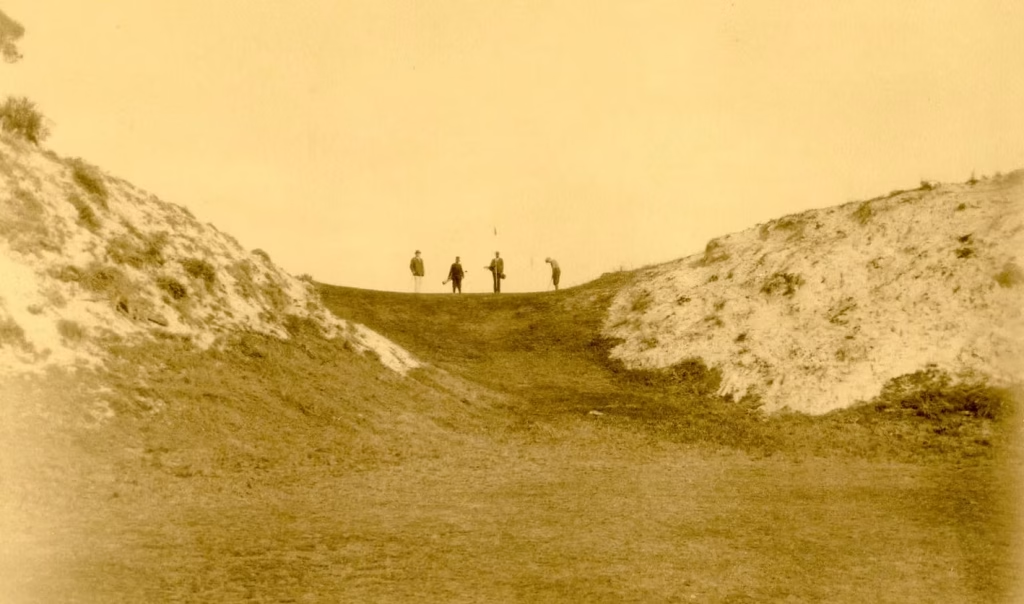
Just below Sea Island is Jekyll Island, where its namesake golf club houses three full length courses along with a nine hole course that was originally designed by Walter Travis (Great Dunes). Brian Ross and Jeff Stein are now restoring the Travis nine holes as well as incorporating nine holes from an existing eighteen hole course (Oleander) that they will transform into the Travis design spirit. The remaining nine holes of Oleander will ultimately be reverted to their native setting for the enjoyment of the public with nature trails. The Jekyll Island Authority maintains archives of the course, which Ross and Stein have been able to use in the restoration that show the holes with their original design. They’re also doing something quite honestly I wish every golf course would do; replacing the asphalt cart paths with more natural paths. The project will ultimately beget a restored yet new Travis design while enhancing the natural elements of the island, all within the same footprint as the existing golf infrastructure. An exciting project in a spectacular setting and Walter Travis. A very much anticipated public project opening, this fall.
Poppy Ridge Golf Course
Livermore. Another lifetime ago, they were our rivals in cross country. We would run against them in all of the bigger state invitationals, our coach harping on us how deep their team was. In fact, one of my first interactions with a golf course was the Stanford Invitational, our racing route set on the Billy Bell design. I remember it being fairly hilly for those years we would travel up there, searching for those Livermore jerseys, hunting them. The town name still gets me. Yet it’s the locale for Poppy Ridge, a 27 hole club that Jay Blasi re-routed. It was three separate 9 hole sets before but Blasi has focused on routing a cohesive 18 hole course, then a separate 9 holer, both of which are now much more walkable. An update of the irrigation system precipitated the wholesale changes while the course will be re-grassed with more drought resistant Santa Ana Bermuda, the greens are seeded with a new bent grass variety and the off fairway areas with fescue mix.

Lake Oswego Municipal Golf Course
The City of Lake Oswego lies just southwest of Portland and funded a re-design of the par 3 18 hole course into a new nine hole course, plotted out by Dan Hixson. The course follows the rolling land and is comprised of gentle shouldered slopes where a meandering creek sharply inserts itself just a touch and the ball has freedom to roam upon the ground with fescue used for off fairway. There are only four bunkers total. Tree work opened up the surrounding scenery as well. A sustainable layout evoking serenity with thought provoking, long and low movement, the changes to the course were meant to attract more novice golfers and provide a more enjoyable playing experience. A refreshing re-design and concept, these are the types of public projects I’ll never grow tired of writing about.

Morris County Golf Club
Jaeger Kovich performed restoration work to this Seth Raynor gem last fall. It appears the Seventeenth Eden was all that was worked on, the finished product shown below. The bunker walls looked to be re-worked more sharp and steep while there also looks to be more assorted movement spread out amongst the hole, instead of the dominant right to left that ceded to the hillside before. Such changes are consistent with its original form. Kovich has been known for his thoughtful, well researched work primarily throughout the east coast and with my penchant for Edens as the unsung hero of template holes, the renewed hole should elevate the course even more. We’ll monitor if any other work is on the horizon.

Oyster Harbors Club
A Donald Ross designed course on Cape Cod known for its greens, Gil Hanse focused on restoring the course to its original design plan while updating course infrastructure of irrigation and bunkers while re-designing the practice area. The course was worked on in the past by Doak and has remained intact for the most part, so Gil’s work should enhance its natural original character. This is a course I have had on my list for quite some time and now all the more reason.
Corica Park North
A few years ago, Corica Park South was written about by me as a notable renovation by Rees Jones of this municipal course originally designed by William F. Bell. Rees, with Steve Weisser, were able to sand cap the course and used material from the old Raiders stadium to cut down on costs, which revitalized this 45 hole complex. Now, RTJII, Rees’ brother, along with Marc Logan, have imparted massive undulations to the originally flattish site by using volumes of sand from San Francisco projects. The North is inspired by Golden Age designs, with a few template components and sod faced bunkering, all of it meant to play firm and fast. Public golf as a community hub, 45 golf holes revitalized in fun, strategic tones yet distinct design styles. And by the Jones brothers.

Cincinnati Country Club
Some times, an update on infrastructure allows a club to hit the rest button so to speak and impart as much change as they want, which can lead to a complete transformation. Michael Hurdzan is doing quite the redesign here with the aim of improving the overall course. The Robert White design will undergo lots of change, with a complete regrassing, green surrounds melding into newly built teeing grounds, bunkering installations and new fairway shaping, as well as some green work. Lots of earth is being moved as well, all to improve strategy and all around engagement for every class of golfer. The course will thrive in firm and fast conditions as well. The club and membership have put their trust and are working closely with Hurdzan, and rightly so. Well versed in firm and fast, an almost brand new course awaits, scheduled to open this year.

The Hideaway
A 36 hole club in La Quinta sporting a course designed by Clive Clark and the other by Pete Dye is in the midst of a $50M renovation, touching on almost all aspects of the facilities, including both courses. Tim Liddy and Clive Clark himself are leading the efforts at the courses, with both undergoing irrigation upgrades, new greens and the Dye course will undergo greenside bunker changes. The work is characterized as “enhancements.” Work to Dye’s courses is inevitable and we’re starting to see it take many forms. Here, the focus is on improvement as well as a touch of refresh at one of the more renown clubs in the area. And then Clark touching up his own work twenty-three years after its opening allows him the opportunity of time and study. The comprehensive project should be completed by December.

Maggie Hathaway Golf Course
Directly next to LAX at the corner or Western and Century in Jesse Owens Park is this nine hole par 3 course, in existence for just over 60 years and providing access to the game with its reasonable green fees. More than $8M has been raised by The Fore Youth: 2023 U.S. Open Community Legacy Campaign, which is led by the USGA, SCGA, and LACC. The City of Los Angeles is contributing almost as much, which will renovate the course, create a new clubhouse and enhance the junior programs available to unrepresented youth. The goal is to remain an accessible outlet for the game while becoming a destination spot for youth. Originally named the Jack Thompson Golf Course, it was re-named after Maggie Hathaway in 1997. Hathaway was a singer, actor, civil rights activist and golf enthusiast. She became interested in the game when she lost a golfing bet to boxer Joe Louis in 1955 and began writing about the game for a couple newspapers. She established the Minority Association for Golfers in 1963, which advocated for young black golfers who wanted to work in the golf industry, as well as the Beverly Hills/Hollywood branch of the NAACP, which she co-founded with Sammy Davis, Jr. She was a fierce advocate against segregation and a top rated golfer, passing away in 2001. In a larger sense, the project aims to further her principles. The golf course and driving range work is scheduled to be completed this fall while the new clubhouse will be further along the horizon.
Shorehaven Golf Club
In Norwalk, Connecticut near the Long Island Sound, Shorehaven sits almost directly across Huntington Country Club in Long Island. Willie Park, Jr. and Robert White are responsible for the original design, which really has not undergone all that much work over the years. Enter Blake Conant, who was tagged to impart restorative work, incorporating its views of the marsh and bay and taking advantage of its hoisting elevations with green expansions to recovery lost pin positions. The greens are mostly original in their wild steeped pitched state. Conant is also rebuilding bunkers with some re-positioning and changes to some of the holes, such as the Eighteenth bringing the marsh closer into play and the Sixth as a drivable par 4, imparting some equalizing strategy into it. Having benefitted from work Conant did to my home course, this is one that should be exciting to get to once open.
Philadelphia Country Club
The William Flynn classic opened in 1927 and hosted the 1939 U.S. Open in which Byron Nelson won in a playoff. It also hosted the 2003 U.S. Women’s Amateur and 2005 U.S. Amateur Championship. This course is sheer refined elegance and realizing it would benefit from a refresh, retained Jim Nagle. Infrastructure in terms of irrigation and drainage are being updated, then the plenary material from the 1939 U.S. Open are being used to restore the course as close as possible to that iteration. The front nine was completed last year and the back nine is scheduled to open this spring. Restorative work from aerials and photographs of the U.S. Open tree work, regrassing, fairway widening (and rough reduction), tee revampment, bunkering and new fescue and sand green surrounds are all part of the project. The Eighteenth is also being rebuilt to return it to a more Flynn-esque style, as it was re-designed in 1955. Nagle took inspiration from the Sixteenth at Shinnecock and the original Fifth here for the re-design. The completion of the work will mark the first time the course will all be compromised of the same grasses and materials. The course will then have a season to settle in before it hosts the stroke play portion of the 2026 U.S. Amateur Championship.

St. Davids Golf Club
We stay in the Philadelphia area at this Donald Ross design, where Tyler Rae started some exciting work in late fall last year to the greens. The club is in the enviable position of possessing the original Ross green sketches from 1926, so Rae will be restoring the sizes, shapes and expanded corners of the greens in what is being called Phase I of the project. The sketches are jaw dropping. Phase II consists of a full on restoration. The greens, as well as Phase II, lie in wait and we anticipate nothing but magnificence from Tyler.

Internationally New
Golf courses abroad are seeing an uptick along with everything else. The below are a small selection of notable projects but in general, Vietnam has approximately eleven new courses, the majority of which are being designed by Nicklaus, Norman, then other tour pros Els and Faldo, as well as veteran designer Brian Curley. Indeed, Nicklaus remains busy with other international projects in the Philippines and even Greece. Mexico has a lot of openings as it seems to most years, with even Doak getting in on the action with two projects in Baja, as well as TGR Design with a second course at Diamante. All of the courses mentioned here are within vacation resorts, public and private. Finally, 7 Mile Beach in Tasmania was featured in last year’s “Return of the New.” It is opening this year as I keep trying to figure out how to steal some time to get down there and have a look-see. There are also numerous international renovations and rebuilds, with most taking place in Australia. I see this section growing in years to come.
Cabot Highlands – Old Petty (Scotland)
In Inverness, Scotland, Tom Doak gets a second project in the home of golf within the Cabot portfolio. The location adjacent to the bay features rumpled ground but as Derek Duncan of Golf Digest points out, the terrain is not characteristic of links land, which will require a bit more imagination from Doak. As seen below in the routing, Doak is certainly up to the task as the course utilizes parallel holes with wide crisscrossing fairways and a series of turns in one primary direction or another to focus on a constant fluctuation of width and shared hazard complexes and fairways. Doak’s vision is a return to an old true links-style course, which will sit with Castle Stuart as the Cabot Highlands courses. Opening late fall 2025.


St. Charles Country Club (Canada)
A 27 hole club where nine holes were designed by Ross in 1919 and nine holes were designed by Mackenzie in 1928 (the only golf holes in Canada designed by Mackenzie). The third nine was designed by Norman Woods and redesigned by Keith Rhebb and Riley Johns. Jim Urbina was tapped to restore the Mackenzie nine holes in 2022, which focused on restoration and expansion of greens and fairways, as well as work to the bunkering. Urbina then started work on the Ross nine in late 2023, again focusing on restoring greens, fairways and bunkers while irrigation and drainage were upgraded, just as they were on the Mackenzie nine. The third nine is being re-designed by Johns and Rhebb. The third nine is being designed as a homage to Stanley Thompson, once again also focusing on the infrastructure upgrade. The club is looking to return to their wonderful historical roots while renovating, striving to be the best course and club possible.

The Macleod – Trump Aberdeen (Scotland)
Martin Hawtree, Christian Lundin and Christine Fraser are involved in designing the new course at Trump Aberdeen, which will now have 36 holes. The land upon which the Macleod is being placed consists of craggy coastal terrain against the North Sea, sandy dunes and even heathland areas. These different landscapes will be interwoven into one strategic fabric. The course has ambitious intentions to some day host majors, yet also claims to be one of the more sustainable and environmental friendly courses ever built. Opening is expected to be summer 2025.

Glendhu Golf Course (New Zealand)
The South end of the South Island of New Zealand, Lake Wānaka lies at the foothills of Mount Aspiring. A residential development along with a golf course are in the works for opening this year. And yes, housing developments are back in full swing, back in the U.S. and globally. There is more respect for the golf course having more central significance and, well, most of the projects are on gorgeous geography. Glendhu certainly has gorgeous geography and the course is being designed by John Darby, who was the architect behind famed Jack’s Point, Milbrook and The Hills. The course will follow its cues from the land while it should be easy enough to accentuate the blessed setting in both structure of play and with long drawn out views. The course is intended to be a significant addition to the Queenstown golf scene, perhaps it’s time to hop on zillow.

The Inspiration Club (England)
The course technically opened last year but we’ll discuss it now since it was missed last time around. In West London, 5 miles from Heathrow, the course managed to find an area of respite. The course was started, routed and much of the earth initially moved by the Menai-Davis family, who also developed The Shire, which is in North London. Mackenzie and Ebert then become involved for the fairways and greens, with Mackenzie taking primary lead. Mackenzie fine tuned and sharpened things, including aspects of the routing. Links features dominate throughout, which include very good bunkering that occasionally veers into bold, maybe even provocative waters. A pretty good design with a fairly reasonable green fee open to the public so close to London proper (and the airport for us across the pond), it’s good to know Inspiration is never hard to come by now in London. I just couldn’t resist on that one.

The New Short
Short courses short courses short courses. They are multiplying like rabbits. Ideally, they can be an engaging, casual briefer time golfing that sharpens one’s scoring clubs. They can also give families and younger ones a more accessible arena for the game. A good short course, however, is a lot more difficult to construct than it seems at first blush. And as these short courses pop up every where, it will become more and more challenging for those of distinction to arise. Nonetheless, let’s take a look at what’s on tap this year. It bears mentioning as well that most of the new projects mentioned in Part I will feature some type of short course upon opening as well.
It was mentioned in Part I, but Davis Love and Scott Sherman will be constructing a 10-hole “approach and putt” course inspired by Alistair Mackenzie’s designs for such a course at Augusta National that was never built at Hazletine Golf Club. Love and Sherman continue on, however, constructing a comprehensive practice facility for The University of Alabama, which will include a nine hole par 3 course rich with versatility, so that the college players will be able to hire their skills as many ways as they can imagine. The practice facility is ambitious and one of the most comprehensive in the country. It appears the course and facility are named, The Reserve. Big Cedar Lodge will be opening an 18 hole, par 3 course named Cliffhangers that yes, will utilize soaring views that are aplenty at the property and was designed by the owner, Johnny Morris. The course will play adjacent to Payne’s Valley and in part will feature a limestone cave. Ape’s Hill in Barbados recently opened a nine hole par 3 course named Little Apes that replicates some of the better known golf holes, such as the Seventeenth at TPC Sawgrass, designed by Ron Kirby. Likewise recently opening is Spanish Peaks in Big Sky, Montana, which is a ten hole par 3 course designed by the late Tom Weiskopf and his partner, Phil Smith, which is named Tom’s 10 and evidences the design principles he and Smith utilized on their projects together. Rees Jones is adding a nine hole par 3 short course called, The Shoe at Golden Horseshoe in Virginia, which will reimagine some of RTJ’s Spotswood short course that used to be adjacent to the Golden Horseshoe resort. Bossier, Louisiana will be housing a new golf entertainment venue called Chasing Aces, which will have a putting course, state of the art driving range and a nine hole par 3 course designed by Lee Marshall and Justin Carlton, who are focusing on synthetic turf a sustainability along with strategy. The inland empire of Southern California in Chino will house a similar golf entertainment venue, Degarmo Park, which will feature a nine hole short course and other community amenities such as soccer fields. The course will be designed by Celebrity Greens. Finally, Chester Valley is adding a six hole short course designed by Jim Nagle, the holes ranging from 50 – 125 yards.
Impressions on all of this
There seems to be a few paths to greatness as far as golf courses are concerned. Groundbreaking revolutionary never before seen design is one. Excelling for some magnificent reason or another with an already well established design framework works from time to time. A corollary to this is Coore’s concept of finding distinction and greatness within differing arrangements of the same design style; outstanding symphonies so to speak. And some times, simply doing the right things with an absolute ideal piece of property is enough to achieve. Thoughtful and vigilant care, attention and evolution of a course over time can grow into greatness as well. There is also a return to the long forgotten, resurrecting some style or feature so that it feels new, maybe even instilling a different interpretation to it. Perhaps there are others. Time, however, is the true measure of greatness. Time always helps with these things and while we may or may not be in a renewed Golden Age, only time will tell whether the golf courses born within it will be considered great.
Course development and architecture are currently humming. Everyone is as busy as ever, with even Coore & Crenshaw taking on more projects a year than ever before. The more veteran architects are finally in a period of time where projects abound and their demand has skyrocketed, despite all of them intimating they’re at the tail end of their careers. They have the experience to remain efficient and ensure each project receives the attention and craft they’re known for, although it will be interesting how these projects distinguish themselves and if they show any signs of design evolution within their respective career arcs. Destination golf dominates new construction as new and interesting land is used while all forms of strategy and Golden Age principles are emphasized. Meanwhile, a new generation of architects are finding their footing and are more likely to push current design trends. Candidly, some of these projects have been very tight-lipped about specifics or even concepts about their courses. This, in contrast to other projects that have mastered utilizing social media throughout construction and development to raise awareness and knowledge, is worth exploring. Perhaps they’re allowing the projects time to develop and breathe before attempting to communicate their identity, or using secrecy as some exclusivity ploy as a way to increase curiosity and interest. Who can say, but hopefully more comes out on some of them for posterity sake.
Most all projects seem to embrace the land as opposed to impose on it, which is a massive positive difference from eras past. Yes, there is still earth moving and significant construction but these mostly all stay within a naturalistic style. Personally, this is a movement I hope stays around.
We are beginning to see the lasting impression of the last few decades. Sand Hills is indeed greatness whose impact has reverberated for quite some time. Rodeo Dunes and Childress Hall seem to be within the same mold with both 36 holes instead, so it will be interesting to see how those clubs expand on or amplify the design standards set at Sand Hills. King Collins Dormer is one of the notable architects from the newer sects. Their style is indeed bold and unapologetic yet well thought out. 21 Club provides an opportunity to make an impression in a more popular golf market. Hopefully that project is progressing. One effective way to add context to a new project is by way of comparison to well known courses. I find Mapletøn’s comparison to Brora interesting and quite honestly, don’t know why other projects don’t do this more often. There are too many comparisons to the most well known courses out there; why not find a strong design with a particular course identity and use that instead? It immediately seems like they have a more focused, distinct design. TGR design is certainly on my radar as well. A number of reasons. Tiger’s design approach thus far has emphasized engaging every class of golfer, interest and strategy over difficulty as well as an abundant ground game. This is fascinating to me. It’s fairly close to the player emboldenment style Kidd has embraced and I see as one of the burgeoning design styles that really could chart new territory. Welling fits right into this, as his design at PGA Frisco Fields Ranch West showcases this style rather well. My theory is that with Tiger’s penchant isn’t just to compete; it’s to rise above and be remembered above everyone else. For course design, he’s looking for more than putting his name on a few courses. I believe he is looking to create his own path and excel at it. Speaking of tour professionals, I’d like to get more of a sense of Davis Love’s style and portfolio, which seems to be growing exponentially each season.
Lots of interesting resto/reno projects showcasing variety and ingenuity across a broader spectrum of the game than new projects. Jekyll Island is especially intriguing. More of a resto and new project all at the same time. Making bold decisions on the existing course and returning some of it back to native is rare yet should absolutely elevate the club with what should be an entirely new Walter Travis round. The same at St. Charles CC in Manitoba, which is bringing back its illustrious historical pedigree as best it can as well as creating a new nine in the style of Canada’s most prodigious course architect. It should likewise provide an entirely new golf experience while showcasing Golden Age strong points. The Hideaway is one of the better kept secrets of La Quinta, with two solid designs and now both should get even better. Liddy has done well at restoring Dye’s work and Clark gets to start in on his very own course. I may be the one of the few excited to see Corica Park. I’ve heard very good things about the South and it likely doesn’t get talked about enough in how Rees and Fazio were a couple of the first to embrace the Australian Sandbelt design structure in the U.S. The sibling rivalry between the Jones brothers is, or at least was, famous. I don’t know if they ever had adjacent designs but here, both are helping restore a public golf complex that is part of the community. And the designs are rather en vogue with current design trends. Shorehaven and Wilshire are others I’m excited about, both seem to have the right terrain and right architect. The work to Philadelphia CC virtually completes restorations to the Flynn courses in the area, with Nagle involved in a few of them. And with Cobb’s Creek in the works (of which Flynn was well involved), the Philadelphia golf scene is poised to become even better.
It is becoming more and more challenging to utilize strategic design as well as firm and fast conditions memorably. It has become such a popular playing style and is one I personally enjoy but it may be time to start incorporating other schools of course design. Are there new and interesting ways to fashion heroism and penal elements? Pine Valley is so great because of its ability to excel in all different design styles. Strategy could still be at the forefront but modified and/or enhanced with these other schools. I think some of this is coming to pass with a return to Victorian design elements as well. Exploration of this, as well as the player emboldenment style mentioned above, and innovative recovery character are some interesting paths course architecture could take in the coming years. We’ll be here watching, and playing, it all.
The time has come, the Walrus said,
To talk of many things –


You must be logged in to post a comment.