6,670 yards, 140 slope from the Black tees.
There was some rambling in the 2026 Preview https://golfadelphia.com/2026/01/13/2026-preview/about the state of today’s golfer. The gist of it was today’s golfer is more discerning than ever before. They pay attention to the courses they play and seek them out not for how difficult they are or the tournaments they have hosted or even for how lush and heavenly the conditioning might be. Rather, today’s golfer concerns himself with interest. How interesting is the course, who designed it and for what purpose and importantly, how is the walk. Courses are no longer being designed primarily to court the Tour or emulate the Tour. Instead, courses for the most part are seeking the best course possible path forward. Engagement, thought, decisions and complexity are now the virtues of priority.
This will become more evident as the public golf scene expands exponentially in an effort to meet the teeming demand that began in earnest at the start of this decade. The mega public projects are growing. Cobb’s Creek, Swope Memorial, Candyroot, Wild Spring Dunes, Rodeo Dunes; these are all names you will hear much much more of soon. While Bethpage and Torrey and to some extent, Chambers, have recently led the way as famous non-resort public complexes achieving national recognition, the intrigue with at least two of those is allowing the public the opportunity for an experience similar to the tour. One could argue Chambers was one of the more recent municipals that was able to attract the tour as well as provide a separate, engaging experience for the amateur. Corica Park should also join the discussion. Sustainable, cost effective recent renovations to both golf courses reinvigorated their allure and perhaps just as notable, became a renewed community hub for both golfers and non-golfers alike. Suffice to say, public golf can be many things to many people. As today’s golfer grows in sophistication and demand, the time has come where some of these public projects will do their best to rise to the occasion.
Enter The Park. Originally West Palm Beach Golf Course designed by Dick Wilson in 1947 that hosted PGA events in its heyday, the course ultimately closed in 2017. By 2018, the land was about to be sold when former PGA Professional Mike McGetrick brought the situation to the attention of Seth Waugh, CEO of the PGA. The land was simply too suitable for golf with its sand base and rolling undulations that were substantial for Florida. Its location was convenient enough to West Palm, Palm Beach and the airport as well, all of which led McGetrick to believe it would be worth saving and building an affordable public golf course. Waugh became motivated and long story short, was able to receive assurances from the Mayor for the public project if Waugh was able to garner private capital interest. Impressively, Waugh was able to rally support for the project and various people joined the cause, fundraising $57 million in sixty days.

Raising money is one matter, putting it to good use is another entirely. With Gil Hanse, Jim Wagner and their team on board for design duties, the board began the process of figuring out how to materialize their vision. As Ran Morrison at golfclubatlas.com writes, a questionnaire was sent to close to 100 donors and close friends asking their thoughts on what makes a golf course fun. The responses mentioned courses such as National Golf Links of America and North Berwick. Recovery options, short grass green surrounds, width and half par holes were all associated with fun. If the course was to be an appealing arm of the community, it had to be accessible and engaging for a wide ranging cross section of that community. One of the best ways to do that was to emphasize fun. A golf course can be good, interesting, engaging, even great with fun at the forefront. The Park endeavored to drive this point home.

Kingston Heath inspired the design concepts based on the terrain, which then led the bunkering and shaping with that in mind. Hanse and Wagner relied on Dirk Ziff for a lot of design help, including the routing. His general charges were to start with a par 5 to give the golfer some warm up and get them away from the clubhouse quickly, avoid a par 3 at the first two holes so play doesn’t back up and have a loop return to the clubhouse early on at each nine in case one wants to play a few holes only. Ziff followed these and took cues from the land for the rest of it. A natural punchbowl green site became the Twelfth and holes fell into place around it. The shelf at the southern end of the property was ideal for another green and became the Seventh. The First through Third was the loop on the front while the Tenth through Twelfth were the loop on the back. There are five par 3’s, which is in line with the design concepts emphasized here. In seven hours, Ziff put together a routing he was proud of, which was endorsed by Hanse and Wagner without too much revision. The Cavemen then did their thing in construction, improvising and using their talents to best express the design intent, and the course ultimately opened in 2023.
The questionnaire was one big indicator of the course design IQ of the average golfer nowadays, which helped direct the overall themes. Templates such as Alps, Punchbowl, Lion’s Mouth, Double Plateau and Redan (reverse) are presented for the golfer to enjoy as well as educate and reward a sense of comfort and familiarity to others. The course can largely be played from the ground, adding yet another layer of fun and complexity. The recovery character is rich with opportunity. Yes there are bunkers and other areas the golfer would do well avoiding but most of missing territory allows a good deal of redemption. At the Sixth, I watched as a cold shank approach dart off to the right and out of sight. I envisioned a lost ball or some kind of ensnarement I would have to endeavor to extract from but instead found my ball among native vegetation, pin high. It was a tough pitch to a green running away from me in hurried fashion but the opportunity to get back in position was there, which I was able to capitalize on. This type of recovery continues to engage the golfer, keeps spirits high and allows the good times to keep rolling. If I ended up bludgeoning the pitch shot some how, I’d realize it’s just not my hole and move on to the next. These multiple opportunities to correct misdeeds certainly help with perspective. The course flows exceptionally well and uses the occasional undulations superbly. Strategic decisions begin to mount as one gets closer to the green. It starts with the approach, where the golfer certainly needs to consider the green movement above all else while maneuvering around any sand that is lulling about. Around the green surrounds, the movement becomes an even more paramount consideration. Putter versus chipping is a pivotal decision. Then, it comes down to how to coax the contours.
When all is said and done, this is one of Hanse and company’s better original designs. One could argue it is his best. The low profile structure is seamless and the game asked of the golfer is flexible and versatile. The golfer isn’t thinking his way around the course so much as he is thinking about how he wants to go about it. Missed shots are handled exceptionally well based on the degree of sin and the game on and around the greens is another full fledged engaging dimension to the round. The fairway corridors are sprinkled with sandy waste areas and the occasional knob or hollow while native grass varietals casually mill about off fairway. These undulations vary in boldness, complicating visuals yet other times serving as helpful aiming points. Every now and then some of these undulations are bold enough to pass as actual hills. The corridors take their time leading to the green and do so in their own idiosyncratic way. Much of the character can be found tee to green while the greens themselves form the core of exquisite sophistication ready to fascinate even the most cultivated among us. Indeed, the course rises to the occasion for the new age golfer at every shot and we all benefit as a result. A pleasant walk to boot, I envy the golfer who is able to take loop after loop here days on end. The design mission certainly accomplished. Just about anyone can walk these grounds and encounter the fun, challenge and overall splendor of the game.
The golf course goes further. I had a scheduled round in the area and reached out to a friend to see if he wanted to meet up afterwards. He was able to and told me to meet him at the Park. We were meeting up around sun down, which is usually when golf courses are winding down and the parking lot empties. Yet we walked to the main area and it reminded me a bit of what one encounters down at PGA Frisco. Music was playing throughout while lighting kept things lively. Various people and groups were enjoying the putting green, chipping area, par 3 course and driving range. There was a grill/patio area overlooking it all. In short, it was a place anyone from the community could enjoy in several different ways. Children and newcomers could learn the game here. The more serious could grind here. Travelers could find it worth the visit to play and hang out here. It is indeed a fulcrum of the community, a place that promotes and facilities fellowship. It is a resplendent example of just how eutopian our game can make things simply, be. While I have emphasized in the past the relationship between golf and community and looking across the pond to golf and community oftentimes intertwined, places like The Park have the potential to usher in a new interplay in the States between the game and the community in which the course is situated. A place of gathering not just for a round or a range session or a Nineteenth hole but some where most anyone can incorporate into their regular social routine. The mutualism between the game and commune in such an arrangement can only make the other stronger in perpetuity.
I showed up the morning after my initial visit the evening before. Meeting others in my group only strengthened my belief in this new, more discerning golfer as all were well played and had very well thought out, substantial ideas of what they enjoy in their golf course. The fairway and sandy scrub was relatively quiet as I swung away at the First, the rust of Winter shackling my swing buried within. Unfazed. I would find my ball and would hit it again. And at least on that occasion, my wits and keen sense of excitement would grind out the par. As I walked off to the Second, I looked out across the horizon and took a moment to relish all the prescient promise hanging ripe in the air.
The First is a 540 yard par 5 (from the Black tees). It’s atypical for trees to frame the tee shot but that’s how the golfer starts out. The grove on the left surrounding the Second green and a couple on the right, the golfer also sees a bunker on the left he needs to avoid. That bunker cues the sandy scrub covering most of the left side so any shot to the right of it should turn out splendid. Once the golfer ventures out to the fairway, the course opens up to him. The fairway continues to gently rise for the second shot creating a bit of blindness ahead but the scrub areas about the sides suggests a right center direction. The gentle climb finally succumbs to a small dip into a valley that rises once again to reach the green. A second shot can try and get as close as possible to the green and hope some of its roll gets the job done while others may figure out where they would like to end on the approach with respect to the valley. The plateau of the green is at the rear right with movement falling away from that corner, so any approach without sufficient gusto will start rolling towards the left front corner. This is one hole the golfer does not want to be above the hole. The green is remarkable in effecting the rest of the leads leading up to it and does well to impose upon the golfer the importance of caution, thought and shrewdness.


The Second is a 391 yard par 4. Heading back in the direction of the clubhouse, the fairway is beset on both sides by sandy waste expanses while a bunker on the left sets up the tee shot. We head slightly downhill and the approach is to a narrow yet rather deep green. The green moves front to back and right to left with a ruder bunker at the rear right. The green movement and its narrowness will flummox. Tee shots that flirted with the bunker on the left in the first place will enjoy a better line into the green to handle that green movement while those off to the safer right side are faced with the a green that will be screaming away from them. They can either try to use the high right side to finesse the shot in with the movement or accept fate and settle for the left to minimize too much roll away from the pin. Once again, it’s a tremendously fun and smart green configuration. I faced these quandaries most of the day by harkening back to good old Martin Kaymer at Pinehurst in 2014 and relied on the flat stick to lead me to salvation.


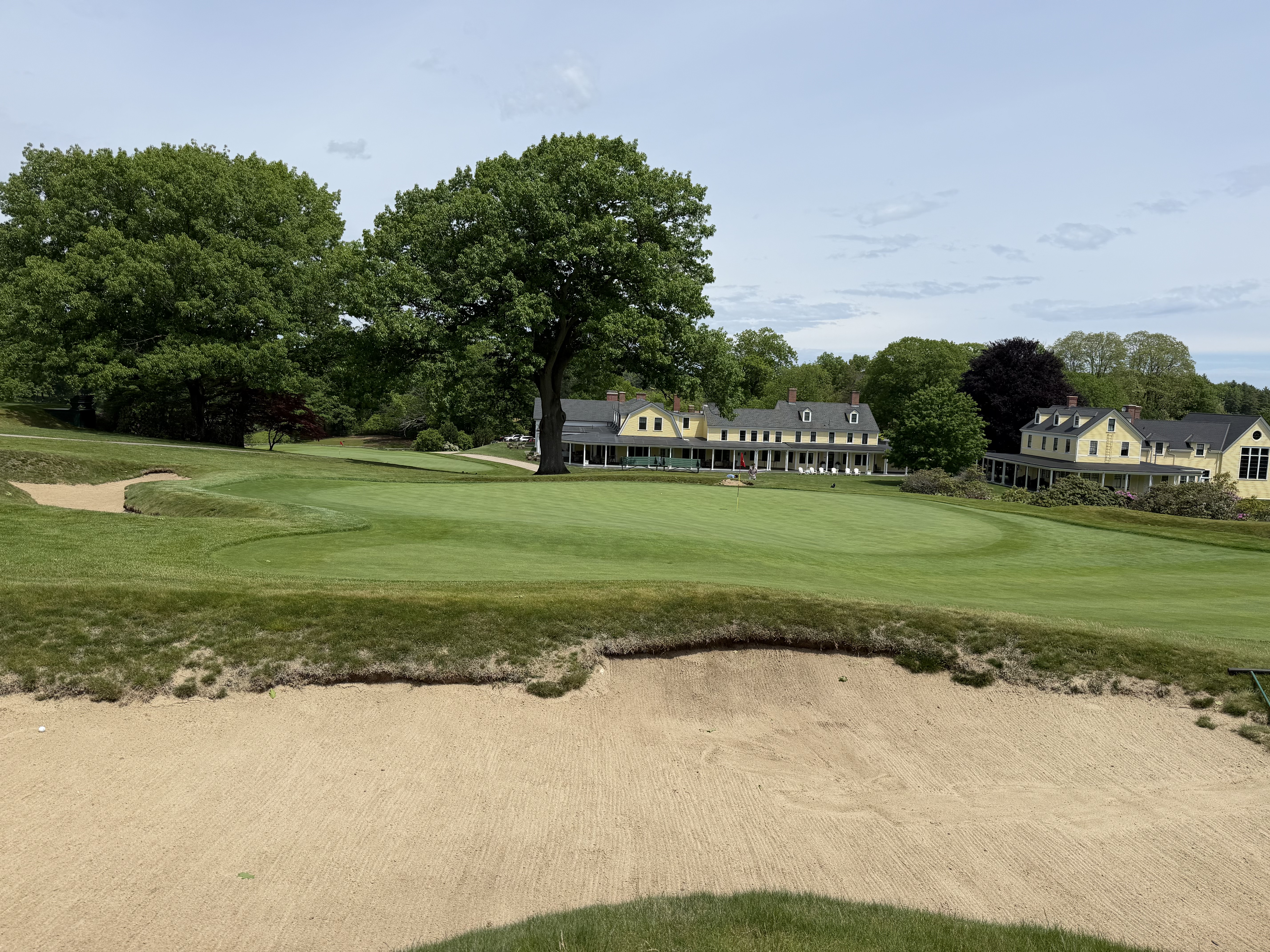
The Third is a 140 yard par 3. With the clubhouse mere paces from the green, we complete the first loop at the first par 3. That green is a double plateau, with one of them at the front left and the other at the rear. The undulation between the plateaus is more prevalent towards the left and lest we forget the below grade bunkers that are about all sides except the front left. Hitting the green is half the battle, then maneuvering about the contours is the other, arguably more challenging half.


The Fourth is a 451 yard par 4. Yet another tee shot clueing the golfer in on where to flirt with danger and where to hedge conservatively. The immense waste bunker on the left is that clue. The golfer can take it on or flirt close to it for the more advantageous approach position or hedge off to the right in exchange for a less than ideal approach. Once again, the green position and movement gives those further left almost the ideal situation with the entire green acting as a giant backboard. Those on the right will be coming in facing awkward quick movement darting off to the left front. They can confront this by laying up short or towards the front or off to the right and hope the ball will fall towards the pin appropriately. The rear of the green is not one to trifle with, as the dip away from the pin and back down away from the green creates a most challenging recovery back up to a green that is rushing towards the front.


The Fifth is a 227 yard par 3. The green to tee transitions are excellent and here, it’s as simple as sashaying a few seconds off the rear left of the green prior. It may appear like a short par 4 from the tee but the green is closer than it appears. The golfer would do well to focus on the corridor between tee and green while avoiding too much margin for error about the sides. There’s a general right to left canting that prevails while the generous entry point allows all kinds of roll up and on even as the edges fall off and away. Ending up short and to the left off the tee sets up a preferable opportunity for an up and down while those high or right of the pin will need to exact a good amount of touch to hold the green altogether. Short and left, good; long and right, bad. We all win with these achingly good ground game considerations.


The Sixth is a 359 yard par 4. A bird’s eye view of the course reveals it is set on a relatively square shaped piece of land. The golfer would have no way of guessing this as he walks the holes since the routing does well to vary up the direction of each hole. Here, we find ourselves in one of the corners yet we head parallel to an outer edge, then back to the corner behind this tee and once again along the outer edges to close out the front. Genius routing and with a more low profile and wide open interior, even more so in how the holes are able to insulate play. Here, the green is more to the lower left while the land generally tilts from right to left. Bunkers on the right tempt the golfer from the tee to carry them to take advantage of the movement, which will thrust the ball forward and then down to the left, closer to the green. In short, the left side allows more advantage to the approach while the further down the fairway and to the right one gets, the more the green will begin to move away from them in earnest. The green has a higher right tier and lower left one to emphasize this point. Those on that perilous right side will need to call upon a good deal of touch to handle the tiers in appropriate fashion. The hole can be played several different ways, all dependent on the golfer’s preferences and strong suits in his style of play.


The Seventh is a 185 yard par 3. This is the Reverse Redan. I’m not sure I ever encountered one where the green is above the tee yet it works wondrously well. For others. It works wondrously well for others. For me, a tugged tee shot moved past the bunker on the left and out of sight. Upon walking over in that direction, I saw that it bounced and rolled down the rear well away from the green. With bunkers on the back slope, I needed a very precise recovery shot I was incapable of pulling off at that moment, which then led to bedlam. I am one of countless casualties that find themselves in a rather unfavorable position long of the green, which obviously should be avoided almost at all costs. Those falling up short of the green, however, will find themselves way down the hill and to the right, needing to recover considerably back up the hill. The green moves from left to right so there is a sweet spot on that side of the green the golfer should vye for from the tee yet there is nothing wrong with settling for the center of the green. I find it deceptively maddening but it is all from my own doing. I look forward to confronting the Seventh once again soon.


The Eighth is a 400 yard par 4. The tree line along the right marks the perimeter. Georgia Avenue and then a waterway ensure that any shot off to the right is lost forever. If we skip ahead to the green, those on the right side for their approach enjoy the entry point and entire green. Those off to the left will need to confront the deep green side bunkers. Personally, my approach was from the left and I found it nice enough. Most approaches will need to carry to the green anyways, so all one seems to be giving up is a pretty bad consequence for a short miss. I’m ok with this, as I’d rather not risk the peril of a tee shot a touch too far to the right. But yes, the hole is set up to reward those who manage to stay further to the right off the tee. One does need to mind a couple mounds in the fairway about the left center, as tee shots that bounce off of them could see their ball dart way off to the left for a considerably longer approach. There is a lot of green to work with and the ridge running through diagonally is subtle.


The Ninth is a 550 yard par 5. The front nine is bookended by par 5’s and we head to one of the near corners of the clubhouse to close things out. The right side remains purgatory and there’s not a whole lot of reason to even favor that side off the tee except one might find himself a little closer to the green. The left side is inviting off the tee and so long as the golfer avoids the bunkers on that side, is able to survey the bunkers that are in the way of the green. The green is well fortified by bunkers lurking below on all sides, so the golfer wanting to make a go of it on the second shot will likely find sand in one of them unless his shot is impeccable. For everyone else, setting up the approach by picking through the bunkers is well advised. The approach will need to carry the green side bunkers and land rather softly. The green moves left to right and the bump out on the left side can help those close enough to use it with intention. The roll out of the fairway can be used rather cleverly and with the precision needed as one gets closer to the green, should probably be explored by most of us.


The front nine is excellent. The variety is astounding, especially with the individual character of the greens. The par 5’s are excellent, the par 4’s requiring much more craftiness than braun and the par 3’s deceptively challenging as opposed to the reprieve normally reserved for those shorter holes. They are all strong. I would rank them 1, 6, 4, 2, 7, 9, 8, 5, 3.
The back nine starts with the 433 yard par 4 Tenth. The back rises and falls more than the front and this is evident as early as the tee shot up the hill. The fairway will ultimately sweep to the right while diving down to the green. An approach from any place on the fairway is fine but with the right to left movement of the green, coming in from the left is some what advantageous. This is certainly one of those holes that might be relatively stress free reaching the green but getting the ball in the hole is entirely an entirely different venture. The center bunker in front leaves entry points on either side. It’s a Lion’s Mouth green where pin position becomes vital. The day I played, the pin was directly behind the bunker, so we could carry the bunker right at it, favor the left side to leave a comfortable uphill putt, or hit to the high side to tease the ball down towards the pin. These strategy scenarios change as the pin moves about so the golfer really should think about an approach position where he is able to use his entire weapons envelope.


The Eleventh is a 171 yard par 3. The tee shot hits down to the green, which moves back to front and a bit right to left. A tad on the narrow side with bunkers lurking below on either side, one would do well to stay below the hole. The contours of the green are bolder here than most.


The Twelfth is a 444 yard par 4. I had no idea this was the Alps/Punchbowl hole when I stepped to the tee; I only knew it was another uphill tee shot that looked like it dog legged left (which it does). The further left the tee shot, the closer to the green for the approach, even if the golfer has no idea where that green is. One does need to mind the bunkers on the left side and avoid those, as they are relatively deep. The strong left to right cant of the fairway should also be accounted for. Standing in the fairway for my approach, I was in the unfortunate position of having no idea where the green was. The rest of my group and caddies were all off to the right searching for balls and I couldn’t walk up the fairway without getting in the way of their second shots. I saw a bell in the distance towards the right and figure the green had to be some where near it so I hit over in that direction. As I walked to my ball, I realized the error of my ways. The green is set much more to the left, down below. One almost wants to aim over the right side of the left bunkers to reach it. The Alps and Punchbowl are marvelous and it is evident this is one of the big reveals of the course. It is terrific. I had fun with my shot near the bell down to the punchbowl and had the benefit of watching my ball roll and careen about. The high front left of the green will impart the most roll and in general, the green moves left to right. A great green and an approach that must be learned through much trial and error.


The Thirteenth is a 405 yard par 4. A nice contrast to the hole prior, the dog leg left now heads uphill to a plateau green in plain view as opposed to a hidden green well downhill. The cant is still left to right. Off the tee, the sand bumps out on the left, which gets the golfer listing to the right but with the cant, it is easy to end up too far down that side which leaves a substantial approach up the hill. If the golfer confronts that sand directly and even more to the point, carries it, he will be in ideal position for the approach. The green complex is nothing short of evil. The hole prior gave us a heavenly ground game scenario full of fun but now we face Hades and his green that simply hates golf balls upon it. The hilltop eschews balls off its edges. Any approach even marginally weak faces the very real possibility of heading down the hill to the right while those who add too much gusto will move off the rear or left sides and face a nervy recovery to get back near the pin. I like flirting with the left green side bunker and go for some where on that left front side of the green but that’s just me. Regardless, it’s a very good hole one needs to face with a very astute short game.


The Fourteenth is a 473 yard par 4. A long par 4 that wraps around a groves of trees within a sandy waste expanse. The strategy is simple enough off the tee. Vye as far left as possible for a short approach, which is helpful here considering the length. The green stays well hidden even as one is in the fairway but the contours and sand make it easy to figure out where it is. With a lot of short grass and broad shouldered contours surrounding it, one has plenty of room within which to work on the approach. This is a longer hole done right. Plenty of ground and options for the golfer to consider.


The Fifteenth is a 494 yard par 5. That’s right, 21 yards separate this from the hole prior with an additional stroke. Yet here, the green ends up being well uphill so there is that. The first relatively level tee shot on the back is here and we’re now accustomed to knowing that while lines towards the outside edge of the fairway are safer, the price is additional length to the green. That holds true here for those opting for the safer right side off the tee. The second shot needs to contend with a bunker on either side of the fairway, then two further up more in the center of the fairway at the base of the mound upon which the green is set. Ran Morrison writes in his review that Wagner saw in a magazine a hole at the Jockey Club by Mackenzie where a large mound guarded a green at the front and Wagner liked that idea enough to use it here. Like the hole prior, there is a lot of short grass to use upon the mound after the bunkers. It is better to miss right than left and anything short right of the green opens up its entire depth for the pitch on. Thus far, the par 5’s have been spectacular here.


The Sixteenth is a 281 yard par 4. A short par 4 with the green in sight of the tee, sitting above the fairway. The bunkers form a gateway of sorts. Tee shots short of them leave a short approach in. Tee shots opting past the bunkers leaves a nice pitch into the green, so long as it is pulled off and does not end up in sand. The green is close enough that many will go for it outright. Sage advice is to avoid the sand on the high left of the green and if your ball ends up rolling off and down to the right, the pitch up the hill is one I would take everyday. For those in a close match or trying to close out a low scoring day, the hole explains as much as it can to simply lay up and take the short approach but for those wanting some fun, some risk, some memories, bombs away and come what may.


The Seventeenth is a 164 yard par 3. The final par 3 uses the elaborate bunker complex that extends to the high left of the green prior. Now, the complex needs to be carried to reach the green. Any shot short or to the left will be well below the green and in the sand with a nasty little recovery shot. At one of the higher points of the course, one must consider the wind, which could wreak havoc on its own. The hole is a great example of access and engagement for all depending on their poison. Those who are looking to score are faced with a stiff test to get close to the pin from the tee. The right side features a wealth of short grass, which is a refuge for many and leaves the opportunity for an up and down. Thankfully, my swing finally decided to give me a nice iron swing that landed at the far side of the green. Plenty of short grass off the green on the back as well, so in short, avoiding the bunker complex is paramount and there are places to seek if the golfer simply must miss the green.


The Eighteenth is a 562 yard par 5. The longest hole of the course ensures the golfer gets plenty more golf at the last. The clubhouse in view from the tee, we are simply looking to belt something out towards it. There are countless ways for the golfer to then reach the green. I will note there are a couple what I would, “spillways,” where the fairway spills out in breaks of the sand scrub. These are nice places to gravitate towards on the second shot or even when out of position. The first of these spillways is on the left, just after the bunker that encroaches into the fairway on that side. The second is after the two meddlesome bunkers at the right center about 80 yards short of the green. Anything past them is pitching shot territory and there is plenty of room over there. Accounting for roll out and avoiding those two right center bunker are paramount to reaching the green in regulation. The left to right movement of the green and abrupt fall off on the right give it some subtle deviousness but there is a good amount of space to work with to avoid anything untoward occurring in these final moments of the round.


The back nine is much more undulating and a couple hundred yards longer than the front. The par 5’s once again shine and all others are very strong. I would rank them 12, 15, 18, 14, 13, 10, 16, 17, 11.
Twenty years ago, could a golf course in Florida thrive without water or views of the ocean or lush grass with flamboyant flora about the edges? Today, however, a golf course without any of those things that instead focuses on variety in structure of play, complex contour movement and substantial fun without worrying too much about eye-popping yet extraneous visuals or features attracts throngs of local and traveling golfers alike to walk its corridors. The everyday golfer is indeed much more discerning nowadays and the designs of major public courses are now benefitting because of it. The Park is fun and enjoyable without being easy. Indeed, the distinction between accessible to all skill levels and easy can be found here. The design allows players to engage with it by providing a bevy of options the golfer must look for while the brilliance about the greens and disfavor of sheer length in shots engages the more highly skilled among us. The recovery character here is also remarkable and maintains that close engagement that exudes fun throughout. The Park accomplishes a rare feat of a public non-resort golf course in the U.S. It is an everything to everyone venue. Sophisticated enough for even the most discerning, accessible enough for the most novice, fun enough for the most casual, it manages a universal appeal. Public golf is likely turning a page and simply put, The Park is one of those places that should set the tone for what should lie ahead.
Clubhouse/Pro Shop: Looking out over the Eighteenth and par 3 course, the clubhouse has places to hang about on the patios or inside. There are some restricted hours or days I believe, which seemed curious to me, but check the schedule if looking to dine. The pro shop is well equipped and the parrot logo is top notch.

Practice area: The Park excels here with lots of putting and chipping grounds as well as a comprehensive driving range. With lighting in place, such facilities are available well after sunset.




You must be logged in to post a comment.