6,330 yards, 142 Slope from the Green tees
The day started early. They usually do for golf in the mornings above Manhattan. It has become a ritual of sorts but not really a complex or involved one. Get in the car and start driving. The sun eventually starts in while more and more cars join me on the road but the next time I stop will be for coffee, some where close to the course. That’s when I officially wake up so to speak, get my wits about me and ready to take in whatever links await. As I took in my surroundings that late fall day, a few Harry Potters ran by the store window. Then a cheerleader walked in to the store with her mother. A car full of older kids wearing black suits and sunglasses parked out front. Ok then I saw Darth Vader. It may be entirely possible I never woke up at all. Of course, I finally realized it was Halloween. And I was up there so early specifically to return home in enough time to walk Maverick and Taylor Swift around the neighborhood with a cast of characters and their parents for candy. Spiderman held the door for me as I wandered back to my car.
Part of what Halloween signifies is the end of harvest and the beginning of winter. This demarcation line is the time of year our ancestors believed the line between the living and dead was at its thinnest, so would honor their ancestors and dead while at the same time warding off spirits by scaring them through costume. I planned on scaring the spirits that day with my golf swing and a bold colored sweater. Both admirably suited the purpose. To be sure, there is indeed a line where winter comes. For golf in our area, we typically have a few good weeks of golf left but each day forward becomes more and more substantial as daylight and warmth dim. The darkness and cold finally prevail, the fairways harden and the golfer is left with degrees of harshness in some form for the months that lay ahead. The circle of life epitomized annually, our cherished golf courses fallen then resurrected. A ritual all its own.
The seasons underscore the importance of seizing the time at hand and making the most of it. And golf, it sure honors its ancestors. Occasionally, it dispenses them. When alive, they have the chance to build their altars and those are honored if all goes well. There are only so many canvases, however. What happens to the canvases is the story of golf course design. Some are certain they can make the canvas better than before while some are certain it will be best as it was in the beginning. It’s a never ending push and pull, all while the ancestors grow in number. Honor them all, in some fashion or another. For they have accomplished one of life’s greatest possibilities, leaving something behind that is much bigger than one person. That will endure for each generation to ponder and discuss in their own ways. We’re all just tourists passing through. Our shots and comments are the contribution, slowly molding what will come much later. Wearing our costumes to the First tee. And warding off spirits. I’m warding spirits off every time I step on to the course. Indeed, it dawned on me as I walked by the werewolf. Golf is one big Halloween.
So honoring the dead, warding off spirits and seizing opportunity while it’s still around were the order of the day. And for one in search of bold and quirk to join the fracas, look no further than Apawamis. Bold and quirk might be her initial attraction but as one delves deeper into the design hole after hole, one realizes the sharply unique memorable features are not just dazzling visuals. They are the structure of play and every inch adds to the story in some way. The story starts in 1896 with the formation of the club. Their first course was a nine hole affair at the Anderson Estate. That same year, however, new nine hole course was established at the Jib Farm. 300 sheep purchased from Central Park served as the lawn mowers. In 1899, the club desired a full eighteen holes which their Golf Committee Chairman, Maturin Ballou, set out with Willie Dunn of Shinnecock fame. That course is what is in play today. There have been very little changes to the routing, save for some shifting of some greens along with the Eighth starting as a par 3, the Ninth used to be over 600 yards and the Tenth began as a short par 4. Much of these tweaks were carried out by Herbert Strong along with the guidance of the golf professionals for the club between 1899 and 1911, whom happened to be Willie Anderson and Walter Travis. In 1918, Donald Ross was retained to create a master plan. The plan wasn’t carried out, however, due to financial constraints at the time. In 1920, however, Englishman and famed Greenskeeper Peter Lees was retained to make improvement to the course, most of which were in line with the Ross master plan. Lees added bunkering throughout and is responsible for Eleanor’s Teeth, a well known hazard residing at the Fourth. Lees repositioned four of the greens as well (the Fifth, Twelfth, Seventeenth and Eighteenth). Robert White replaced Lees as Advisory Greensman upon his death, who apparently took on more work from the master plan and eliminated some of the bunkers. Tree planting took place in the 1940’s and 1950’s, which eventually reduced 10 acres of fairway area and conditions deteriorated as the mature trees exhausted nutrients, light and water meant for the course. Gil Hanse began the process of restoration in 2001-02, followed by Tom Marzolf in 2014, then Keith Foster in more earnest from 2017 – 22. A new master plan was created taking its cues from the 1918 Ross plan. Trees have been cleared, bunkers restored and repositioned, as well as work to the greens and tees.
At present, the course plays much more like it did for over the first forty years of its existence. Its 125 acres does not shy from its flair but instead strives to polish its eccentrics as opposed to smooth them over. Knobby hills full of bunkers, every angle one can imagine off the tee and greens that like to play hide and seek are of but a sample of what is in store for the golfer here. There are rock outcroppings that frequent many of the Westchester courses, which the design embraced and routed through and in some cases, over. It some how manages to widen considerably in many parts and might fluctuate in scale more wildly than any other course that comes to mind. The individual personality of each hole stays with you, very similar to the costumed hooligans I encountered that early morn. The history here is rich and that can be seen in the design, which signifies an emphasis on thrill, adventure and engaging challenge. Ben Hogan once called it, “the toughest short golf course I have ever played.” Apawamis has hosted a number of local and national championships, which include the 1911 United Stated Amateur Championship, 1978 Curtis Cup and 2005 U.S. Senior Women’s Amateur.
Speaking of spirits, I was in them good as we started out. The day was a vibrant one and I was looking forward to getting my ball in some truly fantastic disastrous places. The crack of the driver, the ball soaring through the air, a muted thud upon landing then the dew tracks as it rolled out to a stop. We began walking with the sun shining behind.
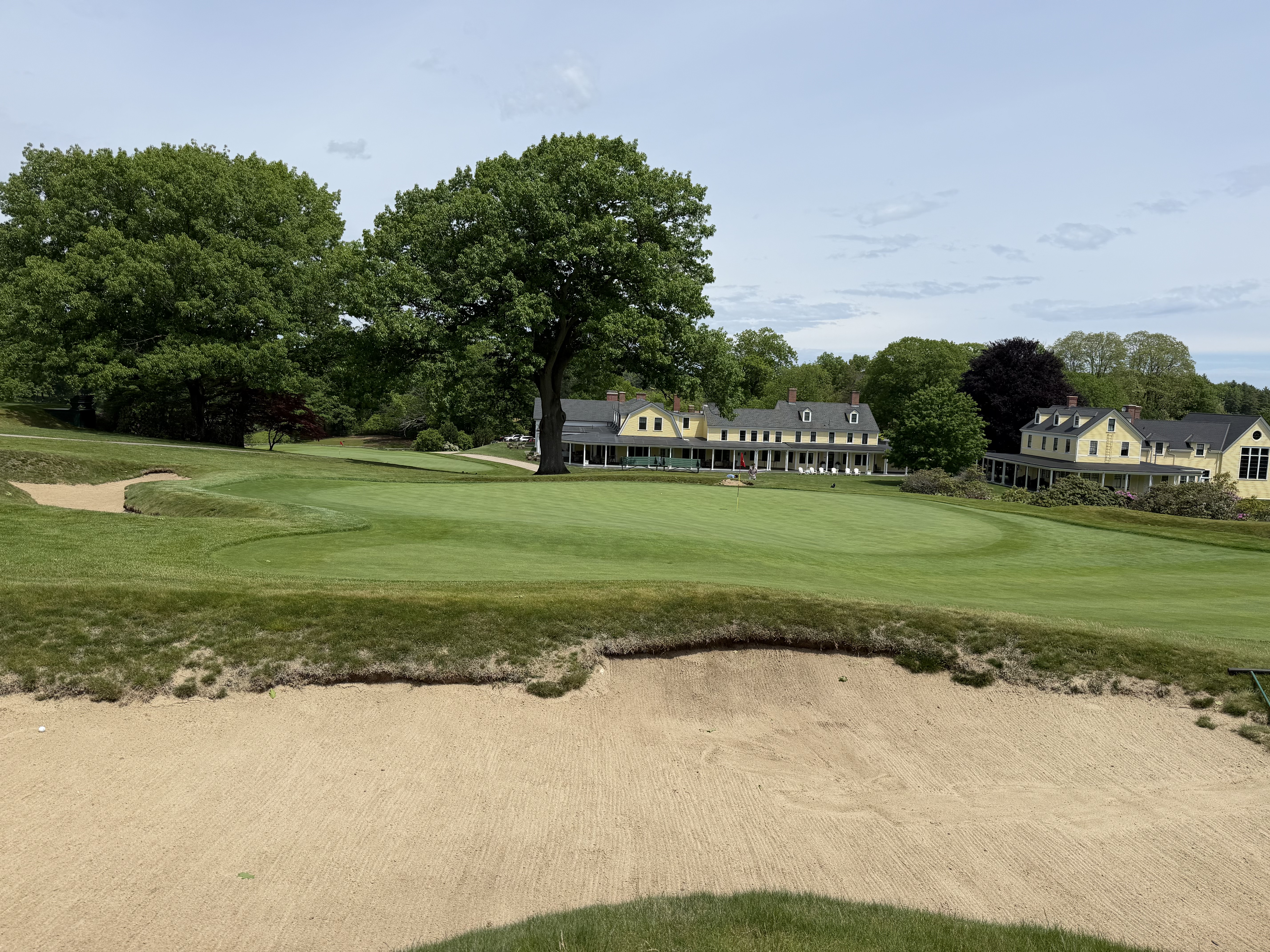
The First is a 368 yard par 4 (from the Green tees). “Meadow.” The opening tee shot is relatively straightforward as the green can be seen in the distance, slightly above. The right side is trees and out of bounds while the left side is dotted with trees yet some degree of the left side should be favored off the tee. The green is slightly blind from the fairway, a trio of bunkers lining the left side of the hill leading up to it. One can still rely on the ground game and use the entry point while others will need to hit into the blind where the green runs back to front. A green side bunker runs along the entire right side as well. For all intents and purposes at the First, right is wrong.


The Second is a 337 yard par 4. “Fairview.” There are two greens for this hole; one straight out on top of the ridge and the other off to the right below in the valley. Each green comes with its virtues and vices, the upper left is larger and provides spectacular views of the course while the lower right allows a bit more freedom off the tee. For the left uphill green, there’s a very real possibility of running out of fairway on the tee shot, so ponder what shot to settle on carefully. The green is relatively wide and squared off and yes, considerably uphill. There really is no other way to say it, missing the green on the approach is relatively disastrous. For the lower right green, the fairway curves to the right so a tee shot that is able to accommodate the turn will reward the approach in proximity to the green. The green is much smaller than the upper left one, with the entry point on its left and a bunker lining both the front and back. Approach shots coming in straight will need to be precise whereas those with some left to right movement will be able to use a bit more ground, very similar to the tee shot.


The Third is a 325 yard par 4. “Dipper.” We now move back in the direction of the First. In fact, the green here is connected to the First green. It is already evident that there is wonderful variety to the green sites, which reverberates back to the tee and sets the tone for the overall character of the hole. Here, the green is well below the fairway in a sort of punchbowl. The tee shot is on the hill where the Second green is, so we look down upon the fairway. There’s a ridge in the middle of the uphill and any tee shot should focus on clearing it. This allows the ball some roll and the further one goes, the more likely the green will reveal itself on the approach. The deep bunker on the left warns the golfer to stay short yet a ridge at the front of the green will send weaker shots back down the slope off the green. The slope on the left, yes near that deep bunker, is more inviting to the green yet will bring that bunker into play. Lots of decisions on the approach yet above all else, do not go long. Better to live for another shot than vanquished altogether.


The Fourth is a 325 yard par 4. “Knoll.” I was unaware of Eleanor’s Teeth before I came upon it and am glad that was the case. Surprise is much rarer these days, especially in golf. The tee shot is off to the right and up on a hill. Even so, the fairway landing area is relatively blind. The left side of the fairway drops down more severely, so those wily among us can use that ridge to move their ball closer to the end to the fairway. The right side is shallower yet still descends slightly. Eleanor’s Teeth refers to the massive hill before the golfer on the approach. There are all eleven bunkers neatly stacked in two rows on the hill with the green at the top. This hazard influences how one plays the hole altogether. One can lay up to the top of the hill of the fairway so that the Teeth and green are more level and everything is in view, or strive to get to the end of the fairway for the shortest shot possible up the hill. Of course, getting on the green is only half of it. The green moves severely from back to front, so one really needs to stay below the hole at all times.
The opening quartet of short par 4’s is just my speed. No two are the same and they all take full advantage of the jutty terrain.


The Fifth is a 130 yard par 3. “Dell.” The first par 3 is also the shortest on the course. The green is deep yet narrow and raised so that any shot off the green will be well below. The green moves right to left as well. Some what of a reprieve hole before the close of the front.


The Sixth is a 337 yard par 4. “Sunnyside.” A return to the series of short par 4’s, the tee shot is blind to the fairway. The fairway narrows as it moves closer to the green, especially after the fairway bunker on the right (which the golfer likely cannot see from the tee). The golfer can decide whether he wants width for this tee shot for a little bit of a longer approach or has confidence in length so that the narrowness is of no moment, which gives him a shorter approach in. Since the hole is on the shorter side anyways, it’s really a decision of what type of wedge one is comfortable with. The approach is important because of the bunker configuration; short left, right and long of the green. The green is nicely sized but staying out of the bunkers is strongly suggested.


The Seventh is a 390 yard par 4. “Gorge.” The fairway here and that of the Eighth intersect, which creates a nice open area that invites the golfer to heavily favor the right side. While the right side is much more favorable to missing left, the tee shot should still stay relatively straight and head for the mounds. This ensures the approach is on the shorter side, as those way off to the right will have a long approach in, even longer since the green is uphill. It may seem like the green is near the mounds but it is not; it is beyond them by about 120 yards. Move through the mounds and uphill, then the fairway starts down to the green. It is of massive size with modest bunkering, moving front to back. A great example of the design embracing the rock outcroppings and using them creatively.


The Eighth is a 349 yard par 4. “Woodside.” The green is out there some where and once again, a tee shot striving for trouble ahead yields an advantageous approach. A dog leg left through and through where a grove of trees on the left guard the green and obscure its location. The green is on the other side of the knoll, settled into a hillside that moves right to left. The terrain will carry the ball down and left so plan the approach accordingly. Staying below the hole is almost mandatory. The continuation of wild variety with short par 4’s largely based on brilliant green site selection starts to get even more impressive.


The Ninth is a 555 yard par 4. “Broadway.” Off to the right, there is Westchester Country Club and further up to the right, Harrison Meadows Country Club. Among these clubs, there are 81 holes of golf taking advantage of the terrain suitable for adventurous golf. Here, the front nine concludes with the first par 5 moving straight along the perimeter of the property. Moving down the right side will produce more length while the hill on the left side will stop most tee shots upon landing, or at least prevent much progression towards the green. At the worst, tee shots off to the left will find the large bunker complex. The fairway continues a bit uphill to the green which moves left to right with the hillside. The hillside makes the greenside bunkering even more treacherous; the high left means the golfer needs to deal with the green contour running away from him and off the edge into the much lower, deep right side bunkers. The right side bunkers will require heft to clear the high lips in order to reach the green. This bunkering crystallizes the importance of the approach.


The front nine is dominated by interesting short par 4’s that provide memorable character in line with the personality of the terrain. I would rank the holes 3, 4, 2, 7, 8, 6, 1, 9, 5.

The back nine starts with the 506 yard par 5. “Lands End.” Out of bounds still runs along the right side while the fairway pinches and slopes back towards the middle around where one can see the tree on the left from the tee. From there, the fairway tilts, dips and dives before ultimately climbing to the green while water starts on the left, followed by bunkers on either side, all before the green. The green moves from left to right and is nicely sized, which is nice since anything off green is likely going to be unfavorable. The size of the green also helps those who want to try for it on their second shot. The same caveat applies, however, hit the green or else.


The Eleventh is a 362 yard par 4. “Bridge.” Continue to ignore the right side as it remains purgatory. The golfer is able to survey the hole from the elevated tee but likely can’t appreciate the entirety of the hillside he is on until he starts walking. The creek in the distance tells the golfer the limits of the tee shot yet the hillside out of view must be carried or will sweep the ball to the left towards the creek on that side. The green is on the other side of the creek and is at its widest at the front. Water is along its left and bunkers its right. Once again, approaches missing the green become precarious very quickly.


The Twelfth is a 174 yard par 3. “Bunker Hill.” The namesake is self evident and the golfer is to hit his tee shot over the water and up to the hilltop while avoiding the rather large bunker on the left and the pernicious bunker on the right. Shot with insufficient gusto will end up moving back down the hill or in one of those bunkers. Longer shots, or at least erring on more club, is advisable. If one starts to think of his immediate shots in progression, he starts to realize the sheer variety of the path he is on. This is due largely to how the terrain is traversed, green size and site selection, as well as hazards from tee to green. It also may be tough to realize, but this is only the second par 3 of the course. Par 3’s are typically great ways for the architect to transition over tougher land or fit in a hole on smaller property but here, the routing figured out how to splay out a series of par 4’s. Mainly, this was done by making them shorter yet diverse and exciting. Length has its place but is not necessary for challenge, interest and strategy.


The Thirteenth is a 354 yard par 4. “Loch.” We immediately take an about face and head back towards the Eleventh tee. The tee area is rather involved and interspersed with rough, a couple trees and even some bedrock. It all must be carried off the tee to reach the fairway below, which is dotted with a trio of fescue mounds. Some will grouse at their misfortune as their well hit shot finds one but a reminder at the randomness and indifference of fairness of our game. One can hit past them but will then need to land on a much narrower strip. Like the Eleventh, the approach must carry a creek to reach the green but the green here is wider and allows more consideration for how to manage something that will situate close to the pin. There’s a general left to right tilt to the green while the creek and bunkers jib and jag into unseen pockets that the golfer will not realize are even there until his ball finds them.


The Fourteenth is a 428 yard par 4. “Waterloo.” Using the fairway of the hole prior shows very nice economy of space while the golfer would do well to hit one of his longer tee shots here. This gives him the best chance of clearing the ridge and having his ball run on the downhill for a bit, every inch useful to shorten the approach, which will be on the longer side. The approach will need to carry a valley as well as Beaver Swamp Brook that moves across the fairway. While it’s a leggy approach, there is some give if the green is missed. Bear in mind the green is at its widest at the rear. A challenging hole that actually helps show the converse that length can instill interest into a hole when relied on properly.


The Fifteenth is a 406 yard par 4. “Mount Hope.” The angled tee shot is challenging; the fairway cants from right to left yet the rough prevents us from starting too far over. The cant makes it inevitable the tee shot will move to the left and frequently, off of the fairway on that lower side. Left is much better than right here based on how the green is situated on the hillside. It reveals itself based on how far left one is. Of course, there are two groups of bunkers on the left side that we first saw at the Ninth, once again appreciating the economy of features that some how make the course feel much larger than it actually is. The green is perched on the hillside with the most severe drop off of the course on the left side of the green. Godspeed to anyone off of that side. A very good hole packed with potent challenge.


The Sixteenth is a 173 yard par 3. “Consolation.” After playing the hole prior, the namesake here is befitting. The third and final par 3 is some how longer than it looks and it looks long. The green is such that missing short of it is better than missing to the sides. In fact, the course website remarks that one of their former club professionals, Jack Patroni, used to intentionally lay up short and to the left of the green. The deep bunkers off to the sides are not to be trifled with and there are three on the right. The green is of a nice size for recoveries as well. Perhaps the hole should be renamed “Marginal Consolation.”


The Seventeenth is a 501 yard par 5. “Sleepy Hollow.” We now are set in the direction of the clubhouse. The green is ultimately downhill and realistically reachable in two shots but the key is nailing the tee shot. Trees and bunkers on either side of the fairway should be threaded and the ball will bound forward. The golfer can then decide on the many options accompanying his second shot. There are two bunkers that mark the start of the downhill leading to the green. The second shot should focus on either reaching the green or some area on the downhill. Or, rest at the top of it if downhill lies are a nuisance for the golfer. This is use of the land in the most fun sense possible. The green is the landing pad of that downhill with sunken bunkers off to the sides. A really good par 5 that starts compounding when one gets out of position.


The Eighteenth is a 310 yard par 4. “Jacques.” The final hole throws out all convention and declares an individuality all its own. The tee shot is completely blind, a nice looking bunker instead staring straight at you. Right center is a good line that accounts for the right to left tilt of the fairway and the two fairway bunkers on the left. It’s a shorter affair, so doesn’t necessarily have to be driver off the tee. What is most important is setting up the approach since the green is well defended by bunker and contour. The member will likely know his favorite area to hit off the tee for the approach as there is a lot of comfort level built into this hole.
The spirits were fended off for another day. Try as they might with their persistent weirdly intense gaze, the beauty and engagement kept me too occupied to realize they lie in wait. They might succeed, eventually, who can tell. Yet just not that particular day. And so it goes each day forward, that’s all we can ask for. The pencilled strokes were counted, clubs washed off of the accumulated earth and bag situated on the rack. I breathed deeply in relaxed rhythm. Let winter come, heck even the spirits. They can do their worst and I’ll have my days like this.


The back nine is a terrific balance to the front with the par 4’s and exceptional par 5 Seventeenth, while the par 3’s are just as good with their interesting challenge. I would rank them 15, 17, 18, 16, 13, 14, 12, 11, 10.
Generally, Apawamis is quirk and character done in exemplary fashion. This seeps into the structure of play and the golfer finds himself in so many unique situations, whether he is in position or out of it. This stems from the creative use of the terrain that used a bit of dare. As one peruses those who laid their hand on the design, they all contributed a bit of that creativity, understanding that to tone it down would be to stifle its foundation of greatness. That creativity in design encourages the same in how it is to be played. Indeed, the golfer’s inventiveness and spirit of adventure are tested just as much as their acumen of swing. In short, this was the perfect course to play on Halloween. The spirit of the game within bold natural surrounds is celebrated here remarkably well so that the golfer has no choice but to appreciate its vitality.
Clubhouse/Pro Shop: Feels like a long lost home.


Practice area: The range is next to the First tee, the putting green behind that.


You must be logged in to post a comment.