6,371 yards, 136 slope from the Blues
A return to the Bridge found me here in peak season of the Summer a few years after my initial sojourn. I have seen a few versions of the Hamptons over the years depending on the time of the year and the Summer certainly meets the hype. It manages a small town feel despite the sold out lodging and housing and the nights still get quiet early despite the lively bustle that starts in the early morn. After dinner at Sag Harbor Tavern and a few beers at the Corner Bar the night before, I was up early to take in the nautical feel of the place. The Bridge was just a few minutes away and with the clear sunny day singing away, thoroughly enjoyable times were ahead.
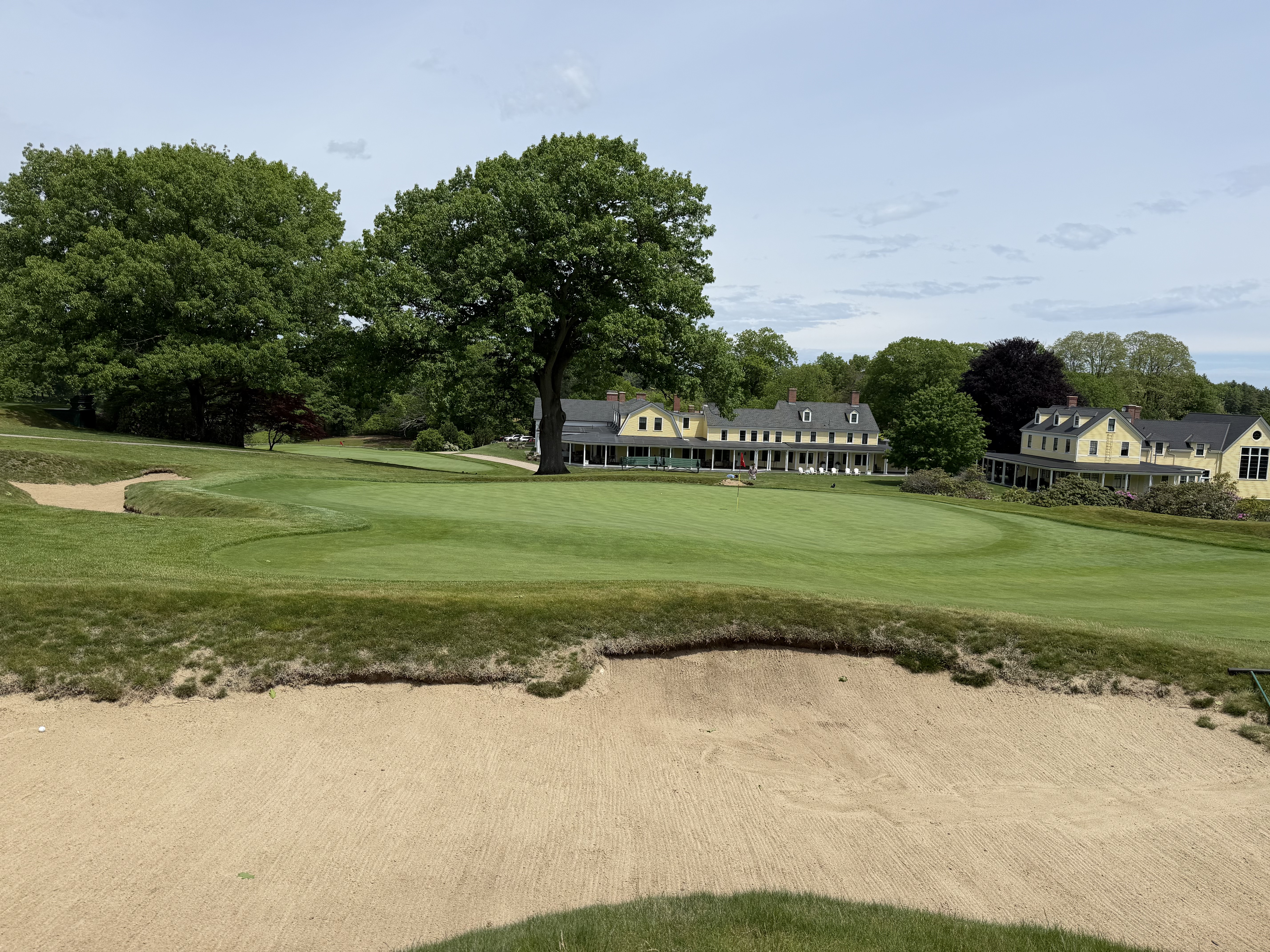
The initial review focused on Rees Jones and his associates and their contribution to the course but did not address perhaps the much more significant work Jeff Warne and Gregg Stanley, the Director of Golf and Green Superintendent respectively, have performed to the course in the ensuing seasons. A golf course is rarely designed at inception and left alone to receive praise after praise; there is the process of time that benefits from experience of play and learning the land on a much more intimate level. Without intruding play, Warne and Stanley have imparted a series of changes to the course that have immeasurably improved its playing structure. I was able to see a number of those changes during my initial round a few years ago but my return was at the point of completion, the most recent work a culmination of that before it. This work focused on playability and aesthetics, restoring native sand expanses and additional clearing of the flora to uncork the inspiring views. The structure of play now facilitates figuring out approach angles and using speed slots while off fairway areas allow degrees of recovery instead of the more severe sanction of a lost shot. In comparing the below photos with those of the initial review (https://golfadelphia.com/2022/05/28/the-bridge-golf-club/ ), the sand expanses and widening are evident, which enhances the playability on several levels, including perhaps most of all its recovery character. As Warne put it, “[T]he challenge is no longer to stay ON the course, but to be challenged and entertained by the hazards and terrain contained WITHIN the course.”
These changes started as early as 2005 with tree thinning, which revealed much more of the remarkable topography and undulations of the property. This thinning also allowed more lower lying vegetation to appear, which diversified the off fairway and allowed a variety of new tee positions. All of the work was in house, save for the occasional project that required earth moving, but each off season, holes were tinkered with in some fashion, in line with the aforementioned two dominant themes of playability and aesthetics. The native areas restored eventually led to enough space within the interior of the property for a five-hole par 3 short course that Brian Schneider designed in 2016 and can be played in either direction. The tees, green sites and walking lines were massaged to ultimately make for a much more walkable course on the hilly terrain. Bunker work focused on emphasizing strategy over penalty, encouraging the golfer to think and maneuver about them within the line of play. In line with this mission was widening fairways on one side or the other, most often in conjunction with the bunker work. This also included adding short grass areas to the green surrounds, allowing the golfer more scrambling options yet also adding approach options in the first instance. The Sixth green was moved entirely, for cohesion and flow.
The project is illustrative of ideal design evolution. The initial design was the starting point yet with the passage of time and the benefit of two professionals that came to know the land with the vision to accentuate its stronger features, the gradual changes ultimately led to an enhanced, enlightened structure of play while allowing the views and natural curtilage to thrive in the right context. Slowly and then all at once as they say. Of course, the owner, Bob Rubin, was vital in allowing these changes, and he approved each of them. All of this coordinated over the patience of time, never once closing the course, profoundly elevating its intrigue.
Yours truly felt good that Summer day. Time, place, company and swing were all aligned in the right place while some shackles of the past were no longer weighing me down. They say the best days of owning a boat are the first and the last. The boat was now gone and I no longer had to worry if it would sink, or something like that. In any event, all things go, all things go. On the First tee, it was full send and time to have a day. Before I knew it, I was almost done with the front nine and one under. I had never even finished nine holes at even par before. My caddie was dialed in, determined. I was locked in. Then, out of no where, double bogey on the Eighth. Par on the Ninth but the damage was done. Finished with a respectable score and all that is well and good and not to diminish it but more importantly, the round was a meaningful, engaging one. The shots asked of me across the terrain were always good and different. My caddie and I were able to get in the weeds on some decisions, from all over tee to green, and then on the lines and movement with the flat stick on the green. The views of the bays glistened in the sun from afar while the sand scapes and native brush danced with delight much closer. The terrain had a some what rugged visual yet a much more pensive, gripping caress walking upon it. Simply put, Warne and Stanley sought to deepen the interaction of land and man throughout the round, and succeeded.
We played the five hole par 3 course after lunch. It was rollicking and includes what I call the “maddening joy” Schneider seems to instill in his greens. You spend half an hour with a putter and a wedge or two, walking from the clubhouse. It fits in well, the same kind of meaningful golf striven for nowadays, just like within the surrounding hills of the big course.
Peak season and a peak round started the real golfing for the year on the right note. And no matter where I ended up thereafter, the interplay with the land was much more discerning, wondering if it could get any where near what I saw at the Bridge.




You must be logged in to post a comment.