6,667 yards, 139 slope from the Black tees
North Jersey Country Club went right to the short list the moment I found out about it. A Walter Travis design on jagged, poppy hills with craggy rock outcroppings throughout that Brian Schneider recently worked on; it made me mad I had not come across it before. Hollywood was another Travis design with Schneider’s recent touch and of course, there was my home club. Schneider is finding a distinct restorative style that pays homage to originality while making it feel fresh and new. Each round at my course renews and adds layers to that appreciation and understanding of his work, at least from my perspective. All of this and the terrain made for great expectations. The newer holes were still growing in but no matter. The dusk of the season was upon us and the days for proper golf were not to be taken for granted. Seize the day, especially when it could be the last. So on one of those bright yet tinty days of the low sun and crisp air, the seizing was seized, another round that would keep me warm for what would be a long winter ahead.
Originally the Paterson Club, which was established in 1895 and was the fourth club to join the United States Golfing Association as an allied member, the club moved from its original location in 1897 where Henry Hewat laid out eighteen holes. The club renamed to North Jersey at that point and is a founding member of the Metropolitan Golfing Association and New Jersey State Golf Association. Travis designed a completely new course for North Jersey in 1923. RTJ was here in 1978 for significant renovation work that included addressing some greens and bunkers (mostly to the back nine) and then Richard Silva in 1994, who focused on the bunkers. There was surely other work, some of it likely in house or piecemeal throughout the decades. With all of these modifications, there were still seven original Travis greens intact and through it all, the routing was never bothered.
As the club’s 125th anniversary began to approach, the effort to return as much Travis character to the course began. Armed with Travis’ original drawings, they began tree clearing and installing large fescue areas in 2012. The Tenth, Eleventh, Fourteenth and Sixteenth were all restored to their iterations based on 1957 aerials. Tommy Fazio, Jr. (The Faz’s nephew) was retained in 2016 to address the Thirteenth and Eighteenth. At the Thirteenth, Tommy moved the green back to its original position and shifted the tees while at the Eighteenth, trees were cleared, bunkers re-positioned, and the fairway was flattened to allow a clearer view of the green on approach. Schneider was thereafter retained to perform extensive restoration. Over the course of a few years, his work included additional tree clearing, tee movements, restoring the memorable mounding that amplifies the boisterous landscape, bunkering expanding, re-positioning and eliminating, and even changing some of the pitches at and near the greens as well as enlarging the greens and surrounds. The Ninth and Tenth were still being worked on when we were there, ensuring everything was set by the onset of winter.
Despite these couple holes where we could still see the finished product, the rejuvenation of the course was evident. Lining up the character of the land with the structure of play is no small feat, especially when the land offers such excitement. Yet that’s exactly how the course currently plays. The variety of hills, meadows and hollows are able to evoke their individuality, which expands the range of play available to the golfer. There is challenge, there is strategy, there is enjoyment and there is also a good deal of rub of the green. This is stylistic of both Travis and Schneider, the product of intricate detail to the craft. I know it well, as Schneider’s work at my club has it in spades, to my excruciating delight. What it does to the golfer over time, however, is develop resolve and creativity. Yet above all else, it ensures infinite vitality.
There’s a reason I flocked here post haste. The idiosyncratic land worked on by such gifted souls charged by a membership appreciating and striving for its original character are the hallmarks of a near perfect day of golf as far I’m concerned. And it was so, even as I found myself sprinting up and down the hills on the back when I left one of my clubs a hole prior and needed to catch up with my group. The interaction between man and land is remarkable here, splendid reason to visit again and again.
The First is a 517 yard par 5 (from the Black tees). Simplistic in presentation, the opener is a long dog leg right that leads uphill, bunkerless. The contours must be negotiated to reach and hold the green at the hilltop or shall see the ball fall downwards, likely to the left.


The Second is a 161 yard par 3. The green is uphill and shares similar characteristics of a Reef par 3, which are typically designed by Tillinghast. There’s a bit of a hidden fairway winding about the bunkers at the front and a semi blind bunker on the left all before the green, but it does not have the diagonal ridge running through the green that typifies the Reef. Travis produced the hole well before Tillinghast wrote about the Reef in his book, “The Course Beautiful,” and there are some historians whom indicate it wouldn’t unusual at all for Tillinghast to take the format of the Second he saw here and make it his own; architects back then did it all the time freely. The concept is how a ship must maneuver around a reef as it is coming into port and here, there is some of that although the front is fairly open. The restoration drew inspiration from the Seventh at the Country Club at Scranton, another Travis design. The mounding and movement after the bunkers is remarkable and emphasizes the free flowing nature of the terrain.


The Third is a 400 yard par 4. The Third and Ninth are which as thieves, running next to each other with mounding defining their separation. Moving downhill back to the clubhouse, the tee shot provides advantage to those who get close to the center line mounding, as an approach from the left side is much more favorable than one from the right. Bunkers on the left can complicate things, depending on pin position and which one the ball ends up in. For others, it shouldn’t be much of an intrusion.


The Fourth is a 493 yard par 5. Moving to the left side of the property and back out from the clubhouse yet again, another bunkerless par 5 awaits. There’s a right to left cant moving all the way to the green, which favors shots to the right. The second shot is likely blind over the ridge while the green is set on a downhill, with stronger right to left sweeping movement. Like the First, harnessing the energy of the terrain is an enjoyable challenge, on full display here.


The Fifth is a 429 yard par 4. Remaining on the left side of the property, the tee shot is blind over the ridge, shifting to the right. Like the hole prior, the fairway leads downhill to the green, with a similar right to left tilt. Bunkers are on either side of the green but set at a distance, which can be a blessing or a curse, depending.


The Sixth is a 389 yard par 4. A shorter par 4 that was inspired by the Eighteenth at Yahundasis, the original green awaits from the fairway with its high left side that drops down considerably to the lower right. The higher left is a clearer, easier approach in while the right is riskier and could be with an obstructed view, but if placed in the proper spot, the right side approach can take advantage of the green contours a bit more than the left. The back left of the green is the high point and it all runs down from there, although a few bowls and hollows make it a bit more complicated.


The Seventh is a 154 yard par 3. The green has been expanded and bunkers were replaced with the original mounding. The back to front movement runs free while the elevated tee shot must carry some water to reach it, yet the mounds create a false front area that need to be cleared as well. There’s also some front to back movement at the right rear that the bottom photo shows, differentiating from an all out back to front green.


The Eighth is a 426 yard par 4. The routing takes an interesting turn back to the clubhouse that signifies a commitment to dividing the land for each set of nine holes. This becomes evident as one sees the back nine with its distinct characteristics. The tee shot must carry water with the wide open fairway on the other side, one of the more expansive areas on the course. The fairway leads up to a ridge then breaks downhill while rolling to the right. The green is original and the mounding defines the green complex and its false front while the left to right movement is more pronounced at and near the green. What complicates matters is the green flattens out and deviously moves right to left, so those on the right side will have the green running away from them even as they are looking uphill.


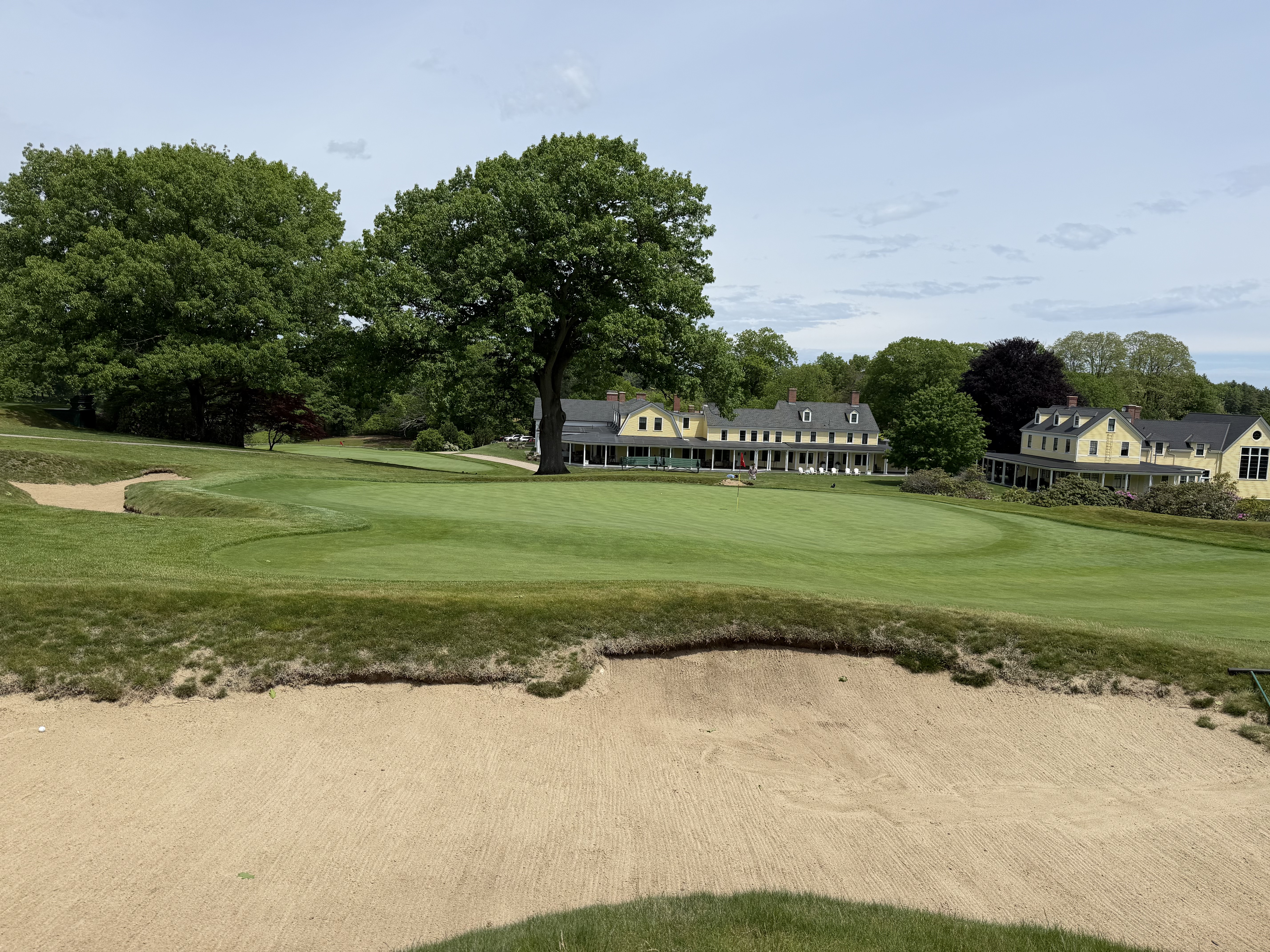
The Ninth is a 438 yard par 4. We played to a temporary green as work to the actual green continued here but the red shot moves uphill and out of view before starting downhill to the green near the clubhouse. The mounding separating this hole from the Third greets us once again while bunkering continues that separation at the green. Similar to the Third, approaches coming in from the right closer to the mounds is advantageous.


The front nine is set upon some of the more gentler rolling land with lively variation that all focuses on terrain movement for its strategy. I would rank them 2, 6, 8, 4, 7, 1, 3, 5, 9 (more like n/a since I wasn’t able to play it).
The back nine starts with the 392 yard par 4 Tenth. The green is tucked away a bit on the right next to the water. The golfer’s attention may drift more towards the left to the wide corridor leading uphill. This was the old fairway, the hole used to play as a par 5 that led up that hill to the green on the hillside. The hole changed to a par 4 in the 1940’s. I believe both greens are now in operation, as the par 5 green was growing in when we were there but the club website only refers to the hole as a par 4. We played it as the par 4, where the further right the tee shot, the more advantageous the approach. The green is sided by bunkers and while it may feel like it should move left to right, it moves the other way.


The Eleventh is a 391 yard par 4. Water is off to the left from the tee and encroaches to center early on enough that it needs to be carried to reach the fairway, which cants towards the direction of the water. The green is up the hill and rounded off, allowing the contours and terrain movement to do its thing. This means it’s entirely possible the golf ball wanders off the green altogether if one doesn’t mind the pace of each putt.


The Twelfth is a 365 yard par 4. The more dramatic land now arrives as we move from the high ridge down to the lower land of the meadows. The fairway moves strongly from left to right and ends abruptly out of view from the tee. It’s vital to manage the tee shot on to that first fairway for the approach down below to the green, which is at its widest point at the rear. The drop shot approach allows some of the best views of the round, so take a moment. Like the first fairway, everything near the green falls off to the right.


The Thirteenth is a 171 yard par 3. The green is at the foot of the hill we just came down on the hole prior, terraced between the high rough and lower bunkers near the creek. There’s some room on the right to play with as well while staying below the hole is almost a command performance.


The Fourteenth is a 386 yard par 4. A dog leg left with an elevated tee shot, one really needs to favor the right to avoid the travails of the left, which include a larger fairway bunker and a larger than that mound. There used to be two of these giant rocky mounds that were known as Mae West (akin to Bel Air) but they were lowered at some point and now one has at least been resurrected. I fell victim to the wrong side of it with my tee shot, which led to an approach shot that felt terrific but was no where to be found once I was able to scale the other side. The fairway feeds into the green, relatively flat with a few contours and depressions doing their best to deter the ball on its way to the hole.


The Fifteenth is a 159 yard par 3. The final par 3 features an elevated green from the tee with bunkers covering the far front corners. While it can’t be seen from the tee, the green is a large rectangle with gentle, subtle, yet determined movement.


The Sixteenth is a 434 yard par 4. The tee shot needs to carry water, which is not original but installed in 2012. The fairway heads significantly uphill and the further left the approach, the less of a view one has of the green up top yet the rear of the green can be used as a backboard from that side. The short grass of the green cascades nicely back down to the fairway and there is some space off to the left of the green to miss but I would favor short and right if hitting the green is some how not a possibility. The green moves from the rear left corner in general.


The Seventeenth is a 526 yard par 5. Back down the hill, the green is just to the left of the Fourteenth. Green Brook crosses the fairway at a point where the golfer needs to take it into serious consideration off the tee. Does one lay up short of it or carry? The green is straight away after the creek decision, a slight ridge running across just before it and just like the Fourteenth, long of the green is no where anyone wants to be. It may not dawn on the golfer until later, but bunkers have become a rarity, as there have been five in the last seven holes. The sleekness of the terrain simply does not need them all that much.


The Eighteenth is a 436 yard par 4. The tee shot is the most demanding forced carry of the course, needing to get over a large pond and the fairway is among the narrower we have come across. Just to the right of the left fairway bunker is a good line. The green is a refuge as it widens out from the fairway yet its contours are bold and there are several pockets the ball may end up favoring far away from the hole. It’s a rather demanding closing hole, certain that the golfer has learned enough and should be locked in to withstand a little intolerance.


The back nine moved across the more dramatic land on drifts away from relying on bunkers, rightly so. The greens were solid and the variety notable. My ranking of them would be 13, 10, 14, 15, 11, 16, 12, 17, 18.
Generally, North Jersey CC is wonderful example of Travis using sheer and abrupt terrain for lively golf. The roll of the ball is allowed to roam free, which makes it incumbent on the golfer to manage pace, direction and any random unexpected bounces. Bunker restraint is impressive, instead emphasizing the hillsides and sleekness of the green complexes. Schneider’s recent work punctuates these design concepts and finalizes the return of the course to its original roots. It all makes for a splendid round with some strategy yet rewards knowledge of the terrain the most.
Clubhouse/Pro Shop: An impressive structure with the pro shop in an adjacent building.


Practice area: Next to the Eighteenth is the driving range and short game area.




You must be logged in to post a comment.