7,099 yards, 148 slope from the Blues
Is there a swing speed craze? There are three things I focus on in life and they take up all of my time. Golf is one of them. So there is lots of time with reading and internet and podcasts and writing, which all evidenced that more swing speed would likely mean I’d be able to lower my handicap. I bought the program and was diligent with the drills and what have you. At first, I saw some gains and was encouraged. Then came the adjustment period, which turned out to be months. It turns out I became very adept at getting higher swing speed readings on my little radar but syncing that up into a consistent swing took a while. Around the time I found myself back at Saucon, things were very much in the adjustment phase. Mind you, I didn’t realize it at the time as I kept on with the exercises. I saw improvement and gains but was emphasizing unsavory parts of the swing that would show up on the course. I’d pipe one further than I had ever seen and would be convinced this was it, then couldn’t execute the 100 yard pitch swing to the green. This went on for a couple months but all’s well that ends well. I ended up with a good amount more distance, most of which has remained even though I haven’t continued on with the program, not willing to risk going through the ordeal once again. And yes, at the end of last season, my index went down 3 strokes. Peaks and valleys as they say. I don’t think everyone has the same experience as me with this whole swing speed thing though, what can I say. I am special.
It had been a few years since I visited Saucon to play the Old course. It’s really a place that lends itself to hanging about and getting to all the courses on the same visit but I take what I can get with the piecemeal approach and Weyhill ended up being the next course to take on. Weyhill was designed by William and David Gordon in 1968. The father-son design duo, with William working with Flynn early on in his career, are responsible for a worthy amount of courses in our area. Their style is kind of a hybrid of RTJ and Flynn, different from the marriage of classic and modern seen from Flynn’s other understudy Dick Wilson. The Gordons held more towards a sleek modern style, opting for more heroic components than strategic. At Weyhill, the Gordons designed it in the late 1960’s, with opening taking place in 1968. The course underwent what was termed a sympathetic restoration in 2010 by Tom Marzolf of Fazio’s design firm. The project included adding new tee boxes (as well as restoring original back tee locations on the Fifth and Seventeenth), some lengthening, addition of chipping areas around the greens, bringing the greens to USGA specification and a bunker renovation. The chipping areas now stand out around the greens, adding to the shaping and movement, all of it instilling some interest to the shots on and around the greens. The bunker style remained in line with the original design yet reduced the volume of bunkers that had grown in number over time. As it stands today, the Gordons’ design is fairly intact. The prominent features are more skewed towards heroics yet some wily angles are occasionally taken. The greens are very much characteristic of the Gordons, with undulations receptive to speed that now work well with the short grass areas they spill into. The land and setting are appealing as the golfer moves about creeks and hills and through woods, with some rocky bluffs thrown in for good measure. The heroism makes for some fun and challenge while most of the strategic character lies with deciding how much of the heroic carries the golfer is comfortable taking on. In short, Weyhill is a wonderful setting that focuses on ball striking prowess, very much a notable example of early modern design tenets and how they shifted away from Golden Age fundamentals.
Standing on the First tee feeling very much like Charlie Sheen’s character Wild Thing from Major League and having no earthly idea where my shots would go, I relaxed slightly as I saw my ball quickly rise and reach out to the depths of the fairway. We were off.
The First is a 395 yard par 4 (from the Blues). The opening tee shot heads straight out, with bunkers on the left and water on the right. The first bunker and water pick the fairway at just about the tee landing area, so the golfer needs to figure out if he can hit past the narrowing or lay up to it. After the narrowing, the fairway angles to the right with the green placed off to the left of most of the chipping area around it. Saucon Creek is to the right but only really severe misses in that direction will find it. The movement of the green and surrounding short grass makes most chips and pitches relatively engaging.


The Second is a 183 yard par 3. Saucon Creek runs diagonally across between tee and green, the right side easier to carry than the left. This probably becomes much more relevant when the pin is at the left rear of the green. Trees on the right some what limit ball slight options to the hour glass shaped green with a bunker on each side at the pinch point. Horizontal misses are much more of a problem than vertical.


The Third is a 449 yard par 4. Likely the straightest hole of the course, the tree line moves along the right and a fairway bunker is on the left. It’s a bit uphill to the green with the right side undulating a little more than the left. Bunkers are on either side of the green while an entry point allows the fairway to transition in at the front. Once again, the horizontal miss here is much more of a problem than vertical.


The Fourth is a 410 yard par 4. A mini double dog leg starts off heading to the left with bunkers at each side of the turn. After the left turn, the fairway dips down and banks right, with the green set off to the left. The immediate shifting of the green to one side is a pattern, which creates some different approach looks and aerial shots if one is on the more opposite side of the fairway. Water is off to the right of the green for good measure.


The Fifth is a 201 yard par 3. The tee here is immediately adjacent to the green of the first par 3. This one is in the opposite direction and the forced carry is less penal. The tee shot must be aerial though, over the bunkers that guard the entire front half of the green. The rear of the green spills down into a chipping area, so that misses short will need to recover out of rough and over bunkers, yet long misses will need to coax the ball from the short grass and catch the right amount of pace to settle near the hole.


The Sixth is a 587 yard par 5. Saucon Creek decides to assert itself not once, but twice. The first fairway is harmless enough, moving straight out before a bit downhill and to the right. The creek moves across the fairway at that point, leaving the golfer to decide whether to use the first fairway or try to carry the creek to reach the second fairway. The second fairway moves to the right at a 1:00 angle, yet the green is visible in the distance to the left. Saucon creek moves along the entire left side of the second fairway. The golfer can decide to try for the green from wherever he is on that second fairway or opt to hit it further down for a much shorter third shot. There is plenty of short grass surrounds about the green to entice golfers to try and pull off a riskier shot than they would normally try for. Heroic shots abound here yet those who use each fairway wisely with even a little accuracy will maximize their scoring opportunities here.


The Seventh is a 404 yard par 4. A dog leg right with trees at bay off to either side. Bunkers gather at the turn. Those are the only bunkers on the hole. The green is surrounded my mounding and short grass only, all of it pushed up from fairway level.


The Eighth is a 400 yard par 4. Another dog leg right, this one starts with an elevated tee shot and Saucon Creek coming into play off the tee and again at the approach. The golfer will need to decide how much carry to take on off the tee to set up the approach while trees remain close at hand. The approach must carry the creek once again, which flows just short of it. The short grass is more at the front while rough prevails at the rear, a sole greenside bunker at the front right.


The Ninth is a 536 yard par 5. Heading back towards the clubhouse, the tee shot is through a chute of trees and the gentle climb uphill to the green begins. The hole is fairly straight and bunkering starts at the second shot and approach to chart out after the tee shot. Of note is the scale of the hole and features, which are much larger than what we have seen prior.


The front nine is utilizes Saucon Creek early and often for most of its heroic notes in a mixture of straight and dog leg holes that ensure the golfer approaches by both land and air, depending. I would rank them 4, 7, 6, 1, 2, 8, 5, 9, 3.
The back nine starts with the 440 yard par 4 Tenth. The fairway looks harmless enough from the tee as it heads straight out with trees off to the sides to some degree. About 260 yards out, however, the right side falls precipitously down. The slope is steep yet gradual so that the golfer has some chance of his shot staying up, depending on ball flight and how bad a miss it actually is. The bottom of the slope is heavy rough and some marsh grass, no where anyone would want to be. This slope stays on that right side almost all the way to the green, creating some what of a forced carry for those finding themselves on the right side of the fairway. The green has a nice right to left movement.


The Eleventh is a 414 yard par 4. Once again straight out with fairway bunkers on the left, the green has a nice sloped feature on the left that will take shots down and away from the green if the approach is missed in that vicinity. The bunker on the right side of the green becomes packed with more pressure knowing that that slope is there to whisk the recovery shot downhill.


The Twelfth is a 569 yard par 5. Just like we saw on one of the par 5’s at the front, this one has separated fairways. The first fairway goes out about 250 yards before a large valley of rough interrupts the hole. The golfer must hit over it to the other side, which spans almost 120 yards. Of course, the golfer is free to hit in it but the recovery is going to be brutal out of the heavy rough that resides within it. There is plenty of room on the other side leading up to the green but this is another hole you don’t want to go too far sideways on. The slope and chipping area expands off to the right of the green.


The Thirteenth is a 393 yard par 4. A good amount of width awaits off the tee, which narrows further along the fairway once it starts to turn right. The approach is interesting, with the green set off after a long short grass neck and short grass moving around the bunker short of the green on the right.


The Fourteenth is a 204 yard par 3. The back has asserted itself as distinct from the front by relying on a number of unique natural features among the setting and that includes some of the rocky bluffs and outcroppings. That is what we have here where the golfer is presented with an elevated forced carry over the bluffs to the green. It’s a majestic shot and always fun to watch the ball soar to those rare heights before floating back down. The green moves dramatically to the left and then drops off abruptly on that side, so a right side approach is ideal to account for that movement.


The Fifteenth is a 419 yard par 4. We head back towards the Fourteenth tee, as we’re not done with the rocks. The tee shot is to a relatively narrow fairway that runs along the hillside which imparts a left to right cant throughout. Any shot too far to either side will prove substantially penal. There’s a trio of bunkers that guards the green at its front, which provides some measure of setting up the preferred angle in off the tee amidst the narrow fairway. The green is well above the fairway as well, making most approaches blind but the green is generous so take comfort.


The Sixteenth is a 145 yard par 3. One last use of the rocky bluff with the elevated tee shot down to the green on the other side of Saucon Creek. A shorter tee shot made even shorter with the drop shot with the primary focus on avoiding the bunkers lining the front side. The use of the the rock is varied and does indeed bring interest into those holes. A nice short par 3 placed in between and before the opening duo is just right.


The Seventeenth is a 365 yard par 4. The tee is on one side of Saucon Creek while the fairway is on the other, it is up to the golfer to figure out how much creek he wants to take on to reach the fairway, all while ensuring his shot isn’t too straight into one of the four bunkers on the other side. It’s one of the more strategic tee shots of the round and take solace that the fairway is wider than it appears from the tee. The green is deep and set close to the creek. The rear of the green is almost a safer approach option but putting back down to the front will be nervy.


The Eighteenth is a 585 yard par 5. A double dog leg with the first turn to the right early on, bunkers on either side of the turn. Most tee shots should be able to clear the whole ordeal yet the wider landing area before them is enticing. The fairway then heads straight and narrow to the next turn, which goes left just before the green. The short grass slope to the left of the green with the bunker on the right is reminiscent of the Eleventh and mind the rear of the green, which rudely drops off. The turns and bunker placement allows an array of different shots and strategies as the golfer works to close out the round.


The back nine has the advantage of more unique natural features than the front, which it uses well and leads to more substantial variety. I would rank them 17, 10, 15, 13, 14, 16, 11, 18, 12.
Generally, Weyhill is a nice look at early modern design and what continued on from the Golden Age as opposed to what shifted to something else. The heroism and enabling of quick movement was some what of a departure from typical classic tenets while using natural features as they’re found, then centering the routing around them, is indeed classic design character. The main shift towards heroic from strategic is prevalent here, yet shows why that style was further explored back then. Such interaction with the natural surrounds brings more nerves and pressure to the shots, as if they fail to execute, the degree of penalty is much higher. The carries themselves are meant to inspire, further rewarding good play while imparting a sense of aspiration to everyone else. So began modern design. Weyhill enjoys a nice place within that course design arc, showcasing a nicely distinct round of golf that picks up a lot on the back nine.
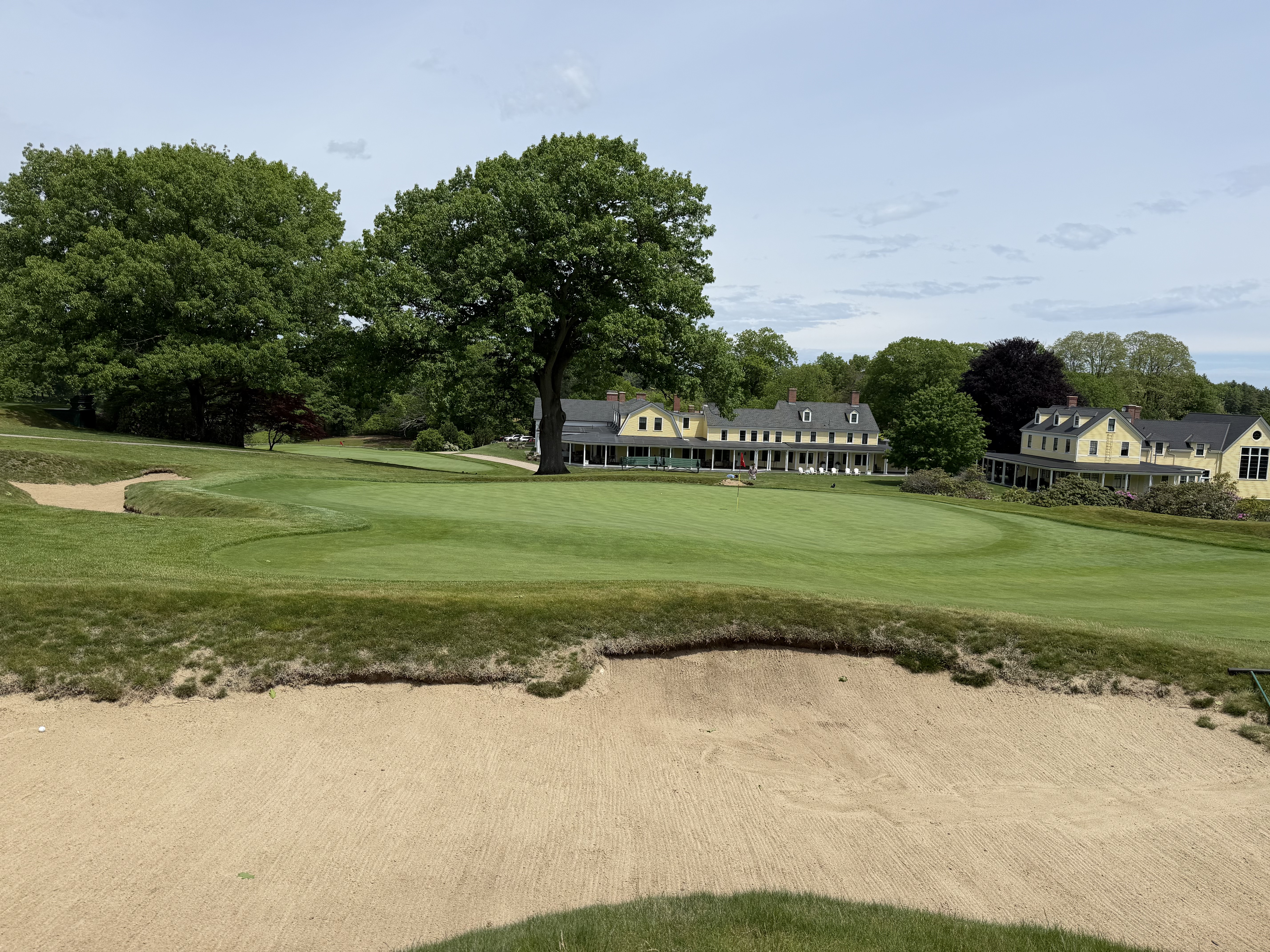
Clubhouse/Pro shop: Weyhill has its own pro shop and a quaint cottage overlooking the Sixth to relax before or after the round.

Practice area: One will need to use the primary range over at the Old, but there is a putting green here.


You must be logged in to post a comment.