2,156 yards, 119 from the White/Blues
There are some very distinct advantages nine hole courses enjoy. Stand alone nine holers, that is. For starters, it’s easier to get some golf in since a loop around goes by much quicker. Yet more specifically, these clubs enjoy a sense of seclusion that maintains an intimate charm a lot of other clubs strive for but can never attain. There seems to be a little more freedom of creativity as well since it becomes more paramount that each hole is memorable and sound; there is no room for weaker or “fill in” holes. In some ways, these courses are much more comfortable in their own skin and don’t waste much time on aspiration. They have their own individual iteration of the game, exuding special tones of character and idiosyncrasies that one cannot find elsewhere. And as mentioned, the golfer then has the shank of the day to do as he wishes.
My first club membership was nine holes, Phoenixville Country Club. Set about and around a prominent hill, that course was designed by Hugh Wilson and has a great patio and clubhouse overlooking the First and Ninth. I’d be able to play in an hour or so, enjoy the view from the patio, then decide if I wanted to go around again. So you can say I have some experience with these nine hole enclaves and they are indeed, charming little niches. Madison Golf Club encapsulates the character and charm one would hope to find at a nine hole club. Set within the hills just below Morristown in New Jersey, Madison stays well under the radar despite its remarkable history and quirk. The club was founded in 1896 as a six hole lay out of 1200 yards by Benjamin Hardwick, a member of Royal Blackheath in London. Three holes were added in 1899 to complete the nine. Remarkably, the nine holes have remained intact since then while land was occasionally purchased to lengthen. In 2002, Bill Newcomb and Robert McNeil were retained to modernize conditioning aspects of the course, which was completed by 2003. No restoration work, no lost holes, no expansion, no big name architect. Just nine holes set out over a century ago, its members going out to enjoy present day just as they have since its establishment. Oh, and it is ranked 25 on Golf Magazine’s 50 best 9 hole courses in the world.
There’s a rambunctious, haphazard, come-what-may demeanor of the course where the golfer sees the green in the distance and likely has to check he is going in the right direction. There are sharp hills and they are used at will. There are trees, some of them asserting themselves more than they should but they don’t care. Hit over or around them. There’s a road two tee shots must cross. The greens are boldly contoured and flank out in random directions against bunkering that varies from death defying to rather docile. There are some spots the golfer will find himself in and may look to the heavens for guidance. One thing no golfer has ever accused the golf course of being is boring. One summits and plummets the hills, finds his ball and does his best to get closer to the hole. It’s wildly fun yet demands a measure of decorum in skills in order for one’s sanity to remain intact. In short, Madison exudes a wonderful quirk that shows rare historical signs of the Victorian age of design with what awaits those out of position on occasion and rewards course knowledge heavily. There is no denying its character and with its potency, nine holes is certainly the right amount of it for the experience of a full round.
The First is a 150 yard par 3. “Straightaway.” Straightaway and straightforward is the opener, a smaller green awaits with bunkers branching out at the sides. An opportunity to kick the rust off and warm up.


The Second is a 251 yard par 4. “Crest.” A short par 4 where the tee shot heads directly over the Ninth green, so much so that groups need to coordinate with those on this hole likely needing to wait for the those on the Ninth to finish out and clear away. The golfer can have a go at the green, which is on the smaller side and guarded by a larger front bunker as well a wide on at the rear. The right side is rigid out of bounds so those opting for the fairway will need to steer away from the right while avoiding the left fairway bunker. The approach is then uphill to said small, protected green. Regardless of the path chosen, accuracy is needed for those keeping score.


The Third is a 191 yard par 3. “Dip.” The off-angle tee shot moves downhill with trees on either side. The trees at the front right of the green are up close and personal and makes the golfer think twice before trying for that side. A couple bunkers do well to cover a lot of the left side, so that side has its issues as well. The back to front and left to right movement of the green adds to the fun, all of it ensuring the golfer is sharp with his longer clubs.


The Fourth is a 195 yard par 3. “Roadside.” Heading back to the direction of the tee prior, this par 3 is similar in length to the last yet plays much differently. This one is uphill with a some what open right side save for the tree closer to the green. The left side is covered with bunkers and the road is beyond those. The golfer needs to favor the left side but his shot must be far and sure or else it will veer out of bounds on the left or be blocked out by the trees on the right.


The Fifth is a 387 yard par 4. “Cross Roads.” It is time to cross over Green Village Road. Trees and shrubbery along with the downhill on the other side makes for a rather blind tee shot. The tee shot is straight out with large hilly rumples leading up to the green. The right side is pushed up closer to the green and aside from the trees, the hills and contours are the only consideration as there are no fairway bunkers. The green is set against the tree line behind with bunkers at the left and rear right. Short grass surrounds the rest of it, into rough, while the fairway feeds right in. The hardwood and terrain are all that are needed for interest.


The Sixth is a 325 yard par 4. “Hollow.” The fairway dog legs slightly right, dropping from the tee before immediately climbing back up the hill and turning. Trees keep the playing corridor narrow up to the turn but then yield for the green. An overall right to left tilt presides over the fairway from the turn to the green with bunkers on either side. The green is deep yet on the narrow side, set at a left to right angle from the fairway. This hole and the last and prime examples of the greens setting up the shots before it in sequential strategy; the pin position begets the approach which begets the tee shot and mercy on anyone out of position.


The Seventh is a 142 yard par 3. “Oak.” The hole is names for the oak tree that looms over the right side of the hole some what uncomfortably. The tee shot must carry over the road once again and almost even more than the tree, the golfer should account for the steep downhill before the green. Shots near it will fall all the way down and certainly affects movement on the green. There are deeper bunkers on the left with none on the right, just that tree that hangs over the green.


The Eighth is a 145 yard par 3. “Well.” A significant drop shot with bunkers on both sides of the green and a road almost flush with the rear. Tee shot off to the right will be lost while those going left will be some where on the hill, likely rough. That is one of the tougher recoveries, extracting out of the rough yet with enough touch to remain on the green with the downhill shot. This even applies to the tee shots; those will bounce and roll significantly, so plan accordingly.


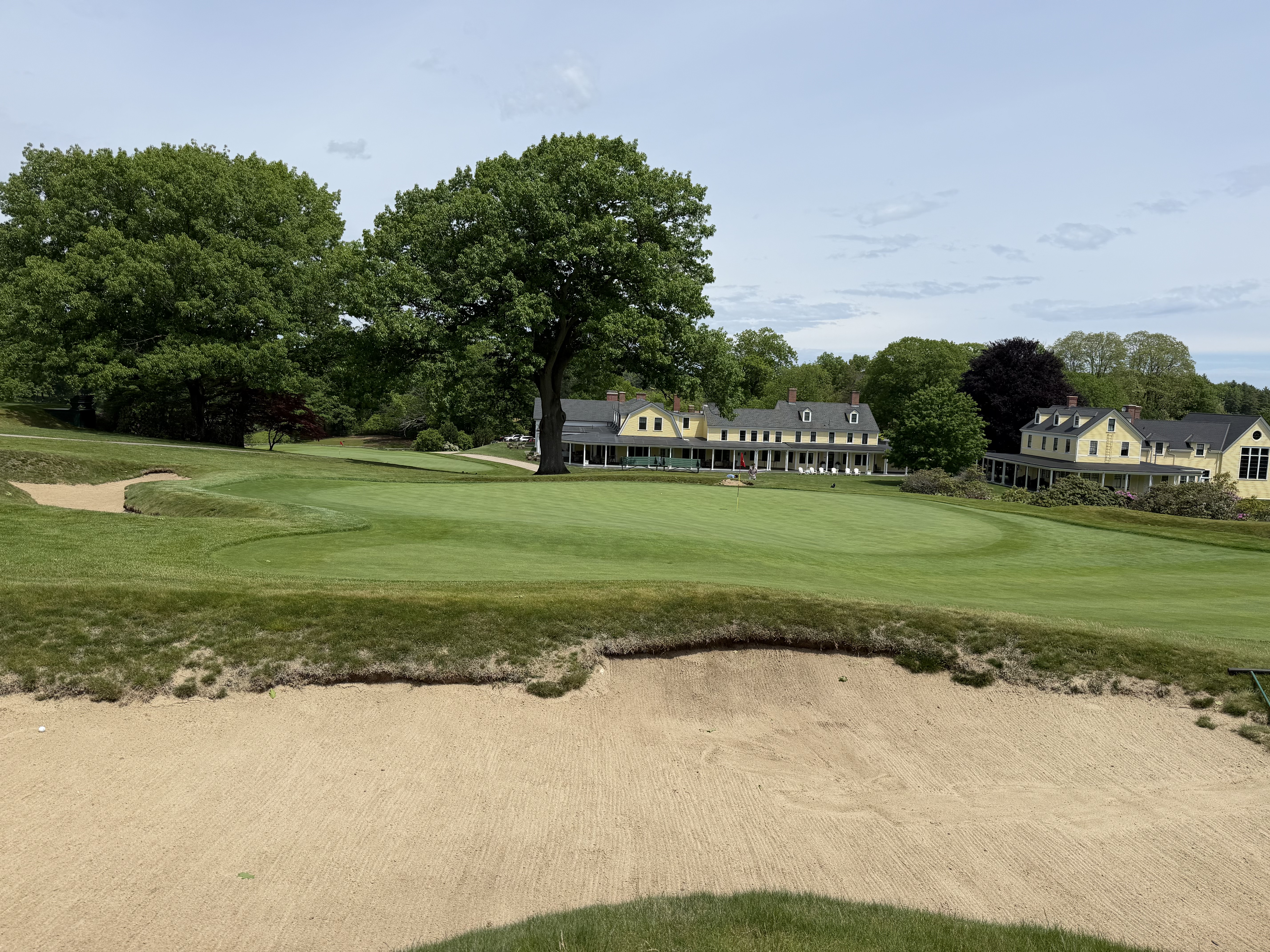
The Ninth is a 370 yard par 4. “Homeward Bound.” The last starts with an uphill tee shot, again blind. The fairway widens after the initial climb and eventually moves downhill to the green. A trio of bunkers are on the left and scattered trees on the right create a choke point mid-fairway which then expands past it towards the green. A larger bunker on the right between the choke point and the green is no where to miss but seems to be positioned for that very purpose. The green is unassuming. Bunkers on either side and the fairway leading right into it, the golfer has already seen it when he played the Second, so everything should be in place for him to finish the round admirably.


The sheer range of how the holes play within nine holes is one of their notable features, variety is surely intact. I would rank them 6, 7, 5, 2, 8, 9, 3, 4, 1.
Generally, Madison is a fun ride and ensures its members never have the same round twice. Its changes in cadence and moods within a mere nine holes was impressive, displaying a wide spectrum of moods almost on a hole to hole basis. It is able to do so with simple design features that take advantage of the vigorous terrain. Smartly, the greens show restraint upon this terrain yet have ample movement to reflect shades of that unbridled character. The degrees of recovery climb to rather challenging proportions quickly, so take heed of that now. In all, Madison is what one should want from a nine hole course. Every bit of an adventure as a full round with dashes of zane and quirk yet a lot more intelligent use of gifted land that the golfer will never tire of no matter how many times around.
Clubhouse/Pro shop: A nicely laid clubhouse off to the side of play with a well stocked pro shop.


Practice area: There’s a putting green at the rear of the clubhouse.



You must be logged in to post a comment.