3,067 yards, 121 slope from the Blues
It was a passing comment but one never to be taken lightly. We were saying our goodbyes at Kingsley when one of the members said as we were getting in the car, “If you have some time, try to stop in at Elk Rapids.” I welcome such comments but you simply never know the credence behind it. Or if it’s some where worth stopping for someone out of town. Yet as we looked into it, we became more and more interested. The spoils of Summer were at our disposal with the long days. After two rounds at Crystal Downs, we made our way to Charlevoix and would stop at Elk Rapids. Our tee time was just before 8:00 p.m. and there was plenty of light as the sun was in no hurry going any where and stayed relaxed in the middle of the sky.
In the early 1900’s, the town of Elk Rapids decided to become a tourist destination after the local iron works facility shut down, along with it the town’s main economic force. Donald Ross was hired and land near Elk Lake was purchased for a nine hole golf course, but they didn’t have the money to complete a lot of the features other than the primary layout. The course remained in this state for almost a century, until the design plans were discovered and Bruce Hepner was retained to complete the design. Today, it sits in that original Ross design, one of about a hundred courses that remain so preserved. The course takes its time getting to the lakeside land and showcases Ross’ practical yet subtle strategic style where the interest level seeps into the golfer slowly without his realizing it. Indeed, I was licking my chops at first taking the course for some what easy but that started to dissipate when I realized there were places the ball could not end up, even if they looked harmless enough. We saw groups heading out for a quick round even as we finished up, a seemingly endless dusk showing them the way.
There’s a timelessness to this game. With its history and tradition and how one can go about in generally the same fashion as those that have done so for over a century, as well as the suspension of time that seems to take place during a round. Time indeed seems to stand still. This to me is one of the game’s greatest attributes, that feeling the universe seems to pause. It allows the golfer to fully immerse in the beauty and natural gifts around him, as well as sort out whatever inner journey the game takes him on. As hands are shaken at the last and the final hole starts to fade behind, it all starts up again, perhaps even faster than before. No matter. The round is all we needed and with such reinvigoration, we’re able to take on the rest of it until the next time we find ourselves on the fairways. That timelessness was reassuringly vivid walking the shoreline holes of Elk Rapids that dusky Summer eve.
The First is a 485 yard par 5 (from the Blues). A dog leg right par 5 to start to get the groups out in the middle of the course as fast as possible. Trees are spaced out yet line the fairway and define the dog leg, with two fairway bunkers about the right side leading up to the green. It’s a gentle opener, the fairway running into the green, and bunkers at each side of the green. The hole allows the golfer to get his affairs in order while setting the tone for the round.


The Second is a 343 yard par 4. Simple and practical, Ross decided to on a predominant direction for the opening holes to run back and forth, which are positioned at an angle to nearby Elk Lake. Two fairway bunkers are next to each other on the left. The green is ever so slightly pushed up, leaving a slight bank around it that can cause more havoc than it initially seems. The banking could also spur the ball into the rear bunker for overly aggressive approaches.


The Third is a 361 yard par 4. Elk Lake behind us as we move away from it, there’s just a slight suggestion of a dog leg to the right. A single fairway bunker is on the right and has some teeth to it with the depth and fescue above its face. The green has some subtle contours as a bunker is at each front corner.


The Fourth is a 381 yard par 4. Back to the lake we go, a small bend to the right and downhill to the green. Two bunkers on the left side, spaced out leading to the green. The opening salvo is over as the approach is blind to the green. One feels as if he is hitting his shot into the lake itself but short steep banking just before the green gives it this visual. The banking can be used on the approach to propel the ball on to it, which could be a good idea with its front to back movement. The views, strategy and challenge coalesce here, within the heart of the course.


The Fifth is a 172 yard par 3. Ross finally takes us along the lake with the next couple holes starting with the first par 3. The green is built into the hillside, which moves left to right. No bunkers; instead, the hole relies on broad based contours and slopes. The short grass right side falls into heavier grass below while the high left side is heavier grass into short. A tree at the rear right casually observes over all yet has no issue inserting itself into play with shots long and right. Simple yet effective design on full display.


The Sixth is a 387 yard par 4. Still running alongside the lake, the area just after the tee fall to the right while trees are just after it. All of that should be cleared with the tee shot. This leaves the approach, where the left side is quite open and right side is guarded with fescue and a bunker. With the green movement towards the lake, the better angle is from the right confronting the defenses on the right while the left side is the path of least resistance yet the green runs away from you. Simple and practical strategy.


The Seventh is a 300 yard par 4. Leaving the lake behind, we are now along Ames Street. A short par 4 that tempts from the tee, through a grove of trees. The green is above the fairway, sharp banking moving up and to the left, which certainly makes the hole a bit longer, especially for those considering reaching it from the tee. The configuration of the banking to the fairway to the green makes the tee shot interesting for those opting to hang back. The further right one goes, the more visible and closer to the green. Yet the further one left goes, the more direct line to the green they receive. It all depends on preferences and playing styles but was one of my favorites of the course.


The Eighth is a 187 yard par 3. The final par 3 utilizes the same elevated banking green style we saw at the hole prior. A general left to right movement with short grass before the green ramping up to it. It doesn’t feel straight with how the green, fescue and bunkers present themselves from the tee but it is. Just realize that upon the ball landing, it will not go straight, but left.


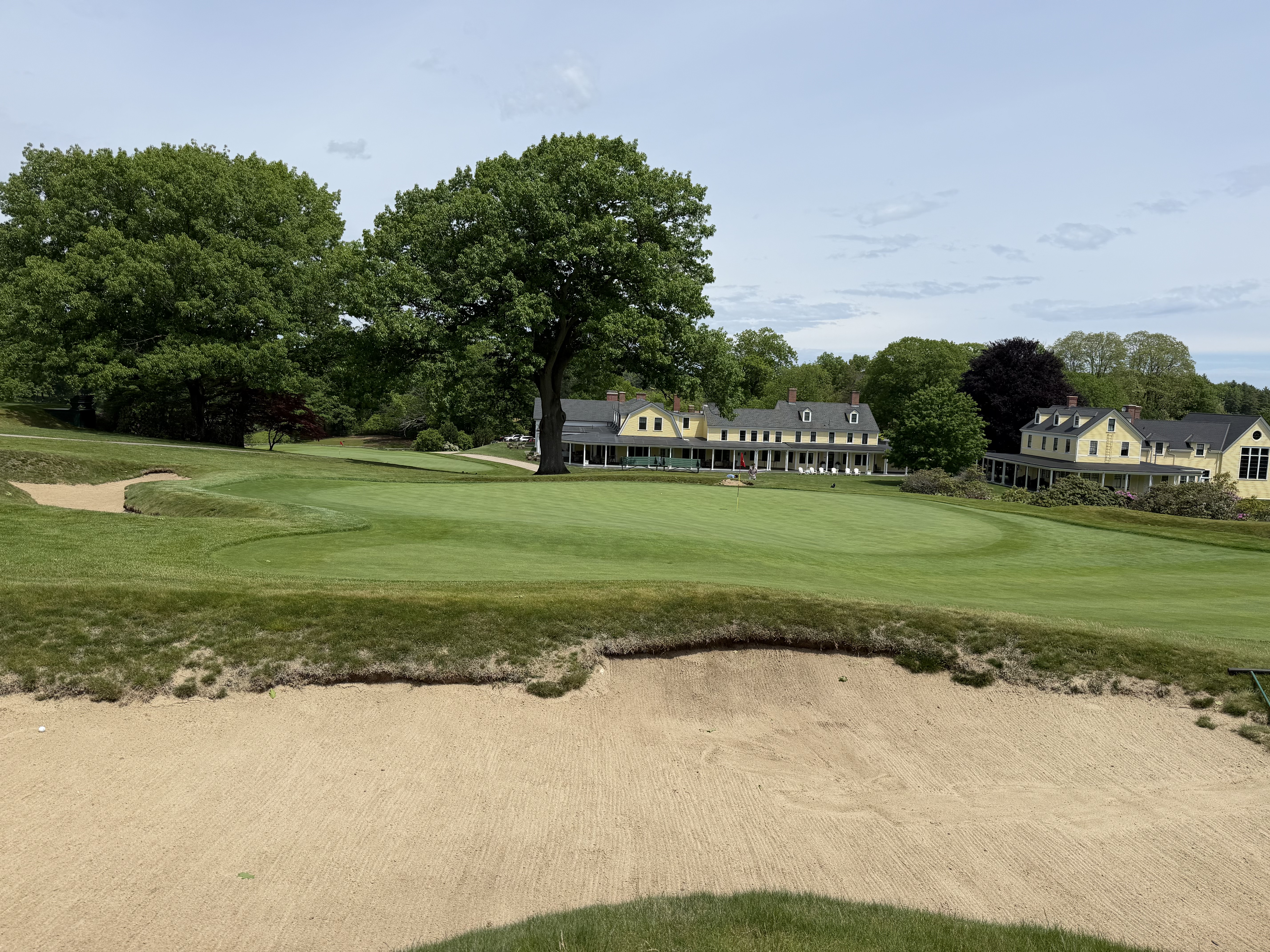
The Ninth is a 451 yard par 5. The course is bookended with par 5’s and this one leads back to the clubhouse. A dog leg left with a narrower fairway that we’re used to, a bunker is on the left at the inside of the turn. The second shot is mainly reserved for the golfer figuring out if he would like a go at the green or approach shot placement. The hole doesn’t do all that much to dictate that shot otherwise. While many believe turtleback greens are a standard Ross feature (they are not), the green here indeed sheds shots off towards the edges. I was fine with my approach creeping to the front a little for an uphill putt. Just as it started, it ends with a gentler closing that leaves the golfer with a lot of discretion how he would like to go about it.


There is a rhythm to the course, with most of the excitement at the latter half. I would rank them 7, 6, 4, 8, 5, 1, 9, 2, 3.
Generally, Elk Rapids is a great example of public golf enhancing the community and of course, accomplishing its initial mission as a tourist destination. A nine hole course on lovely grounds for the occasion with subtle strategy and challenge while accessible for just about anyone that wants to take the walk. It’s engaging for all, which it pulls off with graceful simplicity. Moreover, its story in the golf design context is a great one, with Hepner faithfully completing things after all this time. It’s not a restoration, it’s more of a conclusion. A conclusion that all of us are able to now enjoy for years to come. Anyone is now able to experience a fairly pure Ross design. In terms of a public short course that promotes community, properly introducing newcomers to the more enjoyable notes of the game, as well as keeping the more skilled and experienced set challenged throughout, Elk Rapids is indeed a success story.
Clubhouse/Pro Shop: A great patio that looks out to the course and lake beyond while the pro shop has enough. A nice set up.
Practice area: There’s a good short game area and putting green for those looking to sharpen up.




You must be logged in to post a comment.