6,675 yards, 136 from the Blues
I have wrote in the past how one is never assured of playing a course until he finds himself on the First tee. Injuries, last minute emergencies and the like can all rear their heads at any time beforehand, ruining any itinerary in an instant, no matter how well laid out. So it was as I sat in my hotel room minutes away from Oakmont. A tornado warning had the news anchors pleading with us to shelter in place as the “system” seemed to be moving directly to the door of my room. I thought about the possibility of the hotel roof coming off and me flying away like something out of the Wizard of Oz, or however it is that tornados do their damage, but there was a much more urgent concern blaring in my mind. I hoped the golf course remained untouched and even more urgently, my tee time remained so. The system passed and never materialized into whatever they feared might happen and we all went about our business, a large sigh coming from Room 238.
It is likely no surprise that Oakmont has been on my short list for quite some time but probably for different reasons than most. And in the end, it is probably one of my favorite courses for different reasons than most. Those two last sentences demonstrate one of the best features of the course; its multi-dimensional layers of appeal, which in turn shows its complexity. Getting right into it, Oakmont is no doubt a challenging course but to stop there is incomplete. What it does possibly better than any golf course in the world is in how the challenge is presented to the golfer. There are no inconceivable forced carries, water hazards of any kind, nor are there all that many out of bounds issues or narrowly defined fairways with playing corridors demanding a single strand of acceptable shots. It is simply wide open grass, sand and hills. More than that, the course invites the player down its fairways harmlessly enough. Indeed, it seems eminently playable, luring the golfer into a sense of comfort that perhaps the fuss was all for naught. This of course leads to creating all sorts of temptation within the golfer, which is a problem all its own. The greens await in all their liveliness. Its strategic character befits so many different playing styles. Yet despite such a lovely, idyllic set up, the golfer seems to fall victim to the course over and over. It is not difficulty and challenge in that you feel defeated and morale destroyed. Instead, the golfer is thrown through the ringer and promptly asks for more. Kind of like the gambler at the roulette wheel with the hung dog face, convinced that one of those spins will make everything right. At Oakmont, the golfer goes round and round, convinced that he has finally come across the round that will right all the others only to be left waiting indefinitely.
Oakmont is one of the best examples of greatness born from passion and dedication to a property to ensure a specific vision. Henry Clay Fownes was an iron and steel magnate that sold his empire to Andrew Carnegie. With his fortune and as an accomplished golfer in his own right, he began searching for land to build his own golf club around 1901. Ultimately finding that land just above the the Allegheny River northeast of Pittsburgh, Fownes routed the course himself and adhered to a number of his own design principles. Fownes wanted Oakmont to play like a links, so the course was built with no water hazards and few trees. As a tournament player himself, Fownes wanted a course that could host championships and realizing that technology was increasing distance even back then, lengthened the course significantly for the time to a whopping 6800 yards. It actually played to a par of 80 when it opened because of its length. Despite its length, Fownes wanted holes to vary considerably in their distance to add to its diversity.
There were no bunkers on the course when it opened (except for one). There came to be over 300 at one point, but that has since been reduced. Fownes wanted to see how the course was played over time before deciding where the bunkers belonged. He also did not want any steep climbs or blind shots, which had to be a challenging task with the rolling terrain. Then there were the greens. Fownes desired undulation and lots of movement, even rolling the greens with barrels of sand weighing a quarter of a ton each. The routing was superb, breaking away from the out and back or two-loop nature prevalent at the time. It has rarely changed since Fownes drew it up over 100 years ago and is regarded as one of the finest ever.
Most of Fownes’ work is present today, which was continued on with his son W.C. Fownes who famously quipped, “[a] shot poorly played should be a shot irrevocably lost. The charm of the game lies in its difficult. Keep it rugged, baffling, hard to conquer. Otherwise, we shall soon tire of it and cast it aside.” Fownes, Jr. ramped the bunkers on the course to 300 at one point. Remarkably, Fownes Sr. did not have much assistance or input from others, nor were there an abundance of golf courses at the time that could have aided him. There were architects in Pittsburgh at the time and there is evidence that Fownes at least spoke with them about the course (including Arthur Jack Snyder and Emil Loeffler (who ultimately was the founding club professional and greenskeeper)), but he did not have any team or group heavily involved, nor did he pay anyone as a consultant. Significantly, he recognized that the course would evolve over time and could be improved upon, so allowed such work to continue after its opening. Indeed, Oakmont was a labor of love for Fownes that he saw as work never finished, spending the rest of his life perfecting.
Indeed, the work is never finished. Upon the passing of W.C. Fownes and Loeffler, the course began to drift away from its original mold. A tree planting campaign in the 1960’s dramatically changed its fundamental character. Tweaks were made here and there as well, striving to maintain its reputation as a worthy major venue any day of the week. In the 1990’s, however, a tree removal program began in earnest with a focus on restoring the course to Fownes’ original concept. Ultimately, the results of tree removal here were the impetus for every where else, showing just how remarkable a difference such extensive tree removal can make, especially in the name of restoration. Tom Marzolf imparted some restorative work in the 2000’s, which included changing mowing lines so that fairways ran straight into the bunkers and restoring the Sixth and Twelfth to Fownes’ original design. Gil Hanse was then tagged in 2023 to restoratively reconfigure bunkers and expanding greens to their original sizes. Hanse also addressed the issue of golfers taking advantage of alternate routes on adjacent holes by restoring and adding bunker complexes, including the return of the hook bunker between the Tenth and Eleventh. A new practice area is currently in the works, all in advance of hosting the 2025 U.S. Open.
While the tornado or quasi-tornado or simple storm or what have you left the course untouched just as I hoped while ducking in a corner of Room 238, it also cleared the low lying haze and fog, leaving stunning views of the course as I walked to the Ninth green for the first time. The links grasp on to the hills beyond, the view one of the most satisfying these eyes have laid upon. The wide open nature of the course invites the wind in, which can swirl about between the hills in several directions. The course allows a bevy of playing styles and shots, confident it will hold up to anything the golfer thinks to throw at it. There are some semi-blind shots over hills and such that add the right amount of suspense. The variety comes mainly from the routing about the hills and utilizing the various knolls, ridges and hollows in the right directions and sequence. Yes, the bunkers are intelligently placed and yes, the ditches are a fantastic hazard that should both be used more often by courses and avoided at all costs. The greens are as promised and dictate all of the above, as the golfer needs to consider how he would like to get the ball rolling to the pin with as much advance notice as possible. The ball rolls in all sorts of directions and a general malaise settles in with the golfer early on as he realizes virtually anything is in play at any given time. Such was the case with me at the Seventeenth after a whopping tee shot to just short of the green. My caddie handed me a wedge but knowing about the lurking bunkers and the possibility of a thinned shot, I opted for putter and sure enough, watched in horror as my ball caught the right edge and plummeted into a bunker because I didn’t put enough gusto on it. Such is but a sample of the underbelly of the course, beyond the tempting presentation and sheen of green against the gold of sand and fescue. The roll of the ball makes the margin of error much less than it seems at first glance and the fascination of malaise grows as one realizes that good or even great shots are some times not enough; it is more about hitting the correct shot.
And the roulette wheel goes round and round.

The First is a 445 yard par 4 (from the Blues). Starting on the right side of the property and falling down to the green, the trees on the right mark the nearby out of bounds running down that entire side. The tee shot will likely move out of view and there are bunkers running down either side, many of them hiding in plain sight. The golfer is allowed leeway in what clubs to use to move the ball down to the green considering the fleety downhill movement but those veering sideways will be left with stiff recoveries out of the sand or rough. The fairway feeds right into the green, presenting a much more precarious situation than it appears to the unsuspecting golfer. The movement of the fairway and green is indeed quick, so figuring out how soon before the green to leave the approach and let the movement do its work is one of life’s great mysteries. Yet minding the speed is a proper introduction on what to expect of the greens throughout the round.


The Second is a 335 yard par 4. High above we cross over the Pennsylvania Turnpike and continue our march on the right side of the property. The golfer must once again decide what to take off the tee as there are options, all of which should focus on how to remain in the fairway. The bunkers on the right encroach to the center so must be either carried, hit to the side of or short of. All have their downsides. Laying up short is the safest but leaves a much longer approach in; trying to hit to the side of leaves a small margin of error and exposes the golfer to the possibility of the approach out of rough; and trying to clear the bunkers means a longer club that must be fairly accurate to avoid hopping into trouble beyond the bunkers. There center line bunker before the green, which sits above the fairway and moves from the left rear corner. And yes, the ball can move from that corner all the way back down to the fairway if the golfer isn’t careful.


The Third is a 415 yard par 4. The church pews had my number. Both rounds I saw my ball fly directly to them as if there was some kind of homing beacon summoning it post haste. They are off to the left from the tee but my swing may have subconsciously known that getting in the bunkers on the right is even worse. The church pew bunkers have strands of fescue between them, challenging the golfer to both find the ball then hit out of them. The hill leading to the green ramps up suddenly, which is enough to block the approach view from the fairway. The green is deep up on top of the hill with bunkers on either side of the neck leading up to it while the rear is now all short grass, leading to some nervy chips trying to ensure the ball doesn’t run off the front. The approach needs to be exact to ensure it stays on the plateau of the knoll. It’s a fantastically tough hole.


The Fourth is a 535 yard par 5. On a high point of the hills opposite the clubhouse, the views are rewarding from the tee as we reverse course and back in the direction of the Second. Part of what assures the golfer he will improve his situation the next go round is how the holes turn, twist and angle themselves about the property. This creates a good amount of second-guessing on appropriate lines and the golfer isn’t allowed to see how the ball reacts to the terrain save the end result. The course reveals itself slowly and this is part of the reason how. Such is the case at the second shot here. After the elevated tee shot where the golfer once again needs to avoid the church pew bunkers on the left, the fairway dives and rolls off to the right below some mounding and bunkers, leaving the golfer to figure out how much to take on and how much to account for roll down the hill. The caddies are a tremendous help, whom I found to all be first rate in every sense. Rely on that caddie, as the green complex here was one of the more strategic. There are expansive yet shallow bunkers on the left side, which demand to be carried for those on the left side of the fairway and the carry becomes more demanding the closer one gets to the green. The right side of the fairway opens up the green a bit more but there are a row of bunkers on the right before the green tempering just how far over one can get. The green is deep and there’s a rear flank that juts out even more to complicate its undulations. Yet another wonderful hole.


The Fifth is a 370 yard par 4. Going back up the hill from whence we came, the tee shot undoubtedly moves out of view as it comes down to the ground. Upon cresting, the fairway leads gently downward before ending altogether at a sea of rough. The green sits on a terrace of the hillside with a long trench bunker along its right and the rest of the sides dotted with separate ones. Widening as it moves towards the rear, the green must be approached through the air, bearing in mind the inevitable right to left pull.


The Sixth is a 180 yard par 3. The approach on the hole prior bears similarity to the shot that must be hit here, probably because both greens are set into the same hillside. The bunkering is set in strands mostly about the front half of the green while the rear widens and runs out up the hill. The green is deep yet narrow by most standards and most recoveries can be of the harrowing variety if one is not fortunate enough to end up in a bunker.


The Seventh is a 390 yard par 4. Closest to the turnpike and an elevated tee shot give the golfer a sense of freedom as the fairway is all before him with the landscape beyond. There are a quadrant of bunkers gathering on either side of the fairway, still making sure we keep our wits about us. The fairway widens after the quadrant and moves a bit downhill to the green a modest entry point at the front with bunkers below on either side. The hole should be straightforward but the riddle of the golf swing makes it more interesting and complicated than all that, leaving baffling recovery shots from all over.


The Eighth is a 225 yard par 3. A long par 3 that stretches close to 300 yards for the professionals, the bunkering convolutes acceptable landing areas, making it more difficult for the golfer to realize the green is placed to the left of the tee. Likewise, there is plenty of room to land short, all of it to the right of the Sahara bunker on the left. The bunkers are shallow, the green is large and the contours gentle. The golfer should not length get the best of him here with several other factors in his favor.


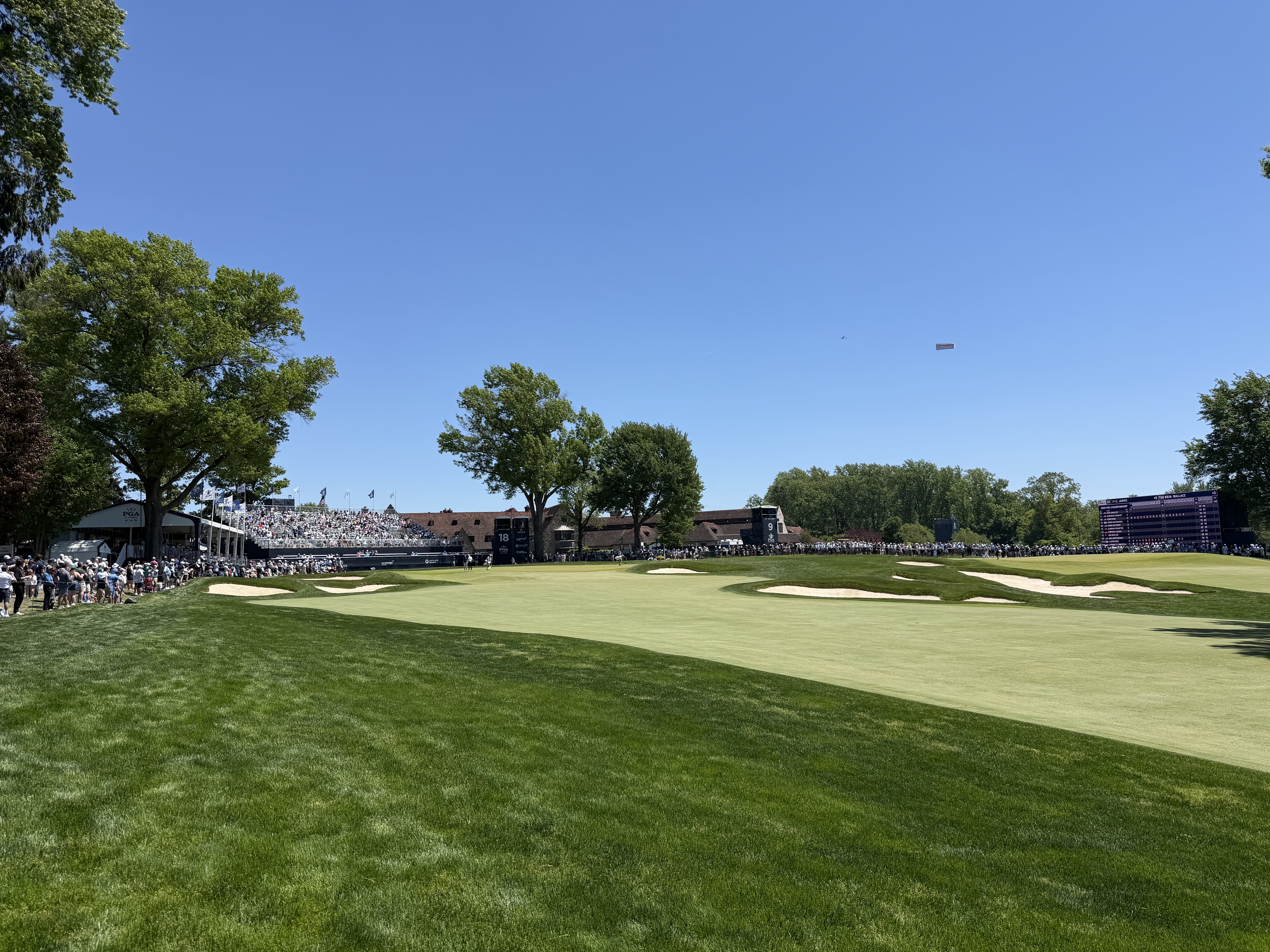
The Ninth is a 460 yard par 5. We move back across the turnpike and up the hill to the clubhouse with this short par 5. The tee shot is not shy about showing off the hill, where the left to right cant is obvious. An honest width to the fairway ensures tee shots must be well executed, which then leaves the golfer with the very real possibility of trying to go for the green in two or laying up. A bunker intruding on the left further up provides a nice target for those deciding on the lay up while those going for it will need to carry it and avoid the deep-set bunkers just to the right of the green. The green moves from back to front, with the practice green at the higher rear. The speed and movement are showcased as the golfer warms up for the round and now, he must try and utilize that experience to close out the front nine before the Almighty, as well as those on the patio and practice green paces away.


The front nine uses the other side of the turnpike with its ridges and terraces on the dominant hillside before finishing back at the clubhouse alongside the First. I found it particularly difficult to prioritize holes since they all were awfully great. In the true spirit of the exercise though, I would say 1, 3, 2, 4, 8, 9, 5, 6, 7.
The back nine starts with 445 yard par 4 Tenth. Moving back down the hole parallel to the Ninth and First, the course does switch back a good amount but one hardly even realizes it as the terrain varies so much that the holes retain individual character and oftentimes are well separated and concealed from one another at least in part. Here, the tee shot moves directly downhill with bunkers lining both sides of the fairway. The bunkers continue until about a hundred yards from the green, then the hill gets a little steeper leading down and feeding into the green, which moves front to back just as fast if not faster than the First. Unlike the First, there are bunkers around the green which make it even more imperative to tame the speed of the hill on the approach.


The Eleventh is a 355 yard par 4. Moving back up the hill, the fairway ends after the crest at one of those famous ditches that crosses diagonally. The fairway on the other side pools along the length of the ditch but only feeds into the green on the left side. Bunkers at either side of the neck of the green have the golfer double take on the visuals and an ideal landing spot. Indeed, the hole is about positional strategy and becomes infinitely tougher with missed shots. A shorter hole that feels anything but.


The Twelfth is a 590 yard par 5. The hole is a masterclass in bunker positioning influencing fairway shaping. A relatively straightforward slight dog leg right becomes much more sophisticated with all the cut-ins and double-backs the fairway ends up taking on the way to the green. With the left to right downhill movement of the hillside, the bunkers become even more relevant if ignored by the golfer on each shot. Many reside well below ground, which mean recoveries out of them will cost as much as a stroke. The green moves front to back and bunkers are on either side of it. Oh yeah, and ditches run down each side for a good length of the hole. One does not often come across a par 5 that is both brawny and strategic but here we are.


The Thirteenth is a 155 yard par 3. The green site is essentially an open field with no distinguishing terrain features other than the hill beyond it. The bunkering and green movement instill its character, which is as a challenging shorter one-shotter. The bunkers are below grade and hitting out of them means care must be taken in dealing with the speed of the slopes on the green. As the narrowest green on the course, precision is mandatory off the tee to remain in scoring position, as those put in recovery mode will be grinding just to come out even here.


The Fourteenth is a 360 yard par 4. Back up the hill, the fairway seems wider than it actually is while a series of bunkers runs along each side. The fairway then narrows after the bunkers stop, a slender path leading to one of the larger greens on the course. Like the Fourth, approaches more from the right open up the length of the green while those more to the left will need to carry the expansive yet shallow bunker on the left. Yes the hole is short and the hole seems eminently manageable but some how, its demands are much more extensive than it lets on. It could have something to do with there is simply no where all that merciful one find his recovery shots.


The Fifteenth is a 460 yard par 4. I swear, I didn’t know the accolades bestowed upon this hole before I played it but after seeing the approach as the fairway dips down to the green, I was infatuated. The tee shot is semi blind as the ball moves past the crest of the hill to parts unknown. At the crest, we see the hole continues downwards and a bit off left. More mild mannered church pews are to the left of the fairway while the left to right cant the fairway takes off the hillside naturally flows down to the green, where a large deep ravine bunker is set against the green. The fairway is set within the natural contours in such a way that the golfer can figure out how much air and land he wants his shot to take in to get the ball to settle nicely on the deep green. One can use more gusto and aim further up the left for more slope or feather it in off the front or even short of the green. Then there’s the green, which falls off the sides and despite its size, still feels like one is on a tightrope between skyscrapers.


The Sixteenth is a 210 yard par 3. The final par 3 is a longer affair with the left to right movement still with us. Quite honestly, the fairway feeds in to the green is a similar fashion as the hole prior and if one should feel inclined to keep the tee shot low and run it up the left side, it would fall to the green eventually if pulled off the right way. For everyone else, the green is large and a fitting landing zone for the longer shot but if one really feels the need to miss, it should be to the right. Missing to the left has the green running away from the recovery, placing the opposite ledge very much in play.


The Seventeenth is a 295 yard par 4. One really encounters it all at Oakmont. Short par 5’s, long par 4’s, short par 3’s, medium size of them all and of course, the short par 4’s. The penultimate hole is the shortest of the 4’s, uphill with a tidal wave of temptation. The green is perched on the hill to the left. Bunkers well below the fairway and green must be carried to reach the green from the tee, which is within the bounds of possibility for the longer hitters. Of course, a much shorter club off the tee assures a much more predictable outcome, leaving the golfer with a manageable approach, which is welcomed at this thinner green running at an angle with bunkers surrounding it. How does one go about it. I finally settled on going for the green from the tee the second round, after a less than stellar approach during the first round led to disaster. In a match or if going for a personal low round, who can say. But the go for broke set, there is hope. Please bear in mind that yes, you can roll into the bunkers well below the green even with well intentioned putts. Yet another glorious terror.


The Eighteenth is a 450 yard par 4. In many ways, the last encapsulates the challenge faced by the golfer for the last hours. The hole is in front of the golfer with bunkers and terrain undulations showing off and hiding various parts of the fairway and while there is an expansive feel, the acceptable landing areas are not as tolerant as they look. Going for the left bunker off the tee and having the shot veer ever so slightly to the center is a good move. The green is large and relatively straight ahead so vying for the rear half assures a healthy carry over the left center bunker and if the shots should stray to one side or the other, will be in line with the green for a manageable recovery. The bunkers certainly have the capacity to thwart the golfer’s hopes and dreams of a strong finish so any recovery shots from the tee or otherwise must keep navigating away from them the utmost priority. The last is a warning. A warning the golfer must stay vigilant, must earn every stroke of the score and must, by God, weather the storm no matter how close the tornado gets. Otherwise, until the ball rests at the bottom of the eighteenth cup, anything is possible.


The back nine stays on the clubhouse side of the hills and is a master class in routing back and forth on a dominant hillside. The variety is striking and the finish brilliant in its remarkable gauntlet arranged like a well choreographed ballet as opposed to an unseemly blunt force brick of difficulty crudely heaved at the golfer from a rusty refuse truck, as is so often unfortunately the case at other venues that have placed their stake in the challenging tournament layout realm. If forced, I would rank them 15, 17, 18, 10, 16, 12, 13, 11, 14.
Generally, Oakmont is sophisticated and subdued in its challenge. The effect this has on the golfer is extraordinary, as defeat slowly sets in and along with it, self-doubt and a lot of wondering what could have been. The golfer’s resolve seems to be strongest when the course has the highest of upper hands, so sure that he is simply having a bad day and can some how make it right if his swing came around. There’s of course some truth in all this but the starker reality is the course is so intricately designed that even if the golfer’s swing was true, there’s a lot of other layers of challenge that must be confronted to score well here. The greens, the angles, the wind when the mood hits, the sheer movement of the terrain and contours; all of it is arranged strategically so the golfer must not only swing true but think his way through the right way, as well as recover from those inevitable misgivings the right way. What is likewise impressive about the challenge is how versatile it is. The demand is never one-dimensional; the course invites you to go about it as you wish yet the challenge remains all the same. This leads to one of the best structures of play I have come across. Beautifully simplistic in presentation yet complex and stiff in its challenge, it is easy to appreciate the hallowed fairways and greens as one of the great American altars of the game.
Clubhouse/Pro Shop: A wonderful and befitting setting. The back patio now enjoys the splendid views of the entire course and hills beyond. It is easy to get lost in the pro shop, which is large and equipped with anything imaginable. The halfway house is fifty yards away, closer to the Ninth green and Tenth tee with its own sit down area.


Practice area: A new practice area was being installed during our round, which is located to the right of the Eighteenth and Seventeenth. Suffice to say it will be fitting with the rest of the course and facilities. There is also the practice green at the rear of the Ninth.


You must be logged in to post a comment.