6,481 – 6,530 yards, 138 slope from the Member tees
It was a short stay in Michigan but we some how managed 81 holes of golf in less than 48 hours. That’s a little over a hole and a half every hour. Landing in Traverse City then heading out to Crystal Lake before moving up the coast to Charlevoix, there was little time to spare save for golf, driving, eating or sleeping. The towns were friendly, the feel was always laid back, the days long and scenery full of sun glazed lakes and landscapes full of trees and rock outcroppings. There was beer, a little bourbon and to our befuddlement, below ground saunas. The joy of discovery and really good golf made the trip easy and memorable. There was no better introduction to Michigan golf in this area than with a round at Kingsley Club.
Individuality in course design is an interesting thing. When an architect is given free rein, the design they resort to typically tells a lot about them. Some may stay close to classic design tenets and use their own flair to assert their style. Some may take their cues from the land and dramatize particular features depending on how they want the course to play. Some may move substantial earth to get what they’re after. Does the architect want something that stands out from everything else and if so, for what purpose? Is the architect throwing out every unique feature they can think of to take advantage of the opportunity and if so, does it overwhelm the design? Some architects refine their sense of design individuality over time, Dye and Hanse among them after trips to Scotland. Most architects refine it over the career span as time and experience take hold. Some architects may never get the opportunity to fully express that individuality, whether due to clients who have particular concepts in mind or because of primary involvement in restorative work or whatever else. There is no question, however, that this individuality is what pushes the envelope of design progression. It is the key to staving off the rising tide of sameness that plagues every era of design trends.
Kingsley Club is an expression of Mike DeVries’ individuality of course design. What makes it so impressive is how DeVries managed to make it simultaneously energetic and mature, especially as one of his early designs. The influence of Crystal Downs is evident, a course DeVries was very familiar with and certainly inspired from. Like Crystal, Kingsley features a more wide open front nine reliant on the towering undulations of the hills that the golfer is free to use as he sees fit while the back nine moves through trees and some how finds even steeper hills towards the closing sequence. I have not come across anything quite like its design and shaping, which was refreshingly exciting. Even as I realized my swing forgot to get on the plane in Philadelphia and was probably enjoying some crab fries at one of the Chickie and Pete’s at the airport, I marveled at how the high and low points of the hills were orchestrated for an overall feel of infinite ball movement, especially on the front. It is not individuality for the sake of it. Rather, DeVries sought to wring the excitement out of the terrain suited for the occasion while relying on the triumvirate of challenge, strategy and variety. Indeed, challenge is asserted on most shots yet the screws really start to tighten for those out of position, some times even heavily penal. Alas, the struggle of redemption contrasts with the delight and immersion of the fairways and greens, all of it combining for a full spectrum round. While the course is over twenty years old (opened in 2001), it still feels new and fresh, even though it has likely began to influence those courses and designers coming after it.
The First is a 568 yard par 5 (from the Member tees). The course shows its character right off with the opening tee shot. A center line bunker complex set on a right to left hillside leaves the golfer with a few options from the tee. The high right ridge takes advantage of the hillside and leaves the golfer in great shape for the next shot but doesn’t leave a whole lot of wiggle room. The longer among us can simply take the bunker complex straight on but there is room that needs to be clear behind the bunker out of view. Short and left are safer options but leave much tougher second shots. The fairway narrows after the bunker complex and leads uphill to the green. While narrows, the hills on both sides funnel the ball to the fairway leading right to the green that has bunkers on the left. The golfer is able to use the contours of the hills as he sees fit on the second and third shots, allowing an opportunity to gauge how the ball interacts with the terrain.


The Second is a 161 yard par 3. The green straddles the top of the hill as the tee shot moves along it, with a left to right tilt. Perilous bunkers lurk below along the sides of the green, the ones on the left preferable to be in than the right although really, they are all tough bunkers to be in. The green has some front to back movement as well, so even though it’s a deep green, mind the possibility of going off.


The Third is a 412 yard par 4. A dog leg right where the golfer must decide on a line to carry the native grass on the right side, all of it moving further right down the hill. The fairway is at the top of the hill on the left and runs towards the green, so the golfer is fighting the left to right movement of the hillside all the way to the green. The green, “kidney beans” around the front right bunker. The green is deeper the more you move to the right while shallower the more you move the other way.


The Fourth is a 385/404 yard par 4, depending on tee position. Another fairway that moves at an angle from the tee, leaving the golfer figuring out how much native area to carry before reaching the fairway. The hills get a little fired up here, as the right side drops out suddenly further along the fairway and the sudden drop and rise operates as one gigantic fairway biarritz. The green is on the other side of the hill top in some what of a bowl, surrounded by bunkers. It’s a wild ride of a hole, exemplifying what makes this place so fun and special.


The Fifth is a 191 yard par 3. The ridge we were on at the first par 3 starts to move down and the green here is on a terrace of that drop off. The golfer needs to use that high left side and have it fall to the hole, unless he can move it on and close short. But right remains no good under all circumstances. At the green, the right side becomes a bit better but still moves away from the green, so keeping a line to the left is much more ideal.


The Sixth is a 373 yard par 4. Cutting through the interior of the course, the tee shot is to a hillside fairway that moves quickly from right to left. The wider part of the fairway is beyond view from the tee. Everything moves left from the tee and there are bunkers on the low left side to deal with shots that move too far left. But a well hit tee shot takes advantage of the hills and see his shot move towards the green and closer to center for the approach. Most approaches will be on the short side with the green moving left to right, most short grass room on the left.


The Seventh is a 569 yard par 5. Now on the opposite side of the property from the Third, we start to move towards the clubhouse to close the front nine. The trees on the left mark purgatory on that side, leaving us to deal with the hills on the right and the narrow valley upon which the fairway is placed. After the tee shot, we start to move uphill to the green where a mixture of sleek undulations and deep set bunkers complicate matters. There is some right to left movement moving to the green and on the green itself. Another wild ride that can be some what harnessed with enough skill and experience to know how what mood the course is in.


The Eighth is a 360 yard par 4. A center line bunker set up similarly to the First, the golfer must decide how to take it on. Right to left movement prevails. There is a good amount of room to the green after the bunker complex. Some will be grateful the greenside bunker on the left is there to stop their ball from darting off into the forest while some will use the movement to coax the ball closer to the pin. The fun continues.


The Ninth is a 135/165 yard par 3, again depending on tee position. There are various tee positions surrounding the green while the opposite ridge is set up for an audience for those who wander a few steps from the clubhouse. The tee angle in to the green is important as it is fairly shallow and the golfer will need to figure out how to use any run out to his advantage. There’s a general left to right movement but the left front has a pad that moves in the opposite direction, ultimately sending balls down the hill. Center left is safe for most pin positions but I’m sure the pin ends up on that left pad some times, which may entice some to try and land it there. The green is mischievous and the golfer needs to be aggressive and defensive all at the same time.


The front nine is exposed to the hills and uses the strong quick contours for a lot of fund and strategy. The challenge resides in controlling shots amidst the wild terrain. The character of the front sets a wonderful first impression that is unique in all the right ways. I would rank them 4, 1, 6, 8, 7, 3, 5, 9, 2.
The back nine starts with the 393 yard par 4 Tenth. Moving away from the front of the clubhouse now, the fairway leads uphill at an angle from the tee with bunkers on either side. The fairway feeds right into the green, with the contours once again rising and falling on either side with a pronounced left to right tilt just before the green. A nice way to settle into the back.


The Eleventh is a 180 yard par 3. A bit uphill, the green disappears into the trees some what on the left. With a fall off on the right and a bunker short as well as long, the golfer looks for where the ball can run out and inevitably, comes back to that left side out of view. The only thing better than mystery is inevitable mystery. Bear in mind that some of the movement on that side starts to move away from the green.


The Twelfth is a 425 yard par 4. A downhill tee shot that is taken to the fairway at an angle. The left side is a rigid tree line while the right is a hillside, with running most of the length of the fairway. The hillside makes for significant right to left movement, so the golfer must vie for the right side to propel the ball forward and towards center without getting stuck on the hillside. The fairway runs downhill to the green in large ripples, the golfer left trying to control the speed of the roll down and to the left. The hole is free of bunkers for the cause.


The Thirteenth is a 292 yard par 4. A shorter par 4 made a little longer than the stated yardage by moving uphill, the center line bunkers are just enough to cause some consternation at the tee. Sure there is room before it for a safer short shot but the contours make it look like there’s a definite possibility of the ball moving downhill off the fairway. That leaves many looking to go full bore with their driver. The left side has some room but the bunker on that side seems fairway easy to catch, as does the one on the right. One could go try and go over the center bunkers or even just to the left of them, which is a nice line. Just mind behind the green, which moves abruptly downhill and away from the hole, leaving a very touchy recovery running away from the golfer. A great short par 4.


The Fourteenth is a 510 yard par 5. If the golfer hasn’t realized it by now, this hole should do it. We are well within the forest and meadows that is reminiscent of the back nine at Crystal Downs not all that far away from here. The trees reach out as far as the eye can see as the fairway dog legs right around some bunkers on that side. The bunkers continue to litter that right side moving up to the green while the fairway narrow a little as we get into pitching territory. And there you have it. After how many years writing these reviews, that is the first time I thought to write pitching territory. It should be a staple moving forward. At any rate, the green takes up an intriguing and unusual position on the left front of the hillside, bunkers and native grass surrounding on the right and rear while the front and left are laid bare. It’s a great approach since both aerial and ground seem equally fun while those trying to pick themselves up from the bunkers or native grass won’t understand why everyone is smiling.


The Fifteenth is a 421 yard par 4. A clearing in the trees allows for some right to left terrain movement before a constructing closer to the green. Like the hole prior, we find a green that is placed on one side while the majority of bunkers and hazards are closely on the other as well as behind. DeVries really doesn’t want the golfer going long on most of these greens. The green is on a landing of the hillside and can easily fall off the left or front, so a measure of delicacy is in order to hold it.


The Sixteenth is a 175 yard par 3. A Redan style green features prominent right to left movement towards the bunkers on the left. There is plenty of room to work with on the right and a well placed shot will bounce forward and left towards the green. Shots too far left on the green will end up in the bunkers on the left but as is the case with most Redan models, recoveries out of the lower left bunkers is much preferred over those on the high right. Another fabulous display of the roll of the ball.


The Seventeenth is a 509 yard par 5. Parallels to Crystal Downs continue here with the severe undulation we encounter in the middle of the hole, similar to the Seventeenth at Crystal. But first, the tee shot must get to the top of the hill and avoid the bunkers on either side, especially with the terrain pulling towards the ones on the right. The downhill is a marvelous sight to behold and those long enough off the tee have a chance to get their ball down it, realizing another 80 yards closer to the green. The fairway immediately starts to climb to the green once the hill bottoms out. Sitting on top of that hill, the green is on the smaller side with bunkers at the front and front right. Just get the approach a healthy distance into the center of the green and you should have a nice finishing putt.


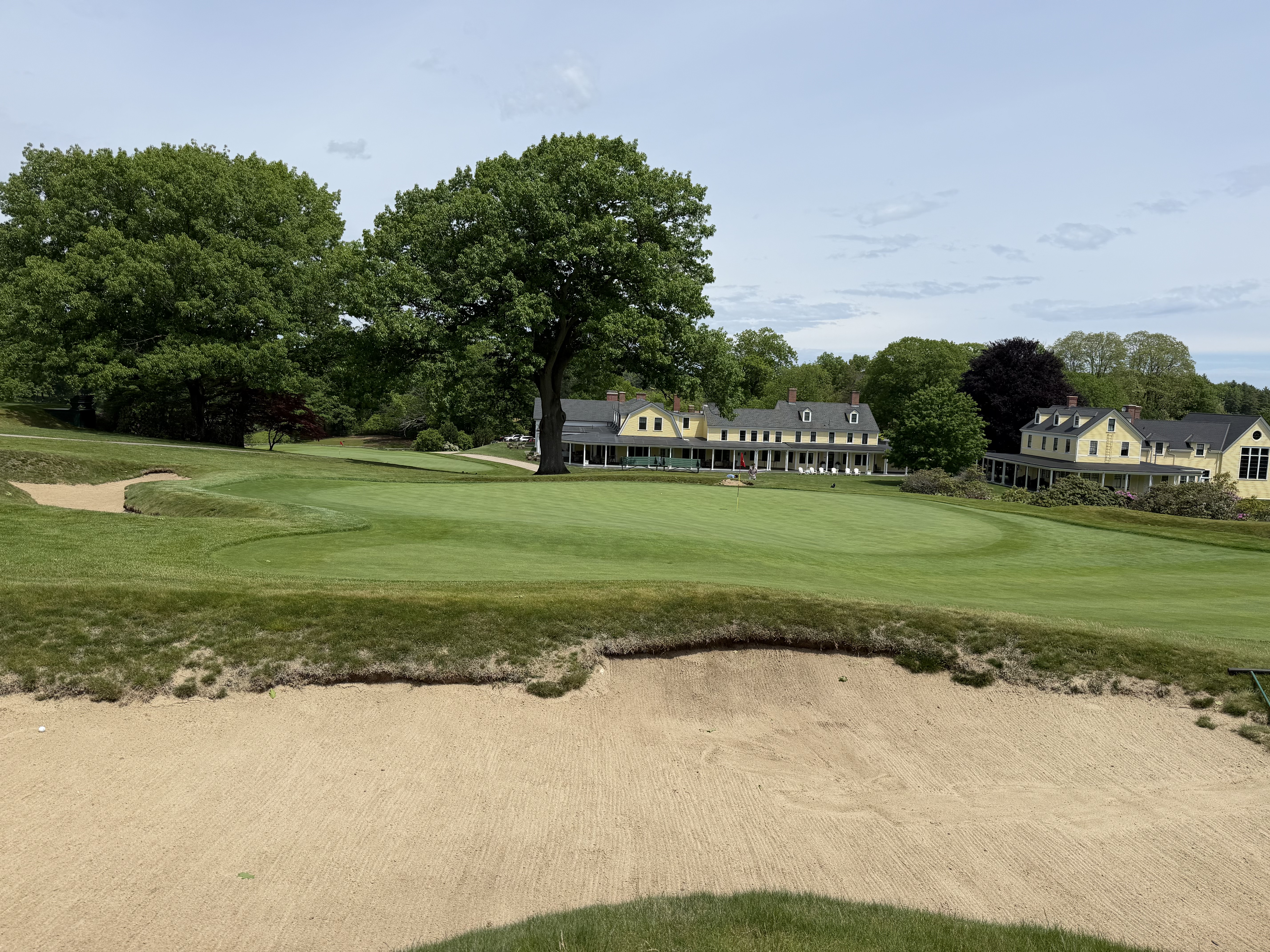
The Eighteenth is a 422 yard par 4. While I was enjoying myself amidst the display of really good holes, my swing was still at that Chickie and Pete’s in Philadelphia. It made for a long day in a lot of sand and native grass, so I leapt at the bottle of Jameson that came out of the wall near the tee here. The late afternoon Michigan sky showed shades of moody blue as the warm still air was decidedly summer. The spirit of camaraderie captured nicely before one last go and off to our next stop. There is more right to left movement than appears visually from the tee, with the short left side of the fairway almost acting as a trap door straight down. Stay to the right or right center off the tee and hot the ridge that runs across the fairway to move the ball closer for the approach. Depending on your position from the tee shot, the hills will play a role in what you can see and the contours that can be used near the green. Another smaller affair that rolls off the sides, the green sets the stage for a nice finish as the clubhouse and its Adirondack chairs beckon in the distance.


The back nine moves into the forested hills and provides a unique style of holes with highly notable selected green sites adding to its unique character. I would rank them 12, 17, 13, 14, 16, 18, 15, 11, 10.
Generally, Kingsley Club is a brilliant use of land full of hills where wild movement is interspersed with strategic placement on greens that pleasantly contrast with a smart measure of subtlety. There is variety for days in it all, both visually yet more importantly, in structure of play. The golfer will remember the unique character here more so for the shots he faced while the visuals are the enjoyable vestiges of those shots. Surprisingly, none of it feels over the top, which would be so easy to fall into for attempts at establishing memorability or simply yielding to the terrain. This all leads to a wonderfully designed course that is certainly worth the journey for those near and far.
Clubhouse/Pro Shop: An understated affair that makes sure the course remains the center of attention. There is lodging, as the club maintains a strong national membership.


Practice area: A well endowed range and short game area.


Also, here is the sauna in the hotel room, downstairs. Unusual for me to come across but apparently fairly common in these parts.




You must be logged in to post a comment.