6,495 yards, 140 Slope from the Black tees
It’s an embarassment of riches in this part of New York. Westchester all the way up to Connecitcutt spans about 10 miles but I can think of at least 15 courses off the top of my head, many considered the best in the country, a few considered best in the world. Like much of the Philadelphia area courses that were considered out in the country back in the day, so it is here with respect to New York City. Several sprouted up in conjunction with the rise of Gotham in the early Twentieth century as it became the most populous city in the world. These courses became sanctuary, just as they were in London, Philadelphia, Boston and the like. Memberships sought individuality and prestige so that their club stood out among the others. In turn, the courses are interesting and unique. The terrain in this area is sharply volatile so that landscapes can differ even when courses border against each other. Indeed, design styles are distinct and histories abound. Donald Ross was active in the area and Siwanoy is one of those few original designs fully represeting his work here.
A well storied club, Siwanoy had a couple of early locations before settling on its current one in 1913. Prior to purchase, it had Ross survey the land to determine the suitability of an eighteen hole golf course. Ross approved and the purchase went through, at which point he began his work on the course, which opened in 1914. One of Ross’ heralded genius characteristics was efficiency in routing and that is easily felt here, as the 110 acres was used superbly. The holes were placed on and within the ridges and valleys of the property, nicely spaced and flowing from one to the next. Indeed, the course feels much larger than its actual size. This routing emphasized a structure of play that relied on contours over hazards and strategic use of angles. Its acclaim was rather instant and by 1916, it hosted the PGA Championship of which Jim Barnes won. The course enjoyed such acclaim with its Ross character until 1952, at which point Robert Trent Jones was called upon in an effort to modernize the course. Jones did not re-design, but rather focused on renovating tees, bunkers, lenghened the course a total of 150 yards and re-shaped greens, all with an eye to increase the diffculty and challenge. Along with RTJ’s work, tree encroachment increasingly crowded the playing corridors, all of which was eventually addressed with the hire of Mike DeVries in 2007. DeVries set out to restore the original Ross design as much as possible by expanding greens and fairways to their original sizes, restoring lost hole locations, bunker work and tree clearing, all to return the rich strategic angle character to the structure of play. As a result, the course is now very much as Ross intended with his original design with a bit of Jones’ polished championship veneer that helps ensure its continued relevance with today’s playing norms.
The course flows and rolls, utilizing the acreage with efficient ease. The large shouldered contours feel gradual and meld into the hills, hollows and knobs one comes upon during the round. These dominate the structure of play and have the golfer thinking about how the ball will roll upon landing as opposed to worrying about flying the ball over and sticking the landing. This interaction with the contours is spirited and varied yet always within mellower subdued tones. There’s a sagacious flow to the holes throughout and even as the fits of challenge come and go, that prescient constant relaxes the overall disposition of the course. In the best way possible. I found excited with the shot scenarios presented to me and focused on that. The possibility of missing or more generally, the tradgedy awaiting if I didn’t pull off the shot, simply never occurred to me. And when such misses reared up as they’re wont to do with my game, I remained at ease. That recovery ended up engaging and interesting as well. That’s even more fascinating here considering the smaller parcel upon which Ross had to produce such effect. This touches on something Ross and a handful of others were and are able to achieve from time to time. I’ll refer to it as the, “stress level” of the design. Every now and then, an architect is able to produce a course that is still challenging, strategic, perhaps a little penal, yet manages to maintain a rather low stress level throughout. This is in comparison to other courses, where the stress level could stay fairly high most of the round. Or it could fluctuate wildly. This stress level indicator is determined by a conflucence of factors that includes types of hazards, hazard placement, recovery options, flexibility, availability of playing options, character of greens and, inevitably, routing. The faithful reader has likely figured out they will be reading much more on this stress level concept at some point in the future but for the here and now, Siwanoy is one of those rare courses where the stress level remains low throughout. That is in large part due to the routing, use of larger contours joining with flowing greens and an abundance of strategic options on how to go about it all.
This stress level issue was tested fairly rigidly the day of my round as we faced triple digit heat. I could make some witty comment how the weather matched my scorching game and I was indeed on fire both literally and figuratively, but I would never do that.
The First is a 379 yard par 4 (from the Black tees). A gentle dog leg right to start off, the tee shot gliding down to the fairway before a gradual rise back up to the green. The embrace of the contours starts early and one notices it immediately at the green. There is a correct side upon which to approach and that all depends on the pin. There is an exmphasis on putting throughout the round that ensures it is not enough to land on the green. If one ends up on the other side of the green from the pin, the putting involved will be substantially complex in gauging subtleties among the more obvious undulations.


The Second is a 424 yard par 4. The property line is on the left, the tree line defining it as well as the general arc towards the green. There are bunkers at the front right of the fairway to make sure those trying to cut the turn do so with sufficient length. All others are obliged to move off to the left of them. The green is slightly above the fairway with the entry point on the left. Approaches can come in through the air or ground, depending on the angle in. That high left side of the green will likely need to be used in one way or another.


The Third is a 203 yard par 3. A long par 3 with plenty of width, bunkers set at the sides. Short is the most manageable miss while long is much more rigid. Simplistic design such as this works tremendously well when the green is full of wonder.


The Fourth is a 519 yard par 5. An early dog leg left with bunkers on the inside in play off the tee. After the turn, the fairway then lifts up to the green, which is just to the left of the First yet situated on the same plateu. Bunkers on either side seem to politely let the contours properly garner all the attention. The approach is a little blind and the golfer needs to take some time to figure out how much roll to impart considering the hill and arches within the green. This pondering dominates the second and approach.


The Fifth is a 539 yard par 5. We have another in the par 5 at 5 club, this one unique in that it is within a consecutive pair of par 5’s. This is yet another example of Ross taking advantage of length within the smaller property at the right place and time and not worrying about convetional wisdom with sequencing. That is likely because there is no conventional wisdom with these things. The tee shot moves down the hill and the fairway moves left to right. Things tighten up just a notch, even more so with the trees on either side and creek lining the lower right. We also have our first fairway interruption which comes into play on the second shot and places a bit more pressure on the tee shot. The green is above, sitting on the same ridge line as the Third. The left to right movement is strong and there is a short grass spillway off the rear. Plenty of ways to go about it here.


The Sixth is a 160 yard par 3. We have traversed to the other side of the property and efficiency in use of space means stashing par 3’s in pockets of the property. Such is the Sixth, the tees adjacent to the green prior and the green just to the side of California Road. A bit of depth to the green and a tad on the narrower side, left to right movement and well bunkered.


The Seventh is a 381 yard par 4. The creek that interrupted the Fifth comes into play off the tee, the golfer needs to either carry or lay up and settle for a much longer approach in. After the creek, the fairway is relatively straightforward to the green, the left side remaining out of bounds and the right with trees. The green is on the smaller side compared to the others we have come across thus far. Like the Sixth, positional strategy is the emphasis and the most advantageous angles into the green mean bringing the bunkers, particularly the one at the front left, into play.


The Eighth is a 343 yard par 4. The routing is neatly organized, the front nine loops about the west side while the back covers the east. The Eighth and Ninth are in the middle and move back towards the clubhouse. The tee shot is blind as the start of the fairway crests over a hill and moves down to a creek. It is possible for tee shots to end up in the creek, so considering something less than driver is adviseable. Ending up before the downhill is even better. The green sits on the other side of the creek level with the hillcrest of the fairway, teasing the golfer. Precision is sorely needed on the approach or the ball will end up moving off the sides, either back down the hill or into one of the opportunistically placed bunkers.


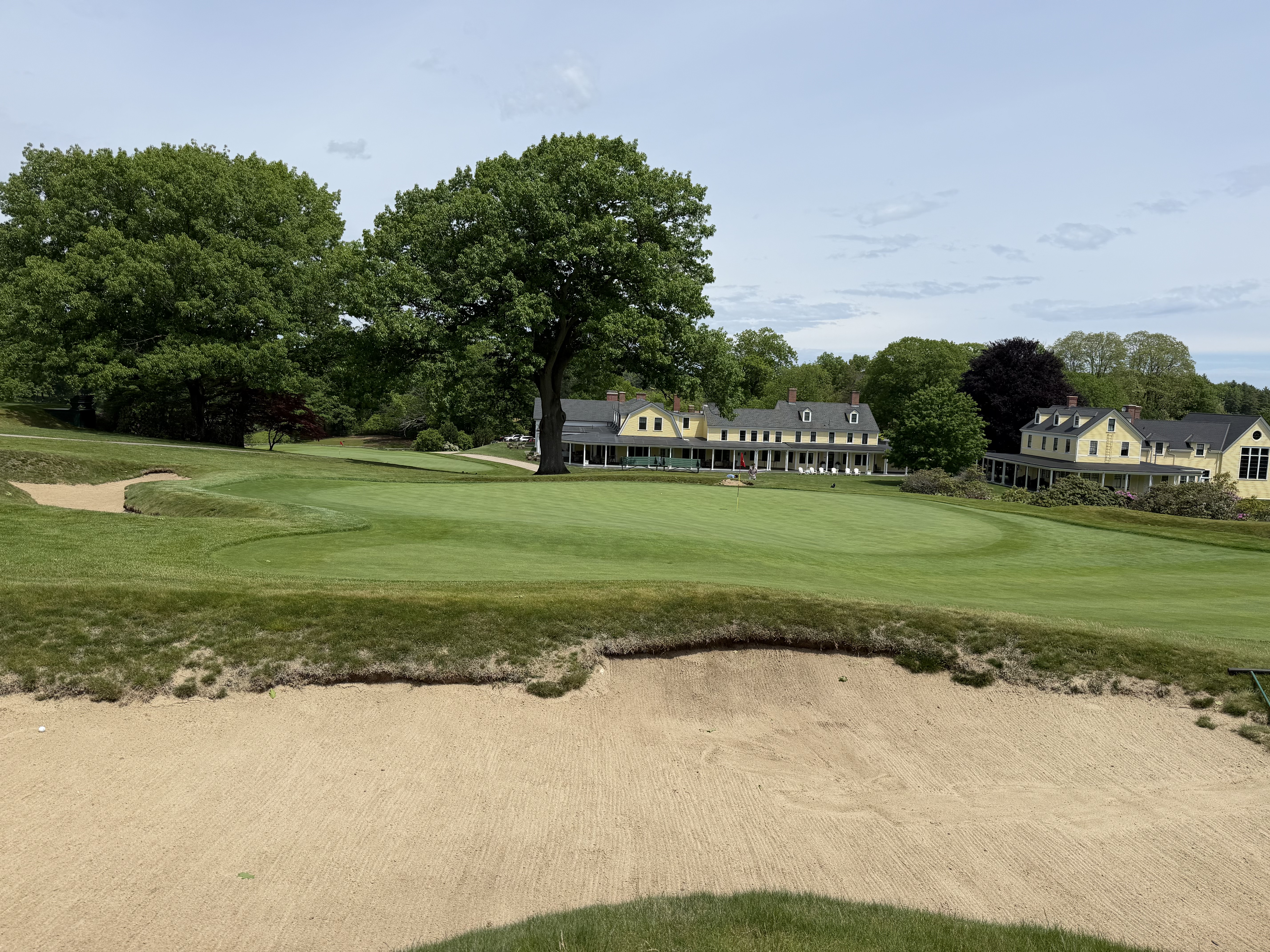
The Ninth is a 319 yard par 4. The Ninth moves in the same direction, its tee almost next to the Eighth, which is its slight routing miscue yet an entirely forgiveable one that is of no moment. Inevitable and really only noticeable if it occurred multiple times, which it does not here. At any rate, we head up the hill to the clubhouse, fairway bunkers taking the rare stance of challenging the tee shot directly. A couple bunkers also guard the front of the green in similar challenging fashion.


The front nine is well balanced and in tune with the land on which it is placed. The opening sequence includes more creative freedom of play before the closing holes start to demand a bit more strategic precision. I would rank them 4, 1, 2, 5, 9, 8, 3, 6, 7.
The back nine starts with the 369 yard par 4 Tenth. Picking up from where the Ninth left off, fairway bunkers substantially dictate lines off the tee. There are three to be exact and they loom large in the middle of the fairway. Many should consider an alternative to driver, as placement reigns supreme over length. Similar to the hole prior as well are two bunkers guarding the front corners of the green. There is more freedom of movement than we saw on the closing stretch of the front, however. Regardless of rhe hole, the ball moves and that certainly holds true here.


The Eleventh is a 189 yard par 3. The shot plays a tad downhill to the green, a bunker on either side and one at the rear. The apron and green amount to about fifty yards, so there is a good amount of play vertically while misses off to the sides seem to be more forgiving the further front they are. The green moves back to front, which helps explain this.


The Twelfth is a 355 yard par 4. Using the same hill as the Tenth and Eighth in like fashion yet still varied, this downhill tee shot is longer than the Eighth and rewards length for a shorter approach. The green is on the other side of the creek and does not include any bunkers. It is all contours as the rounded edges of the green all fall away from the center. Misses are met with multiple recovery options, lively recovery character an unmistakeble Ross trait.


The Thirteenth is a 192 yard par 3. A rather large green awaits at the top of the hill, the short grass apron off to the right since that is where the entry point resides. The bolder among us can take on the center line bunker, which opens up the full depth of the green to the longer shot coming in.


The Fourteenth is a 392 yard par 4. One last time traversing the hill before the course leads in to another sector. A slight dog leg left wuth the creek hiding towards the bottom, right at the turn. The fairway heads upwards to the green after the creek with a single bunker at the front right. Playing conservative off the tee means a much longer approach in while managing and confronting risk pays off handsomely.


The Fifteenth is a 449 yard par 4. Now at the opposite side of the property from the Second, this is a long par 4 that is actually much more manageable since it plays entirely downhill. Twisting to the left off the tee, the right side properly accounts for the cant to the left most every tee shot will take. Once the ball is done rolling down and to the left, the approach is down to the green, which must carry the creek just before and will move down to the right. Short grass areas before the green accommodate this movement as does the collection area at the rear to some degree. There is water on the right side that comes into play on the approach for those really pushing out that way.


The Sixteenth is a 372 yard par 4. The water is more prominent now and will receive tee shots off in that direction. Fairway bunkers once again have the golfer consider other clubs that might better avoid them to find the fairway. The green is up the hill, a trio of bunkers before it yet further out than they appear at first glance. The rest of the green only needs contours and the movement of hill as its defense.


The Seventeenth is a 376 yard par 4. A gentle climb up to the green, the configuration between tee and fairway is worthy of note. The fairway is not simply an extension of the tee but there is a shift in positioning. This means the golfer must really get purposeful with his line off the tee. The right side fairway bunker appears as if it is center line, so using that as a guide, the golfer should envision his tee line not just in the air and landing, but with the roll as well. The green is at the top of the hill with more of an entry towards the right. There’s a right to left pull and those missing left at any point will find their ball well below, requiring some clever hiking strides down to it.


The Eighteenth is a 534 yard par 5. The final hole is a par 5 dog legging to the right up to the clubhouse. A classic dog leg tee shot, the outside of the turn provides the sensible option while the inside is fraught with trouble that the gambling golfer must take on and cover to make it a good idea. Bunkers are more spaced out closer to the green, which gives the golfer pause on his second and third shots. Can one fight the temptation of taking on those bunkers for a closer approach rather than simply laying up before them for a slightly longer approach? There’s just enough room to make this decision rather tough. There’s also almost 180 degrees of angle positioning to consider. The green awaits above, a bit smaller than we are accustomed to at this point. A culminating finish.


The back nine starts off with some jabs before the much broader haymakers towards the end. It’s almost the opposite rhythm of the front yet sets up for a thrilling finish. I would rank them 17, 18, 15, 12, 11, 13, 16, 14, 10.
Generally, Siwanoy represents a lot of Ross design character that made him the stuff of legend. The flow of the routing in how the holes are placed about the land, the strategy that comes from the natural features, the manifold use of the more interesting landforms over and over yet in degrees of distinction, what matters from tee to green is almost important as what lies at the sides where the misses are handled, sophistication in simplistic practicality. All of that is evident here to the effect of what makes Ross courses so decidely memorable. The round makes so much sense as one walks along and each shot is one of substance. The hills are used well, bunkers efficiently to allow more room for the contours to roam free and the greens are the hallmark of subdued brilliance. Ross had a special talent for knowing what the golfer truly enjoys from the game and how to put him at ease even during the more harrowing moments of the round. Such is the case at Siwanoy in understated fluid fashion.
Clubhouse/Pro Shop: The clubhouse underwent major renovations in 2020 to showcase the design style from it origns in 1893. Atop the hill with a nice panoramic view of the course, it is one to linger within for a while.

Practice area: Off to the left of the First there is a range and short game area. Closer to the clubhouse is the putting green.




You must be logged in to post a comment.