“The best of America drifts to Paris. The American in Paris is the best American. It is more fun for an intelligent person to live in an intelligent country. France has the only two things toward which we drift as we grow older—intelligence and good manners.”
– F. Scott Fitzgerald

“Chat.” “Chien.” “Cheval.” A little later, “Je habite a Philadelphie.” More time passes, “Je suis venu pour jouer sur bon nombre des magnifiques parcours de golf français et pour découvrir autant de facettes de la culture que possible durant le peu de temps que je passe ici.” So it went. I’ve always had some urge to communicate in whatever language it is I am visiting. Perhaps another way to get a sense of the place. We had a trip to Italy planned long ago where I did the same thing but the need for a new HVAC system curtailed those plans. I endeavored once again the entirety of this year learning French. With all the apps and everything else now, about half an hour a day was probably going to get me some where near basic casual conversation. No, you do not need to know or speak French if you go. 99% of the people you will encounter speak English. There’s also google translate and the like. Yet I enjoy the linear progression of things. Golf is the exact opposite, so it is nice to see such progression as I put in the time with other activities. The first day, however, I panicked. I did not want to butcher the language. Everyone spoke English anyways. The next day though, I said to myself, fuck it. I waited in line at a decidedly local bakery. Each patron ahead of me spoke French, everyone spoke French. I too would only speak French, even if they answered in English. They did not. The whole transaction was in French. This was largely satisfying for reasons unknown. I took a Philosophy of Language course in college and I think some of those concepts have stuck with me. That croissant was probably the best I had come across.
I found France and the people within to be pleasant and polite. They say hello to each other as they pass by. They are well mannered. They appreciate the innate qualities of dining, such as conversation, comradery and leisure. It seems like a culture that is more interested in deeper, more artistic areas of life such as beauty, philosophy and intellectualism. Logistics or even practicality seem more secondary. Such trivial issues take care of themselves in their own way and besides, life is too short to be all that concerned. That is liberating in a way and for one on vacation intent on exploring, does a world of good. As F. Scott tells us above, intelligence and good manners are the two things that really matter.

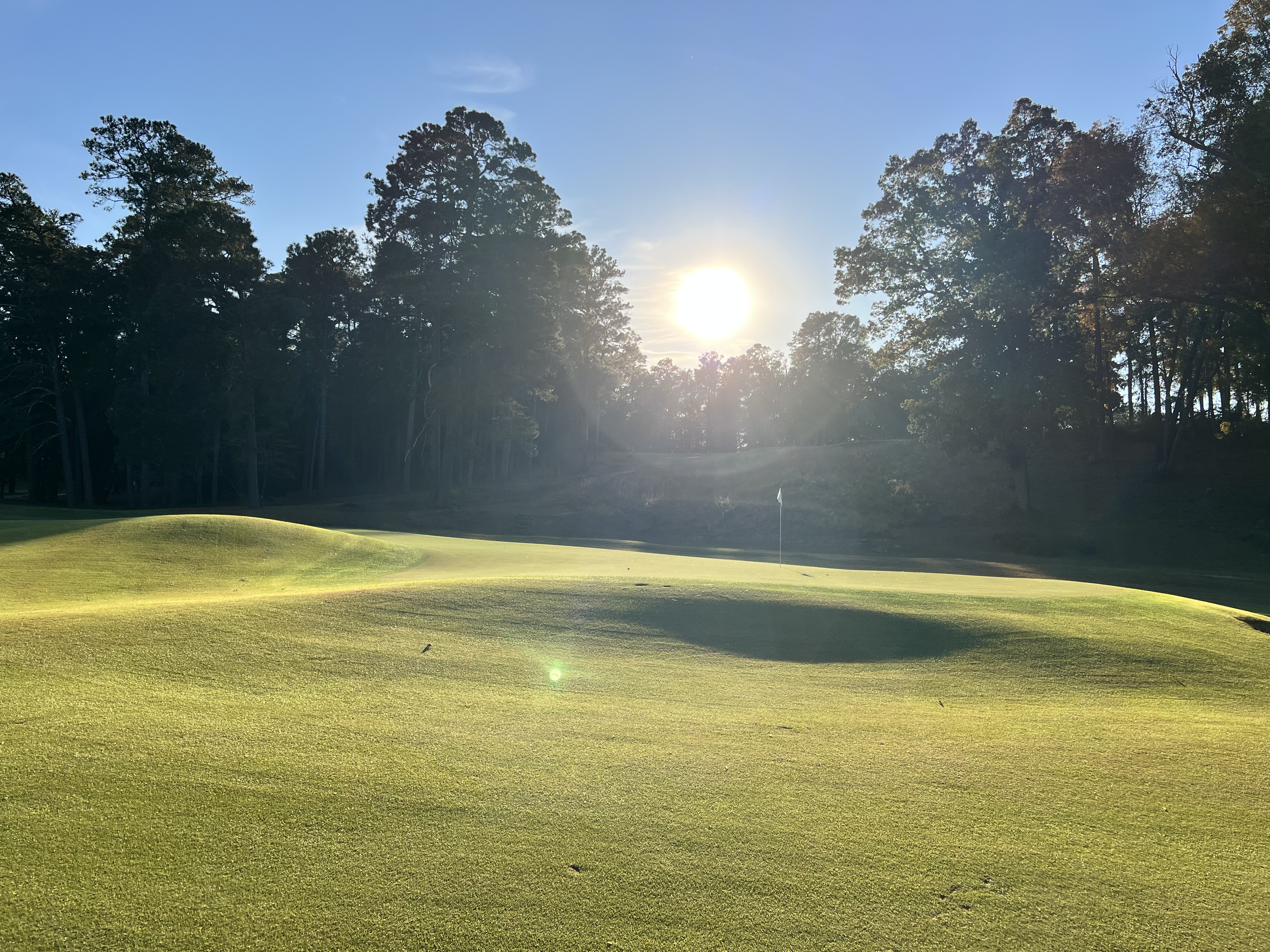
And explore we did. A week in France centered around Paris means one needs to travel a bit in order to get to the notable golf but each is well worth the journey. I got off the plane which got in early, which was good since the journey started with a round at Golf de Chantilly. I needed every minute as my golf clubs seemed to walk themselves off the plane to baggage claim. No time to spare as I pulled up, introduced myself and was walked to the First tee by one of the pros. I looked at the scorecard and decided on the Black tees, which were about 6,300. As I teed off earlier in the round, I noticed people stopping to watch. I just figured they wondered who the stranger was. At some point, however, I realized that I completely forgot about the metric system. The course was actually 6,900 yards. I was playing the tips, unknowingly. I also forgot my range finder, which was still in my suitcase. Shots were by feel and I started noticing a yardage marker off to the side, which I started to use as a loose reference point. Just off the plane with no lunch, the sun began to dim and a fall coolness settled in. The course grew quiet and peaceful those last few holes. Madness subsided and I walked off the Eighteenth at peace. It wound end up being the best scoring round of the trip.
“There is but one Paris and however hard living may be here, and if it became worse and harder even—the French air clears up the brain and does good—a world of good.”
– Vincent van Gogh
France is full of excellent golf. Some of it are within far reaches well away from Paris but our radius was a few hours driving distance from the city. This radius encompasses extraordinary courses, a handful designed by none other than Tom Simpson. Simpson never designed anything in the U.S. so his work is not as well known as others of the Golden Age whose courses are here. He should be just as well known, if not more so. Simpson was at the forefront of strategic design, moving away from the prevalent penal nature of the Victorian style of the late nineteenth and early twentieth century. Simpson insisted on originality, rejecting anything he believed to be unoriginal. This gives each of his courses a distinct style and identity that focus on making the golfer think, above all else. A hole should look more difficult than it plays or play more difficult than it looks was one of his famous refrains. He was eccentric and along the sign of the times, was one of the first who saw course design through the lens of art. There are similarities to Thomas and Mackenzie for the naturalism and strategy and Tillinghast for variety yet Simpson asserts a more emphatic individuality in intelligent, artistic strokes. Simpson was an Oxford educated barrister with substantial personal wealth, which allowed him to practice course design beyond the practical functionality that prevailed at the time. A refreshing sense of adventure and individuality still shows in his work. Golf de Chantilly, Golf de Fontainebleau, the venerable Golf de Morfontaine and Golf f’Hardelot – Les Pins are among his designs generally near Paris. Just as the French embrace a good deal of art and beauty within the fabric of their everyday routine, so it is as well with their history of course design, Simpson at the forefront.
The inherent appreciation of the arts and romance has benefitted our game in France well. While golf may not enjoy the same heightened reverence it does in the U.K., that is not to say the French do not have a rich history and hand in the game. Above all else, there is little to no tinkering with the courses. That is due to this appreciation sewn into the fabric, understanding that original works must be respected and preserved. It is not for others to change such work. Alas, there are no committees or club presidents and the like keen on “improving” things in a perceived effort to keep up with the modern game, or as more often happens, the club next door. Non. In France, these clubs are more intent on enjoying the design as it was meant and serve as custodians so that it stays that way. Along with a general acceptance, encouragement even, for flair and distinction, the French golf scene I saw had a je ne sais quo that gives the designs a spectrum of sophistication.
We did not stay in one place for all that long. In total, we stayed in three different parts of Paris, a night in Orleans and a couple nights up along the Opal Coast, northwest of Paris at the English Channel. Like the golf, each place visited had strong distinction and sense of beauty. We came across Orleans on a Sunday, its streets and walkways rather empty and quiet while most of the foot traffic was down at the Loire River, where a line of stands were put together as a casual market. We then played Les Aisses before heading back up North. Golf de National – Albatros and Golf de Saint Germain were next before moving up to the coast. As we were heading up that way, we ended up stopping in Amiens out of necessity for dinner. The walk from the car to the restaurant had us looking up at Cathédrale Notre-Dame d’Amiens, which happens to be the largest cathedral in France. A fortunate coincidence. The Opal Coast was more of a resort set up where a lot of Englanders vacation yet the golf is splendid. Simpson’s Les Pins is there, as well as Golf du Touquet – La Mer, which was the masterpiece of Charles Alison. We also played Belle Dune in France. Our final round was scheduled at Wimereaux, a French links on the Channel, but fatigue set in. As the last course of the trip and not realizing it would mean a few extra hours of driving as well as getting back into Paris fairly late, we called time of death on the golf and instead arrived back in Paris much earlier with enough time to take in the wonder of Montmarte. The parting time was on top of that hill, looking down upon the rest of the city. I was up the next day to see the sun rise about the Basilica du Sacre Couer, the morning quiet welcoming the sunlight traipsing about the church walls before aimlessly finding the courtyards and streets. It was then the joggers, then commuters, began filling up the sidewalks and hills while the shops slowly awoke. I walked around watching the morning bring everything to life, visited some shops for breakfast and that was it. A few movies later and I was back home, wondering if there was a nearby boulangerie worth its salt.

“I do not believe there is another city on earth so beautiful as Paris nor another people with such an appreciation of the beautiful as the French.”
– Edward Hopper
The main tenet of this journey has always been finding extraordinary golf then playing it. That journey finally made its way to Continental Europe. The golf was indeed extraordinary and probably gave me one of if not the best days of golf I’ve had. There will be more on that in the months to come. There is indeed an inherent elegance of France that is apparent within its people, places and yes, golf courses. The journey is one for golf yet also of travel. An experience of place, people, culture and what they hold dear. The more it moves along, the more I realize how important sense of place is to golf course architecture. And how important it is to seek out these places with extraordinary golf to try and understand its story and place in the game while considering where it is. Twenty years ago, I would have never thought golf would bring me to France. Yet that is the beauty of the journey and perhaps, the reason for it all along.

Some brief thoughts on each course played.
Golf de Chantilly – Vineuil. The maiden round was at one of Tom Simpson’s most revered. As mentioned, yes I played from the tips. And yes I only had a notion of how far I had in to the greens, or even where I was supposed to go off the tee. This only added to the fun; golf does not have to be a rocket launch as it seems to get some times. The strategic bunkering and deceptive visuals were delightful as I tried to figure out advantageous angling on the approaches. The subtlety underneath it all was marvelous, the green sites among the rolling terrain allowing the strategy to flourish. What I realized as the trip wore on is how skillful Simpson was at getting the most out of moderate topography here. The challenge is understated yet complex and the decisions the golfer must make, along with the recovery scenarios, are substantially infinite. The round is a grand chess match with countless ways to take that king. An all world strategic work of art.

Golf de Fontainebleau. The comparisons started early on in the trip as the second round was another Simpson design. It’s a substantial re-design by Simpson, undergone from the 1909 design of French architect Julien Chantepie. Fred Hawtree also performed significant lengthening and modifications in 1963. The natural landscape upon which the course is set is more lively and more dramatic, which is reflected in the design as well. Fontainebleau is sporty and playful in its challenge, the deception more at the greens and a lot more temptation. The Seventeenth is a short par 4 and while the fairway almost teases the golfer from the tee, the green beckons. The temptation to swing driver is too much for most all, including the member we played with. When I asked him if he ever laid up short into the fairway he said no, never. His words, not mine. “The temptation is too great.” The course moves on the forested hills and rock outcroppings, adjusting its character to fit in to the terrain. There are blind shots and several risk reward scenarios all set within tremendous beauty. The greens were smaller than Chantilly, or at least seemed that way, marked by subtlety and deception. The golfer only realizes the actual movement when he sees the ball upon it. The way in which the course is able to reflect the expressive natural landscape is remarkable, which leads to a meaningfully engaging, all world round.

Les Aisses. We were initially scheduled for an event at Les Bordes that was cancelled but ventured a couple hours south of Paris into the Loire Valley anyways. The area experienced a very hot summer and fires that took its toll on the golf courses yet were still very much playable. Les Aisses was initially designed by Oliver Brizon in 1992 as three nine hole loops but in 2010, Martin Hawtree reimagined the design, routing one of the nines as a nine hole course now known as, “La Canne” and the other eighteen into a cohesive full length course called, “Les Aisses.” Hawtree converted a lot of Brizon’s eccentric, modern design style into a more traditional heathland type layout that distinguishes itself with wide open, flat terrain defined by an array of vegetation, sandy terrain, occasional water and smart bunkering. It was one of the surprises of the trip. I found myself enthralled with each shot as I stalked my opponent in our match, finding myself murmuring to myself over and over without even thinking about it, “this is great.” My opponent kept murmuring, “this is great.” Every hole was distinct and the tee shots made you think more than that Philosophy of Language I mentioned earlier. In this way it accomplishes the wonderful structure of play typically found at those English heathland courses it sought to emulate. I would opt for a round at Les Aisses again before many other courses that are regulars on the ranking lists du jour. An excellent modern design grounded in classic heathland character.

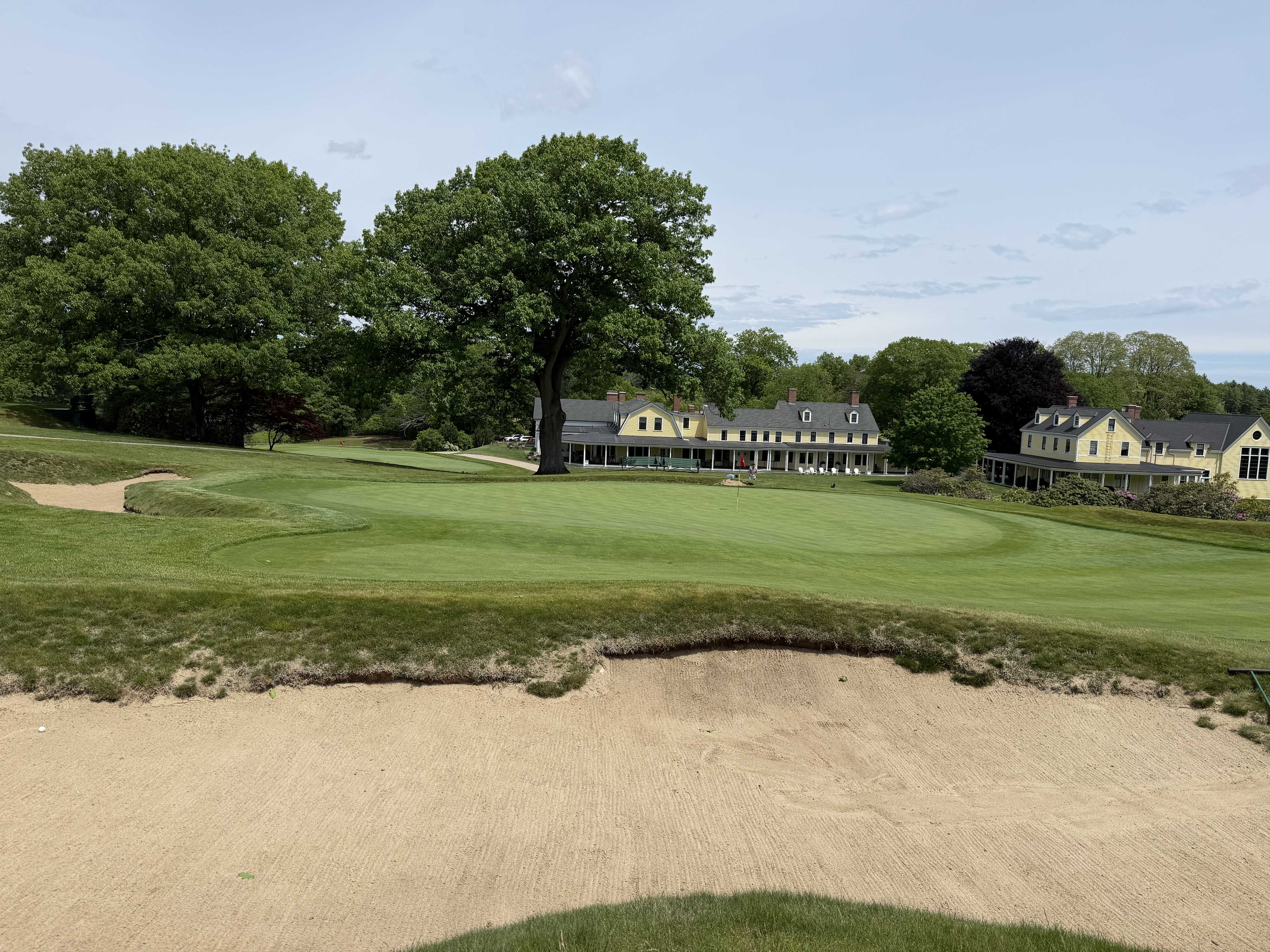
Golf de Morfontaine. Morfontaine is widely regarded as one of the best golf courses in the world as well as the best in Continental Europe. At the outset, it should be emphasized that this holds true for every hole on the property. There is the eighteen hole course named, “Grand Parcours,” which opened in 1927 and designed by Tom Simpson, then there is the nine hole course by the name of, “Valliere,” which opened fourteen years before the Grand Parcours in 1913, also a Simpson design. Both are among the best golf courses in the world, for very different reasons. I’m serious when I say there are times golf courses speak to me. The word that kept coming to me during the round at Grand Parcours was, “graceful.” It is extremely rare to come across a golf course that is able to achieve such thoughtfulness and strategic depth without challenge being the overriding objective. To be sure, there is challenge but it is beside the point. The course seeks to evoke a much more meaningful response from the golfer. The interaction with the land is sage, the forested sandy floor always moving about the terrain at an angle. The use of the naturale is quite imaginative but again, it favors more of a strategic creative playability so that the golfer is more rendered towards a synergy with the surroundings instead of simply plotting against it. For example, the bunkering doesn’t simply ask whether one can carry it but rather, what is the advantage to carrying it in the first place. There’s a splendid scale as well, grand for the most part that allows intimate chapters throughout. That could be a tee shot or a green or even a series of holes, so that the features, no matter how grandiose, never overwhelm. This is due to functional beauty, all of it part of the structure of play and none decorative. This is also supreme design of width at its finest. The greens are large and the apex of this grace of the course. Bold interior contours alongside broad shouldered sweeping slopes that slowly then all at once transition direction. With the understated yet tasteful country home as the clubhouse and quiet sophistication that pervades, it was the most polished round of golf I have ever played.

The Valliere is a wonderful complement to the Grand Parcours. The terrain is hillier with moody undulations and the design follows this rambunctiousness. The starting series is within the hills and the golfer finds himself rising and falling to great heights and depths. Then the closing stretch comes down to the valley floor yet uses knobs, hollows and ridge lines for its wild fits. It would be perfectly understandable for the golfer to go on fits of delight and madness, sometimes all within the same hole. The variety is remarkable, making sure the golfer keeps his wits about him. Always in thought and focus in stronger more direct strokes than the Grand Parcours but encouraging more wild risks as well. With no hesitation, it was the best nine hole course I have played.

Le Golf National – Albatros. The Albatros intrigued me ever since the 2018 Ryder Cup was played there. It had a way of flummoxing the American golfers by essentially completely eliminating the possibility of the bomb and gouge. Designed by Robert von Hagge and consultation by Hubert Chesneau, the course opened in 1990. Even at that time the design was unique in how it challenged the golfer, demanding positional execution above all else. There are several risk reward plays and whichever option the golfer chooses, he must do so with precision. The penal elements abound, which include plenty of water, fescue and hay rough. If the shot miscalculates or is executed poorly, it is likely to excise at least a stroke penalty. The course is an interesting and unique challenge in how it emphasizes precision and thought over length. In that way, it equalizes the playing field. Accuracy above all else. The course certainly made me plot and think my way around. I found it sporty and interesting in how it really demands fairways and greens are hit, as recovery opportunities are limited. When one understands and accepts that concept, it is amazing how his game can focus accordingly. A beguiling gauntlet if there ever was one.

Golf de Saint Germain. We played the eighteen hole course here, not the nine hole. The Grand Parcours was designed by Harry Colt, dating back to 1922. Set on a relatively flat site, Colt wrought interest with attending grabbing bunkering and mounds that likewise instills much of its strategic interest. The tee shots are rather inviting yet where they end up with respect to their angle to the pin is what matters. The greens vary in size, to the gargantuan Second to the much smaller Seventh. There is a nice push and pull between heathland and woodland structure, the playing styles varying mainly with the tee and recovery shots. It’s a great Colt design for the variety of approach shots and skills needed as one gets closer to the green. The greens and bunkers are phenomenal, making it well worth the sojourn.

Golf d’Hardelot – Les Pins. If Les Aisses surprised with just how engaging of a round it was, Les Pins was just as surprising for altogether different reasons. The fourth (or four and a half) Simpson design of the trip, this is where his devotion to originality became vividly apparent. The hilliest of the Simpson sites we saw, there is a lot that stood out here. Opening in 1931, the course could have easily overly relied on the mature pines that pervade but instead, they are only used for framing and definition. Instead, the structure of play is more reminiscent of links, the mounds and hills used more like dunes. They play with visuals, selectively fall off on specific sides and move in assorted directions so that the degree of roll out becomes a primary consideration. Frank Pont and Patrice Boissonnas performed some restorative bunker work last decade. The bunkers are critical to the design in how irregular and bold they are, which adds to the originality of character. That originality of character is felt at each hole, which asserts its individuality from the others yet remains cohesive. Like a tasting menu at a restaurant you know will end up one of your favorites after the second course. It is an excellent course and for me, much higher than many might expect.

Golf du Touquet – La Mer. Also opening in 1931, La Mer was designed by Alison and Colt yet there is some discussion as to how much each contributed. Top100golfcourses.com might have the persuading source on this by pointing out that in 1936, J.S.F Morrison, a senior partner at the architectural firm none other than Colt, Alison and Morrison, Ltd., wrote in The Bystander magazine: “Captain Alison designed the new course at Le Touquet, and was secretary of Stoke Poges shortly before the war, but he is chiefly famous for having, when representing Oxford v Cambridge, played off the roof of the clubhouse at Woking to halve the last hole in 5.” A partner at the very architectural firm in question wrote publicly it was the work of Alison. Colt was certainly involved to some extent and the name has more recognition, so it has been embraced a bit more despite Alison’s chief involvement. The course was significantly damaged during WWII but in 2010, Pont and Boissonnas began an extensive restoration plan in earnest, using historical aerials and survey information. The restoration was completed in 2017. As for the course, it is more based on links traits, confronting the dunes head on for the most part. Climbing them, diving off of them and climbing them again, the adventurous routing stays thrilling by constantly seeking the dunes out and tussling with them. The scale seems to do the exact opposite of Les Pins in that there appears to be infinite wide open space yet the tee corridors are more demanding while the approaches are more inviting from a broader spectrum. Our man Simpson reportedly called the Fifteenth one of the finest holes he had ever seen. The transitions between low and high are mesmerizing and the links shots around the greens are substantially pleasant. Magnifique.

Belle Dune. Along the lines of Le Golf National, Belle Dune is a modern design that sought to push standard norms with some bold experimentation. The transitions between the hilly pines to the coastal dunes and back again is notable, as are a handful of the holes. The holes reflect whatever landscape they’re in and most of the more interesting plays were in the wide open spaces on the dunes. The back nine uses the pines more interesting as the front is fairly confined, perhaps to accentuate the refreshing release of the width out at the dunes. It’s a unique play and I’d rather see something different upon this setting such as this design than conventional tree lined parkland fare that dots the Mid-Atlantic. But the confined tree corridor holes bring down the cooler experimental ones. One could also make the case that the cooler experimental holes actually make the course.



You must be logged in to post a comment.