2,943 yards, 115 slope from the Blue/White tees
There are the dog days of Summer and then there is the dead of Winter. The dead of Winter of which I speak has more to do with golf and the long sleep that is the off season. Philadelphia enjoys its days when you can get out and some of the warmer days it almost feels like a fool’s early Spring, but the death is something else entirely. It’s the course with the halfway house shuttered and patio furniture no where to be found. Temporary or alternate pins and walking only. Whistling wind dominates any sound out there while everything has a distinct ghost town feel. The branches and limbs creak and sway, the off fairway is more haphazard piles of sticks than any kind of rough. There’s usually a soggy spot walked through every now and then, out of no where. The sun is likely shining but does very little, your face almost instantly gets cold and stays that way until you’re back inside, for a while. All of this makes it feel like the proper golf season is a long ways off, on the dark side of the moon if you will. Just a tinge of despair but despite it all, the golfer takes it any day of the week and twice on Sunday. It is golf. Hearty, grinding, damn raw golf. One keeps these dead of winter rounds with him. They keep him going and sharpen his resolve when the time comes.
The round at Flourtown was distinctly one of those dead of winter days. I wouldn’t have had it any other way.
Flourtown Country Club originated as a full eighteen hole course designed by Donald Ross in 1914. It was known as Sunnybrook Golf Club back then. In the late 1920’s, William Flynn was commissioned for re-design work, which he carried out. The construction of Highway 309 would intrude on the course, most notably the Fifth green, so the in the 1950’s, the club decided to move at which point it was taken over by the local township. The northern nine holes were sold off for development. George Fazio then came in to redesign the remaining nine holes (although there is some indication of involvement by William Gordon as well) and the club became known by its namesake at that point. Plenty of history and evolution within the nine holes, which includes a rare Ross design worked on by Flynn afterwards. Flourtown is some where I have wanted to see for quite some time and on one of those taciturn winter days, it was time to take hold.
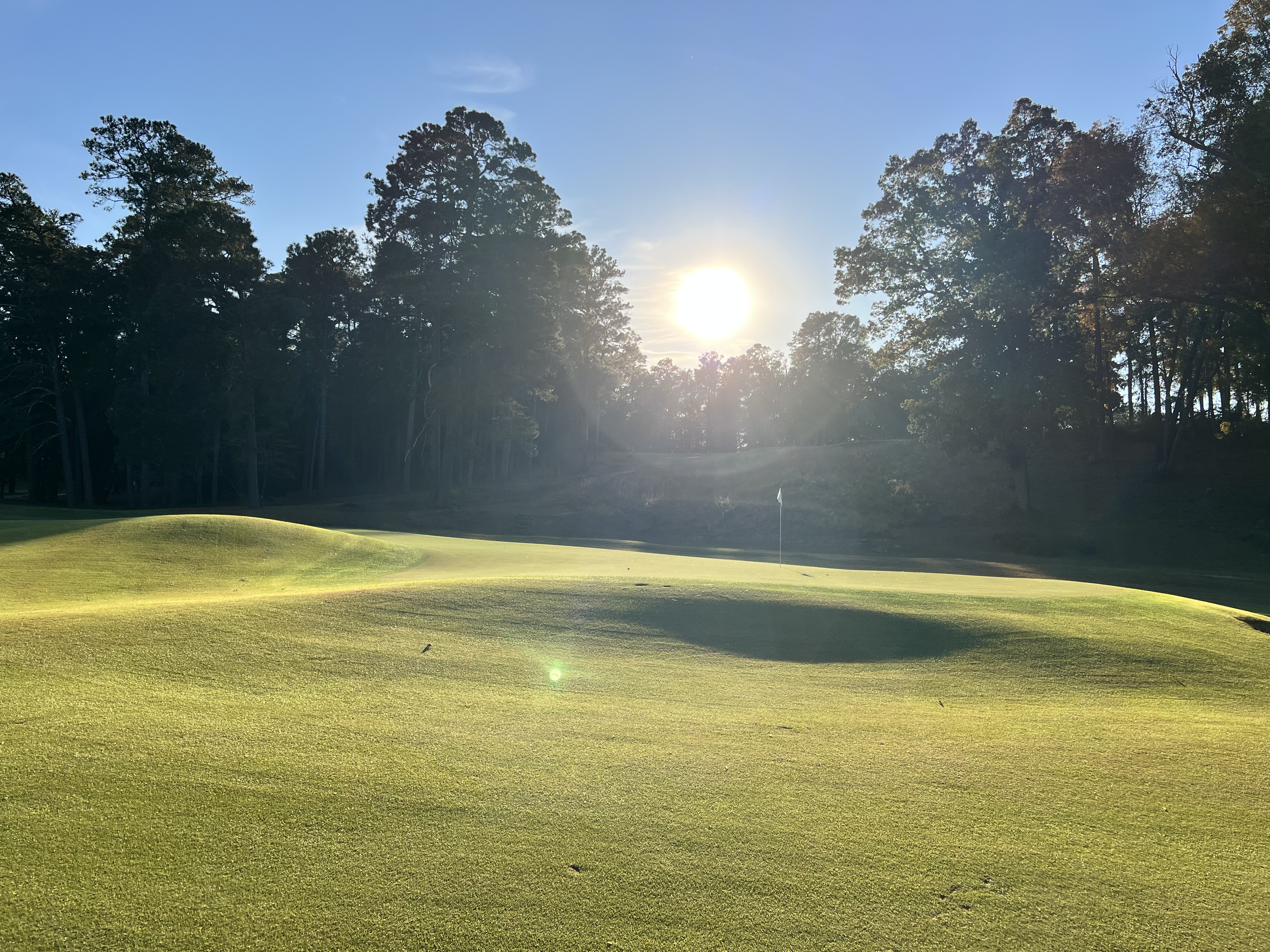
The routing stood out, making the most out of the predominant hill upon which the clubhouse sits. This provides much of the variety of shots into the green while the tee shots are more straightforward. The greens have a good deal of interest and that’s in large part based on where they are placed. The mounding and bunkers are likewise placed well, more for strategy than anything else. I found the golf easygoing yet engaging and that engagement seemed to increase as I got closer and closer to the hole. The design doesn’t derive interest with ethereal views or standout quirk. It does so with that solid routing, adept use of the existing terrain, intelligent use of design features and some refined restraint. I’d like to visit again during the season when ground movement is a bit more spry but it did just fine on that winter spell of a day. A classic structure of play very much in tune with the Philadelphia course design scene from architects that produced many of the other courses in the area, Flourtown is a worthy jaunt.
The First is a 372/422 yard par 4 (from the White/Blue tees; the second nine is played from the Blues). Straight downhill from the clubhouse, trees line either side. There’s a bit of an uphill towards the green and a bunker front left to contend with and the rear of the green is pushed up. A gentleman’s opener. This used to be the Ninth, which played as a par 5 up the hill. Flynn’s re-design incorporated a central fairway bunker.


The Second is a 448 yard par 5/408 yard par 5. Still moving about the perimeter of the property, the tee shot negotiates a hill with a couple bunkers on the left. The entry point is between a couple bunkers on either side, where accuracy is at a premium.


The Third is a 145/167 yard par 3. A short par 3 down the hill to the green with a bunker at the front left. There’s plenty of room off to the right to hedge the tee shot and avoid going too far left.


The Fourth is a 283/260 yard par 4. This part of the property used to extend away from the clubhouse but the 309 construction ultimately led to many of the original holes NLE. The course now turns back in the direction of the clubhouse while remaining on that outer perimeter. A large bunker on the left demands attention off the tee. It should be avoided, yet the tee shot needs to flirt with it in order to set up an ideal approach. One could lay up short of the bunker for a longer approach in, yet it would still be a shorter club. A pretty good short par 4.


The Fifth is a 437 yard par 4/478 yard par 5. The outer loop ends by moving up the hill to the other side of the clubhouse than the First. It’s really the reverse of the First in that it enjoys similar width and is relatively straight. The approach and green were one of my favorite of the course. The bunkering is nicely positioned and the movement both towards the rear and front is well done.


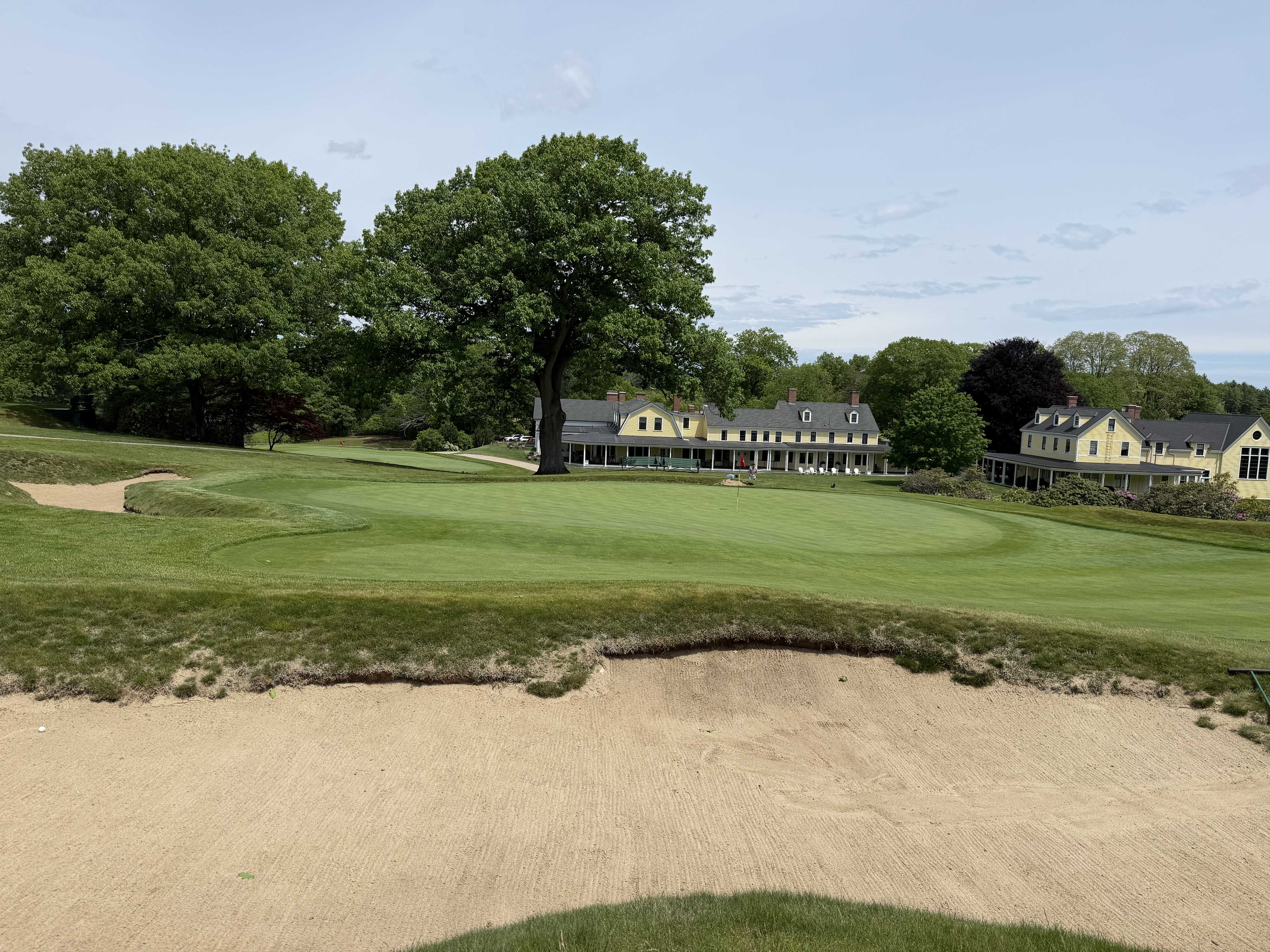
The Sixth is a 432/380 yard par 4. This used to play as the First hole originally and with the clubhouse immediately behind, it is easy to see why. The fairway bunkering that was in place is no more, nor is a left bunker short of the green. Now, the tee shot remains downhill with a right to left tilt. The approach is uphill, with bunkers on both sides ramping up to the green. The green has a bit of a curl to the left at the rear.


The Seventh is a 267/293 yard par 4. The rest of the nine moves in a counter clockwise inner loop. The short par 4 has a left to right movement from the prominent hillside. The right fairway bunker needs to be carried or maneuvered around while the green is in the midst of a number of bunkers, placed perpendicular to the fairway off to the right. The green is wide and shallow, leaving the golfer to figure out how best to approach it. The bunkering, green placement and general terrain movement all pitch in to make this an interesting play.


The Eighth is a 166/129 yard par 3. The only water on the course must be carried off the tee to reach the green, which moves at an angle away from the golfer. There’s a good amount of room to miss off to the right while left misses will have to deal with trees.


The Ninth is a 349/406 yard par 4. Back up the hill to the clubhouse, the tee placement helps accentuate the dog leg to the left and uses the hillside at a nice angle. This provides some challenge and thought to the tee shot. The approach then moves uphill to the green where an assortment of bunkers and even a tree at the rear right await. There is plenty of back to front movement to consider on the approach and while on the green.


The nine holes is essentially a five hole outer loop moving clockwise followed by an inner counter clockwise loop of four holes. The short par 4’s were nice plays while the greens held a lot of interest. I would rank them 4, 7, 5, 2, 9, 3, 6, 1, 8.
Generally, Flourtown is a classic nine hole that uses the natural undulations well and is set up for brisk ground movement. There is enough thought and challenge to go around, all of it in a fairly traditional classic structure of play. While highway 309 had a substantial effect on a number of golf courses in the area, Flourtown managed to adjust and now offers an engaging course that is now a rarity of sorts. Solid design fundamentals and again, the ground game has a good amount of thrill.
Clubhouse/Pro Shop: The classic stone structure is worthy of a tour while the pro shop is next to the First tee.


Practice area: There’s a putting green and perhaps a hitting net or simulator for warm up.


You must be logged in to post a comment.