6,162 yards, 133 slope from the Blues
Winter golf and all its promise. A sign of things to come in better climates, when the courses and clubs are full of life. Yet it must be said that the quietude of those winter fairways can be just as fulfilling. While most are resigned to wait out those months inside with the warmth, this leaves the outside a pleasant desolate respite. The swing seems to loosen up as the only purpose is to get outside and enjoy it. There are no club championships or match play events or rounds to post. It’s funny how it works and surely the slower conditions help but the golf indeed gets easier. This adds to the anticipation of spring. It’s all a wonderful cycle. Of course, the trick is usually figuring out when one can actually dodge the weather and get a round in, but seems to have become easier in recent years. Also, one of the best things about winter golf is how much easier it is to golf courses that have been on the list for quite some time.
Reading Country Club is some where I’ve been meaning to play for close to a decade. Time does fly and it was a January when I decided the time had come. I became undeterred, even when my playing partner had to bow out for a work emergency (or he saw a change in the forecast) but no matter. The time had come to finally get to Reading. The place is too close and has too much history to ignore for another day. The first nine holes were designed by Alex Findlay in 1923 and then he expanded to eighteen holes in 1925. Golfpass includes Hugh Wilson with a design credit as well but I cannot find anything further supporting this. The remarkably fascinating and historically relevant clubhouse was designed and built in 1931 by Harry Maurer after the original clubhouse burned down. Findlay was also involved in nearby courses Galen Hall, The Manor and Riverside Golf Club (NLE) as well as providing consulting services at Berkshire Country Club. Byron Nelson became the head professional here in 1937 – 1940, winning the U.S. Open at Philadelphia Country Club during his tenure. The course was also co-host for the Reading Open, which was a prominent tour event for decades in the century prior.
One of the noteworthy characteristics of Reading is how preserved the course and clubhouse are. In fact, the course website has a treasure trove of historical articles that highlight its rich heritage, which I urge everyone to peruse. This is a course that enjoyed quite a bit of prominence for a sustained period of time in eras past. The club was private until 2006, at which point Exeter Township purchased it. Whether the membership always knew what they had or lacked funds to engage in too much significant transformational work, the course and club have managed to stay relatively intact. All for the better. The course exudes a rich classic character that is becoming more and more difficult to find in the public sector. In comparison to Tavistock Country Club that was just reviewed https://golfadelphia.com/2024/07/09/tavistock-country-club/, the course is set on more topographically interesting land that Findlay used as cues for his unique mounding and bunker work that is likewise on display at Tavistock. Here just as there, there’s a strategic structure of play borne out of the terrain features that occasionally can seem abrupt or bold but are flowing with the natural surrounds just the same. The green complexes stand out with their rumples and bold variety, which don’t just suggest, but dares the golfer to attack them any way he sees fit. The challenge is likewise at the tee and fairway, as it is not enough for the golfer to swing away and hope for the best but to look at the green and plot accordingly. Admittedly, one of the other advantages to winter golf is that tree effect some what subsides, so playing corridors are restored to some limited extent and here, there were very few instances where I felt trees were impeding too much. The character of the course cannot be denied and beseeches the golfer at most every shot to delve into his creativity. All of this was done in naturalistic tones and coming away from the round, my admiration of Findlay grew.
One of the very cool articles the website has is Findlay’s description of the course and its holes, which he wrote for the Reading Eagle on October 22, 1922. You could say that Findlay was not only the father of golf, but the father of Golfadelphia. Findlay writes that the beauty of the course is unsurpassed and remarks how all of the greens and pins can be seen from their respective tees. Findlay also mentions how the Ninth, Eighteenth and even Sixth and Sixteenth return to the clubhouse, which shows the various loops the golfer can take if one is looking for less than eighteen. Some of his descriptions of the holes will be included below but again, I urge anyone interested to read the article in its entirety. As I wrote in the review of Tavistock, Findlay is not as heralded an architect as others of the Golden Age which is a detriment to us all. His designs are unique and full of sharp, whimsical character that set him apart for just praise as the others now receive. A prime example of this is at Reading.
Indeed, the winter asserted itself as I was on the back nine with swales of snow flurries gently blanketing the fairways ahead. It was far from blustery, instead it was charming. Winter golf at its finest, on a remarkably historical course that I had all to myself; the game keeps on giving even in those seemingly cold, barren times that prove to be anything but.
The First is a 371 yard par 4 (from the Blues). A long dog leg left that Findlay calls a, “slight dog leg,” the elevated tee shot must thread through trees on both sides to the plateau fairway. Those who end up left off the tee will end up in a gulley below the fairway and the blind out of view. The green is, “terraced on a rock ledge” and is nicely contoured. The rear of the green falls off dramatically, so staying somewhat short is a good idea. A nice little opener.


The Second is a 386 yard par 4. Findlay elevated the tee shot so the golfer could, “see his ball sailing in the middle of a nice valley.” The green is a bit below the fairway but that is tough to discern with a large mound before the green that obscures the approach view and repels shots to the green that are grossly short. Findlay characterizes the hole as an easy par and mentions plural bunkers about the green that are easy to get out of but there is only one on the right present day. The sunken green in conjunction with the mound makes for a terrific approach.


The Third is a 365 yard par 4. Now running parallel to Philadelphia Pike, the tee shot is to an uphill fairway that bends to the left a little. Findlay characterizes the green complex as very large and rolling, surrounded by grass and sand mounds. He calls it one of the nicest holes to play and I agree. The incline of the tee shot is a prelude to the wonderful green that shows just how remarkable he was with mounds. Worth the price of admission alone.


The Fourth is a 203 yard par 3. The first three holes are a nice warm up, which Findlay calls a chance for the golfer to limber up and limit congestion of the course. He refers to this hole as a 265 yard par 4 but it is now a long par 3 that must carry Antietam Creek. There’s ample room leading up to and around the green with a bunker on either side. You don’t necessarily need to hit it to the green but however you do it, you must get the ball a span of about 200 yards and in the hole in at least three strokes or bogey awaits.


The Fifth is a 523 yard par 5. The tee shot needs to hedge slightly left but there’s lots of room to work with. Antietam Creek crosses over the fairway and needs to be carried on the second shot, then again at the third. The green is deep and narrow with room short that is only useful if one carries the creek. Findlay says it best; “A long hitter may be tempted to reach home with a long second shot, but he won’t be in a hurry to attempt it a second time.” The carries over the creek must be strategized, which becomes tougher if one falls out of position. But be sure to take in the scenery.


The Sixth is a 159 yard par 3. “A grand test of golf” Findlay proclaims here, with its green set on a hilltop high above the tee. The green is a good size and the areas around the green are fascinating, to the point one almost wishes his ball misses the green into them just for the chance to think their way out. A real good looking par 3.


The Seventh is a 426 yard par 4. From the hilltop, we tee off down to the fairway below. The routing shows its brilliance as the creek is now in play for the fifth time in three holes. It either comes into play off the tee for the longer hitters or on the approach. Either way, it must be carried. The green is nicely placed in a meadow, elevated, and surrounded by an array of shallow sand traps and mounds, according to Findlay. I couldn’t have said it better myself. It used to play as a par 5.


The Eighth is a 183 yard par 3. I probably don’t have to say it, you know by now. Yes, the tee shot must carry Antietam Creek which rushes by the foot of the green, as Findlay writes. Bunkers and pits are below the green as well. Like the Sixth, the tabletop green sits precariously and only true shots will remain on.


The Ninth is a 328 yard par 4. With the First directly off to the left, we head back up to close this nine out almost exactly where we started. The fairways are pronounced as the ridge remains rough, giving the golfer a choice where to go off the tee. A slight crink to the right with trees on both sides leading up to the green. At the green, however, things are nice and open, which accentuates the bunkers and mounding surrounding it. Findlay calls it, “a first class hole.”


The front nine is a great set of holes. Every single one is solid, set very well on the terrain and emphasizing variety with a really good set of green complexes. The off green areas are excellent as well. I would rank them 3, 2, 6, 9, 7, 8, 1, 4, 5.
The back nine starts with the 169 yard par 3 Tenth. The tee shot is slightly elevated while the green sits on a knob separating it from the Eleventh tee. Findlay refers to this as a par 4, but the green sit remains the same, which he characterizes as, “scientifically trapped.” The rear bunker is indeed devious and only overly aggressive shots should be back there considering the size of the green.


The Eleventh is a 391 yard par 4. Moving uphill, the fairway dog legs hard left, which the golfer must account for off the tee. The tee shot must focus on accuracy more than length, as the ball will start to veer off to the right upon landing and the approach will be a challenging one. The green is on a hillside that moves right to left, which falls off sharply on that lower left side. A bunker is below on that side as well as the rear, so the golfer is able to use the right side to have his ball fall down to the left, or even use the front right in the same manner. In terms of extreme dog legs, this is a good one. Findlay seemed to enjoy them, as there is one at Tavistock as a par 5 as well.


The Twelfth is a 360 yard par 4. We cross over Fairline Road for the next couple holes, the first being a par 4 that drifts off to the right from the tee. Trees on either side ensure a more accurate tee shot and the uphill fairway pulls at the shot upon landing. It used to play 70 yards longer and Findlay regarded it as one of the tougher holes on the course. The current shorter length gives one a more controllable club in their hand on approach, the green moving right to left. Mounding to the left and a bunker to the right for those who feel like missing their approach.


The Thirteenth is a 407 yard par 4. Moving back slightly downhill in the direction we came, the fairway lists to the left from the tee. From Findlay, “The green nestles at the foot of very large trees, numerous fruit trees skirt the fairway boundary. . . punishment awaits the wayward.” That’s the gist of it, the tee shot needs to favor the right side to access the green that is up against the trees on the left. A bunker at either front corner are well off the green but can come into play with even reasonably missed approaches.


The Fourteenth is a 510 yard par 5. Back over the road and the first par 5 is straightaway. Findlay had a penchant for ensuring straight holes played just as interesting as those that turned and twisted, mainly by utilizing unique topographical features. Here, he head out down a hill that gets more substantial as we go along with a bit of a left to right cant. As one gets closer to the green, the features start to impose themselves, starting with a hogsback eschewing shots to one side or the other while the green is hidden downhill below the fairway, scooped out of the hill surrounded by numerous difficulties as Findlay puts it. A significant right to left movement with no where admirable off the green to favor. Findlay called it one of the nicest long holes in the United States and it is understandable. The green complex is so creative in how it uses the hillside and the build up before the green is likewise a real good example of not simply using terrain features but using them the right way.


The Fifteenth is a 220 yard par 3. The course doesn’t let up as the golfer now faces a long drop shot par 3 across our favorite creek. Findlay characterized it as the third and final par 3; the Fourth and Tenth were originally par 4’s. He also has it listed as 175 yards. Findlay champions his triumvirate of iron shot holes here, comparing them favorably to those at Tavistock. A bunker is at the left while some room to miss is to the right while not all that much room is at the rear. One could lay up to the creek and opt for an up and down from there. Drop shots are largely about whether you hit the shot or not, which is essentially the case here.

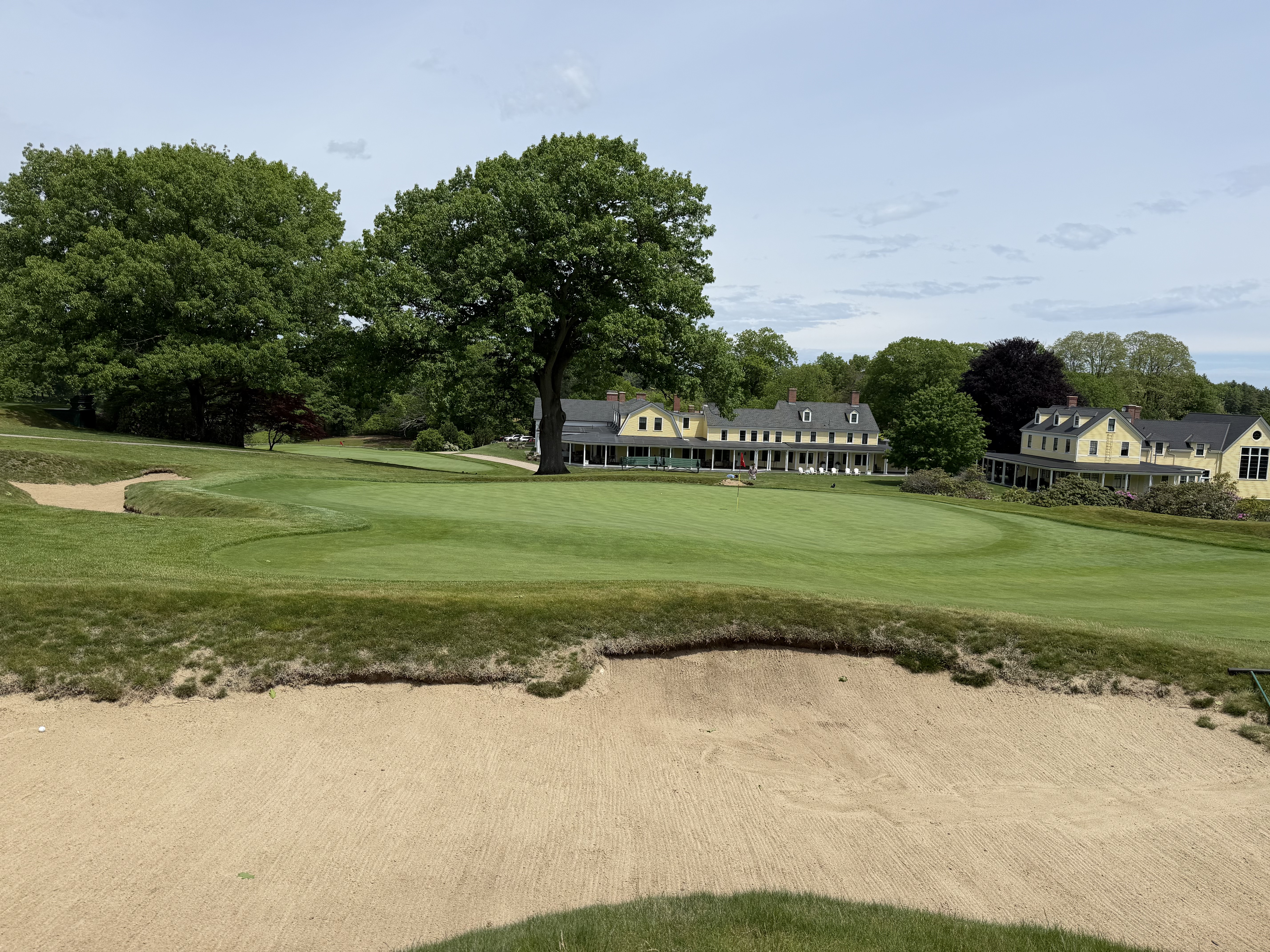
The Sixteenth is a 304 yard par 4. Antietam Creek is just past the tee and beyond it, the fairway climbing uphill to the green beyond its crest. Findlay refers to the green as well bunkered but there is only a single one now on the right side. The clubhouse is on the left, which Findlay also mentions how easy it is for those winning their match 3 and 2 to strut the 50 yards in from there. The golfer should contemplate what club to take off the tee to remain straight between the trees that will leave him with a clear approach, the whole time favoring the left side to mind the hillside movement off to the right.


The Seventeenth is a 512 yard par 5. The final par 5 runs parallel with the Fourteenth, its green just before the road. Starting uphill, it then goes down a bit before another uphill to the green. There are no fairway hazards to speak of and a lone greenside bunker on the right. The hole seems to be changed from the original; it used to be a par 4 and Findlay writes about the tee shot looking down to the fairway and then straight out to a green that is properly bunkered. It appears its place in the routing is still intact but the tee shot was likely further up the fairway and the green is now missing some bunkers. As it stands today, keeping it long and straight will do just fine. Would be nice to see the original design here.


The Eighteenth is a 345 yard par 4. The final hole moves back towards the clubhouse, the uphill in front of the golfer creating a blind tee shot. The downhill after the hill we see from the tee is steep, plummeting downwards before back up to the green, which gives the golfer plenty of ways to get the ball rolling around. The fairway feeds right in to the green with the front bunkered on either side before the rear fattens a bit, all of it with a general back to front movement. The clubhouse is steps away yet again, Findlay making good on his promise of the various loops the golfer can take if he seeks less than eighteen.


The back nine takes us to the other side of the property and like the front, showcases its remarkable terrain that the structure of play incorporates splendidly. I would rank them 14, 11, 15, 13, 16, 10, 18, 12, 17.
Generally, Reading Country Club is one of the better public classic options in the greater Philadelphia area. Much of the Findlay design is preserved, showing off remarkable mounding and off green areas with some of the marvelous bunkering still intact as well. The playing corridors are indeed strategic, as the golfer needs to constantly make decisions on which side or ridge or hill he should strive for, which presents varying consequences for the next shot. The hills are likewise used a variety of ways even when most of them needed to be confronted vertically. A lot of this is due to the green sites Findlay selected, which opened up the rest of the land’s potential. It’s a great play, emphasizing guile over anything else. As I mentioned before, its character cannot be denied and I will be returning soon when the snow forecast is more towards nil. With Jeffersonville enjoying its revival in full bloom and Cobbs Creek in the middle of its restoration, Reading CC is now the public gem in the area the game would benefit most from restorative work taking place here. Findlay thought a lot about the course and it went on to host a bevy of tournaments in the ensuing decades of its formation. With so much of it nicely preserved and intact, it is a tremendous opportunity for the golfing public to fully enjoy the genius of Findlay on such divine terrain.
Clubhouse – Along with the course, the clubhouse is historic and interesting. Harry Maurer designed in line with the Tudor style, paying homage to the Reading in Berkshire, England, the town for which Reading, PA is named after.


Practice area: There is a driving range.


You must be logged in to post a comment.