6,607 yards, 135 slope from the Black/Gold tees
What a difference six months makes. That is the amount of time between my first and second visit to Tavistock, the first on an unusually nice winter day and the next on a clear summer afternoon before heading down to the “Shore.” The first started waking up in Manhattan late for my train and rushing down the state to meet my group on the course, the second was a relaxing jaunt with the windows down and music on. It’s not often I endeavor to return before a course gets reviewed but after the first round, I knew another round with better weather and circumstances was in order. There were a lot of appealing cool features I wanted to pay proper attention to; I owed it to myself and I sure as hell owed it to Findlay.
My first visit was brought on by a renewed desire to see more Findlay designed courses. A recent January visit to Reading Country Club was the impetus yet my own course consists of significant remnants of Findlay as well. And so it was I felt some loosely based kinship to the man but above all else, his work is interesting. Findlay is known as the “father” of American golf. He was the first known golfer to score an even par 72 in recorded competition, which he did with three clubs; a brassie, a mid iron and cleek. Findlay eventually travelled to the U.S. where he built one of the first golf courses in our country just outside Fullerton, Nebraska in 1887 (six holes). He eventually settled in Philadelphia, where he transitioned from a player to an architect, as well as club maker. Walnut Lane and John Byrne are among his designed courses, both a staple of the Philadelphia municipal scene. Llanerch, Pittsburgh Field Club and Burlington Country Club are also among his work. Never one to shy away from the bold or extreme yet maintaining a higher level of practicality, Findlay accentuated the wonder of the more severe terrain while always keeping strategy in mind. While many of the Golden Age designers have received their just due, Findlay was a slight step before them, influenced their work and produced some really good courses that don’t get mentioned in the same tones as the others of the Golden Age. They should.
Tavistock was designed by Findlay and opened in 1921 while Frank James constructed the greens. The course underwent a myriad of changes throughout the ensuing decades, which included significant changes to the Fifth, Sixth and Fourteenth when Interstate 295 was built, while bunkers and a few greens were moved when RTJ and Ault worked on the course at different times. The course then underwent significant restorative changes with Forse and Nagle in 2007. Recently, Jaeger Kovich completed a master plan that focuses on further historical restoration and renovation with Findlay’s design concepts in mind to enhance fun, interest and variety with a lot of expansions of fairways and greens as well as making infrastructure and drainage improvements. Kovich’s recent work at Cedarbrook was impressive and fairly transformative, so we will await with excited anticipation how the changes here mete out.
As it stands, the course is a great play and exudes Findlay character. Findlay wrote that Tavistock is destined to be one of the finest tests of golf in this country, showing his pride in the course. On moderate hilly terrain with various knobs and hollows, the course goes where the mood strikes and settles on natural green sites on elevated ground or at the lower end of downhill stretches. The mounding and use of the creeks and few hills are done well, all with strategy and placement priority in mind. The greens grab attention with their sizes and shapes, many of them squared off. The mounding that surrounds a lot of the greens likewise dominates as below ground bunkers vary in depth and often add an extra layer of defense. Those bunkers are typically flat bottomed and present much of their challenge from the grass faces and surrounding mounds. It’s a well put together course that tests the golfer throughout the spectrum. It will be interesting to see how Kovich influences its structure of play but with a commitment to Findlay a primary focus, it should no doubt result in a lot of newfound complexity. This will assuredly mean a return trip soon, where I’ll need to pick my seasons and prior night’s sleeping quarters carefully.
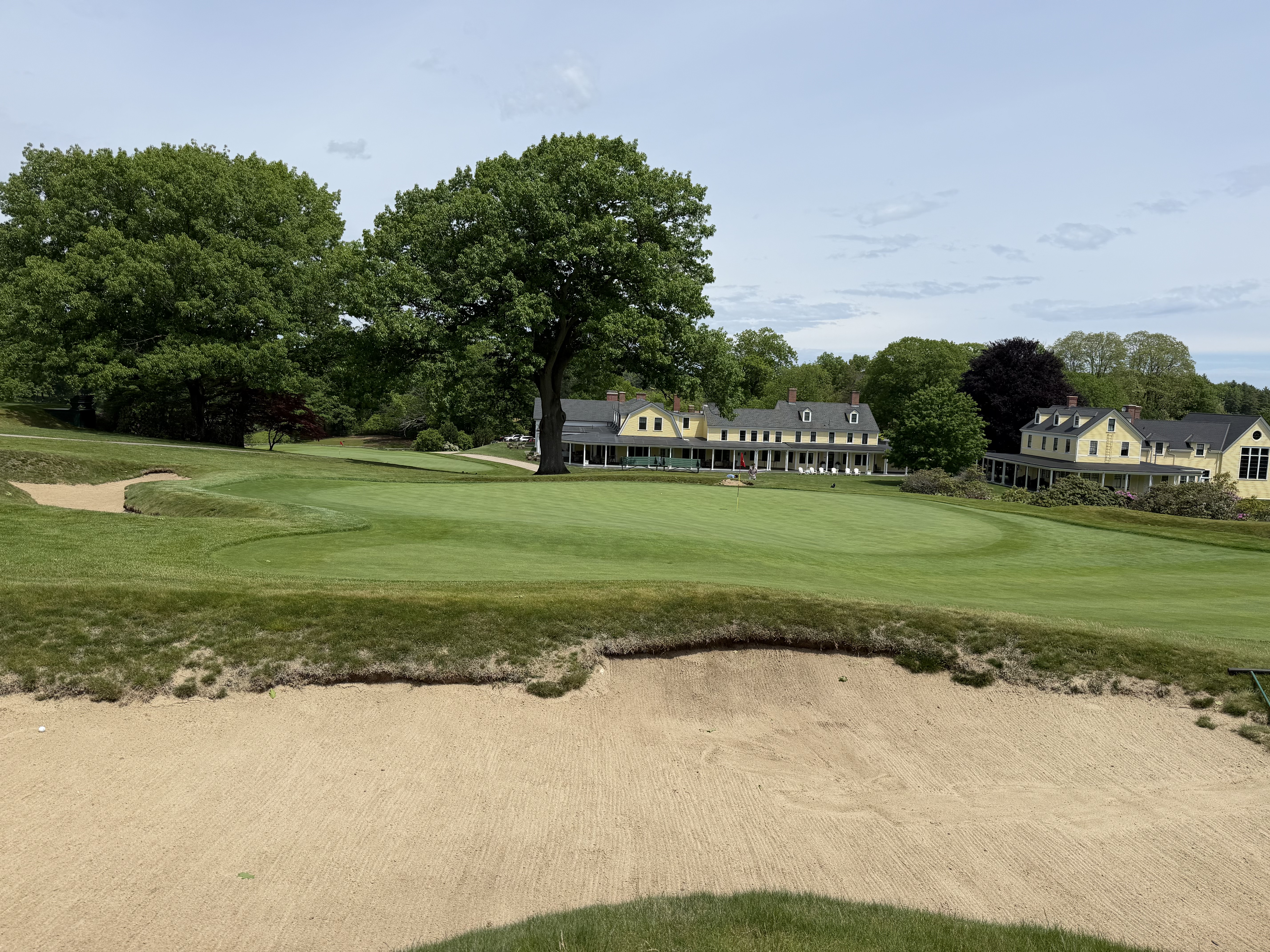
The First is a 355 yard par 4 (from the Black/Gold tees). With the clubhouse perched on the right, the First heads to the opposite corner from where where the majority of the course is located before coming right back around. A fairway bunker on either side comes into play off the tee, then the fairway widens moving past them. The fairway starts to constrict moving closer to the green, which is pushed up from the fairway and has a front neck of an entry point before widening out, with two deep set bunkers on either side of it. Based on the master plan that can be found on the club’s website, it looks like Kovich, among other changes, seeks to modify the two fairway ways and reposition them a bit further away from the tee while expanding the green and enlarging the left greenside bunker. A nice traditional hole that plays uniquely based on utilizing elevation changes and variations in fairway/green width.


The Second is a 546 yard par 5. Reversing course and moving back to the interior, we remain on the perimeter of the property for the next few holes. Trees line both side of the fairway, which is straight to the green. A single fairway bunker on the right is all that stands in the way of the golfer getting to the green. Like the First, the entry point to the green narrows from the rest of the fairway like an hourglass but here, the apron is wider and can be used a lot more to run shots up to the heart of the green. Bunkers on either side lurk well below the green. Kovich’s changes here include adding fairway bunkers on either side where the existing one is, shifting the existing left bunker closer to the green to the right side and including a short grass area on the left of the green that would move around the bunker on that side.


The Third is a 404 yard par 4. Still moving in the same direction as the Second, the fairway moves slightly left and there are no fairway bunkers to speak of, yet. There is a ditch on the left side in the rough, however, that needs to be avoided while the apron leads uphill to the green, careening to the left. It’s one of the oldest holes on the course. Here, Kovich intends to expand the ditch and swales while connecting the fairway to them, remove some trees, restore a right fairway bunker after the tree removal and shift the green a bit to the left, away from the property line.


The Fourth is a 159 yard par 3. The first par 3 maintains the same direction along the perimeter with the green pushed up above the fairway. It’s a larger green, with larger bunkers swirling about it in turn, with a good amount of movement from right to left in general. The course seems to uncork a little bit at this point after an opening sequence that focused on precision. Kovich’s changes here include emphasizing a forced carry to the green by replacing the fairway before the green with heathland style ditches and have water running around the front, rebuilding and repositioning the green to make it two-tiered and more over to the left, removing the right greenside bunker in place of short grass recovery area that will meld in with the Fifth tee and continue with tree removal on the right.


The Fifth is a 512 yard par 5. The hole is one of the newer on the property, mostly the result of RTJ’s work in the 1950’s. The trees encroaching on the right make it all too clear that the tee needs to stay to the left, which is fine since the hole starts moving to the right and we’ll have a clean look to the green. The fairway is separated by a creek that runs through. It’s a narrow slit of a creek, like a surgically cut burn. The second shot needs to carry it and decide whether to carry the water further up that crosses closer to the green. The deep green is on the smaller side and a bit narrow, so utilizing the area before the green to get close to the pin instead of trying to heave-ho for it on the second is advisable. Kovich aims to insert more Findlay character here by taking the trees out on that right side to open up the tee shot, remove the trees on the left, then rebuild the green while re-bunker a lot of the area near the green to insert more strategy and options about it.


The Sixth is a 382 yard par 4. We start to head back to the clubhouse. The tee shot is slightly elevated while the fairway cants from left to right. The creek from the last hole crosses through this fairway as well, which can come into play off the tee, so pay heed. The fairway stays wide after the creek but starts to narrow moving to the green. After the entry point, the green spills over to the left and moves in that direction, which means most approaches need to favor the right side of the green. Here, Kovich wants to expand the fairway and green as well as re-work the bunkers a little.


The Seventh is a 377 yard par 4. A modified dog leg to the right where the golfer needs to think about his fairway positioning to set up the approach. The more left, the safer but views of the green start to get limited the further over one goes on that side. A narrow strip of fairway branches off to the right and meanders to the green. A couple fairway bunkers reside at the front corners. The green is on the smaller side, so the approach must be fairly precise while the mounding and bunkers serve as worthy adversaries for those scrambling back on to the green. Kovich would like to install a center line bunker to add to the tee strategy and force golfers to commit to the left or right side, then expand the green and surrounding short grass area for even more options around it.


The Eighth is a 190 yard par 3. A longer par 3 that is more exposed to the wind sitting in the middle of the property, the green sits slightly above. It’s a great par 3 that recognizes its length and provides plenty of ways for the golfer to approach it with the fairway before it. Kovich plans to restore the greenside bunker on the left front and expand the green while lowering the front edge that has built up over time. One of my favorites on the front.


The Ninth is a 357 yard par 4. A slight dog leg right, the hole was originally the Eighteenth. The fairway works off of the hillside to the right and the golfer needs to clear the trees on that side for a view of the green on approach. The green is set upon the hillside amidst rough and bunkers. No doubt about it, the position of the green on the hillside makes the approach one of the tougher on the course. One has to negotiate whatever wind might be blowing through with the movement of the hillside and for those missing the green, recoveries out of the bunkers and rough is likewise challenging. It’s a tough hole and knowledge of how the terrain moves helps. Kovich will be taking out the trees on the right, fill in the center bunker towards the end of the fairway and most significantly, will re-work the punchbowl green by adding a second punchbowl and removing the steep false front.


The front nine is an out and back for the most part, starting out through trees before finally getting more out in the open and exposed to the wind. The par 3’s are real good while the 4’s and 5’s do well in staying varied within the design theme. I would rank them 8, 6, 4, 7, 9, 5, 1, 3, 2.
The back nine starts with the 342 yard par 4 Tenth. Heading out in the opposite direction than the First, the fairway moves slightly downhill to the green. Like the Seventh, the entry point narrows from the fairway and takes a circuitous path off to the right to the green. On either side are large shallow bunkers that fill out the front of the green nicely. Kovich seeks to challenge the tee shot more by installing a large bunker that will come into play here and on the Eighteenth, which in turn means expending the fairways of both holes so they connect and expand the short grass area around the green and green in general, among other changes. As it stands, however, it remains a great approach shot in to the green with well done bunkering.


The Eleventh is a 384 yard par 4. We start to get into some of the more undulating terrain of the course. The fairway here tilts terribly from left to right and the golfer must favor the left side and try for the ridge to keep his ball from falling deliriously off to the right. The approach loses visibility and becomes more uphill the further right it is. The green is beyond the ridge and there is flat terrain before it, allowing sufficient room for recovery. The fairway feeds right in to the green for one of the wider entry points of the course and while it’s large, there is a devious fall off at the rear right corner to keep in mind. Kovich will add a fairway bunker on the left to keep the tee shots honest enough using the upslope, expand the fairway and green while bringing the greenside bunkers a little closer to the green.


The Twelfth is a 416 yard par 4. A dog leg right around a large Sycamore tree gets the goner thinking whether to head straight out or try to carry the tree for a shorter approach. Once clear of the tree and turn, the fairway heads downhill and feeds right in to the squared off green, a bunker on either side towards the front. Recognizing that the Sycamore is in its final stages, Kovich intends to install bunkers and mounding in its place to challenge those trying to cut the turn from the tee, reduce the right greenside bunker to its smaller original size and create more versatility with the short game around the green by expanding short grass areas and removing the left greenside bunker in place of a chipping area.


The Thirteenth is a 150 yard par 3. The first par 3 on the back, the large center bunker makes clear the golfer needs to carry it to reach the green, even if there are two small entry points on either side. The center bunker creates a false front as there is room between it and the green while bunkers are on the sides below the green. Kovich would like to remove the trees on the left to improve views across the property and rebuild the green and greenside bunkers with a focus to improve pin positions and playability. These changes will be inspired from one of Tavistock’s original lost holes and original Findlay bunker pattern. These changes will enable the golfer to use the contours and mounding off the tee and on recovery shots creatively.


The Fourteenth is a 415 yard par 4. An elevated tee shot that narrows as one gets closer to the green, there’s a lone fairway bunker on the right while the fairway generally cants from right to left. Water is on the left closer to the green as well that will collect badly pulled shots. The green is above the fairway and curls to the left away from it. There’s a greenside bunker on the lower left side, mercifully placed to stop balls from continuing down the hillside to the water. Kovich will continue tree removal on the left side to improve vistas, expanding the fairway and rebuilding the green so that it is lower and have to move from back/right to front/left. He will also remove that left greenside bunker so that the water moves closer to the green’s edge.


The Fifteenth is a 542 yard par 5. The fairway turns almost ninety degrees to the left off the tee, which complicates that shot and makes many take out their fairway wood instead of driver. Once really needs to know the right line if they decide to try and cut the turn off the left. The fairway eventually straightens out and moves downhill to the green with bunkers guarding it rather well. Plotting shot placement comes at a premium here, which includes figuring out where the ball will roll upon landing. It can be a scoring hole but the golfer needs to nail the tee shot to avoid having to get back in position. Kovich wants to keep the playing structure as is but enhance it by thinning trees on the left to expose landforms and increase the possibilities of recovery shots on that side, expand the right turn area of the fairway, install and re-position fairway bunkers to increase the strategic challenge as well as reshape the greenside bunkers and expand the green.


The Sixteenth is a 166 yard par 3. A forced carry over water to a raised green with bunkers before it within the hill. The green moves back to front in a hurry and while there is some room beyond the rear of the green to miss, the recovery will be a delicate proposition. Kovich will remove trees behind the green for vista improvement while rebuilding the green and bunkers to increase pin positions and include short grass area behind the green that will connect with the Seventeenth tee area. It should also be noted Kovich will continue with the theme on the use of mounding here, which should mean even more character with that trait that is used so well throughout here.


The Seventeenth is a 507 yard par 5. We start heading uphill to the clubhouse and it starts with the final par 5 heading straight out. There are bunkers on the left to contend with off the tee but plenty of grass to work with. The fairway eventually bends to the right to the green, which is deep and narrow. Kovich has big plans for this hole in creating a Great Hazard, Hell’s Half Acre type bunker that will span most of the fairway, forcing golfers to take it on. This will eliminate the current left fairway bunkers. Trees on the left will also be removed for vista purposes and bunkers will be re-worked, as well as rebuilding the greenside bunkers to how they’re portrayed in historical aerial photos.


The Eighteenth is a 403 yard par 4. Still proceeding in the same direction towards the clubhouse, the right side is rigid out of bounds into backyards of residences while the fairway is a bit tighter than we have become accustomed. The wind always seems to be against us on the approach as the green sits above the fairway with slender trench bunkers lining all but the front of the green. It has some strong movement depending on the quadrant, ensuring the golfer earns his finish. Kovich will expand the fairway to connect with the Tenth, which will incorporate the large bunker mentioned at that hole, install a smaller bunker more to the center of the fairway and in turn, removing the current left fairway bunker. The green will also be lowered and re-shaped to take out some of its severity and re-work mounding and greenside bunkering so that the parking lots beyond is hidden from view.


The back nine uses the more undulating terrain of the property and has a nice collection of holes, mainly with the par 4’s. The mounding and bunkering are used a number of ways as distinguishing features that provides a lot of character. I would rank them 11, 10, 12, 18, 13, 15, 16, 14, 17.
Generally, Tavistock stands out for its prominent Findlay features and a design with a good amount of strategy that can present a stiff challenge on short game recoveries with its wealth of deep bunkers and mounding. There is variety in length and use of dog legs, which translates into structure of play. The course does well in showing a parkland can rely on trees in some respects while widening and relying on wind and width in others, all the while maintaining cohesive design themes. There are a few penal areas where a missed shot means loss of a stroke but mostly the course allows the golfer some modicum of recovery throughout. The chances of recovery and degree of penalty largely rely on how grave the error. The changes that Kovich includes in his master plan seek to improve and enhance not just the structure of play but the logistics of drainage that should likewise lead to a better overall playing experience and in the end, elevate Tavistock’s Findlay charm.
Clubhouse/Pro Shop: The clubhouse is on a hillside overlooking the course while the pro shop is on one side of it, nicely sized with anything and everything. A recent renovation has everything feeling very fresh.

Practice area: A smaller range, putting green and short game area but Kovich’s plan seeks to revamp all of that. Stay tuned.




You must be logged in to post a comment.