5,947 yards, 110 slope
There was no London Bridge, or Abbey Road, or even Buckingham Palace. Or Big Ben. My first time in London and I was never there. Instead, we were west of London and on our first full day, were about 45 minutes southwest. A quiet room, a bar on one side, a historic painting on another wall, a fireplace in another room with windows. We had just finished the round and were on vacation, so why not spend a few minutes of the mid-morning with a Pimm’s. A few groups consorted outside on the patio but in general, things remained rather regally subdued. The golf felt like a stroll among a larger English garden. Artfully yet neatly arranged, undertones of strategy and resolve at the forefront. The locker room with its history, each member’s name no longer with us crossed off in place of the next, who was then crossed off when the time came and so on. The history with us in that room, same as it ever was. As we took our time looking over the history on the walls and reflected on the round, it would come back to me the weeks after I returned to the States. We saw the English in their element here more than we’d likely come across most any where else.
It was fitting that we drove in the direction of Windsor Castle and saw it in the distance on our way there, a mistake with the GPS that we were then able to correct course. New Zealand is set upon land that was originally part of the Royal Forest of Windsor before it was reverted to common land in the 1700’s. Descendants of philosopher John Locke acquired the land the next century pursuant to the Enclosure Act of 1815. Two cottages were built on the land in 1850, which were named “New Zealand” to signify the family’s involvement in establishing colonies in that country approximately 12,000 miles away. It currently takes over a day to travel from London to New Zealand with modern technology, one can surmise such a voyage in the 1800’s took several months. Hugh Locke King inherited the land in 1885 upon the passing of his father and in 1893, commissioned Samuel Mure Ferguson, a famous golfer of the time, to design and construct a golf course on the land. The course opened in 1895, taking the name given to the land all those years ago. Novel at the time for its construction within the forest, Ferguson tended to its evolution the following thirty years as club secretary. After Ferguson’s passing, Tom Simpson was retained to re-design the course in 1931. Simpson, with the assistance of Philip Mackenzie Ross, created a few new holes (including the Third and combined the original Tenth and Eleventh). New greens were constructed at the Tenth, Seventeenth and Eighteenth and focused on revamping the bunkering, greens and green surrounds. The course remained very much intact after Simpson’s work, with the exception of the Ninth green. Of course, there was tree growth and encroachment of the rhododendrons, which tightened and confined playing corridors over the years. In 2015, the club retained Frank Pont for restorative work. He initially focused on the greens, tees and bunkers of the First, Second, Twelfth and Fourteenth. He then moved on to the Third, Fifth and Eighth, and kept on in this fashion focusing on a few holes each off season. The doughnut bunker between the Seventh and Thirteenth reappeared, ribbons of heather were once again interlaced within the bunkers, and the sophistication and multi-layers of the bunkers likewise returned.
The course runs through forested ground where oak, pines and large rhododendron bushes define its structure while the heather fills in every where else. The holes are isolated from each other for the most part, creating a more intimate profile of each hole as it’s presented in succession to the golfer. There are a few loops the golfer can take; a small loop of the first five holes, a larger loop of thirteen holes, the full bore eighteenth, as well as any combination if the golfer cuts through or skips holes. The placement of the trees, bushes, heather and most important of all, the bunkers, are carefully arranged in conjunction with the subtle contour undulations so that each shot needs to be closely plotted out. Any shot too far off to one side or another simply will not do and likewise, there are some carries over the flora that need to occur or the golfer will be left wondering what on earth happened to his score. I’d characterize the course as formal parkland. A very strategic, pondering course, demonstrating with a punctuation mark length means nothing. I hope it stays just the way it is, as it has. It encapsulated an old English character full of tradition and dignity while exuding a sense of history into a quiet charm that prevails about. All while the course stays true to subtle yet intelligent design attributes that acknowledge the deeper, profound reaches of the game.
As Bernard Darwin put it, “New Zealand is sui generis. It does not compete with other courses, but it sets its own standard and lives up to it. If anyone wants to play a friendly game, uncrowded and unseen, to have a good lunch in pleasant company, and get home early to London, there is no place like New Zealand.”
Alas, in experiencing the sense of place and character of England, who needs London proper when one has New Zealand.
The First is a 431 yard par 4. Straightaway and slightly downhill, the crux of the hole is the off angle position of the green from the tee. Any tee shot too far left is blocked out while those favoring the right side likely need a slight draw to make sure they don’t run out of room. The green is ready for approaches from the right and has fashioned a bunker complex on that side, just before it. The green runs front to back as well. There is width but the forested edges on either side remind the golfer to keep his wits about him.


The Second is a 429 yard par 4. The heather after the tee and along the right side is an introduction what to expect throughout the round and the tee placement to the right has the golfer trying to figure out how far left to favor for a clear approach. The fairway narrows a bit at the bend but widens near the green, just where a center line bunker appears. Placement is a bit deceptive as here and the hole prior feature bunkers that may appear to front the green but do not. There is still a good amount of room between bunker and green even if the visuals fail to reveal. The green is wide and oval, once again leaning towards front to back movement.


The Third is a 148 yard par 3. The walk between the Second and Third emphasizes the isolation of the holes, moving through dense forest to reach another clearing for this par 3. Sitting slightly uphill, the green moves back to front. Once again, the center line bunker is not fronting the green but is rather well before it. More yardage is needed on the shot than it appears at first blush and any miss really should clear the bunkers for the best chance at redemption.


The Fourth is a 396 yard par 4. The heather must be carried from the tee to reach the fairway and is then sauntering off to the left before the trees. A boomerang bunker is up the left side and reachable from the tee, so the tee shot must stay relatively straight while avoiding it for a shorter approach in to the green. All uphill, the approach will probably take a but more heft than it looks to reach the green.


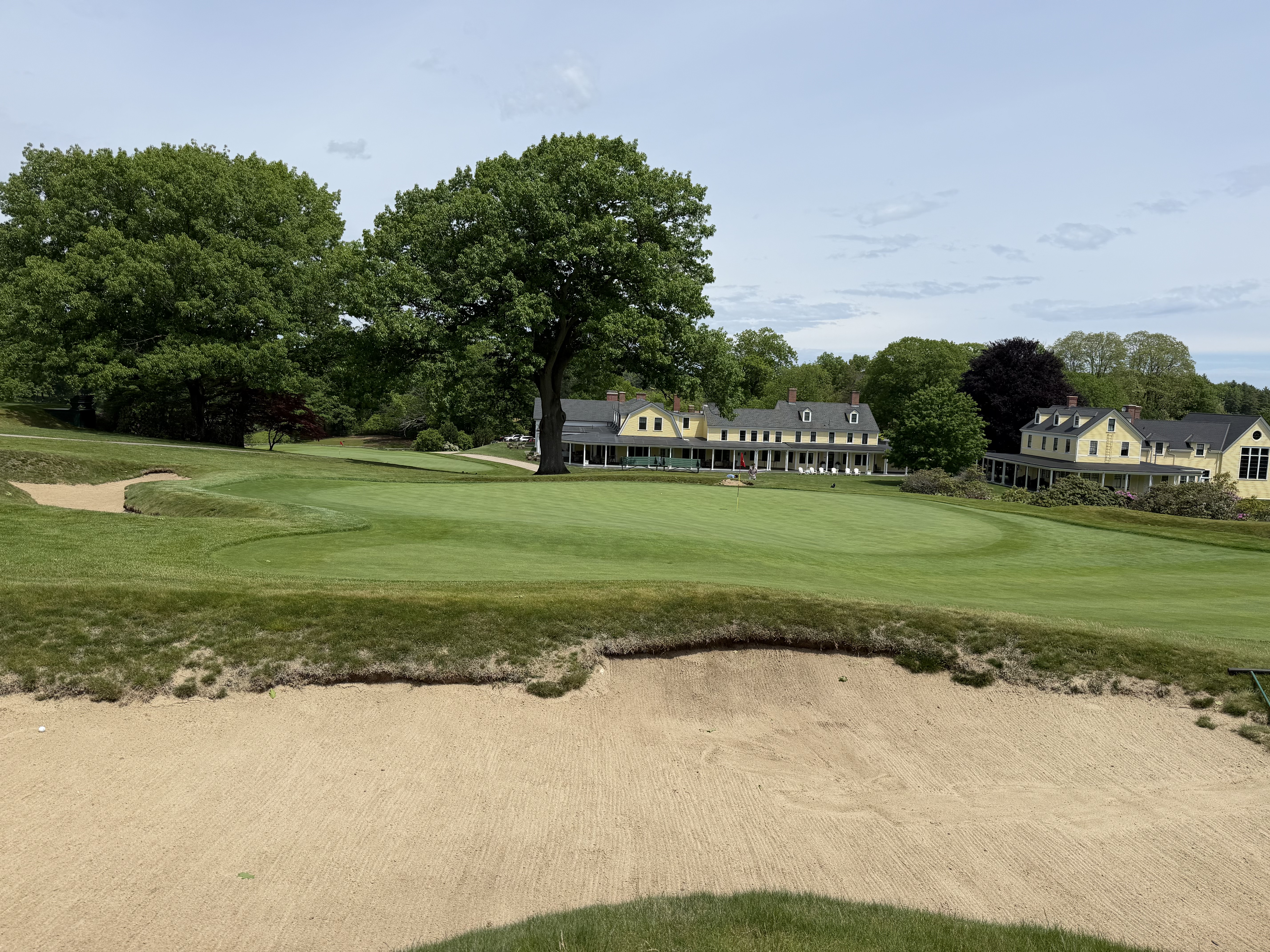
The Fifth is a 165 yard par 3. A neat little loop back to the clubhouse, which is off to the left. Sure, eighteen holes is regulation but the game is of every shape and form, it’s certainly not out of the question for a member to look for a casual five holes, or perhaps a trip in for a Pimm’s, another five holes, and so on. Uphill yet again, bunkers are now on both sides of the green yet there is enough depth for some flexibility of the shot. Long of the green is certain death.


The Sixth is a 377 yard par 4. The thirteen hole loop starts here, as we start yet again from the clubhouse. A narrower opening off the tee and a right side fairway bunker challenging just off the heather, the golfer may opt to stay short of it for a longer approach but in any event, will need to keep straight. The bunkers are once again off the green and here, the left side is free of them, which is good enough since the green moves left to right. The course promotes a healthy short game, as the greens allow some margin of roll out but there are plenty of areas where the golfer will need to be more precise. One of those areas is to the left of the green here.


The Seventh is a 213 yard par 3. The course allows some views in this interior where five holes converge with either their green or tee. A small halfway house is just beyond this green, a hut of sorts with an area for socializing. The donut bunker mentioned above is off to the right of the green, coming in to play at the Thirteenth as well. The left bunker is well before the green and its right side is a good line in to the green. The golfer might initially shy away from the trees on the left and unintentionally bring the donut more into play but that bunker is what should be avoided above all else. A long strategic hole well designed on relatively benign terrain.


The Eighth is a 336 yard par 4. An explosion of heather after the tee and on either side of the fairway. The green is downhill, so the tee shot is also likely blind. If there is a shot to absolutely not miss on, it is likely at the tee here. The approach and green complex are among my favorite and accentuate the strategy here. The golfer must figure out how the green moves relative to his approach and adjust accordingly or is liable to see shots on the green move off in disgustingly dejected fashion. My humble suggestion is to only use the ground game if coming in from the left while taking on the front right bunker from any where else.


The Ninth is a 402 yard par 4. We cross Martyrs Lane to continue and the heather is now demanding full attention, on both sides of the fairway yet again. The tee shot is blindish with a trio of bunkers on the right, which need to be carried for the opportune approach. The green is narrow yet deep albeit modestly sized with bunkers on either side but a good deal of surrounds area to accommodate any miss. It’s a stiff close to the front yet the golfer should be well within his game by this point in the round.


The front nine presents direct and subtle strategic challenge at each hole and is able to do so without overwhelming the golfer with length, yet the golfer is faced with enough length shots. The bunker placement and green configurations are spectacular and demonstrate how engaging a course can be even when on the shorter side and set upon fairly mellow ground. I would rank them 6, 8, 1, 3, 2, 7, 9, 4, 5.
The back nine starts with the 120 yard par 3 Tenth. The vistas grow a bit more and the green appears shortly after a domain of heather. The broken ground bunkering has been restored, its jagged edging about the green another masterclass example of using mid terrain in extraordinary style. The green waves here and there, ever so slightly.
There’s something about the short par 3. It’s a combination of of strategy, execution, touch and feel in the shot. I can hit a thousand shots in a row the way I want but get me on the tee of the Third at Wissahickon or even the Seventeenth at my course when the tees are up and all bets are off, for whatever reason. Fortunately for me here, it came together on one of those rarer than I wish occasions for nice tap in bird.


The Eleventh is a 419 yard par 4. The tee shot back uphill yet some what blind, heather off the tee then all along the left. Mind the left fairway bunker off the tee and then the right bunker near the green. It only appears to be closer to the green than it is, actually 25 yards in between. This knowledge helps, as approaches coming in from the right side are wise.


The Twelfth is a 411 yard par 4. The fairway widens as it grows further from the tee, listing ever so slightly to the right. The uphill makes the shots longer than perhaps the numbers mete out and one should favor the left side on both shots. Like the fairway, the green expands as it moves away from the front.


The Thirteenth is a 304 yard par 4. The green and halfway house are in the distance, slightly above where the golfer stands at the tee. There’s a center line bunker to contend with. There either was one or is another one just behind it, which make the carry even more challenging. The photos don’t show it but Google Maps does and it may just be I have the wrong camera angles but at any rate, the tee shot needs to maneuver that area regardless if it’s one or two. Beyond the bunker(s) is a short approach in to the green, with the risqué donut bunker off to the left. There are several ways to play this hole, all of them thought provokingly pleasant.


The Fourteenth is a 476 yard par 5. The par 5 of the course dog legs right at the tee shot and while many may think they’re doing well by cutting off some distance on the right, there’s a concealed bunker on that side waiting. Opting for the left side also keeps the green side bunkers at the right at bay. It may be a longer avenue from tee to green but much safer. At the green, note the front to back movement. Once again, bunkering placement is exceptional.


The Fifteenth is a 387 yard par 4. Heather on the left! You heard it here first. The first and only hole with a fairway interruption, slender yet deep trench bunkers bisect the fairway in a V, interlaced with heather. Placement strategy at one of its finest points, the tee shot needs to aggressively avoid the interruption as well as the entire left side. All while setting up an ideal approach. The green is wife and once again, the bunkers are off set and not directly adjacent to the green. Simple yet effective, these rueful placements play tricks with the mind while instill a wealth of the right kind of character. So many courses nowadays could take a page.


The Sixteenth is a 200 yard par 3. There are two sets of tees; one on the left and the other to the right side of the Fifteenth green. A sea of heather used to rush across from left to right with a wooden fence running along the road but now there is more of a natural fescue look yet the concept remains. The golfer needs to carry the nasty wilderness before the green, as well as the random assortment of bunkers that punctuate the point about ingenious placement. Their location further off from the green means it’s more imperative to hit the green from the tee or get as close as possible to it.


The Seventeenth is a 362 yard par 4. A hard dog leg left where the tee shot needs to get past the turn for a clear approach to the green. A deep, thinner green awaits, bunkers on each side again with some space between them and the edges. Heather along the outer left of the left bunker is of note.


The Eighteenth is a 371 yard par 4. A milder dog leg left than the hole prior and the golfer need not worry about bunkers at the tee. The trees on the left need to be cleared and then the green is at hand, mounding and wavy movement before it with bunkers on the right and rear. Of course, the green moves left to right towards the sand. A great final green to tackle before retreating to the hearty clubhouse.


The back nine starts at one of the furthest points of the course and casually makes its way back with two very solid par 3’s and engaging variation with the routing. I liked them all. I would rank them 10, 16, 18, 13, 14, 15, 11, 17, 12.
There are those that look to the past fondly and yearn for its return and others who look to it as historical appreciation. New Zealand celebrates and preserves its history yet remains powerfully relevant at present day. For its challenge and its ingenuity in course design. Conjuring engaging interest from milder terrain without over relying on width, or length for that matter. Its variety in routing, hazard placement and excellent bunkering are arranged wonderfully. It all straddles the line between pleasant camaraderie and lively interaction. The structure of play is substantial yet allows casualness even if formally presented. The past charms with its historical character here while exuding an appealing English dignity that this American was pleased to stumble upon for the spell of a Summer morn. I’d happily return again and again for a round. Places such as New Zealand are rare yet fascinating in how it speaks for the game and I’d be fine in its company, all the better for it.
Clubhouse/Pro Shop: Simple, quiet, charming and relaxing with just the right amount of formality.

Practice area: Hitting nets and a putting green.




You must be logged in to post a comment.