6,452 yards, 129 from the Black tees
I drove across the country once. It was when I moved from California to Philadelphia, way back when in August 1999. In a 1997 Buick Regal. I used an Auto Club trip tik, which was a flip through map that showed me which highways to take. I would drive from the left side of the tik to the right and when I was off the page, I would flip to the next. Beaver, Utah, Denver, Omaha, Chicago and Twinsburg, Ohio were my stops. I drove by myself. Without a cell phone for regular use, I was only able to talk with anyone at the end of the day when I was done driving. It was a lot of time in the car with my thoughts. Cell phones became a lot more prevalent later on and in a matter of a few months after arriving in Philadelphia, I would get one for normal use. Road trips would never be the same.
There was a lot of determination in that drive. It’s a hell of a thing, leaving all your family and friends thousands of miles away. For what. I wasn’t sure. I was going to law school and had a hunch. A hunch about the east coast. A hunch about Philadelphia. Yet a man in his early 20’s doesn’t have all the answers. Instead, I yielded to determination. As I sorted through a lot of thoughts and memories on that drive, I kept moving forward on that open road. Running to, running away, not running at all, who can say. That determination spurred the car on, fueled by the wonder of uncharted territory and not much else.
The last day of the drive took me through the entire width of Pennsylvania. I wasn’t expecting the mountainous rises and falls of the highway with the tunnels running through some of the hills encountered in the western part of the Commonwealth. The dense woods on either side just beyond the four lane highway in conjunction with those mountains and hills were jarring, especially after the days of driving through the much more level Midwest. Before I knew it, I was sitting in traffic on 202 and a little after that, my landlord handed me the keys to the apartment and told me where the nearest Ikea was. He left and I sat on a bench outside the building looking out towards LancasterAvenue. The determination that pulled me across the country faded and in its place, a flood of apprehension. What have I done? The moment passed and the determination returned. Time to go to Ikea and get something to sleep on.
It would be years later before I drove again in western Pennsylvania. Now married and with our dog in tow, we headed to Pittsburgh for a long weekend with some friends. I forgot all about those mountains and hills, how they suddenly shifted the horizon. It intrigued me, reminding me of the drive from L.A. to Santa Barbara when you crest the hill at Camarillo, the valley and ocean laid out before you. Here, however, it was the seemingly infinite sea of trees. I’d make that drive countless times after that for one reason or another, always looking forward to getting into those hills. It would be years later before the game of golf took hold of me and eventually, learning of Sunnehanna. Still I would drive on through the hills, seeing the Johnstown exit and knowing the golf course was off in that general direction. Fate and circumstances did their work and a couple decades after that first drive through, my car finally signaled off that Johnstown exit and headed into the hills where Sunnehanna had been waiting the whole time.
The hills that I was so fascinated with on the drive indeed extend beyond the highway and the course resides in the Laurel Highlands, which is part of the Appalachian mountain range. The climb from the highway to Johnstown is significant, boasting views of the horizon. One of the main reasons I love this game so is the ability to interact with the land in such a profound manner. All those years driving through and admiring those hills from afar, I would now get to spend a few hours pondering their finer points by rolling a little white ball about them. This interaction and embrace of the hills the course does well. Designed by A.W. Tillinghast, the course opened in 1923. To assist with early turf issues, the club hired esteemed Emil Loeffler of Oakmont fame to consult on fertilizers, grass strains and the like for the ensuing six years. In 1936, William Flynn was retained to undergo design changes that did not alter the routing. Many of those changes are noted below in the hole descriptions yet the more recent work by Ron Forse in the 1990’s and Tripp Davis sought to return the course to Tillinghast’s vision. Most recently, in house changes took place last year, which included bunker renovations, shortening the fairways at 9 and 11 while expanding the fairways at 15 and 18. As it stands, the course moves about the hills in all directions, the routing doing well to instill a refreshing freedom of movement. This feeling is emboldened with the large greens that reminded me a little of those at Oakland Hills. In the sense that both sets of greens use their size well with arching contours and ridges that require both thought and nerves to maneuver about, yet also allow several pin positions that change the dynamics of the hole from tee to green. The routing is such that the downhill holes are memorable and glorious yet the uphill holes aren’t soul crushing with steep climbs or cliffs of green the golfer must jumar to summit. It remains pleasant and inspiring in that way, all the while varied within the terrain. The ground game is alive and well while there are only one or two forced carries I can think of. Most of the time, however, the course in its broad scale allows the golfer to play in the style he wishes, with the greens awaiting as the great equalizer. It’s yet another better Tillinghast designs, for its use of scale, its greens and the versatility of play.
The wonder of uncharted territory. It explains a lot of why I do what I do and the game of golf is perfect for those who see the joy in exploration. We get to see places and people we wouldn’t otherwise see and get to know land and settings in a more keen sense than those who may simply walk over it, or stop and watch, or drive by on some highway, on their way to the rest of their life.
The First is a 420 yard par 4 (from the Black tees). The clubhouse is perched upon one of the taller hills so the opening tee shot is moving down from there. Bunkers are on both sides, running parallel to the fairway. The fairway feeds into the green, which runs back to front and left to right. There’s a bunker to the right front of the green where balls seem to be attracted to no matter where they are on the green. Flynn proposed removing bunkering and adding a mound to the rear right of the green. While the fairway bunkers were removed in late 1930’s, the greenside bunkering did not change and the mounding was never installed. Flynn also aimed to narrow the entry points at the greens while Tilly had nice wide, almost seamless transitions from fairway to green. The entry points are more in line with Tilly’s intent.


The Second is a 400 yard par 4. A dog leg right back up the hill with a couple trees on the inside of the turn trying to keep everyone honest. The fairway straightens out and climbs uphill to the green after the turn, leaving a blind approach as the front of the green dips down to the rest of it. The green is large and moves delicately yet assuredly towards the front left. Flynn added the mounded bunker to the left of the green, which remains today as the most distinct of his changes still in existence. Flynn also wanted to add bunkers and re-contour the green to break it into two tiers.


The Third is a 373 yard par 4. Back down the hill we go and the fairway fades out of view as it tumbles down to the green. There’s a left fairway bunker to consider off the tee but otherwise the golfer is free to use the downhill as he wishes. The green is extraordinary; it’s set at an angle from the fairway as it runs downhill to the right while sunken bunkers stand at its sides and rear. The internal contours provide more definition while the length of the green instills challenge for just about every stroke after the tee shot.


The Fourth is a 403 yard par 4. Tee position is relative here and depends on which tees the golfer is playing. Flynn likewise altered the tee position and the more rear tees play from that position, which gives the hole some left to right bend. There’s a bunker starting on the right that encroaches towards the center of the fairway. This bunker used to run parallel with the fairway so the shift to its perpendicular orientation is fairly recent. Likewise, there used to be rough in between that bunker and short of the green but that is now gone, replaced with all short grass that feeds right into the green, so the golfer can decide how to take on that bunker and has some options with respect to his shot reaching the green and moving close to the pin. The group game is now much more relevant.


The Fifth is a 185 yard par 3. The left to right cant of the hole is evident from the tee as is the water that runs up the right side. There is a lot more room than it appears from the tee but the golfer really needs to focus on making sure the shot stays more left. There are some bunkers on the outskirts of the green but I wouldn’t worry about them too much. There is enough room before them that only the really overambitious shots will reach the sand and even then, the size of the green makes most bunker shots feasible enough.


The Sixth is a 400 yard par 4. Back up the hill. One notable thus far is the yardages of the par 4’s are all very similar, yet those holes have their own separate character. That proves true here as well at this dog leg right. The tee shot focuses on the ridge, which happens to be where the hole turns as well. Favoring the left side off the tee is a good idea, as the fairway moves from left to right and there are a group of bunkers on the right side that should be avoided. The fairway kind of turns into the green at the top of the hill, the left to right continuing up there. Bunkers are at the sides. Some will not heed proper caution at the left to right movement of this hole in general, to their detriment.


The Seventh is a 225 yard par 3. The longer par 3 is a drop shot so plays a bit shorter than the scorecard yardage, unless there is the influence of wind. The green is comparably smaller than others here, yet there is short grass before the green to play with if needed. I believe the bunkers here have been reduced, which allows more dimensions on the recovery game.


The Eighth is a 327 yard par 4. A short par 4 that seems anything but from the tee, where a deep ravine must be carried to reach the fairway. Take off as much as you think you can. Most shots landing on the fairway means a short approach shot in with bunkers on the sides and in front of the green.


The Ninth is a 574 yard par 5. Moving up the hill on this long par 5, fairway bunkers were taken out in the late 1930’s but two are now present on the left; one towards the start of the fairway and one closer to the green. The fairway tilts from left to right at its initial climb, then levels out with even a little more right to left closer to the green. The approach is blind and the green has a heavy left to right movement. It’s a tough hoe. One works to get to the green, then one needs to likely work harder to roll the ball in the hole. A nice finish to the front.


The front nine moves about the hills nicely, with the par 4’s standing out in all different kinds of ways, yet the greens lead in memorability. I would rank them 3, 4, 6, 8, 1, 2, 5, 7, 9.
The back nine starts with the 155 yard par 3 Tenth. A pushed up green not all too different from a volcano or Short; a raised plateau with bunkers flanking the sides. The green is a bit larger than it appears from the tee, moving from back to front and right to left.


The Eleventh is a 505 yard par 5. A double dog leg that starts uphill and immediately into the first turn, which is to the right. There is more room than it appears before running out of fairway on the left for the tee shot. The fairway then starts to move downhill and dog legs left to the green. Maneuvering the twisting hills at each shot and angles the golfer faces with the shifting playing lines is part of the enjoyable challenge here, while the fairway before the green cascades to the green and provides a nice refuge for those out of position. A solid par 5 showing creative use of the terrain.


The Twelfth is a 390 yard par 4. Off to the left we can see the Seventeenth green and Eighteenth tee. The rest of the back nine is an out and back to return this area for the final hole that stays near the base of the hills yet still captures plenty of ridges and undulations. Here, the tee shot heads uphill then bends to the right at the fairway bunkers. As we have grown accustomed, the wide fairway feeds right into the green, which is pushed up and runs from back to front. Flynn altered the green and added the right front bunker, still recognizing the importance of allowing run up shots with the inviting entry point.


The Thirteenth is a 402 yard par 4. The right side remains rigid as we continue on the bottom of the property. The tee shot heads straight out, a crest downwards obscuring our view of where the ball ends up. While there were originally fairway bunkers here, they are no more, likely taken out in the late 1930’s. The contours and rough beyond the fairway is the defense, which moves downhill to the green in terraces. The terraces mean the approach shot obscures the approach just as the tee shot with the green wide with bunkers at the sides. Knowing which part of the green to land on relative to pin position, as well as the acceptable miss spots, are all part of the strategy here.


The Fourteenth is a 190 yard par 3. A long par 3 moving slightly uphill from the tee with bunkers on the sides more towards the front. The green is another strong one, moving left to right yet the interior contours do shift directions in spots. There are lots of acceptable misses here except long.


The Fifteenth is a 570 yard par 5. We now start to head back to that Eighteenth tee area we saw a few holes before. Like the Eleventh, the longer hole is allowed to sprawl out over all kinds of terrain. The tee shot moves uphill with bunkers on the right, turning in that direction at the top of the hill. Tilly usually narrows the fairway after a turn but here, the fairway actually widens (this may be from the in house changes noted above). There’s a lot of space to work with after the bunkers with this width until reaching a bunker on the right that swings into the center of the fairway. That must be cleared on the second shot. With short grass after it leading up to the green, some may opt for a lower shot that cleared the swinging bunker, then rolls through the short grass on to the green. It really depends on the pin position. Those rear pins will demand a much more assertive approach shot in. A long par 5 that seems to transition into various areas and allows assorted plays upon it.


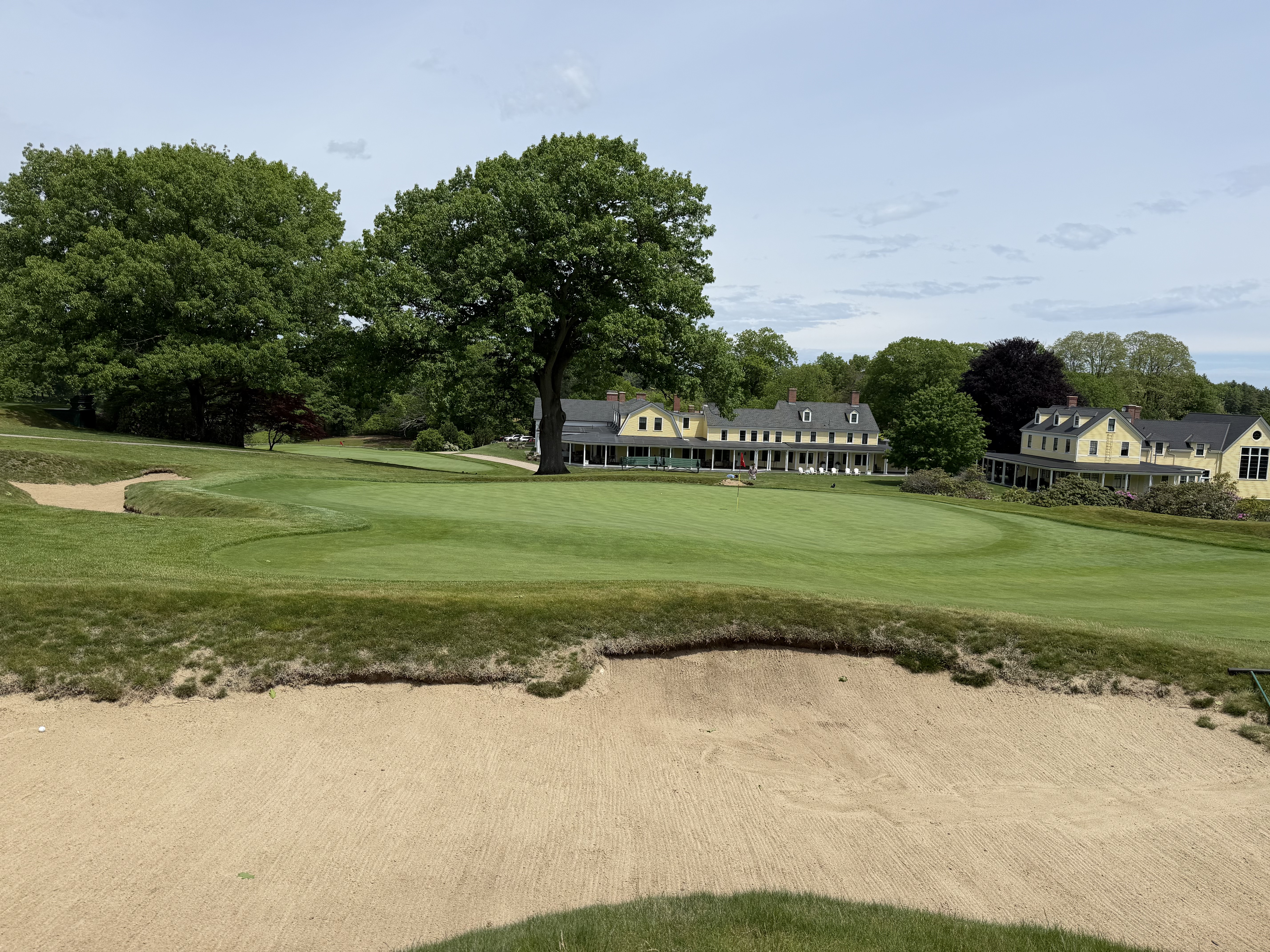
The Sixteenth is a 175 yard par 3. The final par 3 heads briefly back up the hill and the green is blind from the tee. The short grass swerves between the bunkers on either side leading up to the green while the green is almost in an L shape. It appears some of Flynn’s changes to the bunkers were incorporated and indeed, they appear more imposing than the others seen throughout the course. For good measure, as the hole shows off to all who move up the drive to the clubhouse.


The Seventeenth is a 408 yard par 4. A dog leg left that moves downhill to the green. The tee shot must favor the right in order to clear the trees on the left for a look at the green. While the fairway is wide, the bunkers on either side are not to be trifled with. So long as one remains in the fairway, the approach can use as much or little of the ground as he wants, just avoid the below grade bunkers meandering about the sides of the green. It’s a cool hole with the turn setting up the approach to the green really well, all which emphasizes the need for a well meaning tee shot.


The Eighteenth is a 350 yard par 4. The final hole is also the final climb back up to the clubhouse. There are bunkers on the right to be mindful of off the tee. The climb doesn’t let up and the approach will likely be blind as well. The fairway narrows up after the right bunkers with most of the bunkers near the green gathering about the front. A short yet tough hole, especially for those who get sideways.


The back nine uses the other side of the hill and lower parts for a more rolling set of holes with a solid pair of par 5’s, well varied par 3’s and one of the better holes of the course at the Seventeenth. I would rank them 17, 13, 15, 14, 10, 18, 11, 12, 16.
Generally, Sunnehanna is able to straddle the line between challenge for the highly skilled and engaging for the everyday member. Tee and pin positions largely accomplish this. The extra length with the hills and pins ensure the better players have plenty of challenge and options to go about it while the other tees allow the rest of us to take on as much as we can handle. The greens are great fun, occasionally serving as refuge, yet eventually we need to find the bottom of the hole, which is where the greens bare their teeth a bit. It’s a very good course in this way, as well as for how it is routed about the majestic hills. The tee shots need to be on the exacting side while the approaches have a lot of leeway and exhilaration as those inviting and gregarious greens await your shot from where ever your approach. One of the better Tillinghast designs in the Commonwealth.
Clubhouse/Pro Shop: The clubhouse is laid out on the ridge of the hill, which looks out to front nine. The pro shop is within the clubhouse with a good selection of just about anything.


Practice area: The driving range is between the Fourth and Sixth, where you hit up the hill. Putting greens are near the clubhouse.


You must be logged in to post a comment.