6,690 yards, 141 slope from the Blues
“How do you say the name?” My friend asked me as he drove us to the club. “I think it’s Wee-ka-gil.” I guessed. It’s not. It’s Why-ka-gil. Like me, my friend had heard about the course but knew very little about it. I knew a tad more but not much. I knew enough that I was willing to travel to play it but this was mainly due to the search. My search, that is. My search doesn’t involve a list or name dropping or any of the rest of it; it’s much simpler than that. My search simply involves seeking out the character of the course and thinking about its place in course architecture. For some courses, this is relatively straightforward and categorical. For others, there’s a rich unique identity that adds yet another layer to the tapestry of our game. Those are what I look for. I sensed there was a pretty good chance of Wykagyl being the latter, so alas, we headed up under the threat of rain with the utmost earnestness. We’d learn how to actually say the name correctly in due time. Details, details, details.
There are hot beds of brilliant golf throughout the Northeast in various areas, tracking rich topography and population trends of the time of construction. One such hot bed is Westchester County and in particular, south Westchester County, where within a span of eight miles, one can find Quaker Ridge, Winged Foot, Siwanoy and Wykagyl. Indeed, I had heard of Wykagyl when I saw its entrance on my way to Quaker a few years ago and seeing the budding hills beyond was enough to further my intrigue. Subsequent discussions and some reading online piqued my intrigue and a couple years later, I found myself driving to the course, trying to figure out its pronunciation.
The club first started as Pelham Country Club at a different location. Forced to vacate the original location in 1904, the club moved to its present site in 1905 and along with the move, changed to its current name. The name originates from combining two terms found on a Dutch map of old New York that showed the location of Indian tribes, Dutch settlements and other villages. Wigwos (birch bark) was meshed with Keag (country) to signify country of birch bark. I still don’t see how those add up to Wykagyl but regardless, it’s a unique and endearing name that is fitting with the character of the course. Lawrence E. Van Etten, a new member of the club at the time, designed and built the course in 1905. The course remained in its original design for fourteen years, becoming well known in golfing circles. Harry Vardon was remembered for remarking that the Eighteenth was one of the greatest holes he had ever tackled. Several of the holes were known for their severity, the New York Times writing that the Sixth (present-day Seventh) required, “alpine training” while the Eighteenth was called “cardiac hill” and a few others noted for their strenuous climbs. Indeed, the course is laid out in hilly country and even its present iteration does not shy away from the topography. In 1913, Wykagyl hosted one of the matches with Harry Vardon and Ted Ray on their tour of America. Vardon and Ray played against the club pro, Alex Smith (U.S. Open Champion in 1906 and 1910) and his brother Macdonald Smith, an assistant pro at Wykagyl. The match took place immediately after Vardon and Ray lost the U.S. Open to Francis Ouimet at Brookline. The Smith brothers defeated Vardon and Ray, handing them their first and only loss on their American tour of matches.
Donald Ross was retained in 1919 to impart some changes to the course, redesigning several holes that focused on strategic angles and bunkering, including the Hell’s Half Acre bunker at the Twelfth. Tillinghast then came in the 1930’s and re-designed the first two holes to accommodate the practice area, installed the Fourth through Sixth, Seventeenth and shortened the Eighteenth to a par 4. It appears the course remained relatively intact since then, save for Stephen Kay and Arthur Hills working on the course in the 1990’s. In 2006, however, Coore and Crenshaw were charged with renovating the course to maximize its strategy and interest. An ideal charge for any project. C&C underwent extensive tree removal while bunkering was both added and returned to original positions at spots. Strategic intent was restored at some holes, playability was improved overall while fairways and greens were generally expanded. Most importantly, C&C were able to tie their work in with portions of their predecessors to smooth out a cohesive classic, fraught with riveting strategy, suspenseful blind shots and sporting challenge. Wykagyl can now be found on Golfweek’s top 200 classic golf course list, along with Golf Club Atlas’ list of 147 Custodians of the Game.
It seems the only flat spot on the course is the First tee. The golfer is then sent off into the hills, which are used in multi-directional splendor. This use, as well as incorporating the various rock outcroppings as opposed to blasting through them, demonstrates classic architecture character that would likely be worked much different today. The strategy of the hills lies in knowing where the ball will move upon landing. This entails positional strategy, which includes knowing where not to miss, as the ball is known to take off into unknown depths at times. The greens could parallel this volatility but instead, show restraint with subtle contours among strong movement, which turns out a nicely balanced set even when the tilt is noticeable visually. As the New York Times noted way back when, the climbs are notable, as are the descents. Streams and water are met occasionally at the lower points. But it is the hills that define the character of the course. The blind angles, rock outcroppings, sharp transitions and rollercoaster fairways set it apart, the severity of the terrain never transposing to severity in structure of play. There is always challenge and there are always options but the golfer is not meant to barely survive the round. He is meant to find a meaningful, engaging, unique round, which he does.
The First is a 537 yard par 5 (from the Blues). A long bend to the left moving downhill from the tee. A few slender bunkers are on the left side further down the hill to make sure the golfer thinking about cutting the turn does so with gusto. The green is at the bottom of the hill, separated from the fairway with a right to left tilt. There’s an apron to the front right of the green, which clues us in to stay on that side as opposed to the left side, which gets very dead very quick. The downhill par 5 is a nice opener.


The Second is a 396 yard par 4. Moving back uphill, the right to left tilt we saw at the First green continues with the fairway here. Bunkers are on either side of the fairway, encroaching the width of the fairway from the right closer to the green. The cant along with the bumps and hollows of the terrain make for interesting bounces up to the green, which is where course knowledge is bound to help. Rear of the green is where not to miss here.


The Third is a 456 yard par 4. Still moving in the same direction as the holes prior, the tee shot darts downhill and crooks to the right. The point of the crook is where the fairway narrows, a sharp ridge grassed over with a bunker before it. It’s a poignant enough feature to steer clear of it and keep the tee shot more to the left, even if it means a long approach in. Large pools of sand are on either side of the green, pinching the front of the green then expanding off to the right.


The Fourth is a 144 yard par 3. One of the better examples of designing around the rock outcroppings instead of through them, the green is situated amongst a lot them on a small hilltop. The green is deeper than it looks with a rear left pad while the rest of the green moves to the front right. A devil of a short par 3.


The Fifth is a 397 yard par 4. Teeing off on the same hilltop as the green of the prior hole, the hillside tom the tee of the hole prior obscuring our view of the entire fairway even though there’s a lot more of it off to the left. This is important, as it is necessary to get out to the left in order to clear the tree line on the right for a clear approach. A small creek interrupts the fairway for the longer hitters to consider it off the tee while the second part of the fairway moves to the green, which is above. The green is perpendicular to the fairway and a deep bunker guards the front. Stay left off the tee and stay left on the approach is a good rule of thumb.


The Sixth is a 525 yard par 5. A wild hole starts off moving back in the direction of the Fifth tee with a creek very much in play moving along the right side. In fact, the creek is even more relevant with the fairway tilting towards it, making the left side valuable property although bunkers on the outside temper those opting for there. The fairway wraps around the hillside on the left before unceremoniously ending at a hill. The green is on top of that hill with a short grass apron before it that endangers shorter approaches from moving down the hill and away from the green. The green never seems to level out. It just rounds about the hilltop, always keeping the golfer on edge that his ball will find some contour and never stop rolling until nestled far down in the valleys below.


The Seventh is a 171 yard par 3. The selection of green sites are notable as we make our way around the hills. A lot of high points that stay within the topography instead of imposing their shapes on the landscape while practically facilitating easier draining. Here, the green is placed in the middle of the hillside with dramatic left to right movement with a healthy dose of bunkering. The movement is indeed strong, affecting every stroke.


The Eighth is a 446 yard par 4. Now moving down into a valley, the fairway dog legs hard to the left. A couple bunkers at the inside of the turn make sure any shot going for the turn is properly far and sure while bunkers further on the right after the turn can come into play for the longer hitters. The fairway funnels to the green with a larger bunker expanse off to the right. The green is deep, falling off all sides save for the front. Angles on both tee and approach shots matter here while the terrain movement takes a break from swaying us in one direction or another.


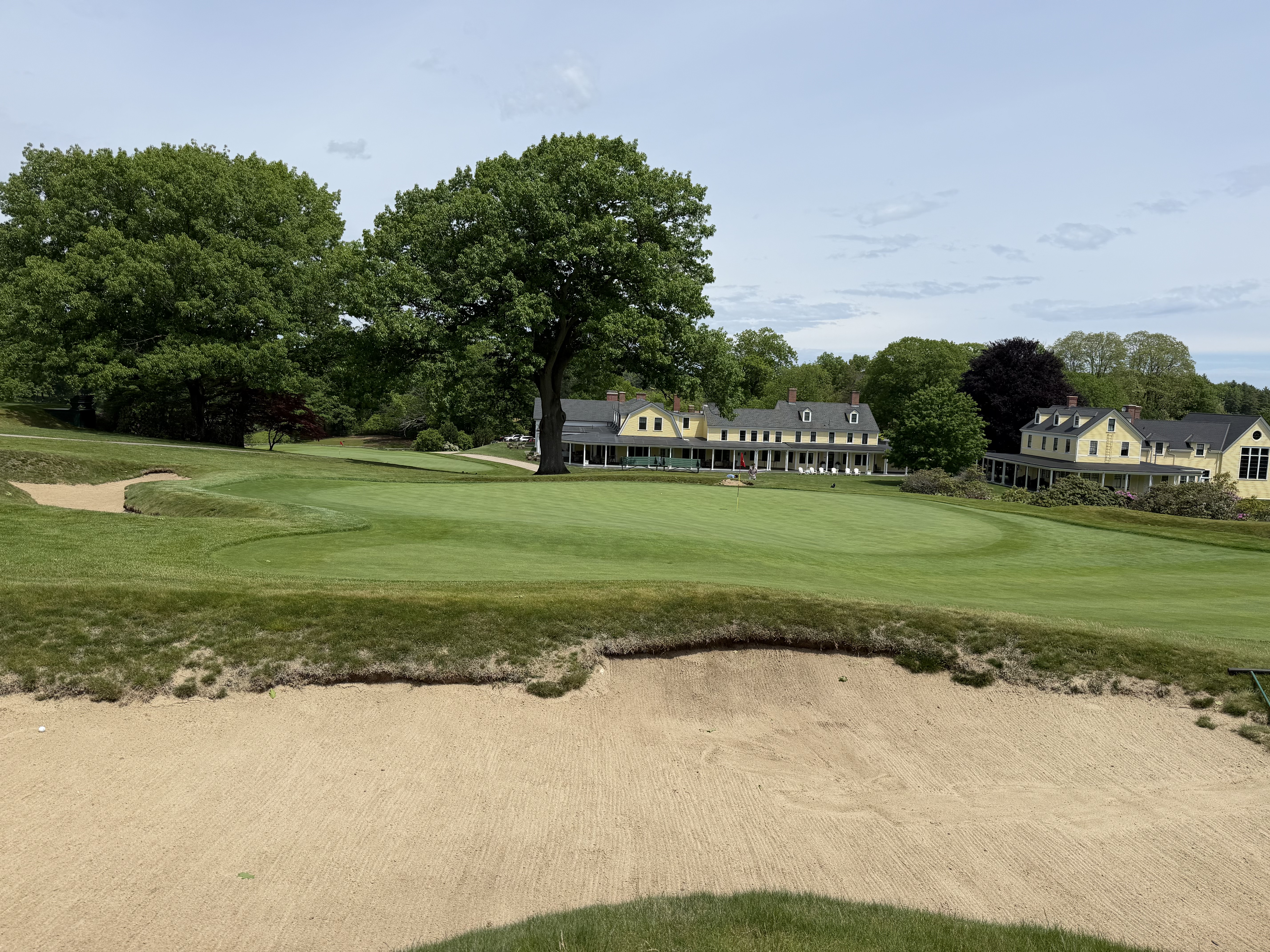
The Ninth is a 494 yard par 5. A bear of a hole to close out the front. We climb uphill towards the clubhouse while turning right, trees close at hand on both sides. The right side gets a little steeper than the left and staying to the left is more ideal for views of the green even though it may be a little longer moving up that side. The hill finally yields and the last part is downhill to the green. Those who are able to play the ridge correctly could see their ball hit the hill and move down considerably. Take note the green is of moderate size even though there’s a lot of short grass to work with.


The front nine is bookended with a pair of par 5’s that contrast well and show just how influential the topography is here on structure of play. The par 4’s do most of the work weaving in and out of the valleys while the par 3’s utilize the hill tops and sides in thrilling fashion. My ranking of them would be 3, 8, 1, 6, 4, 5, 7, 9, 2.
The back nine starts with the 513 yard par 5. Leading downhill where a creek runs across which longer tee shots can reach. After the creek the fairway moves back uphill to the green where most of the movement is back towards the golfer’s feet. The fairway narrows just before the deeper green, bunkers along either side. Managing the hills and creek should be some what familiar by now, this hole providing a full spectrum of elevation changes.


The Eleventh is a 161 yard par 3. Back down the hill we go, the green sitting just short of the stream. A drop shot requiring some precision with the bunkers guarding most of the front half and the rear’s contours angling towards the creek. Just hit the green, easy enough.


The Twelfth is a 499 yard par 5. A 5-3-5 start, the par 3 refreshing before the golfer tackles yet another uphill brawn. The tee shot must carry a ravine before the fairway which leads uphill before shifting to the right in front of the green. The second shot can confront the steeper right side for a shorter approach while the more conservative can opt for the mellower left side in exchange for a longer shot in. While those approaches from the left will have a better look at the green, those on the right will have a better angle based on the movement of the green.


The Thirteenth is a 209 yard par 3. The longest par 3 we have encountered thus far, we go from one hilltop to another. There’s plenty of room short slinking left while bunkers are at the edges. The green is nicely sized so those in the bunkers will likely have lots of room to work with.


The Fourteenth is a 399 yard par 4. And we’re at our first par 4 of the back. The fairway moves across the tee from left to right, forcing the golfer to choose his line and judge just how far right to go. The fairway contours make tee shot placement even more interesting, as a noticeable cant sweeps shots to the right for those going for the earlier fairway. The cant then switches to right left, gently at first then much more aggressively closer to the green. Bunkers are essentially at the corners of the green with the right to left movement at full scream.


The Fifteenth is a 341 yard par 4. A shorter par 4 that dog legs left and moves uphill, much depends on the tee shot. The shorter right side is the hidden obvious option since most will start licking their chops at a longer tee shot towards the green for a short wedge in. But the left side gets dangerous fast and may not be worth the risk. In fact, it is not but the temptation is very real here. That right side sets up a nice direct approach but come one, one can swing out of their shoes and chip it up the hill instead. It all depends on the golfer’s mood and tendencies I suppose.


The Sixteenth is a 224 yard par 3. The longest par 3 of them all is the last, set about a hillside moving right to left. There’s fairway moving up to it that allows a shot to release and run, which will inevitably fall to the left. Ending up to the right or above the pin off the tee places the golfer in a good amount of consternation, so figuring out where the ball will end up after landing is a good exercise.


The Seventeenth is a 356 yard par 4. The hill makes the hole play much shorter, so long as the tee shot is pulled off in the right way. Tumbling severely from right to left and also towards the green, the tee shot needs to get on far enough to move past the severe horizontal movement and take advantage of the lower part of the hill, which will move the ball closer to the green. Those tee shots will be rewarded with a wedge into the green, which is very much appreciated considering the smaller green. While some holes seem to reward those resisting temptation and opting for shorter, arguably smarter shots off the tee, length rules the day here.


The Eighteenth is a 422 yard par 4. We arrive at the last, where the tee shot needs to carry the creek to reach one of the wider fairways on the course. The green is set on a small terrace of the hillside beyond. It’s a harrowing climb and the approach needs to be strong yet measured considering the rear bunkers. It’s a final send off, if you will. The course is a primer on the game upon hills and through valleys, so this green upon the terrace high above gives us one last vivid impression of it all.


The back nine is set on a longer set of hills than the front, saving the par 4’s for the closing stretch. The variety in length and use of the hills is on full display, the par 4’s certainly worth the wait. I would rank them 17, 15, 12, 14, 18, 10, 13, 16, 11.
Generally, Wykagyl is a nicely woven hilly rendition of the game. The tempering of the severe landscape is done well, allowing its thrill and excitement to come out on full display at measured times. The roll of the ball becomes a thought provoking adventure and those that find themselves off track are not lost in some pit of despair, at least not all of the time. Instead, the golfer is able to dig within his arsenal to get back in position with a little work. The greens follow this theme of variety and measured embracing of the hills, where restraint matters most. The golfer may tire walking the frequent drops and climbs yet the inspiration he gets from watching his ball joyously romp about them will keep the spring in his step throughout.
Clubhouse/Pro Shop: A wonderful classic structure boasting a stately men’s locker. There were plenty of rooms for dining and gathering, utilizing long views of the course.

Practice area: The range is off to the left of the First, short game area is over near the Ninth green and putting green just before the First tee.



You must be logged in to post a comment.