6,019 yards, 129 slope from the Back tees
A long time coming. If I shouted loud enough from my club or even my house, I feel like the folks on Merion West at the time could hear me if they really tried. After all the times driving by the course and craning my neck to see more and the many fortunate times I had been able to visit Merion East, I was finally able to pull off of Ellis Road, park my car and walk on to the grounds of the West. A few hours later, I’d walk off with a while new appreciation of the Philadelphia golf scene and even more reverence for Merion the club. It all started as soon as I came upon the single room log cabin clubhouse with a fireplace at one end. A fire was indeed going when I walked in and I was offered a hot chocolate, which I welcomed. It was friendly, familiar and comfortable. I went from the warmth of the log cabin to outside and surveyed the course.
Merion West opened in 1914. It resides a mile away from the East. The membership was rapidly growing and the club sought land for an additional course to accommodate this growth. Hugh Wilson had primary lead for its design while William Flynn was just as involved and took on supervision of its construction. Draped over a large hillside for the most part, the clubhouse and First comprise the top ridge while everything falls off diagonally from there in dramatic fashion. There are assorted undulations, cliffs and ravines within this grand hillside, all of which makes for a terribly wonderful site for thrilling, volatile golf. At the time of opening, Merion was the first club with two full eighteen holes courses. A few changes to the course took place in the 1950’s, which included moving the Eleventh green and a new lower tee for the Eighteenth while the Eighteenth green was rebuilt to incorporate an elevated rear tier. For the most part, however, the course has remained relatively intact, adding to its vintage feel and making it one of the more intriguing under-heralded venues in Philadelphia.

The differences and similarities between the West and East are worthy of discussion. There are all types of two-course clubs out there nowadays but none quite like Merion. Neither course relies on length for challenge, nor do they need to. The East is an elegant introspection into the golfer’s ability to think through the round and coax the contours in his favor, all on blessed natural terrain. Its challenge comes in waves, some times at the tee, some times on approach but always at the greens. The West maintains similar qualities with the East in terms of strategic valor on exquisite natural topography along with riveting greens. Most two-course clubs try to differentiate their courses between one being the more serious championship caliber exam and the other being the more fun, casual zany sibling, or try to make both courses comparable championship cadre. Merion is unique in that both courses share some excellent qualities and have managed to maintain their classic character, yet while the East has strived to continue its history of hosting professional and amateur tournaments, the West has remained content to showcase its classic design plume that even today, requires thoughtful well executed golf to play well. Some may think West is a fun casual shorter course. They would only be partially right. It is by no means casual in structure of play. While it is not meant for championship pedigree, it conjures similar architectural qualities that make for very good golf. As I wrote in my yearly review of the course, “[I]t is not a terribly long course either, which seems to matter to a number of golfers. Yet the hills are wonderfully situated with the valleys and creeks while the greens are vibrant with character. It calls for a soulfully strategic game with surgical touch on the untamed greens.” C.H. Alison famously quipped to Alan Wilson about the West, “Of course, I know the East is your championship course; yet while it may be heresy for me to say so, I like this one even better because it is so beautiful, so natural and has such great possibilities. I think it could be made the better of the two.” Such is the architectural merit found at the West.
On its own, the West is routed well on the hillside and features challenging greens with strong movement that reflects the terrain upon which they are situated. The front nine stays on the perimeter before climbing into the interior at the last while the back nine is a more complex inner loop that manages to finish at the perimeter anyways, closing the circle around the property that started at the First. The fairways rise and fall while creeks come into play every so often. The hills ensure that the longer clubs will be used and that longer drives don’t mean much unless they’re placed well and avoid the pitfalls of the contours and bunkers. It all makes for a lively, spirited round in a largely untouched classic structure of play that simply can’t be found done so well very many places any more. My high regard and admiration of Merion the club grew that day.
The First is a 317 yard par 4 (from the Back tees). A slight dog leg left that starts uphill but crests early on with a trio of fairway bunkers on the left just above the Eleventh green. The right side has some give before the boundary line. The fairway crests and heads a bit downhill to the green, feeding right in. A lone greenside bunker is on the left while the right side banks down abruptly into rough that steeper at the rear. There are a few ways to deal with the approach but all of them should focus on ensuring the ball stays on the green, as mischievous chip shots await shots that end up rolling off the slopes. In the late 1920’s, the green was shifted, which removed a troublesome hollow that hoarded too many shots in its direction.


The Second is a 402 yard par 4. A straight hole where the right side remains rigidly out of bounds, keeping it straight to left center off the tee is preferred. Still warming up on the some of the flattest terrain on the property, the approach is to a green that completely feeds in from the fairway, which is at grade. There is mounding to the left and a bunker to the rear right, as well as some subtle interior contours that wreak havoc along with the general back to front movement.


The Third is a 526 yard par 5. Still moving in the direction of the Second with the tree line on the right continuing on, the tee shot is not unlike the hole prior. Those that end up off to the right from the tee run the risk of being blocked out by the trees at the next since they protrude out at about mid-hole. The green is a few paces to the right towards the tree line. The green used to be closer to the woods but was rebuilt in 1929 and moved further out, as well as expanding while installing the bunkers at the left side. The green moves off the bunker towards the right front. It moves remarkably well and was the point where the course began to grab my attention.


The Fourth is a 217 yard par 3. That attention was even more forcefully taken upon laying eyes on the first par 3. We now start falling down the hillside, at an angle so that shots are not moving straight downhill. There’s a left to right cant that is more dominant than it looks. The green is deep and allows shots to fall from the front and move towards the rear but mind the hollow and rough short of the green that must be negotiated for those deciding on that route. One bunker on the left, the hillside movement is all that is needed to challenge the golfer on every shot in to the hole. The green is impressively ensconced into the hillside. A great par 3.


The Fifth is a 409 yard par 4. Use of the topography continues to impress here. Now at the bottom of the hill, we climb back up but it is not as simple as a mere up and down. The tee shot is blind and all that is known is the shot must move uphill and avoid a Sycamore that guards the left side well. What is not seen is that the fairway almost immediately falls steeply to the right after the tree, with the movement stronger as one proceeds further from the tee. This means that those who hit driver too far will find their ball completely off the right side and in an abrupt valley, blind to the green. The approach will likely be a longer one, the green high above the valley with a harrowing front edge moving back down the fairway and strong movement continuing left to right. An excellent hole.


The Sixth is a 133 yard par 3. A shorter drop shot par 3 that plunges down to the lowest point of the property, the green is blind from the Back tees. This certainly adds to the suspense of the shot, which must land softly with the two-tiered green moving back to front. The green is modestly sized as well and there’s not a whole lot of room off of it, especially with the creek on the left and moving across the front. It’s a great drop shot, demanding distance control and acumen at the green.


The Seventh is a 284 yard par 4. Now moving along the lower points, the elevated tee shot must carry the water that’s mostly gathered on the left and decide on their second shot. Longer hitters may consider going for the green, but there’s not a lot of room for a drive to roll out let alone miss. A much safer shot is a long iron to the fat of the fairway, which leaves a wedge in from there. The tee playfully points towards the road off to the right, so mind your aim. Like the hole prior, the shots are shorter lengths but accuracy is at a premium.


The Eighth is a 243 yard par 4. An even shorter par 4 than the last, it is all uphill which makes it play longer than the stated yardage. The tee shot looks more exacting than the Seventh but there is more room on the right after the trees. It’s more important to hit the fairway than anything else, especially length, although the green is more inviting for tee shots than the hole prior. The green is a strong back to front with bunkers on both sides. Two very good short par 4’s back to back that play much differently from each other.


The Ninth is a 431 yard par 5. Now in the interior of the course after last hole’s climb, we traverse across the property slightly uphill through the green. The width is a nice contrast to the last few holes, which adds to the rhythm of the round. The tee shot is at an angle to the fairway so that a long straight shot will move off the left side. Either a left to right or coming in over the tree on the right are more preferred. The fairway then straightens out to the green. The green moves left to right and is rather deep. There is mounding and bunkers on the left and bunkers on the right yet plenty of room to maneuver around those, even if they seem to creep into play more often than not.


The front nine starts out nicely before messing about in the hills and evening out again at the last. The holes are well varied, the par 3’s are very strong and the shorter length is handled superbly. My ranking of them is 4, 5, 7, 6, 3, 9, 8, 1, 2.
The back nine starts with the 362 yard par 4 Tenth. Moving downhill, consider something less than driver off the tee. The fairway moves downhill quickly with a left to right tilt, so much so that the speed will likely take most drives and send them through the fairway. A creek separates the fairway and green, so overambitious drives could find it. The approach will be decidedly downhill to the green and will need to carry the creek. This is a shot I struggle with yet both courses at Merion seem to be full of them. The green is on the smaller side and moves in the same directions as the fairway, with scant room to miss. In fact, most golfers will pray their misses end up in one of the bunkers. Another great tough hole.


The Eleventh is a 399 yard par 4. We continue with an inner loop, moving uphill towards the ridge of the First fairway. A dogleg left with fairway bunkers staggered along on both sides, the green is likewise well guarded with bunkers and moves left to right, back to front. Once again, the movement here is strong. Balls would move back down to the tee if allowed. The approach must be hit with purpose or the golfer will be hitting it again.


The Twelfth is a 337 yard par 4. Moving parallel with the Second that is off to the right, the tee shots downhill to the fairway that heads straight out. There are no bunkers to speak of. The fairway provides a downhill lie for shorter tee shots while those closer to the green are rewarded with a flat lie. The green is off to the left, raised just a few feet and a swatch of rough between it and the fairway. Anything left of it will move precipitously down towards the Eleventh while the green moves back to front. The classic playing structure here is rare nowadays, as its simple presentation would likely be unnecessarily supplemented by most clubs. Here, however, the holes relies on the contours and uses them elegantly to create challenge where one must look to the land.


The Thirteenth is a 346 yard par 4. The walk to the tees gets into the trees with the fairway moving from left right in front of us once the trees clear. There’s a fairway bunker on the left to avoid off the tee yet ending up on that left side yield a better approach angle into the green. The green is in an enclave of sorts, separated from the fairway with bunkers, mounding and rough. The green configuration was developed later on in an effort to individualize it from the Ninth green, and tees of the Tenth and Fourteenth. It has a prominent left front corner, which the rest of the green moves towards a lot fast than it initially appears. The rear greenside bunker is stroke avalanche territory.


The Fourteenth is a 441 yard par 4. We’re still moving along with the Third and Fourth, the green resting on the same hillside as the Fourth, just above it. Straight out but with an overall left to right cant, we move downhill from the tee. Remember the left to right movement because it becomes a lot more prominent at the green, which is set within the hillside. The only bunker is at the right front of the green, well positioned to collect shots that move down the hillside that the golfer failed to account for properly. With a longer approach likely in to the green with a bit more roll out, one may consider the left edge of the green as the aiming point.


The Fifteenth is a 224 yard par 3. The inner loop continues. Ironically, the longest par 3 is right next to the shortest. On the same crest of the hill, the wind has a way of whipping across the hole here but there’s lots of room to play for it. A bunker is on either side with lots of room feeding into the front of the green but there is movement from front to back that complicates any shot into it. With the wind, this can easily be a par 3 where many reach for driver.


The Sixteenth is a 462 yard par 5. Now on the same hill as the Ninth tee, we move to the right of that hole to a fairway with significant left to right movement. The fairway then starts moving downhill and eventually, the green comes into view. There’s a salve in front of the green that must be carried to reach it, making an aerial approach necessary. The green is on the smaller side but take refuge that there are no bunkers to deal with. The land movement and green size are plenty challenge.


The Seventeenth is a 140 yard par 3. A downhill tee shot yet not as severe as the Sixth, there is more green here to work with which moves left to right and back to front. One of the larger bunkers on the course is on the left side of the green while another resides at the right front. Anything long of the green will be quite troublesome negotiating back on to the green without it sprinting off the front. ‘Tis the right time for a deft touch off the tee.


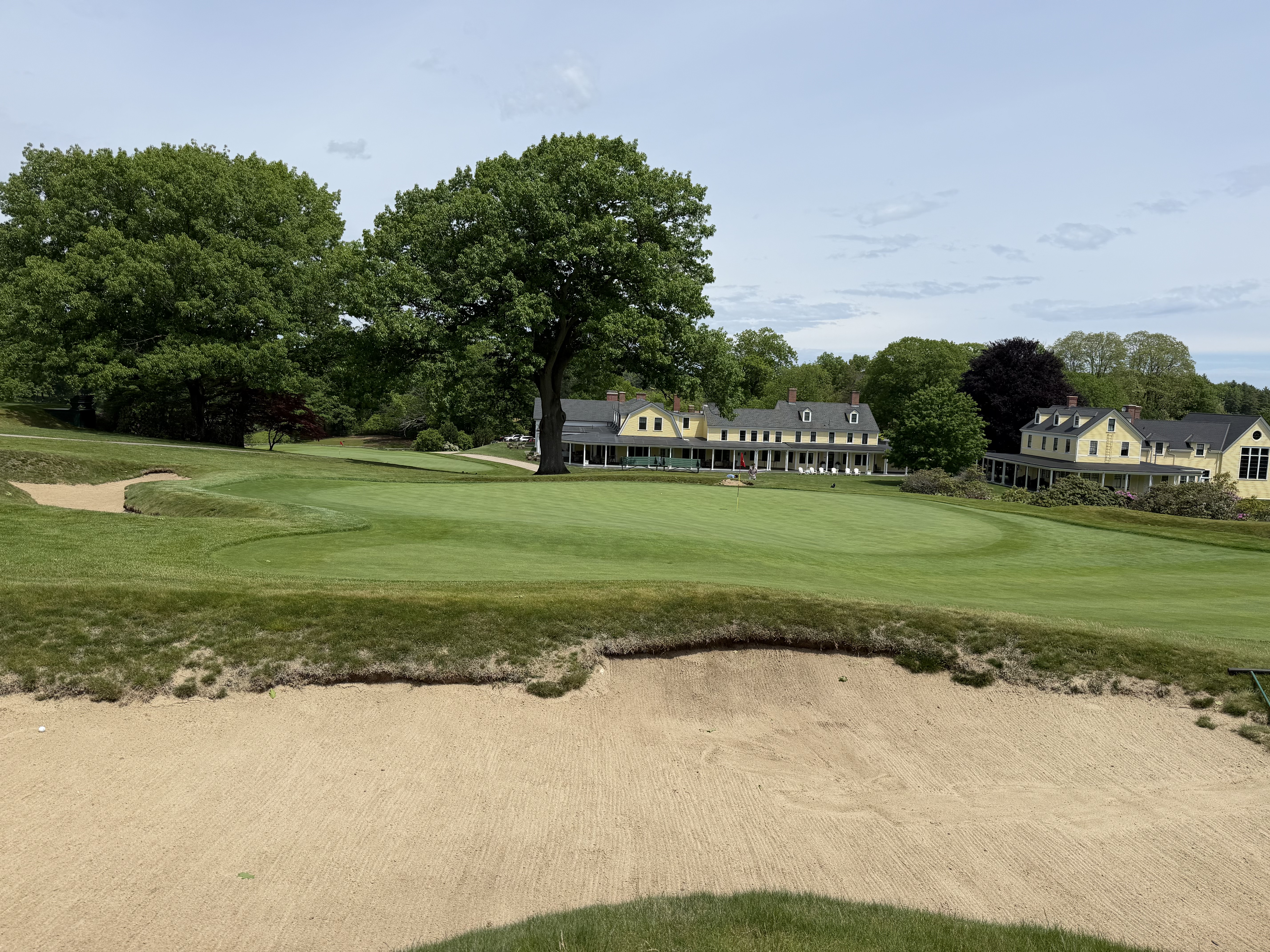
The Eighteenth is a 346 yard par 4. The last leaves us with a challenging tee shot where the golfer must invent the proper line and avoid the many pitfalls out there. Just to the left or even left side of the bunker is a good line, or even over the tree but that line must really be a strong tee shot to guarantee fairway. The fairway dog legs to the right and uphill to the green. Bunkers on either side of the green frame the approach while the clubhouse is just behind. One can run the ball up to the green if desired but whatever the approach, consider the left to right and back to front movement. The green was shifted in the 1950’s to accommodate the parking lot.


The back nine and its inner loop confronts the same hills we saw at the First but from different positioning, they are an entirely new experience. The par 4’s are a very strong and varied set. It’s a bit more challenging than the front, as it should be now that the golfer is warmed up and in the thick of it. My ranking of them would be 12, 11, 10, 18, 13, 16, 17, 14, 15.
Generally, Merion West is a genuine classic layout that makes great use of hilly topography. The greens are a remarkable set and the strategy from tee to green is mostly within the contours and angles; bunkering is used sparingly. The manner in which the terrain is used likewise results in a wide swath of variety in play, sending the golfer in multiple directions about the hillside. This use by the way, is in ways that just wouldn’t occur today, with greens abutting fairways, creeks lapping at green’ edges and its assortment of blind shots. Challenge off the tee, an engaging ground game and selective aerial game are all accounted for. It is also notable for how untouched the course remains, leaving it as one of the most intact Flynn designs out there. On its own without considering its more famous sibling, I consider the West one of the stronger courses for strategy and architectural merit.
Clubhouse/Pro Shop: The single room log cabin is just my speed. Casual and comfortable, be sure to order the Texas Tommy.



You must be logged in to post a comment.