6,693 yards, 135 slope from the Blues
Normally at the end of the season, I stop worrying about my swing and game in general. I come to terms with where things are and just play with the hand I have. Knowing that each round may be the last of the year, each hole, each swing, becomes more purposeful, more meaningful. And sure enough, I start playing much better and end the season with all kinds of high points and promise.
Until the time I played Jericho National.
I came in to the round with all kinds of moxie. My swing was clicking on all gears, winning matches and taking names, it was all coming up Golfadelphia. At the range before the round, I was showing off my 2 iron, finding that sweet spot with ease and watching it boom over the yardage markers. And then I was paired up again with someone I just cleaned up with a few weeks ago. The round, the match, the day; what a marvelous time to the alive. Then it happened slowly, before all at once. It started by ending up in wrong places about the holes and scoring became a challenge. This some how was enough to start wearing on my swing, which was a complete mess by the end of the round. I putted out with a sigh of relief, shook hands, settled bets . . . and then went looking for the nearest barstool.
Just outside New Hope, Pennsylvania near the New Jersey border, Jericho National opened in 1999 and was designed by Hurdzan and Fry. Intended as an upscale club that takes advantage of a large valley, Jericho uses the contours and hillsides in all kinds of different ways while the greens, bunkers and few water hazards follow suit. The club seems to be part of the movement in the late 1990’s that started to break free of the housing development model, as you will see none; just the natural, fairly remote setting. The presentation of the holes shows that modernism is more of an influence here, setting itself apart with visuals such as atypical bunkering and mounding on hillsides and raised up or tilted down slopes. The greens are mostly large, with with their shiny undulations moving swiftly downwards or towards the nearest bunker. With respect to its era of design, we notice that setting is emphasized externally, but the course does not concern itself much with naturalism except to use the rise and fall of the valley. The design may feel disconnected from the natural setting but that setting still surrounds it. Instead, the course focuses on a shaped structure of play, intended to stand out with its conditioning and liberal, eclectic use of bunkering. Variety of play is an emphasis as well but as we have seen in the other post-Golden Age courses reviewed recently, that variety is for those who find the fairway. Recovery plays and what happens to those off fairway is mostly either a redundant or penal affair with most degrees of creativity replaced by sheer survival. The strategic decisions here are relatively straightforward, with most thought directed towards avoiding the bunkers and a bit more interestingly, handling the greens, which usually have a dominant movement based on their position with respect to the valley, then secondary movements based on the undulations. One thing Hurdzan and Fry do well is accommodate for speed. The greens are more on subtle and on the broad strokes side so that they can roll faster if so desired.
An interesting point of discussion for Jericho is its course identity. It doesn’t seem to have aspirations to host on a national stage yet is capable of hosting local tournaments if it wanted to. There are some similarities to Militia Hill, which is sensible since both courses were from the same architects, but Jericho came first. What stands out though is the course seems comfortable in its own skin and is one of the few in the area that has not sought some significant renovation or re -design project. It’s in a more tranquil wooded region with a local membership that enjoys the club. Its design tenets mark a distinct point when conditioning and difficulty were emphasized, yet here they were done without a lot of the heroism and severe penal elements common at the time. In all, it enjoys a distinct place in the Philadelphia golf scene as a mid-modern course with a firm and fast presentation that has a hundred and one different bunkering arrangements, all in a pleasing setting.
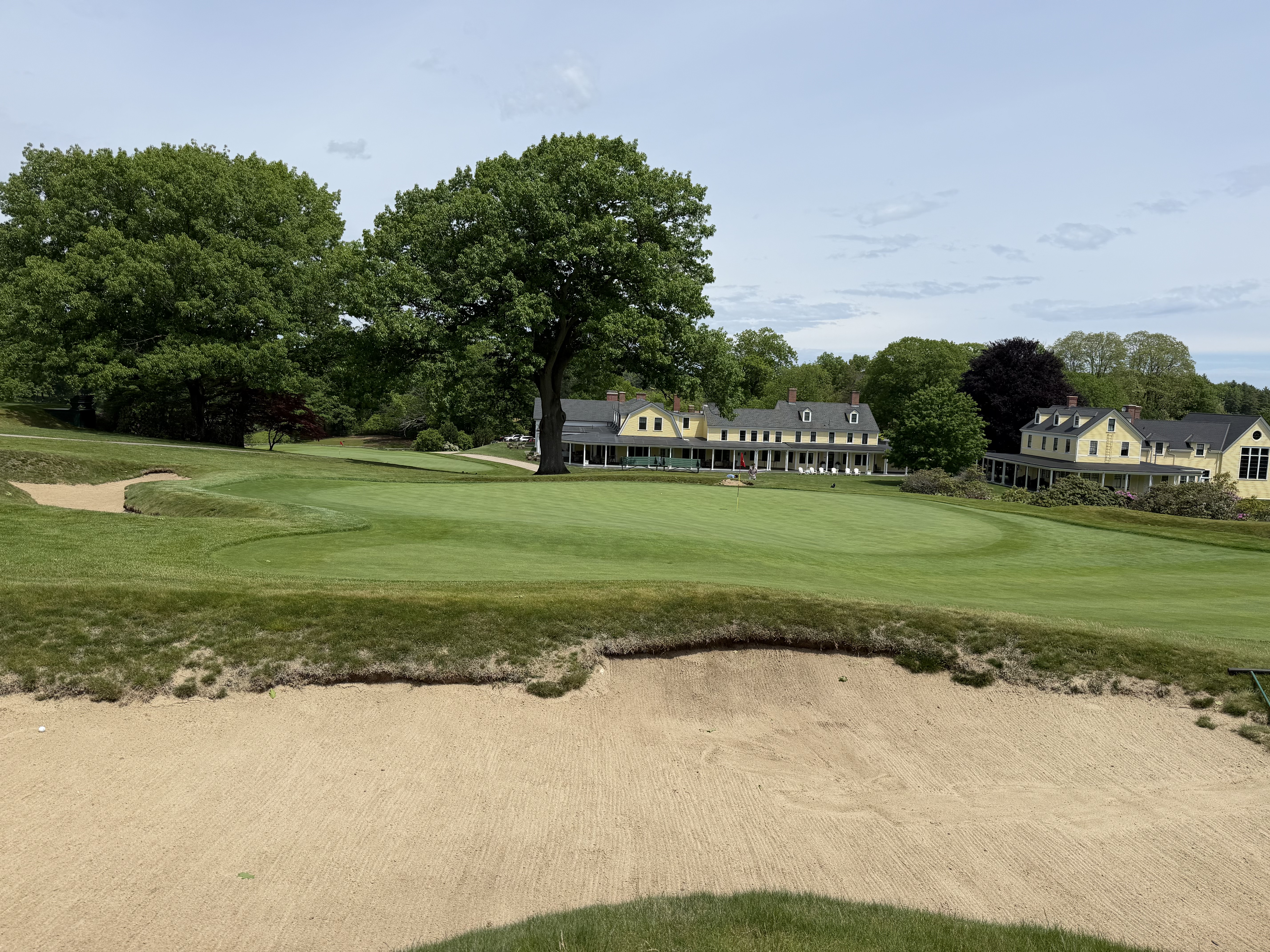
The First is a 559 yard par 5 (from the Blues). An uphill par 5 with bunkers on the either side, there’s a bit of room on either side to play with to ensure the ball rolls out and remains on the fairway. As we walk the fairway to our tee shot, bunkers surround us and the word that kept coming to mind throughout the round as I came across them is squiggly. The fairway eventually ends where the cart path crosses over, picking up on the other side and moving a little left towards the green although there’s a flanked shoulder on the right before it all narrows to the green. Bunkers are at the rear and front corners of the green with a nice entry point into it at the front.


The Second is a 204 yard par 3. The cart paths take a lot of liberalities and here it swerves around the tee boxes for some reason. We continue uphill on this longer, uphill par 3 to a deep green that moves from left to right with bunkers on either side. The left side has a bunker at the left rear, which is space enough to favor that side off the tee and have shots moves towards the center of the green.


The Third is a 339 yard par 4. The first section of fairway is downhill and its edges lined with bunkers. The green is off to the right, below the first fairway and hidden from sight from the tee. Longer hitters can have a go at the green if they know where to aim, but there are holes on either side close by and the right miss could end up just about any where. Those will temperance will take something reserved off the tee, which then sets up a short shot into the green.


The Fourth is a 390 yard par 4. Back up the hill we go, which tracks to the left. The fairway widens after the bunkers on the left and the right side is lined with them along the hillside. There’s a center line bunker close to the green with greenside bunkers off to the sides, so going for the rear of the green avoid all the sand while anything to the front or short really needs to thread the needle to avoid it. The approach will be downhill, as opposed to the tee shot, which starts uphill.


The Fifth is a 179 yard par 3. The green runs left to right towards the inset bunkers on that side. The bunkers on the left collect those shots that are over-anticipate that movement. Plenty of room to work with short of the green as well while conversely, long is death.

The Sixth is a 371 yard par 4. Heading back to the clubhouse and moving down just right of the range, figuring out how to deal with the right side bunker off the tee comes to the forefront of decisions. The bunkers are grouped in a staggered fashion, first left, then right, then left again. Flirting with its left edge is ideal, which will make the ball peel off towards the center of the fairway. The green is large and there’s a center line bunker at its front, so get the ball well past it.


The Seventh is a 505 yard par 5. Moving over to the perimeter of the property beyond the left side of the driving range, it dog legs right after a ridge, the wide left side in view off the tee an easy place to go for off the tee. The fairway narrows considerably once it turns but then expands after moving past bunkers on the left. After the turn, there’s a hillside on the right that remains rigid up to the green whereas there’s more room on the left even if much of it is taken up by bunkers. The placement of each shot in an effort to stay on the fairway and avoid the trouble becomes a delicate question with each shot, especially considering the green that is of only a modest size.


The Eighth is a 284 yard par 4. A short par 4 that brings all kinds of temptation to go for the green. Water is at the left and the fairway cants towards it. An expansive waste bunker sprawls on the left side between fairway and water, which works to narrow the fairway as it gets closer to the green. The decision is a very direct one; why not hit a shorter club off the tee to the wide part of the fairway, then have a short club in? Because that green beckons; nay, taunts us, to try and go for it. Whichever voice the golfer listens to depends, but it’s a fun, short par 4.


The Ninth is a 405 yard par 4. The dog leg to the left takes a little longer than the abruptness we encountered on the Seventh, but the bunker visible from the tee is all we need to know in terms of where to go and not go to start off with. Once the green is in sight, it’s pushed up from the fairway surrounded by bunkers save the front, where all the ground shots one would like to pull off are possible. It’s a nice finish to the front nine, an approach with plenty of ways to go about it and a green that with large, sweeping movement.


The front nine takes up the southeast part of the property and manages to stay well balanced with variety of lengths and par holes. The closing stretch sets itself apart with its interest. I would rank them 9, 8, 5, 4, 3, 2, 1, 7, 6.
The back nine starts with the 395 yard par 4 Tenth. The loop is on the opposite side of the property, which is hillier, more remote and the holes more insulated from one another. Starting off with an elevated tee shot with a hard turn to the right that must be negotiated with the tee shot. The inside of the turn is well bunkered and sure, there’s a bunker on the outside as well, then water along the left after the turn that still comes into play off the tee. The tee shot becomes much more critical to pull off and driver may not be the answer for everyone. The approach is down the hill with the green resting next to the water on the left. The smaller green and dearth of off green space means the approach must be precise or else.

The Eleventh is a 362 yard par 4. A shorter par 4 where the green is up the hill on the right, the golfer has room off the left to use for the approach but may be tempted to get as far right as possible. I give the course credit with its temptation pull, as I foolishly rationalized I’d belt it to the right of the bunkers and then have a wedge in from there, no matter if it ended up in the rough. It did not go well. The bunkers are well below the green, which increases what I’ll call their hazard level. This hole indeed encountered a bunker explosion near the green and every where you look, there is sand. Next time, I’m opting for safety off the tee for a clean approach up the hill.


The Twelfth is a 136 yard par 3. A carry over a small valley to the green, which sits on a ridge running diagonal from the tee. A sinewy trench lies below at front right and don’t worry, they didn’t forget to place a couple bunkers high rear left. The green is narrow and while the front looks like there’s some room to play with, those shots can run down into sand if they land just so. The course wants us to be dialed in now and if we are not, the sand wedge hopefully is.

The Thirteenth is a 401 yard par 4. Moving towards the far end of the property, the fairway falls downhill to the green. The sides of the fairway fall off substantially and are really no where any one wants to be. That leaves us with the fairway, which ends halfway down the hill into some rough before picking back up again near the green. Since hitting their fairway from the tee is almost a command shot, even something shorter yet accurate should be considered with a longer approach as a trade off. The green is skinny and well guarded by bunkers, so that shot too must be rather precise.


The Fourteenth is a 596 yard par 5. Now at the bottom of the hill, we head back in the general direction of the clubhouse while Jericho Creek runs along with us within the trees to the left. Similar to the hole prior, any shot off the fairway will not fare well. The tree line on the left stays rigid against the fairway while the right side is a hillside fraught with bunkers and trees beyond. A trio of bunkers and rough separate the first fairway from the second, which seems to tilt more towards the creek on the left. It narrows closer to the green, which is deep enough to accommodate longer shots coming in.


The Fifteenth is a 240 yard par 3. A slightly elevated tee shot to a decently deep green with bunkers on either side. Ho hum.

The Sixteenth is a 414 yard par 4. Still moving in the same general direction as the Fourteenth, there’s a lot of turn here, to the left. A row of bunkers is on the outside right, greeting those shots who don’t move left enough or stop before them. The fairway narrows considerably at these bunkers and really doesn’t widen all that much more afterwards to the green. The green is modestly sized and more deep than wide. It’s a tough stretch of holes in the middle of the back nine, where the course tightens up and gets very stubborn on those sideways shots.


The Seventeenth is a 510 yard par 5. Back up the hill to a fairway much wider than we’ve encountered this entire back nine. The cart path separates the fairway further up, which extends on the left while the right side becomes rough and bunkers. The green is off to the right and for those that didn’t cross over the rough and bunkers on the second shot, you will likely need to on the approach to reach the green. The hillside movement to the right becomes a lot stronger at the green, so using some care in remaining center to left up to and through the green is a good idea. There’s a lot going on with this hole in how the green is placed in conjunction with the fairway and bunkers.


The Eighteenth is a 403 yard par 4. The tee shot is elevated and the widest part of the fairway happens to be where the bunker is on the right. Off fairway is nothing good on either side. The green is well defended by bunkers, with the entry point more on the left.

The back nine is decidedly more challenging than the front and after the Twelfth with the exception of the Seventeenth, gets lean in terms of options. The fairways and greens dictate play sternly. I would rank them 11, 10, 17, 13, 16, 12, 18, 14, 15.
Generally, Jericho National showcases aspects of modern design that emphasized challenge and relied on shaping over naturalism and strategy. To be sure, the setting is lovely and there are shades of variety in the challenge throughout the round but there are times when the barrage of bunkers and mounds distort definition and a golfer is left guessing where exactly to direct his shot or even strategize. The tough stretch of the back nine is as intended and likely at the right time of the round, as the golfer should be as warmed and sharpened up as he will get by then. The greens were enjoyable with their movement and speed, and the feature that is its crowning highlight. I would be fine getting to within fifty yards of each one, dropping a few balls and playing them all into the hole. The late 1990’s was a time when golf was rising in popularity and newly formed golf clubs could sustain themselves if they were able to attract the right membership. Challenge and beauty were among the main draws and the name of the course architects mattered, even relying on labelling signature holes to add to the excitement of the design. Jericho National is of that ilk, representing the characteristics of that era nicely and just fine remaining that way, rightly so.
Clubhouse/Pro Shop: Well adorned and equipped in all respects, with a nice pub to boot.


Practice area: The driving range is close to the clubhouse and on its far side is a learning center and short game area.



You must be logged in to post a comment.