6,657 yards, 133 slope from the Blue/White tees
It was difficult not to get too sentimental as I stepped to the First tee that morning. Of course, the rain and overall dripping moisture of the air quelled them a bit but I couldn’t think of a place where I had returned after so much happening. A younger man stood on this tee before. His wife back at the hotel pool, they were spending one last weekend before their first child would grace them with her presence. He didn’t know she would be a she and come to think of it, the man and his wife suspected it was a boy more than a girl. But at any rate, he stood on that tee fairly new to the game but just starting to take it a little more seriously. But something drew him to the game and he enjoyed the few hours outside either by himself or with others. He was paired up with another that day, a nice guy that had a couple kids of his own. He had a Guiness driver head cover, which impressed the young man a lot more than it probably should. They golfed their round, then the young man met his wife at the pool before dinner and so on. Their daughter arrived a few weeks later and a few years later, their son arrived. The young man stopped being so young and kept golfing. When he found himself at that First tee a second time, his children were almost teenagers and he was decidedly middle-aged, even if he remained terribly good looking by pretty much every standard out there. So much had happened, such as the wonderment of time. It was fascinating in more ways than one and I enjoyed comparing my shots at each hole this time around to the last. For our purposes, however, it is useful playing a course again to determine how it plays and impresses after gaining perspective and experience of other courses.
The second round became self chastising. How could I go so long returning?
Hershey is that place many in Philadelphia forget about but every time they visit, are so impressed that they make it a point to visit more often. Then time wears on and they realize it all over again once they make their delayed return. The hotel makes for a splendid stay, there are a number of restaurants worth checking out and the theme park is very good in all respects. It’s fairly close by as well, so even though it has all of this going for it, Hershey remains under the radar, some how. This almost goes double for the golf. There are a few options but the main courses are the East and West. The East was designed by George Fazio in 1969 and has hosted a number of notable tournaments, including a regular stop on the Nationwide Tour from 1997 – 2004, the NCAA Division III Men’s Championship in 2010, the NCAA Division II Men’s Championship in 2013 and the PGA Professional Championship in 2011. The West was designed by Maurice McCarthy in 1930 and is likewise rich in its championship pedigree, hosting the PGA Championship in 1940 (where Byron Nelson bested Sam Snead 1 up), the LPGA Lady Keystone Open from 1978 – 1994, the Pennsylvania Open in 1935, 1953 – 62, 1964 – 66, and 1971 – 72, the USGA Senior Women’s Amateur Championship in 2012 and the PGA Professional Championship in 2011. A two-course facility with such pedigree for both courses is indeed a rarity and even more so remaining accessible to the public.

The West opened in 1930. Milton Hershey and his mansion were in the hills above Hershey proper and initially he had a nine hole course constructed between his home and the plant. As his business grew, so did the plant, which started to encroach on some of the holes. Hershey then retained Maurice McCarthy to design an eighteen hole course using the land and hills near the Hershey Mansion, with his home serving as the clubhouse. The course rose in prominence, with Henry Picard its pro (followed by Ben Hogan) and hosting the 1940 PGA Championship. Aside from the clubhouse moving in 1970 which impacted a few of the holes, it remained without substantial work to it until 2008, when Lester George was retained for renovation work, which focused on modernizing aspects of it (including the very much needed drainage issues), updating the soil and turf grass and re-designing four of the holes – the Eighth, Ninth, Sixteenth and Eighteenth. In general, George’s goal was to restore and recreate the classic McCarthy features while adding strategy, playability and length. This included reconfiguring bunkering positioning as well. The work was completed in 2010.
The course is a romping parkland that is set about the hills and their glens. The diagonals and angles used in conjunction with the hills and water features instill a lot of its identity while the greens move a lot more intricately than they appear. While the trees are usually close at hand, there’s sufficient width for various playing corridors throughout. It’s a charming classic parkland that is tasked with delighting resort guests while remaining a challenging tournament venue for professionals and amateurs alike. There are few classic resort courses living up to that double duty, which include The Greenbrier, Pinehurst and Sea Island. Hershey West is one of the more intimate layouts with such intentions. Without the crowds and/or price tags of the others, one can zip about the hills, play some meaningful and engaging golf, then enjoy the rest of the day however one sees fit. With its history and playing structure, it’s a worthwhile golf destination while enough of everything else to keep everyone happy.
I still need to play the East. With my kids growing up, I see a round with the family a nice next milestone. My son was talked in to his first real roller coaster ride at the park nearby last season, so maybe next time a whole golf course/roller coaster tour should be in order. The car ride will be loud and my daughter will want to spend way too much time in the stores shopping, but it will all work out and be worth it some how. If only that guy all those years ago teeing off knew what was in store for him.
The First is a 424 yard par 4 (from the Blue/White combo tees). A dog leg right where the golfer is presented with a single bunker on the right inside of the turn with trees and rough on the left outside. Ensuring that the tee shot properly gauges the turn and remains on the fairway is the opening salvo while longer hitters may consider taking on the bunker. The fairway narrow near the green and there’s an assortment of well sized bunkers on its sides. Most of the bunkers have this expansive yet shallow feel to them which can get unnerving at times as you try to decide how much to actually put on the shot without overpowering it. The green here is a proper introduction on what to expect throughout. Direct, large, lazy contours but quick as regret.


The Second is a 542 yard par 5. An elevated tee shot into a small valley that we immediately start climbing out of to reach the green, which is on the opposing ridge. There’s a lot of horizontal movement of the fairway as it starts to climb upwards and there is a section of rough between the end of the fairway and where it picks up again short of the green. The green moves from back to front in general, the remnants of the fairway movement still a consideration.


The Third is a 354 yard par 4. While it is a straight hole, the angle on which it is set with respect to the tree line and perimeter to the right make it play anything but. A couple bunkers are in front of us to the right but there are also a few lining the left side awaiting those trying to cut the trees too much. In fact, getting too close to the left side through the green means the risk of the hillside catching the ball and dropping it down into the woods. It’s a challenging tee shot requiring some plotting but if pulled off, the green is straight ahead, slightly below the fairway. The green likewise moves right to left towards the depths of the woods, with bunkers on that side as a half hearted attempt to assist the golfer from staying out of them.


The Fourth is a 307 yard par 4. We tee off above the fairway, which sits below in this glen that runs away from us at an angle. The golfer must once again manage to find the fairway by determining how much to take off the left side without running off the right, or impart some direction to his ball to accommodate the angle of the shot. The green is on the smaller side, well bunkered. A bit deep and narrow, it will tolerate approach shots that run out yet those off to the sides will likely find sand. Its speed is much wilder than it looks with its smaller size, so stay vigilant until the last.


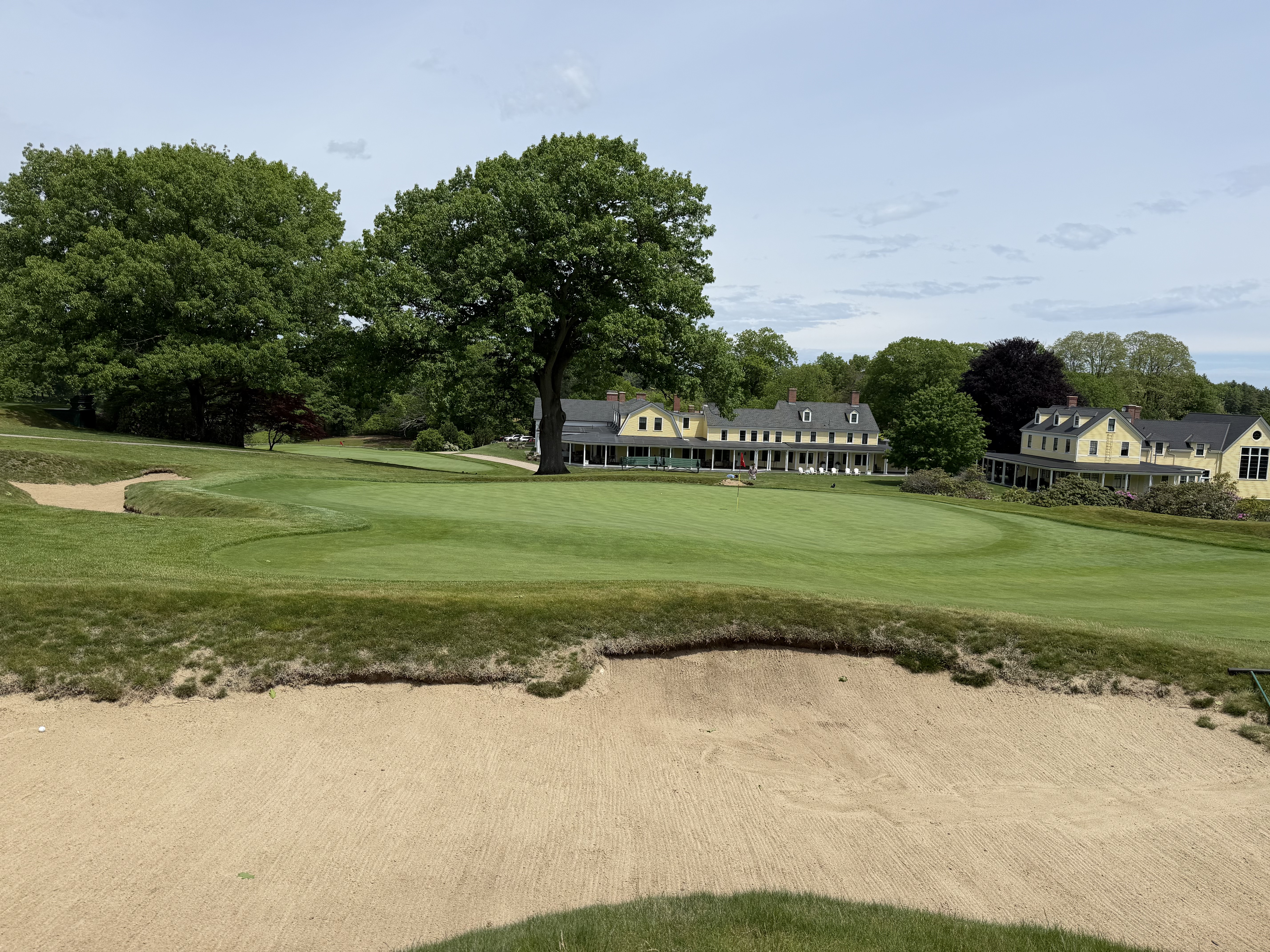
The Fifth is a 164 yard par 3. Milton Hershey’s house is in the background showing just how close he wanted the course to his grounds. The stone work short right is where Catherine Hershey’s rose garden use to reside. The historic scenery may mean the golfer loses sight of just how good, and tough, this par 3 is. The green sits on a ledge across from us at the tee, with hard movement down the hill at the front. The rear half of the green may appeal to the golfer but then the speed towards the green on the putts will be a challenge. A simplistic hole in presentation, it gets complex based on its use of the terrain.


The Sixth is a 335 yard par 4. An elevated tee shot as Spring Creek runs along the fairway. Similar to the Fourth, figuring out a line off the tee that clear the creek yet remains on the fairway without running off the far side is key. Approach shots from the fairway will then need to cross back over Spring Creek to reach the green. Once again, directional awareness is vital in making sure the approach is in fact at the green, as it will not simply be a straight, point and shoot affair. Bunkers on either side of the green help emphasize this concept for the golfer.


The Seventh is a 519 yard par 5. An uphill par 5 that bends slightly to the right. A couple fairway bunkers are on either side of the fairway while trees frame the playing corridor. My host pointed out to the left of the trees of the fairway is where Ben Hogan would hit balls when he was the pro here from 1941 – 51. The green may appear flat but moves much differently. The assortment of larger, shallow bunkers stacked against each other around the green is a nice look and again may bring some trepidation to the golfer who is used to trying and clear a more steep lip between him and the green.


The Eighth is a 209 yard par 3. A long par 5 to a longer par 3, playing a little uphill from the tee. The features are on a grander scale here and there’s much room for the golfer to miss without getting lost in the trees. The bunkering adheres to that shallow lip style that has specific effects on the golfer. The green runs back to front, so a shot into the healthy part of the green is a good idea.


The Ninth is a 389 yard par 4. While heading in the same direction as the Eighth would lead us to the Eighteenth tee and in, we head back in the direction we came to continue on. The ridge is used often for greens and tees, acting as an anchor edge for the routing. The tee is set at an angle to the fairway but it’s a fairly straight hole. A perpendicular bunker is on each side of the hole well before the green, acting as a gateway of sorts before heading a little downhill to the green. The green is small, surrounded by bunkers, and moves quickly from left to right, forcing the golfer to favor the left side on the approach likely beyond his comfort zone.


The front nine has an interesting array of par 4’s that use the terrain to create interest with angles, especially off the tee, while the par 3’s focus on strategic placement amidst well moving greens. The par 5’s use the climbs to add to their length with the interest increasing as the golfer gets closer to the hole. I would rank them 3, 4, 9, 1, 6, 5, 2, 8, 7.
The back nine starts with the 406 yard par 4 Tenth. The tee shot moves a little down hill where the fairway bunkers are on either side in rough. The tree is tucked away on the right so left to left center is a good line off the tee unless you’d like to try to cut off the turn altogether. The green is below the fairway, so running shots can move on and will roll towards the rear and to the left. It’s a nicely moving green as it relates to how the terrain appears visually.


The Eleventh is a 354 yard par 4. A blind tee shot where a platform is used to make sure the fairway is clear before swinging away. The fairway continues to climb, canting from left to right and there’s a bunker on the left to make sure the golfer does not have free rein to use that left side at will. Once the fairway crests, the small, sharply moving green is abruptly below. It’s compactly fierce and those who are off with their approaches will have a hell of a time recovering close to the hole.


The Twelfth is a 169 yard par 3. Playing uphill, the bunkering tee to green is striking both visually and in how it plays. The shallowness of the bunkers continues to torment yet provides a much better chance of recovery to the green than those that are much deeper. The green seems to have more oomph in it than others as well, generally moving from back to front. It was the original closing hole, as the Hershey Mansion is off to the left.


The Thirteenth is a 537 yard par 5. Essentially climbing up the side of a hill, there’s a significant right to left pull off the tee that makes aiming directly at the right side bunker as a pretty good idea. The pull to the left calms a bit more moving closer to the green with a group of bunkers short and right of the green collecting those shots that over corrected for the terrain. There are bunkers on each side of the green, separated by slivers of grass between them but acting as large unified hazards for the most part. The hole plays uphill the entire way, which lengthens the shots, as does the rough on the left where many tee shots will likely be played from. It’s a good par 5, dealing with severe terrain strategically.


The Fourteenth is a 354 yard par 4. How the bunkers are positioned to the playing corridors is notable. Sometimes they are parallel, some times they are perpendicular and some times they’re some where in between. Here, they are perpendicular on each side off the tee, emphasizing the need to hit the fairway. The fairway continues uphill after the bunkers to the green, a smaller affair that funnels shots towards it center for the most part. The green remains open to the fairway just like many of the holes here, allowing an array of short game shots by land or air into it.


The Fifteenth is a 501 yard par 5. Now we run back in the direction we came the last two holes and benefit from the downhill. The rain, wet and climbing was starting to take its toll so the downhill was welcome indeed. The hillside is now a left to right tilt and of course will move towards the hole. There’s a place where the ridge sits on a small plateau before dropping down into a ravine. A belting tee shot can get there and place the golfer in line for a chance to reach the green in two shots. Everyone else will need to decide whether to hit their second to remain up on the plateau or go down into the ravine, where the approach to the green will be a steep shot up. The green is on a hill of its own, which pronounces the drop and climb the ravine presents. Anything short of the green runs the risk of running back down the ravine while shots too far into the rear will face the risk of the green catching the ball and sending it down the ravine anyways. Deftness of touch is the order of the day for one of the more memorable holes on the property.


The Sixteenth is a 500 yard par 5. For those keeping track at home, three out of the last four holes are par 5’s. This is the last one we see of the round. Just a slight bend to the right and back up the hill, where the fairway moves from left to right before twisting over from right to left. Similar to what we saw at the Second, the hill between the end of the fairway and green is rough. The green and its surrounds move from back to front.


The Seventeenth is a 182 yard par 3. The final par 3 continues up the hill and dips down just before it, leaving a lot of its contours blind from the tee. There’s a hillside further over to the left that should be kept in mind for the hookers among us. Three bunkers are on either side of the green, which moves back to front and right to left, perhaps influenced by the hillside alluded to earlier. It’s a smaller green and with a longer shot, turns into a challenging hole pretty quickly.


The Eighteenth is a 411 yard par 4. A dog leg right sends us home and fittingly, the same driving concept we saw on the opening hole is here as well. The straight shot only works if it carries the trees on the right or is terribly short. Otherwise, it will run through the turn and end up some where in the left tree line. Once the turn is cleared, however, the fairway opens up all the way to the green. Two large bunkers surround most of the front side of the green, but there is enough of an apron in front to use to get on if one wants to use it. The green sits above the fairway and seems to have a dominant move to the left. The drive is the real challenge here and if executed nicely, the ensuing approach to the green should lead to a much more easygoing end to the round.


The back nine is full of par 5’s, a great pair of par 3’s and some solid par 4’s. It uses more of the higher hills well and does well in varying the looks and structure. I would rank them 15, 13, 11, 12, 10, 14, 17, 18, 16.
Generally, Hershey West is a nice classic parkland with some sophistication in how it uses the hilly terrain and accompanying ravines and glens. This results in challenge off the tee as much as it does challenge on the greens, all of which provides nice complexity to how it engages the golfer throughout the round. The shallow bunker depth is a feature relied on in eras past but adds good character here as the bunkers seems to be laid down in layers yet do not dominate the landscape with steep or jagged faces. The greens in conjunction with the hills is a good amount of the engagement here, which I found similar in some ways to some where like Rolling Green. Placing this course in its proper context of a resort, it certainly provides one of the more substantial golfing experiences in the classic realm.
Clubhouse/Pro Shop: A great place to explore after the round, as there is plenty of history on display.


Practice area: The range is across the street, which also has a short game area. The putting green is near the clubhouse and First tee.




You must be logged in to post a comment.