6,525 yards, 140 from the Black tees
One of my heavily underrated personal preferences for golf is that it is walking distance to some kind of town place. The embedding into the community gives the golf a special kind of feel. Most golf is situated in its very own separate peace and strives for self-sufficiency, trying to provide anything the golfer could want. This makes sense, as golf courses need some measure of space so it can be rather tough to have town and course in the same vicinity. Yet there are exceptions and when done well, the course and community have an opportunity to reflect each other in favorable light. The best I have seen is at the Old Course, where you could finish up at the Eighteenth and walk twenty paces to the Dunvegan, or just about any where else in town. Some others that come to mind from personal experience include Walnut Lane, where Dalessandro’s is a lovely jaunt and the line could be near the course anyways; Garden City Golf Club where Leo’s is a favorite; and last but not least is my home club of Llanerch, where all kinds of Havertown places are close at hand, including Manoa Tavern across the street. North Berwick is probably another but we didn’t have a chance to check out the town. And at Leven, apparently there is a pub golfers sneak to in the middle of the round for a pint to hold them over. I have heard of Southampton as well. It’s simply one of those things to me. The sense of place is a bit more vivid when the community is so close at hand.
One of the best of these is Westhampton. Main Street literally leads to the entrance, which is full of restaurants, shops, a bakery, farmer’s market and even a theatre. I envy the members who could finish an afternoon round, have a beer at the clubhouse before walking out for dinner and a show. Residential neighborhoods are nearby and that would be an enormous boon to anyone that lives within the vicinity as well, a true aligning of the stars. A car is no longer needed as one has all they need nearby, able to enjoy the place in which he lives a variety of ways without needing to transport for any of it. Walking Main Street the morning before the round and watching the place wake up more and more as the sun rose higher and higher, I wondered how such an idyllic arrangement came about. It also made me wonder how many other courses are similarly arranged, especially those courses of such admirable quality as Westhampton.
Westhampton is one of Seth Raynor’s earlier solo projects, opening in 1915. While the course would see its share of changes from hurricanes, war and economic downturns, the routing remained intact and the changes were never irreversible while the greens remained almost all original. Brian Silva began rebuilding efforts in 1988 – 89, which allowed Gil Hanse to articulate a master plan in 2007, focusing on re-establishing the original bunker scheme. Hanse was able to complete the restoration work in 2009. The course now shines close to its original design, where Raynor showed maturity beyond his burgeoning solo career at the time. On relatively flat property, Raynor showed a much more complex and technical side of his design character by creating interest in mounding, angled corridors and splendid green complexes. Moreover, he did so without relying on immense bold features. Mind you, there is boldness but it’s not overly relied on for its character. It was smartly distinct in its subtlety, while the strategic layers ran deep the more the golfer thinks over each shot. There are template holes but they are not the main attraction. Instead, the interplay of the mounding and angles is what sets the course apart as a rather intelligent design. While the course is set upon a smaller piece of property, it is some how generous in width which allows the wind to wreak havoc and interest all at the same time. Hanse did wonderful work accentuating all of this, highlighting Raynor’s genius in how he was able to adjust to the given terrain. Westhampton is some how underrated, likely due to its proximity to more famous and bolder courses that most will seek out instead. This is a mistake, as there is just as much Raynor brilliance here to take in even if for the more discerning golfer. I found it to be one of my favorite Raynor courses played.
The First is a 303 yard par 4 (from the Black tees). “Ketchaboneck.” The opening tee is a couple paces from the clubhouse in its own little alcove. The tee shot depends on wind direction but right away one needs to mind the assortment of bunkers and mounding, along with the Oneck Drain, which crosses over the fairway just before the green. It’s a shorter hole, so the approach is on the shorter side no matter what club is used to start things off. The green is modestly sized and surrounded by bunkers except for the creek at the front. A proper introduction as to what lies ahead.


The Second is a 326 yard par 4. “Oneck.” Another shorter par 4 where the prominent cross bunkering starts on the left, so carrying it is shorter on that side while those opting to lay up have more room on the right to do so. There’s a lot of room after the cross bunkering to the green, which opens up in size and scale a bit. The cross bunkering and how the mounds obfuscate views of the green do a splendid job adding mystery to the hole, making it appear much larger than it actually is.


The Third is a 172 yard par 3. “Punchbowl.” I challenge the reader to find more intricate bunkering than can be found here, nine total bunkers artfully arranged and almost identical on each side. The downhill and mounding conceal a lot of it from the tee, the green in its own hollow as the punchbowl moves front to back, one of only two par 3 punchbowl par 3’s designed by Raynor (the other being at Southampton).


The Fourth is a 444 yard par 4. “Raynor.” That’s a lot of 4’s. The tee shot needs to carry water but should not be all that hard to do so at this dog leg right. Bunkers are placed at the inside of the turn on the right while a slender scarring bunker encroaches towards the center of the fairway a little further up. The green is slightly uphill from the fairway, feeding into it and its on the larger side with bunkers way out on the edges.


The Fifth is a 541 yard par 5. “Woods.” The course lies in a residential neighborhood and the occasional crossing of a road is in order. We cross South Road for the next four holes, which takes us to the far point of the course and then looping around. The Fifth is the first par 5, the tee shot straight out with dense, bushy trees on either side. The fairway isn’t narrow by any means but it’s not necessarily the widest we have come across. A bunker intrudes from one side or another as one makes their way to the green, which need to be negotiated on the tee and second shots to set up the approach. The bunker arrangement gets a little more intense near the green which makes planing the approach all the more necessary. Personally, the bunkering near the green starts about 100 yards beforehand, so I’d opt for laying up short of all of it and taking the hundred yard shot in. For those wanting the green on the second shot, the green is large enough to account for roll out but will need to take on the front bunkers to do so.


The Sixth is a 447 yard par 4. “Narrows.” The fairway seems wider than the hole prior, despite its name. The tree line on the right needs to be given some distance but otherwise the tee shot has a lot of room until the three cross bunkers on the right, which constrict the fairway to a small strip on the left before widening out again to the green. The green is yet another work of art, pushed up with a general right to left movement. Six bunkers line the rear and sides but with the green size, come into play when the pin is placed near the edges or an approach gets away from the golfer.


The Seventh is a 208 yard par 3. “Redan.” I can’t think of a Redan I have come across on such flat terrain before yet it is brilliantly shaped. Significantly pushed up on the right side with the front right bunker in place and those on either side of the green some of the deepest on the course, the green movement is wild yet manageable for the most wily and clever among us. A nice romping play coming at the right time of the round.


The Eighth is a 457 yard par 4. “Senility Ridge.” Completing the loop on the far side of South Road, we now run back to it with the Fifth parallel to us on the left. The tee shot can head straight out while bunkers move up the right side and trees are on the left. A center line bunker eventually graces the fairway further up, which makes most approaches here aerial. There’s plenty of room to work with at the green but a bunker is always close at hand. With most if not all of them significantly below grade, they can be troublesome with recovery and demand attention at all times.


The Ninth is a 448 yard par 4. “Vista.” The tee shot faces a forced carry over water which the golfer must decide which side of the cross mounding he would like to end up on. The safer, shorter tee shot would be off to the right yet the trade off is a significantly longer approach to a green that will be running away from the golfer. The other path is confronting the water head on and opting for the left side of the mounding. This leaves a shorter approach in but depending on the wind, could be long anyways. Cross bunkering is next, the fairway then narrowing leading up to the green that sits above and falls off on the left and rear. It’s quite the hole, especially for a par 4 and demands two very fine shots to remain in scoring position.


The front nine has two par 3’s that stand out well while the par 4’s and 5 vary their play with the bunkering and green configurations in artful and strategic splendor. My ranking of them would be 9, 2, 3, 7, 1, 6, 4, 8, 5.
The back nine starts with the 466 yard par 5 Tenth. “Shore Road.” Shore Road is indeed running along the left side, then wraps around the rear of the green. There’s a single fairway bunker on the right yet the wind is sassier on this side so likely more of a worry. There’s some width on the left, which is native sandy ground off fairway up to the road. There’s a pond on the left of the green that will come into play if the golfer opts to move up the left side for the approach. Right to left movement at the green so left-sided approaches actually work out well. The horse trade is needing to carry that pond, I’ll take it.


The Eleventh is a 136 yard par 3. “Island.” Originally a Short template, sand surrounds the green. The green is indeed an island, with views of the bay dominating the background. It plays similar to a Short in that the shot needs to hit the green or else, but the tee stretches back enough to turn into a longer shot. The green movement here is extraordinary, with a couple rifts changing the predominant direction in spots.


The Twelfth is a 401 yard par 4. “Judge’s Elbow.” Shore Road is once again on our left as it finishes wrapping around and moves back inland. The right side of the fairway moves towards water, then sand while the left side is dominated by a tree line all the way down. A bunker at each front corner of the green while the left side seeps into the tee of the following hole. The green is large but drops off on the right into the bunker, so hedging short or even left is good management.


The Thirteenth is a 318 yard par 4. “Deception.” The fairway is at its widest at the middle just after the diagonal cross bunkers. The tee shot should focus on getting over to the left side. Mounding is built up around the green and the entry point is left-facing. Those on the right side of the fairway will need to carry the high ridge mounding before the green and mind the bunkering that goes around the left side. It’s a fun green and the further left you are, the more the ground game opens itself up to the golfer.


The Fourteenth is a 503 yard par 5. “Plateau.” Moving back towards the Tenth green, bunkers pinch the tee shot landing area and those looking for length should favor the left. The second shot selection should be well-pondered. A center line trio of bunkers about seventy yards from the green need to be avoided one way or another while the right side leading up to the green is at first a sandy waste area, then water. Four bunkers cover the left side of the green both before and after it as well. Hence, there is plenty of pockets of trouble which are all advisable to avoid in reaching the green. Again, I’m fine laying up short of the center line bunkers and attacking the green from there but that’s just me.


The Fifteenth is a 400 yard par 4. “Hillocks.” A bunker on the right, then left, are all that are needed to keep the tee shot honest. The hillocks start about sixty yards short of the green, which are five bunkers in a V formation. The hillock mounding denote each bunker that are below grade, then there is a large short grass apron before the green with a small pot bunker on the right with steps down to it and everything. Golf Club Atlas describes the internal contours forming the letter C, which I think is pretty apt and does more to characterize its lively movement. The symmetry of the bunkers before the green is in line with the Third bunker scheme, which is more profound when facing it as a player walking on the ground.


The Sixteenth is a 335 yard par 4. “Crossings.” The march to the clubhouse starts now. The tee shot must carry water as the fairway moves uphill to the green on the other side. A long and large bunker takes up the left side while a fairly involved bunker complex is further up on the right side just before the green. Slender bunkering frames the rear half of the green while mounding is at the front front right, leaving the entry point at the front left. Strategically, those that get close to the left fairway bunker off the tee have the ideal approach line while those opting for a safer tee shot off to the right will have a blind approach that needs to deal with the bunker complex and mounding.


The Seventeenth is a 208 yard par 3. “Biarritz.” The clubhouse now in sight, the tee shot confronts the extremely deep green head on with bunkering surrounding most of it except the rear. The swale is substantial and the golfer who needs to get from one end of the green to the other will be quite challenged in taking on the swale as well as the grade of the green.


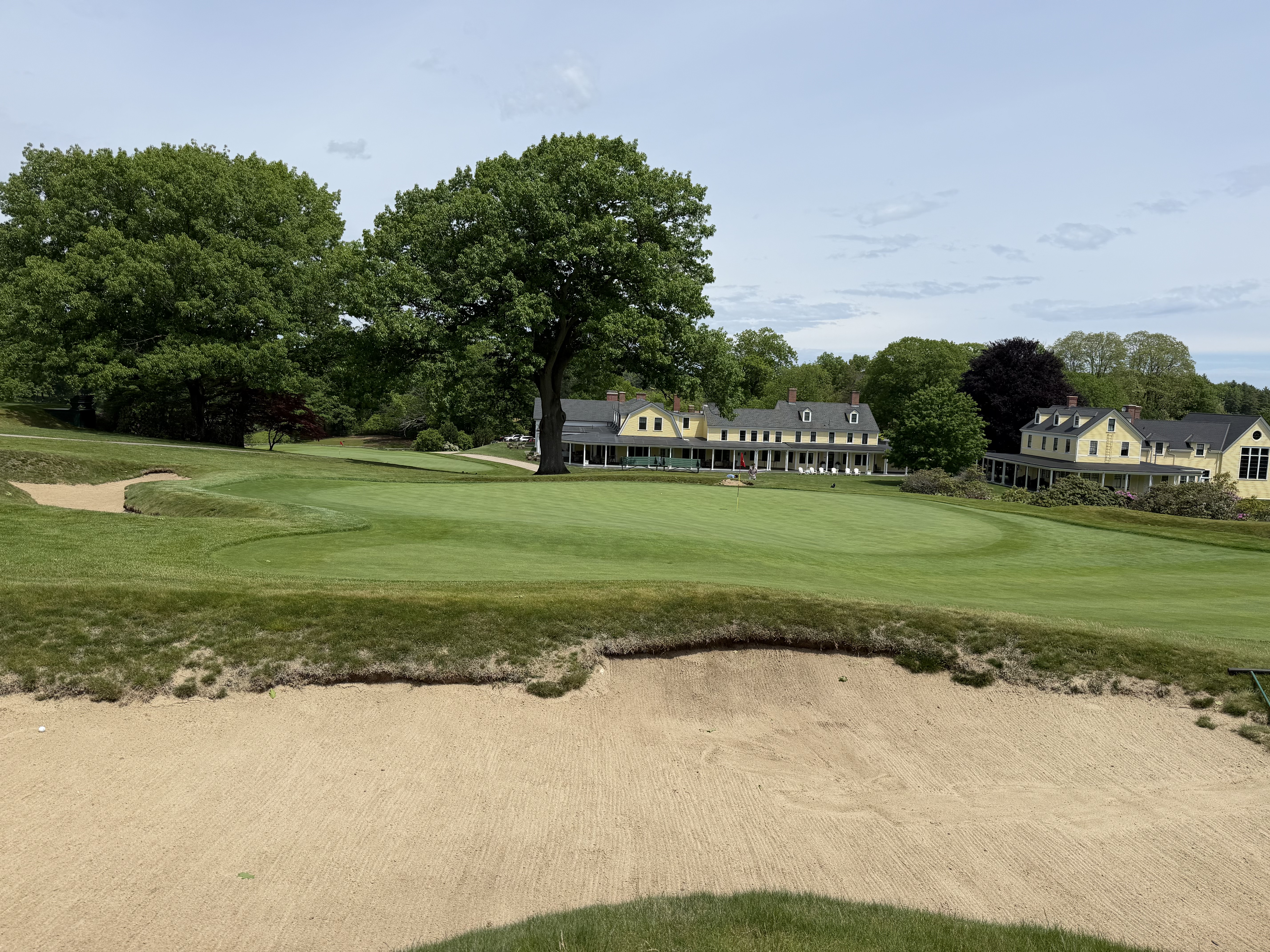
The Eighteenth is a 412 yard par 4. “Atwater.” The tee shot must carry Oneck Drain while the start of the left is comprised of a rather elaborate sandy waste area. The fairway is some what obscured from the tee but like the Sixteenth, a tee shot flirting with the left side sand will make for a nice approach in. There is a fairway bunker on the right in distance from the tee that is likewise a good line but approaches from the right need to carry bunkering and deal with a semi-blind shot. The clubhouse is rapping distance from the green and the round closes out, the opening tee alcove a few paces away as well and Main Street a mere hundred yards off.


The back nine is a bit more subject to the wind than the front and matches the quality of the par 3’s on the front. The par 4’s and 5’s have nice variety, once again showcasing brilliant hazard placement and extraordinary greens. I would rank them 11, 13, 15, 17, 10, 18, 16, 12, 14.
The design style of Macdonald, Raynor and Banks has enjoyed a strong resurgence over the recent decades. The bold geometric features and familiarity of the template holes has shown immense appeal for its ease of distinction and sharp definition. This style does not overwhelm at Westhampton but instead, showcases just how subtle and remarkably complex Raynor could get when he needed to. Faced with rather benign land, he relied on mounding and below grade features to make the golfer think his way around the course, similar to something like Portmarnock. He relied on wind in conjunction with the hazards, making sure no forced carry was overly burdensome if the elements were extremely against. And he relied on splendid green complexes, which require patience and study to figure out their whims of movement. All of this demonstrates a side of Raynor’s genius he didn’t get to show off all that much, as he was usually asked to build courses on much more dramatic land that typically lent itself to broad strokes of memorable boldness. What places like Westhampton and Fishers and Yale establish, however, is Raynor absolutely worked with the land instead of imposing his style upon it. It may not be immediately apparent since his style is not really naturalistic, but he took his cues from the land and his style was a reflection of it. Raynor’s subtle complexity as an architect is most impressive and with Westhampton a wonderful example of it in spades, is one of the better Raynor designs one can play.
Clubhouse/Pro Shop: Inviting and spacious without a hint of ostentatiousness, it fits in well to the landscape and Main Street beyond of the namesake town.


Practice area: There’s a driving range and putting green, the range adjacent to a baseball field and public tennis court, once again showing the refreshing intertwinement of club and town.



You must be logged in to post a comment.