6,454 yards from the Blues
I took a First Amendment speciality class in law school where we dove into various areas of that subset of constitutional law. It was my final year and I grew pensive on the philosophies surrounding legal theories and Supreme Court precedent. As I wrapped my head around a collection of case law on a specific free speech issue, I essentially figured out how the issue should be analyzed. Proudly going up to my professor and explaining how I sifted through precedent and combined that with logic and common sense, my professor smiled. Apparently what I just explained is exactly how the Supreme Court addressed that particular issue. As an offer of consolation, he told me I had great intuition.
I had come up with nothing ground breaking; I simply reached the same destination going an entirely different route. This is how golf course architecture feels some times and definitely how I felt realizing in my own way how wonderful Swinley Forest is. I knew of the course and its general vitals but was almost criminally unaware of much else when we stepped on that First tee. Yet as I walked the course and stood at each shot, I slowly learned what was obvious to the rest of the world. The course swooned with its harmonious forested setting and masterful use of the hills. The heather was strategically placed, usually integrated more into lines of play among the other natural features. The delicate dance at the greens encourages an intimate knowledge of their whims that one can only acquire through experience. I reveled in the challenge and the experience, which are distinct yet both originate from the design. Harry Shapland Colt called Swinley his “least bad work,” the wry sarcasm a perfect undertone for knowing just how special the course turned out. Tom Simpson was more straightforward, referring to Swinley as Colt’s finest piece of work. Some times, getting there your way makes it all the more remarkable in revelatory self realization. I felt like I had discovered some secret of the game after the round.
Legendary Golf Clubs of Scotland, England, Wales and Ireland characterizes Swinley Forest as, “a gentle course for gentlemen.” There is no course rating and the club does not hold medal championships. Instead, the club focuses on golf among friends in splendid solitude. And if one would like his hound to accompany during the round, that’s a fine round indeed. Similarly, the course does not rely on length and instead, is able to engage and mesmerize the golfer with substantial design character throughout. The course reflects the gentlemanly spirit the club is known for. Designed by Colt in 1909, there is an understated laid back charm that takes hold among the ingenious design. The collection of par 3’s (there are five of them) are among the best one can play, the routing within the forest and particularly the angled use of the hills is extraordinary, bunkering is used selectively and not overly relied upon (within the same vein as the heather) and the design has been kept intact since opening, one of the rare courses that simply has not allowed any significant changes at any point. It just hit all the right notes of personal appeal for me in what I love in a golf course. A vibrant walk, functional yet beautiful artistry in the natural surrounds that seek strategic prowess from the golfer across a great plain of skillsets. All among a tranquil setting that sets the mind at ease no matter what. I felt like Brennan and Dale when they asked each other, “Did we just become best friends?” It was a profound, gratifying impression, definitely immediate. The setting, structure of play and nuanced strategy was unlike anything I had experienced prior. When all was said and done, it was my favorite course played of the trip, slightly standing out among a stellar collection of English brilliance.
Great intuition indeed.
The First is a 416 yard par 4 (from the Blues). The first few holes ease the golfer so that he’s able to get properly situated. A tree line on the left running along the entrance road has the golfer figuring out how far to the right he should move off the tee. The fairway bunker on the right is of concern but otherwise the golfer should be figuring out his preferred approach angle and formulate his tee shot on that. There’s left to right movement at the green, which means coming in from the right is favorable on most occasions. There are no greenside bunkers to speak of but the selective heather mentioned earlier sprouts up off to the right of the green.


The Second is a 385 yard par 4. A blind tee shot over a ridge faces us at the tee with trees fairly dense at both sides. The fairway moves downhill after the ridge where a creek crosses the fairway further down near the green. The golfer will need to decide whether to try and carry the creek or lay up short of it from the tee. The green runs front to back and there is a good amount of surrounding short grass off to the right; heather and mounding on the left.


The Third is a 324 yard par 4. Short, clever holes comprise the opening trio and here, there is no sand at all. The golfer is left to his own devices in figuring out the appropriate angle for his tee shot as the fairway runs across from right to left. This mainly consists of deciding on how much roll out there will be so that the shot does not run off the right side. The green signifies a transition to more challenging tones of the course ahead, moving swiftly front to back and right to left, away from the fairway. The golfer must exercise all the deft at his disposal on the approach or recover brilliantly.


The Fourth is a 198 yard par 3. The routing uses the forested hills marvelously, which Bernard Darwin wrote Colt must ‘have a sixth sense’ in order to ‘map out his course… when in many places he can only see a few yards in front of him.’ Such routing started with placement of the par 3’s, all of which are placed on plateaus as Colt favored. Here, the green is above the tee but the entry point noticeable between the bunkering, heather and within the hillside. The cardinal rule here is to get the ball up the hill and well on the green or suffer the fate of it falling back down. The heather is interspersed the off green areas and bunker edges, further complicating the randomness of the recovery for those missed shots. And by all means, do not go long, which comprises of plenty of heather and an uphill making any recovery down to the green treacherous.


The Fifth is a 505 yard par 5. Colt endeavored to instill an engaging driving game into the longer holes, where he wanted to emphasize accuracy amidst “long optional carries” and, “provide opportunities for the bold and straight driver to play close past the edge of a hazard which he cannot carry.” Ultimately, Colt believed that the player with a successful drive should substantially benefit over the player who does not. Here, the tee shot moves from the plateau upon which the Fourth green is placed back down the hill at a diagonal away from the green with bunkers about the landing area. Those drives that either carry the right bunkers or skirt them and roll past certainly gain an advantage over those who shy away to the left. Those taking the conservative left route will be left much further away from the green and the larger bunker complex further down on the right comes into play a bit more. Those tee shots to the right will be closer to the green and can decide on taking on the green or leaving a manageable short approach. Such a shorter approach is indeed an advantage, considering the smaller green and bunkers protecting it about the front. As strategic par 5 that definitely starts at the tee shot.


The Sixth is a 439 yard par 4. The broader meadows from the hole prior continues here as we move uphill, a few fairway bunkers at the neck and tee landing area. The fairway narrows after those bunkers to the green, where the entry point is off center left. The entry point is dictated by the two greenside bunkers that guard the front. Pin position is important here as it relates to the bunkers to set up the most ideal approach.
There is a green between the Sixth and Seventh, perhaps used for short game practice. There’s a bunker front right cragged on to its side.


The Seventh is a 431 yard par 4. Almost identical length to the Sixth, we continue upwards. A heather mound crosses the fairway at just about the tee shot landing area so that one must draw intent on how to handle it. The fairway cants to the right as it climbs to the green and a large central bunker is between the mounds and green. It’s the only bunker of the hole, as the sloped contours near the green are all that is needed to ensure the golfer focuses on the approach. The ball will roll well downhill if the approach does not overtake most of it. The arrangement of features along the hillside and its movement with the green placement may be some what overlooked but I personally felt captured much of the essence of the design. Constant attention to the terrain amongst the freedom of width while those who stray have varying degrees of redemption. It’s distinct yet subtle and natural.


The Eighth is a 173 yard par 3. The next stretch of seven holes are generally regarded as the best on the course and for good reason. They move over some of the more volatile land, which is used tremendously well. Here, the green is placed at the corner of the property. The front and right sides drop off substantially while the left and rear have some immediate relief with mounding yet anything beyond those will likely become lost down hill on the other side.


The Ninth is a 464 yard par 4. Goodness, there’s a lot of distance from the tee to green, moving from one hillside point to another. The tee shot heads down to the fairway and must carry swaths of heather while avoiding the fairway bunker on the left. The fairway is on a constant turn to the left and eventually moves back uphill to the green. A bunker occasionally appears on the left as we proceed to the green, which bears some situational similarity to the green prior. The front and right sides are sloped contours downhill yet much more recoverable tan the left and rear sides, which fall off into the oblivion of the deep recesses of the forest. The approach will inevitably be a long one into the green so accounting for where the ball will dart off to once it lands become a paramount consideration.


The front nine consists of a gradual rhythm that starts off light and playful while building in challenge and more importantly, a comfortable cadence the golfer becomes set in. There’s a pondering of a second or two before each shot that goes a long way in substantiating the content of the round yet never becomes cumbersome. By the end of the front, the golfer is well acquainted with what the course expects and is likely quite pleased with the arrangement. My ranking of the holes is 7, 3, 5, 4, 9, 2, 6, 1, 8.


The back nine starts with the 227 yard par 3 Tenth. The longest par 3 on the course that ensures the golfer’s acumen with the long clubs is tested, just like the longer par 4’s. Here, the tee shot is across a hillside, falling right to left that is simply something to keep in mind until reaching the green or unless the golfer misses left. The bunkering is all before the green for the most part while heather is at the outside edges of the short grass surrounds. This ensured the golfer accounts for roll after the shot; much more is needed than a mere blind lashing at the hole.


The Eleventh is a 332 yard par 4. A shorter par 4 with the tee shot tucked in at the bottom of the hillside leaving the fairway completely blind. The fairway bunkers are meddlesome and need to be out-maneuvered at the tee. A relatively straight tee shot should accomplish this so long as on the correct line. Left is no good as suggested by the tree line and favoring the right is fine to a point. The larger bunker on that side needs to be carried, which gets the ball in pitching territory. Any shot too far off to either side and the hole immediately grows in challenge exponentially. The green moves more away from the hillside than with it, something to bear in mind.


The Twelfth is a 460 yard par 4. A longer par 4 like the Ninth, one needs to make sure the line off the tee is correct should they decide on driver or will otherwise run out of room on the right. The fairway double dog legs, the first turn more substantial than the second. There are large bunkers dominating the fairway further down which could come into play with driver as well. Moreover, a general downhill from tee to green means the ball will run, so there are clubs off the tee that might make more sense to ensure the ball stays in the fairway. The approach is among my favorite on the course. The green is at the base of a hillside and the fairway comes in to it from the left, then everything falls down to the right. The contours at and near the green move with remarkable naturally terraced cascading down the hill. Watching my approach shot move about the green was one of my favorite shots of the trip.


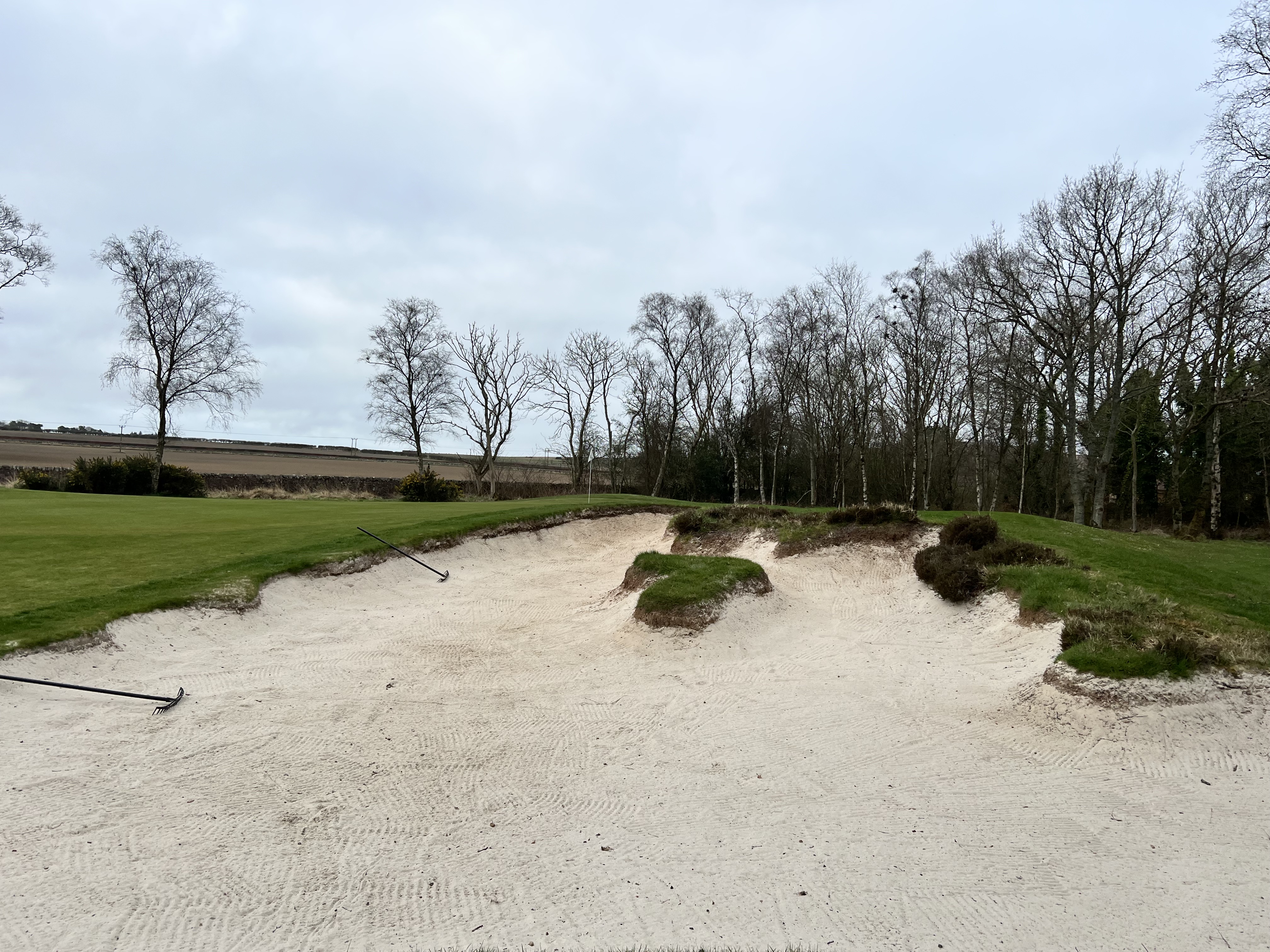
The Thirteenth is a 193 yard par 3. The only par 3 that is not set on a natural plateau yet one of my favorite, bunkering comes across before the green from the left and at least partially obscures the green from the tee. Heather walks among the bunkers and the rear mounds to spice up the misses, all while the elegant green awaits with its gentle nudge from left rear to right front.


The Fourteenth is a 390 yard par 4. The fairway narrows as one gets closer to the green, finally ceding to mounds of heather before short grass leading to the green. A successful tee shot should lead to an approach the golfer can focus on getting close as there are no hazards to speak of near it. Take advantage.


The Fifteenth is a 510 yard par 5. The golfer likely doesn’t realize it but he is now charted in the direction of home. This is at the same time the course starts to bear down on challenge, ensuring a stern closing until the last. A crook to the left off the tee where two larger bunkers on either side await. Getting past those and the fairway starts uphill with trees lining both sides. While there is some pressure on the tee shot, the second is likely where most flounder because there’s not a whole lot of room accepting misses and a lot of golfers will take a longer club and whale away. Those opting for accuracy and a more forgiving second shot for a slightly longer approach will show wisdom beyond their years. The green is at the top of the hill, a trio of bunkers placed before it. Rear is no good as it plummets back into the forest.


The Sixteenth is a 415 yard par 4. Evening out at the top of the hill, the tee shot is straight out carrying over strands of heather. The fairway contours stand out as does the bunkering, which seeks to deter the golfer by making recovery tougher than usual. The green is the deepest of the course, falling off into rough at the sides and the narrowness complicating those recoveries depending on position.


The Seventeenth is a 189 yard par 3. A pushed up green with bunkers within its sides that falls off at the front and rear. Those off line with hope the bunker catches their shot, as the areas beyond the sand is quite unsavory. It’s time to hit a green or face the stiff consequences.


The Eighteenth is a 403 yard par 4. We come back to finish next to the First tee, the same creek in play off the tee as it was at the start. The tee shot is the conundrum here and figuring out whether to take on the creek or lay up short of it needs proper attention. The green is uphill, the clubhouse in the background. The high left and low right near the front both are guarded by bunkers while the green has some back to front movement as well. Avoiding the bunkers altogether is advised; they grew mean some where around the Fifteenth.


The back nine is confronts with indelible interest at the start then begins to hone in on challenge with the final sequence to close out with invigorating style. Strategic decisions and advantages for knowing the whims of the terrain are at every shot. My ranking of them would be 12, 13, 14, 16, 11, 10, 18, 15, 17.
There is unparalleled charm at Swinley Forest, achieved without even really trying. The design is suggestively engaging without ever imposing or insisting on itself. Its natural presentation within the forest indeed gives off the impression that the golfer has discovered it by mistake, then takes hold and wins the golfer over with each distinct courtly hole some how coming at the perfect time during the round. Yes we did become best friends. I adore unassuming brilliance. Colt was never much of a self-promoter and Swinley typifies this honorable trait of simply letting the character of the land and craft, be. Those who know, know, and others will come upon it in due time. Swinley facilitates all the creativity and deftness that strategic design strives for in tones that emphasize the oft ignored yet powerful camaraderie contained within the game. The preserved design within the tranquil setting gives the golfer no choice but to feel at ease and enjoy his time golfing, no matter how many strokes it takes him to get around. This is the essence of the game, embodied here in august sentinel.
Clubhouse/Pro Shop: Colt favored clubhouses with inspiring views to, “get the greatest possible enjoyment out of intervals of rest.” The clubhouse here achieves this, as well as striking the balance of remaining impressive while keeping in the background to the course. The patio overlooking the Eighteenth was a remarkable spot to unwind after the round.

Practice area: There are some hitting bays and a small range, along with putting green and I believe a short game area some where within the course but could be wrong on that front.


You must be logged in to post a comment.