6,466 yards, 135 slope from the Blues
There are different types of quiet. I started to realize that in my forty-eighth year of life as we sat in the men’s locker room waiting for our host. The rain outside was all-pervasive. It wasn’t just falling; the air itself was now water, millions of suspended droplets impossible to avoid without getting drenched. Alas, the quiet locker room. I would characterize that particular quiet as forlorn reverential hope. The chairs creaked every now and then with a shifting of weight as we sat in that quiet, unsure of what fate lay ahead. That uncertainty was mild because, well, we were in The Los Angeles Country Club. One of the founding inspirations for my fascinating journey into the world of course architecture and the game of golf. The quiet continued. A calming quiet on top of everything else. I let out a quiet sigh as I sat deeper in the chair. Let hope spring eternal. The rain continued, unforgiving and relentless.
The club began in 1897, starting with nine holes called, “The Windmill Links.” It was not long until the club moved sites, again building a nine hole course, this one called, “The Convent Links.” The club remained at this site until 1910, when it moved to its current location. The eighteen hole golf course was originally designed by club founders Joe Sartori and Ed Tufts, as well as Norman Macbeth and Charles Orr, which opened in 1911. In 1920, the club decided to build a second golf course for which it retained Herbert Fowler and Tom Simpson to design. Fowler and Simpson were also asked to perform re-design work to the first course. As both Fowler and Simpson resided overseas in England, Fowler asked a newer member of the club to supervise construction. The member was George Thomas. Thomas was on site everyday, ensuring Fowler’s design was faithfully carried out. Thomas’ excitement for the work can be seen in a letter written to Pacific Golf and Motor Magazine in 1921, when he described it as a, “remarkable proposition” and he does not believe his role in the project would have held his interest all that much normally except here, where in his opinion the project, “contained a lot more than anything I ever developed before.” Credit to Geoff Shackelford’s The Captain for much of the historical background, including the aforementioned letter (and the one below).
Fowler intermingled the original holes with the two courses and suggested in a letter to the board they be called the “North” and “South” to, “prevent any possible idea arising that one course as superior to the other.” In the same letter, he characterized the courses to be, “of a very high standard.” The courses were of similar length but Fowler wrote, “the ground over which they are played varies considerably . . . the Northern course [having] more feature holes than the Southern. At the same time I shall be surprised if the latter is not more generally popular with there rank and file of the club if for no other reason than the walking will be considerably easier.” Fowler believed the North had either seven or eight of these feature holes, which he felt placed it in rather elite company. Significantly, Fowler also wrote, “I am particularly anxious that examples of modern hazards should be shown in California, as I am bound to say that at the present time many of them fall far short of what is desirable from a golfing and an artistic point of view.” The mention of artistry married to the game is significant and evident that it made an impression on Thomas as we will see later on.
The North course hosted the first Los Angeles Open in 1926. Several of the players complained about the severity of the course, the Seventeenth bearing the brunt of it. Thomas and Billy Bell thereafter decided on a complete overhaul of the North. Thomas felt strongly about the necessity of the changes, at one point threatening to quit when club leadership resisted. Fresh off the completion of Riviera and after considerable critique of the course after the Los Angeles Open, there was a culmination of Thomas’ vision for the North course full of grand strategic variety. This included a series of “course within a course” and even certain holes capable of being played as a par 3 or 4 based on tee position. There are four courses within it, “with other combinations being possible.” These combinations played on lengths, angles into the greens and bunker positioning with consideration of various tee positions. Thomas also eliminated the Seventeenth that was the focal point of consternation, replacing it with the Fifteenth par 3. With the sharp banks and hills rolling and jutting in multiple directions, the terrain was much more natural for strategic golf than Thomas’ prior projects such as Bel-Air or Riviera. He also was most familiar with the course and design at the time he and Bell completed the re-design. He realized the importance of his work here and where he believed it would stand within his legacy, stating of the North, “It will surpass Ojai, Riviera or any of my former courses. I expect it to be my last.”
One of the advantages LACC benefitted from over the decades is it was always well preserved, meaning it really never experienced any age of disrepair. Yes the course went through a few iterations, most notably a renovation by John Harbottle in 1996-97 but its gifted natural features never eroded or disappeared; the way in which they were incorporated into the course simply changed over the years. Such was the favorable state of affairs when Gil Hanse worked with Shackelford on a restoration plan for the North in 2006. These restoration efforts focused on a return of the course to the 1927-28 Thomas/Bell iteration. The first phase of the work was re-working bunkers, some times even uncovering old ones and restoring features. This work seemed to earn the trust of most of the membership, so a second phase focused on removing trees, re-routing fairways such as tying the fairways of the Tenth and Sixteenth together, increasing the size of the greens to their original size and shape, restoring the position of the Second and Eighth greens and alas, bringing back the old short par 3 Seventeenth, abandoned in the 1920’s after all the controversy, which can now be played as an additional hole. The work also allowed the course to return to Thomas’ design intention of playing short loops about the course. Now, you can play 10-16-9, 10-16-17-18, 1-2-17-18, 1-2-9 and of course 1-18.
LACC North is now one of the more purer Golden Age courses and a tremendously thrilling showcase of Thomas’ genius. It’s a sophisticated, intelligent restoration that rejuvenated the brilliance of Thomas, the Captain. The Golfadelphia 2025 Preview mentions, “there are two very notable projects that took place long ago we’re able to evaluate their long-lasting impact. Two well known architects with different styles each restoring respective very well known courses originally by the same architect is an evaluation exercise I’ve wanted to embark on for a while. This is the year it happens.” Doak’s restoration of Bel-Air is one of those projects while Gil Hanse’s restoration of Los Angeles Country Club’s North Course is the other. Hanse’s project here came ten years earlier and along with Coore and Crenshaw’s restoration of Pinehurst 2, are the benchmark restorations that beget an age of returning to glory, those projects trying to capture what was accomplished at Pinehurst and LACC North. In comparison to Doak’s Bel-Air project, Hanse perhaps needed to account for modern game aspects a bit more with aspirations of hosting the Walker Cup and U.S. Open, which can be seen with the installation of hydronics were installed under every green, drainage adjustments were made and a more uniform type of Bermuda rough was installed, amongst other irrigation and aesthetic upgrades. Moreover, the course was lengthened. The Third tee was lengthened 30 yards. Even at the Eighth, where the hole was shortened to get more in line with the original design, a new back tee was installed. Hanse commented that restoring in this age of “high tech equipment,” he made changes to the barranca on that hole, adding more challenge and intrigue, creating a risk reward par 5 in the likeness of the Thirteenth at Augusta. The project was on full display at the 2017 Walker Cup and again at the 2023 U.S. Open. The versatility and strategic conundrums of the course were rightly highlighted to delight of guys like me, who feel mainstream coverage of golf only scratches the surface of portraying how deeply complex and sophisticated the game really is, which is much more captivating and interesting. Instead of showing the same crane shot of the same court foot putt over and over and again, commentators were discussing pin positions and fairway slopes and the different between laying up and targeting various fairway positions had on scoring. It was a refreshing step in the right direction, all due to Hanse returning the course to its apex.
There’s always that spark. Akin to the sports fan who has that crowning experience he remembers fondly and keeps him dedicated to his team, golf provides those moments to us all as well. For me, it was a round of golf I had with my dad the day before my wedding. I had drifted away from the game for a while, just stopped seeing the point and was tired of being so terrible at it. Yet my dad stayed with it and insisted we play. In the British Virgin Islands, we played at Royal St. Kitts. He was already at the driving range when I arrived, honing his swing. I hit some balls to warm up, surprised at how uninterested I was in playing. Golf has a way of surprising us and the round was one of those sparks. It’s time well spent with the people you care about, meaning much more than how you play or what your score is. With the beautiful Caribbean environs at hand, it revitalized my fervor for the game. Such was the case learning about LACC North. Learning about the restoration project just after that St. Kitts round, following and reading all I could about it, it did a lot to spark that inspiration in discovering the fascination of golf course architecture. Shackelford wrote how golf courses are art the individual is allowed to interact with and that has resonated. The LACC website includes Thomas’ own words, “In golf course construction art and utility meet; both are absolutely vital; one is utterly ruined without the other.”
Indeed the rain continued. Yet indeed, hope springs eternal. There was a lull with the weather and before I knew it, we were out on that grand opening par 5. When all was said and done, we walked the Eighteenth with the clubhouse lit up in the dark. The rain was pelting us but it didn’t matter. We couldn’t get any wetter. What I remember most of that round, however, was the discussion. Learning about the design history of each hole, seeing the options and terrain use, asking the caddies a host of hypotheticals at each shot (what if I hit it this far to that spot?) and so on. The course was substantive enough to endlessly discuss and the company was interested enough to keep talking, regardless of the elements. We were the only group out there as well. There were good shots and bad but no one was paying attention. It was one of those rounds much more important than score. For me, it was a round of getting to know a golf course I had admired and studied for years much better and getting every expectation essentially blown away. I was blithely unaware how much property is used or the variety and degree of hills. Except for the tees, I don’t believe there’s a flat lie. And while I was aware of the strategy and options and courses within the course, I certainly didn’t account for those options individually available to the golfer they could invent on their own. Or the abundant recovery character, which finds the golfer in ravines, barrancas, off hillsides and of course, in the revered bunkers. I was enthralled. Yes the rain continued but I didn’t give a shit. I realized it while I was playing, I realized it as we unwound after the round in the clubhouse and I realized it at Musso & Frank’s later on that night. It’s one of my favorite golf courses. I suspected as such even before playing it and after the round, I stood in delightful disbelief in how it surpassed expectations. I let the whole experience settle as we sat back in Alfred Hitchcock’s booth. While I resisted this whole espresso martini trend at first, it had grown on me and I sat there after dinner with one going over the holes in my head, mentioning those points worthy of discussion. As I went back over the holes and the shots, one thing was missing from those thoughts and memories. The rain.
The First is a 509 yard par 5 (from the Blues). On some of the higher land moving a bit downhill, the golfer starts to get a sense of the rolling terrain with an array of tree cover in the distance and off to the left. Eucalyptus, oak trees, pine trees, fescue, creeks and barrancas all await the golfer in a dizzying array of raw naturalism and the First is the grand path leading to it all. There is bunkering on both sides at the fairway while the green leans considerably back and to the left. A friendly introduction.


The Second is a 428 yard par 4. Running parallel with the Seventeenth off to the left, a rise in the fairway signals its right to left movement. The left side actually falls off as well which is difficult to discern from the tee but all the more reason to favor the right. The fairway dog legs to the left to the green at its original location. In the 1960’s the green was moved to the hills on the right and is still there. A barranca separates the fairway from the green. Unlike a creek or stream that usually mandates a simple carry, the banks and cragginess of a barranca covers a lot more ground, which makes the carry consideration much more significant. Here, that carry is just about thirty yards. Those that end up in it will most likely find their ball and will then need to figure out recovery options. That’s one of the beauties of the course. Similar to Pine Valley, the golfer will most often find his misses no matter how egregious, but will on occasion wish his shot disappeared into oblivion when realizing the precarious recovery situation. The green is wide yet shallow, bringing the barranca even more into play as the golfer is required to be much more exact on approach.


The Third is a 375 yard par 4. Now the hills start and the famous trio of palm trees are in the distance. Teeing off in the valley, we strive to get up on to the valley wall on the right. The tee shot is blind and will likely move right to left back towards the valley floor. The valley floor rises with us so that the sides of the fairway funnel shots back towards it, moving at a diagonal right to the green above. Three bunkers guard the green at the front, all running parallel to the fairway. The bunkering schemes at the greens are marvelously diverse and that is evident here with how each runs down the hill top. The green is large but is liable to skew to the right if the approach is overly aggressive at the center or rear. A good deal of knowledge in how things move at this green is certainly essential.


The Fourth is a 199 yard par 3. A drop shot that’s steeper than it looks in the photo below and a great example of an inviting green with recovery character that varies in degrees of difficulty if one misses. The green is set just above a wash with a bunker at both sides at the front while the wash, patches of sand and wild grass surrounds the rest. The green seems wider than it actually is, moving back to front and left to right with two main plateaus, including a restored mound on the left side. While there is more room to miss left, it is the more challenging side to recover from with the green moving away from the golfer on that side.


The Fifth is a 440 yard par 4. The Fifth and Sixth are par 4’s next to each other and I would be happy as a clam playing them on an endless loop. Playing uphill with most tee shots ending up in the blind, the fairway cants left to right enough to favor the left side, although too far left will find the trees. The movement continues down the slope where a sandy wash used to reside that is now inhabited by trees. Thomas emphasized the course within a course concept here, relative to tee and pin positions. For a pin at the rear right of the green, Thomas intended a shorter tee on the right be used (conversely, he was clear that it would be unfair if a rear right pin was used with the rear tees). The back tee could access the lower level pin position towards the center. Thomas factored in the movement of the ground contours and prevailing wind direction in detailing these options. The green slopes left to right, providing a much wider surface at the left while even Thomas characterized the right side as a “small” green, which falls off abruptly just after the green’s edge. Ground movement is on full display on both shots while strategy is tied into it while again, recovery from missed shots focused on calculated inventiveness.
Another shout out to Shackelford, this time for his Quadrilateral newsletter he has been doing for the last few years. The newsletter focuses on the four majors and Ryder or President’s Cup depending on the year, yet he writes about much more touching on the professional and amateur golf landscapes. His perspective and prose is among my favorite to follow. He wrote a number of articles on LACC North ahead of the U.S. Open that provided a wealth of detail on the design and history of the course that are relied on here. Shack dispels folklore about the palm trees here, however. There’s a famous story about Ben Hogan’s first round playing here. His caddie told him to aim at the five palm trees for his approach and Hogan characteristically asked the caddie, which palm tree specifically. Shack points out the palm trees would not have been tall enough in the 1940’s to be seen from the fairway. Like Santa Claus and the Easter Bunny, I’m believing it anyways. It’s just too good of a story.


The Sixth is a 320 yard par 4. The short par 4 is one of the holes that got me hooked on golf course design. That very likely could be directly due to Thomas’ famous short par 4’s that include the Tenth at Riviera and this very hole. Both can be considered two of the best short par 4’s in the world. Here, the tee is atop the hill and has to be one of the high points of the course and drops down a total of fifty-five feet to the green. Many can reach the green with a well blasted drive in the right position and that is the temptation here. Of course, the tee shot is blind and there are various spots near the green that become especially challenging to recover from. That is the downside. Even well hit tee shots can find these areas based on the indifferent randomness of the terrain. A more advantageous angle into the green can be had a bit more conservatively by laying up off the tee to the left any where from 180-200 yards, which leaves a short club into the green with favorable movement. The green sits on a ridge above the fairway while a bunker and wild grass guard the green at its front. It moves towards the left rear yet not enough to help those trying to recover from the rear, who face the very real danger of moving off the front of the green and into the bunker below.
When I played Riviera, I moved down to 3 wood off the tee, which set up a manageable approach and walked away with par. Here, temptation got the best of me and I opted for driver. It was well hit but we couldn’t find it, perhaps straying or even an unfortunate bounce to the right. Or we did find it on the right and I massacred the wedge shot in. I can’t recall exactly mainly because I was too busy reprimanding myself for failing to cede to wisdom and simply laying up. Temptation will always be a worthy and deceptive foe!


The Seventh is a 219 yard par 3. The barranca is the center of attention along with a few well placed trees, all of it in splendid native variety. The green is shifted to the left of the tee that calls upon a right to left tee shot or setting up on the right side for a straight shot heading left. Trees make a left to right shot more complicated. Thomas provided the option of this hole playing as a short par with a tee just off the Sixth green with particular pin positions at the rear. Hanse, Wagner and Shackelford were intent on restoring these options. Shack writes that the green doesn’t move back to front as much as it looks but my wedge shot from behind the green took off like it had a date. And that was in the rainiest day LA had ever seen (certainly felt like it), so I’d at least proceed with caution with that back to front movement (in Shack’s defense, he wrote that over the green is, “dead”). The tee shot needs to carry the barranca and then avoid the series of bunkers looming up the right side. LACC North highlights the importance of variety and options. This can be seen at the set of par 3’s and here, there are more options and ball striking demands than we encountered at the Fourth. It reminds me of the Eleventh at Pine Valley inasmuch as it’s not as highlighted as the Fifth and Sixth yet I found it to be one of my favorites and consequently, under heralded, which only adds to the overall quality of the course.


The Eighth is a 504 yard par 5. We’re on the lower side of the ridge. To our right and above is the Twelfth, most of the back nine taking that higher ground. The longer hole continues along the ridge but moves mover the barranca, which crosses at the start of the fairway, then moves along the right side before crossing the fairway yet again further up. The tee shot needs to carry the initial barranca crossing, avoid the trees and try to get to the left enough for a clear second shot. The golfer then needs to figure out his second shot. One might be in a position to go for the green yet the smaller green size and creek on its immediate right make that a risky proposition. Figuring out where to place the second shot over the barranca short of the green is much more productive, which will depend on the tee position and knowing the green movement, which is towards the green albeit on a flatter place than expected. In general, it’s much more critical here to avoid troublesome areas, making navigation an important theme. For those able to manage restraint, the Eighth should usually reward.


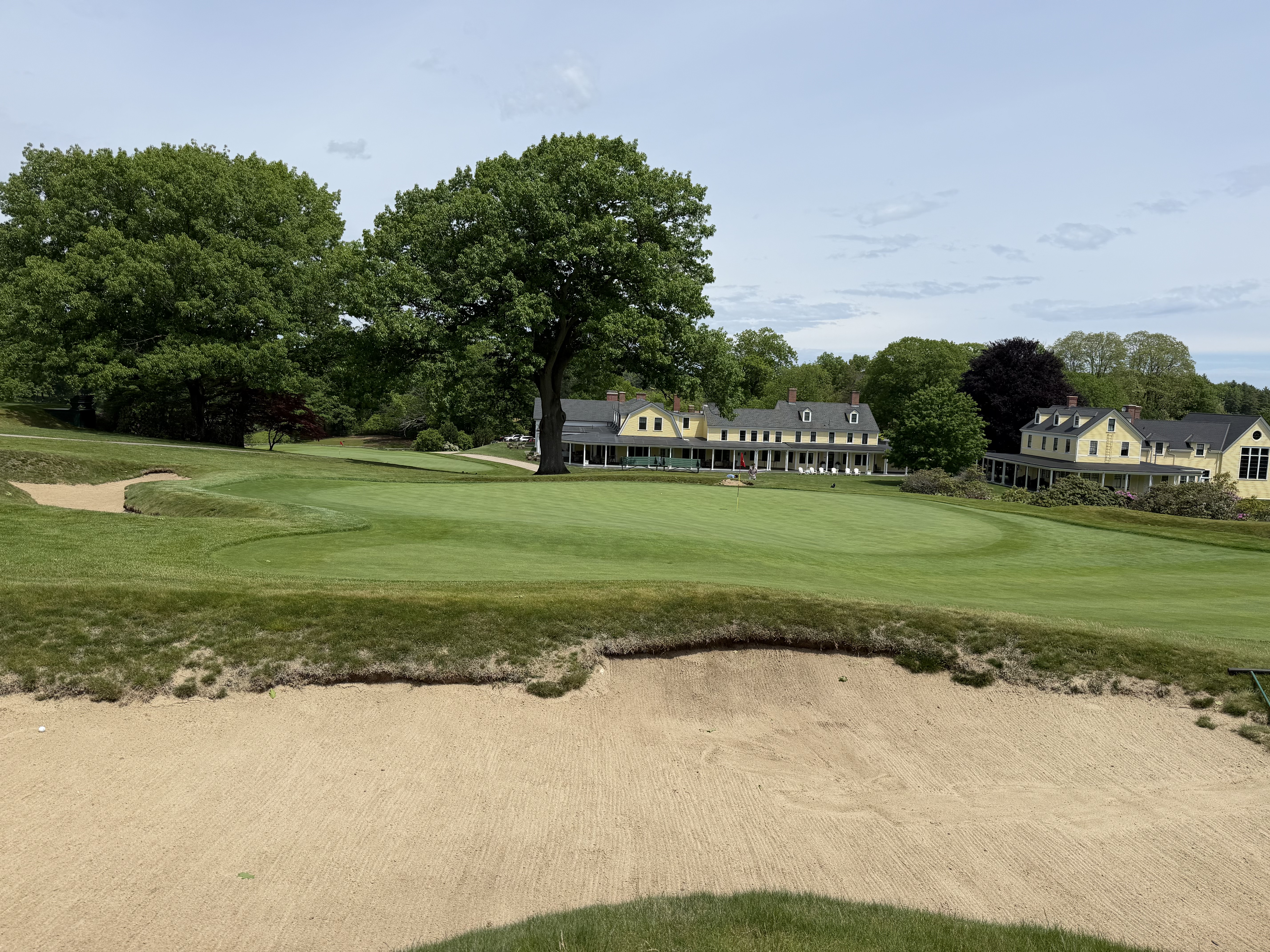
The Ninth is a 165 yard par 3. We now climb up the ridge and carry the ravine below to reach the green residing near the clubhouse. Bunkers are on both sides as well as one in the center before it. The green has specific quadrants of movement with tiers and shelves that again emphasize the importance of pin positions. Our caddy guided me well as my shot was above the pin but in the correct quadrant and we were able to navigate the back to front speed for a par. The right side presents the risk of falling off towards the bunker on that side. The triumvirate of par 3’s on the front are all different. Here, the green is the most devious an bold, demanding acumen with the flat stick.


The front nine is a rambunctious loop with all kinds of elevation changes and transitions from one natural surround to another. The strategy and structure of play adapts to these transitions in thrilling fashion, showcasing the brilliance in the design. Qualifying this that I am love with all of them, I would rank them 6, 5, 7, 3, 8, 2, 9, 4, 1.
The back nine starts with the 374 yard par 4 Tenth. Width awaits the golfer while Sixteenth to the right adds to it. The South course is off to the left. There are three center line bunkers in succession at the top of the rise, the last suggested by USGA Executive Director Mike Davis just before the Walker Cup. The fairway lists to the left slightly, ascending to the green. The tee shot needs to reach the bunkers to take advantage of the ridge that will advance the ball closer to the green. Past those bunkers is the green, which bunkers defend well. Deep yet narrow, approaches to the center of the green ensure the shot clears the sand and deals with any elevation change issues. A splendid example of using width tremendously well, the bunkers reside within the terrain as well as the terrain itself all serve strategic purpose.


The Eleventh is a 225 yard par 3. Taking cues from their work at Riviera, the next couple holes were manufactured and stand out as shining beacons of brilliant naturalism. Thomas and Bell built this hole, which was left largely vacant by Fowler originally. The green rests in a valley, the tee shot above adjacent to the Tenth green. Strong left to right movement and the bunker positioning very much give it a Reverse Redan feel and as Shack writes, that is as intended. There are alternate tees Thomas installed for a par 4 option further back but if the wind is against the golfer on the tee, he might be treating the hole as a par 4 any ways. The ground movement makes for beguiling chips and putts, especially from the left side. I viciously pulled by tee shot to the left yet pin high. A delicate pitch used all the contours it could before mercifully resting at the right edge of the green, which I am convinced would have continued on if not for the rain. Indeed, aiming and hitting it at the pin here is simply not enough. Much more thought is needed from the golfer.


The Twelfth is a 362 yard par 4. A dog leg left where the tee shot must blindly climb a hill to uncharted territory only marked for us by tree lines. Moving up the hill and through the pines reveals a clearing where starts to to see traces of bunkers rising up a bit from the expanse. These are the greenside bunker complexes that are a marvel in how they stand sentinel in front of the green. The green moves around those front bunkers, boomeranging in at the center and more particularly at the front right. Graceful and cunning movement await the golfer where relying on feel much more so than sight is strongly suggested. Thomas and Bell created the green complex, which is a sight to behold and like much of Riviera, shows how masterful they were of making something out of nothing.


The Thirteenth is a 431 yard par 4. The fairway starts in a valley before climbing up to roughly the same level as the tee. It is this level the golfer seeks to reach with his tee shot. Favoring the left side makes this much more possible, which will then ensure a view of the green on approach. And really, there’s not really a tolerable alternative off the tee. Similar to the Fifth, the fairway and surrounds conspire for a left to right consideration and most all shots while avoiding the bunkers on each side leading up to the green. This movement is much stronger than it appears at first blush but the right greenside bunker gets much more play than you would think.


The Fourteenth is a 532 yard par 5. The rain worsened from here on out, likely upset we had come so far despite its impressive display of waterworks. Daylight also began to give up. Regardless, we kept on, thinking nothing of it. A long par 5 with a rather rigid right side dotted with some of the more grand mansions in prime Los Angeles real estate. Most have tall hedges concealing them so the golfer need not worry too much about trying to take them in. There is a trio of fairway bunkers grouped on the right side that comes into play off the tee. Clearing them will propel the ball onwards and shorten up the second shot that much more. With that said, there is still much more to go and figuring out where one wants the second shot to end up shows the depth of possibilities within this hole. The land tilts left to right and there are bunkers lining the right side, so steering clear of those, as well as staying in the fairway and out of the rough and grove of trees on the left, are all a priority. The green actually moves right to left and is yet another boomerang shape around the center bunker that starts well before the green and runs into its front. Its movement and pin positions comprise the complexity, strategy and options the course excels at so well.


The Fifteenth is a 121 yard par 3. One of my favorite attributes of the course is how well and complete its versatility is. There are short par 4’s, long par 3’s, long par 5’s, short par 5’s, all of them of substantively excellent. Now we come upon the short par 3 that might be the hole I looked forward to playing the most. The hole can vary in distance as much as fifty yards based on tee and pin position. The green is widest at the back and narrows towards the front, bunkers around it all sides, yet at varying distances from the green so that some shots could end up in precarious positions between bunker and green. Alas, the recovery character is off the charts here. With the green movement and the very real possibility of tight quarters on some of the shots, the golfer must call upon his utmost creativity and deftness to salvage par for those shots off green, which is very likely considering its smaller size. The hole will never play the same twice and emphasizes mastery of the short game. We played it after the Tenth to save time and am glad we saw it in daylight and tamer conditions. One of the best short par 3’s in the world.


The Sixteenth is a 437 yard par 4. A wide tee shot with the shared Tenth fairway, the bunker on the left is a cornerstone of the hole to keep in mind off the tee, as moving over or to the right of it will result in a much shorter approach. Most shots accomplishing this will move to the right, which brings the right side greenside bunker much more into play (and less of a view of the green). That bunker is further away from the green that it seems the more left it goes, so the golfer must do more than simply carry it. The green is bowl shaped but its front half moves back towards the fairway quickly.


The Seventeenth is a 412 yard par 4. The tee shot puts us back into the valley we first encountered at the Second. It must carry the Barranca crossing over, which then runs along the right side of the hole. Flirting with that right side off the tee open up the ideal view and angles on approach. This is mainly due to the position of the green, its lack of depth and the row of bunkers protecting about fifty yard before it. Quite honestly, the left side off the tee looks so inviting that I might take the disadvantage on the approach to ensure a safe tee shot. The recovery character near the green is likewise full of interest. Aside from the bunkers, the golfer can maneuver either before or after the sand, all of which is likely pin position dependent.


The Eighteenth is a 413 yard par 4. Now going up the hill and moving back to the clubhouse with the First to the left of us. Like the Seventeenth, the right side is to be avoided, as now it falls steeply into the Barranca. Also similar to the Seventeenth, the golfer is rewarded with an advantageous approach if he opts to move up the right side off the tee. And also similar to the Seventeenth, the diagonal bunkering before the green starts about fifty yards short of it but allows a generous entry point where the fairway feeds in. Those that went up the left off the tee, they will need to carry this long bunker to reach the green. Also note the green is at its widest and clear of bunkers at the rear.
None of the above was evident at all to me as we walked the final hole in darkness (although I did notice there is not as much room to the right of the fairway off the tee as was intimated by some after the fourth round of the U.S. Open). The glow of the clubhouse took on a heavenly tone as I started to remember things such as warmth, dryness and perhaps even sanity. It has been a momentous year and walking that final fairway to the clubhouse was a realization of fortunate times. These are places that ignited a passion long ago. I never stop marveling at how remarkable it is to be able to experience them firsthand. Alas, there was delightful joy in those steps that brought us closer and closer to that inviting glow. Such is life at its heights.


The Nineteenth hole is the Seventeenth from the 1921 design, preserved for those who would like to play it. It is just off the current Seventeenth green and plays approximately 120 yards. The green is within the hillside and barranca that separates the lower and upper holes.


The back nine is about as good of a nine holes as I could dream up. The contrast of par 3’s, the natural features along with those manufactured that meld into the landscape anyways, the challenging finish; it is splendid aspiring golf. They are all excellent holes. My ranking of them is 11, 17, 15, 13, 12, 16, 10, 18, 14.
The concept of rankings helps the golfer clarify the designs that stand for what they feel is significant in course architecture. It is subjective. There are publications with rankings and those are more guiding posts for discussion more than anything else. I enjoy sorting my own rankings and watching it evolve over time. That evolution is spurred by an array of factors such as experience, knowledge, discussion and of course, retrospect. Perhaps most important of all, however, is sheer intuition. I played this course essentially in a monsoon. It’s possible I wouldn’t have noticed all that I did without knowing what I know at that point but it is only part of it. My opinion of the course grew high very early on and continued to rise as we went on. When all was said and done and I was in that Alfred Hitchcock booth, the rain finally in its death throes, I realized where I would rank LACC North. I took a draw of that martini and breathed fulfillment deeply.
Thomas expected this course to be his last and finest work. In club newsletter Bel Air Progress, Thomas set forth his general guidelines for golf course design that are worth stating here:
- Each hole should be a thing alone, set off from all others
- Uneven stances on irregular, canted fairways are essential: far too many American courses offer monotonous lies from dead-flat terrain
- Length means nothing without character, character means proper hazards and hazards should be on a natural and heroic scale for superlative golf; glorified mole-hills are ruled out
- An ideal hole should provide infinite variety of shots and at time give full advantage for the voluntary pull or slice, one of the most finished stroked in golf
- Bunkers will be sloped so that the ball runs to the middle and now left unplayable under the faces; but such traps must be tight, closely guarding the greens
- One-shot holes of par 3 are most important; here ones gets a keener interest off the tee than any where else and five one-shooters in 18 holes are not too much
- Greens will have great differences, with rolls, dips and grades demanding judgment with a keen eye
LACC North exemplifies what I believe are the hallmarks of ideal golf course design. Artistic use of natural and naturalistic elements for a lively range of supreme strategy and challenge. The excellence in which LACC North adheres to these design principles is among the if not the best I have come across. The course goes even further for me in its exceptional versatility and recovery character. The decisions, shots and especially the greens expand one of the highest engaging structures of play one can find, leaving it playing at that high level across the plane of positions on any given hole as well as the spectrum of skill levels. The recovery character is of special note. Almost all of my favorite courses have a good deal of “zero sum game” recovery character. There are places that are absolutely as dead as out of bounds while most spots for recovery are either bunkers, high grass or rough. LACC North emphasizes Thomas’ fourth guideline above, which is among the more important: “An ideal hole should provide infinite variety of shots and at time give full advantage for the voluntary pull or slice, one of the most finished stroked in golf.” There’s a raw natural element here that comes in at a lot of off fairway shots, then there is the bunkering that is the best one can find any where. These conspire to offer the golfer a chance at redemption for most misses. This might be the most under discussed “game within a game” at LACC North. The golfer will face a never-ending assortment of recovery situations that I dare say he will hope he misses on occasion so that he can get some more of it. The genius of the place is so high level in all respects while remaining a pleasing beastly challenge without succumbing to the limitations of penal design.
Beyond the design facets mentioned above, it’s just how I felt while I was there. I reveled at every shot, no matter where I was and what ungodly stroke number each one came about. The transitions between the higher expanses with their hills and larger contour changes and the lower barranca arroyo valley with its diverse flora yet with more craggy and jagged terrain undulation, were mesmerizing. The ground game was omnipresent, usually an option for those liable to take it and at times, demanding of attention. It’s a course not dependent on weather or wind yet welcomes it when the mood strikes, enhancing what is already in place. It is some where I could play over and over and over, curious what I would see at each shot and never tiring of because of redundancy or toil. There was beauty without needing views even though those of the city line were there for those who enjoy them. What the heart wants the heart wants. When all is said and done, if I was able to place a tee at the First hole of any course I played in North America up to this point, it would be here over any where else.
Clubhouse/Pro Shop: A grand Georgian Colonial designed in 1911 by Sumner Hunt, most widely known for designing the headquarters of the Automobile Club. It is among my favorite clubhouses visited.
Practice area: There is a driving range, putting green and even various short game areas, including this one I came upon off of the Third.



You must be logged in to post a comment.