6,269 yards, 127 slope from the Black tees
The old man appeared early on in the round. He walked with his arms behind him, slowly. More of a patient pacing, really. There are people walking about on the trails of the Old and at first he was one of the crowd but at some point, I realized he was following our group. He always kept his distance and remained quiet, showing no reaction to the parade of chaos our group unleashed on each hole. Trying to find balls, trying to figure out where to hit, bad shots, silly questions. He followed us all the same. At some point I wondered whether I was hallucinating. Did anyone else see the old man? I felt bad we couldn’t put on more of a show for him. On the Seventh, I hooked wildly onto the beach. As we walked up for me to drop, a golf ball came flying back up at us from the Eden. It was my ball, a walker down there threw it back up and I waved in gratitude. The old man looked on. Perhaps he had played the Old in this direction before, perhaps he had some involvement with the course, perhaps he simply enjoyed the walk and watching the game. Or he was simply a curious onlooker, wondering how exactly the left-handed course played. I’ll never know. At some point amidst the wind and gorse and greens, he was gone. Just as furtively as how he arrived, if he was there at all, a man of the past no doubt.
The history of the Old is very much tied up with the course playing in the opposite direction it normally is today. Indeed, the Old originated playing in the left-handed direction but the same greens were used out and back. In 1870, Old Tom separated the First and Seventeenth greens, which established the counter clockwise, or right-handed, routing. Then for over thirty years (1872 – 1904), the Old would switch directions of play on a weekly basis. The left-handed course would then be used frequently until the 1920’s, then less frequently after that. There were major championships played in both directions while at the 1886 British Amateur, the opening group played clockwise by mistake and the rest of the tournament played in that direction. By the 1970’s, the left-handed route was only used for a month during the winter until 1978, when it bowed out, very much like the old man with us for most of the round. The routing remained dormant for the most part after that, used on rare occasions but largely forgotten.
Specifically, the left-handed routing consists of starting at the opening tee and hitting out to the fairway but instead of approaching the First, the golfer turns to the left and approaches the Seventeenth. The rest of the course follows, using the regular routing as reference points:
- First – First tee to Seventeenth green
- Second – Eighteenth tee to Sixteenth green
- Third – Seventeenth tee to Fifteenth green
- Fourth – Sixteenth tee to Fourteenth green
- Fifth – Fifteenth tee to Thirteenth green
- Sixth – Fourteenth tee to Twelfth green
- Seventh – Thirteenth tee to Eleventh green
- Eighth – Twelfth tee to Tenth green
- Ninth – Eleventh tee to Ninth green
- Tenth – Tenth tee to Eighth green
- Eleventh – Ninth tee to Seventh green
- Twelfth – Eighth tee to Sixth green
- Thirteenth – Seventh tee to Fifth green
- Fourteenth – Sixth tee to Fourth green
- Fifteenth – Fifth tee to Third green
- Sixteenth – Fourth tee to Second green
- Seventeenth – Third tee to First green
- Eighteenth – Second tee to Eighteenth green
The receptiveness of the Old in either direction stresses its versatility. It’s exceptional just how different the course plays in each direction. While the right-handed or regular routing is elegant and builds up in its strategic challenge, the left-handed or reverse routing is an upfront shot across the bow, raw and rugged with a good amount of blind shots and abruptness to the greens. In short, they are two different courses entirely. I wasn’t quite sure what to make of it immediately after the round as my first time stepping foot on the Old, yet the same time the next day I realized just how brilliant the two routings were with my newfound experience and knowledge of playing it both ways. The advantageous angles into the greens are different, the tee shots now need to couch to the right and avoid the left with more urgency than the right miss the other way, bunkers come into play in all sorts of new and exciting manner. Indeed, one of the better 36 hole days would be playing the Old right-handed, then going back out and playing it left-handed. I can’t think of very many other days that would consist of such magnificently engaging golf.
It has been nearly five decades but it is now possible to play the Old in Reverse once again. For about a week in early Spring, the St. Andrews Links situates the course for reverse play and holds a lottery for the tee times. Unfortunately, reverse play will not be taking place next year due to maintenance related course closures but for those interested, 2027 will be here before you know it.
At the Twelfth, we were waiting for the fairway to clear before teeing off when we noticed all four shots on the Eleventh green were close to the pin. I remarked that there was quite the group behind us, to which the caddie explained that group included Stephen Gallacher, of the 2014 Euro Ryder Cup team and still playing the Champion’s Tour. Sure enough, if you looked back at the green from the next tee after each hole, you would see at least one ball cozy to the pin. The real question, however, is whether he would be able to bogey the First after the approach ran onto the road. That’s the stuff of legend and until then, he’ll just have to rely on that whole professional golfer thing. Gallacher, along with me, the old man and the rest of us, were out there to step back in time and experience something historically significant, none of us knowing when that opportunity would arise again.
The First is a 374 yard par 4 (from the Black tees). The line off the tee is the Swilcan bridge and with the wind to our backs, it was less than driver to get there. With the groups playing the Eighteenth teeing off at the traditional Second tee, we criss crossed with them, which took some coordination. The course this direction comes at you fast and before I even knew what was happening, I was staring at the Road bunker and trying to figure out my approach for my second shot on the grounds. The green is about fifty yards from the burn and wraps around the Road bunker, all of it facing you from the fairway. There is plenty of room off to the sides of the green to work with but I went right for the pin, hit a groove too low and watched as it bounced a couple times on the green before rolling on to the road. “Ok I guess we’re doing this now” I thought to myself. The third shot would be off the road, my introduction to the Old tantamount to spilling a tray of coffee all over her nice white dress. The caddie handed me my putter but I asked for a wedge. He then asked me what I intended to do with the wedge, he said he was curious, a bit of incredulity in his voice. I said well, I’m going to take the wedge, hit the ball, and get it as close to the pin as I can. The first chip wasn’t strong enough to get there but the second was and the fifteen footer to save bogey was probably one of the best putts I would have on the Old the entire two days. That’s the charm of the Old, it allows various strong suits of one’s game to flourish. In retrospect, the strategy here is to either be dead on with the approach and allow for proper roll out, or leave it out on the flank on the side the pin is sitting. On that day with that pin position, I would now have gone for the rear right side. Left and/or long are really no good at all, as I learned all too well.


The Second is a 422 yard par 4. We now face the bend of the traditional Seventeenth around the hotel in reverse. Cheape’s bunker features prominently off the tee and getting close to it in either direction is a good leave for the approach. Those that go further right may have a look at the green and will avoid the hotel altogether but will need to worry about running into long grass and other groups on that side. There are bunkers adjacent to the traditional Seventeenth tee and they make a lot more sense when one sees them on the left-handed routing, as they are after Cheape’s. For most, the hotel will completely block the view of the green. The shot was into the wind, I guess it switched since the First, and I needed a hybrid to get there with the wind against us. “I guess we’re doing this now” rang through my head again, hybrid off a tight lie, carry the hotel and try not to damage property or kill anyone. I some how pulled off a wonderful shot that bounded over the hotel and I expected to be paces from the green. Instead, it just caught the deep bunker before the green, unlucky. The double green is wide yet shallow and with the out pin on the left side, levels out on the high left before dropping down precipitously on the right. Indeed, the course comes at you fast and before you know it, you have just played two of the best holes.


The Third is a 324 yard par 4. There is rough after the tee that needs to be cleared, which it does after the Principal’s Nose ahead. So the nose is the focal point of the tee and either clearing it or staying to the left gives the golfer the best approach in. Hedging to the right is a fine path as well, so long as the rough is cleat but brings the Cartgate bunker more into play, which is now more prominent in front of the green (as opposed to behind it with the traditional routing). The mantra of this hole is really, stay left but not too far left. The green is ample so the approach should focus on clearing the Cartgate. After the challenging opening duo, this hole provides a brief respite of sorts if the golfer lets it.


The Fourth is a 378 yard par 4. Thus far, there is some prominent feature for the tee shot to focus on. The Swilcan Bridge, Cheape’s Bunker, Principal’s Nose and now, the Cottage bunker. Well, the Sutherland is before the Cottage n the same line but Cottage gets the billing because it’s much bigger. It is out there, signaling the end of the fairway. Driver is likely too much off the tee and there is plenty of room if one lays off. The more right one goes, the better the approach angle in but approaches from the left only need to deal with one small pot bunker just before the green. Both shots are blind here as well, so understanding where the ball will go upon landing is important, especially on the approach to the shallow green. Coming in more from the right opens up more green space for that roll out.


The Fifth is a 455 yard par 5. Hell bunker is more of an attraction than anything else in reverse on the Out, sitting off to the side of the tee. The Beardies are the prominent feature here and should be out of reach except for the longer hitters and when there’s a tailwind. In any event, their general direction is the one to take off the tee; just don’t go in them. From there, the golfer can decide whether to go for the green on the second or stay short of the green, most all shots taking some turn to the right. Mind the Spectacles that are well short of the green but pay more attention to the three successive bunkers at the front left that again, make a lot more sense in the left hand direction. If the golfer can clear or avoid those on the second shot, then it’s time to uncork. For those laying up, it will need to be fairly precise as there’s not a whole lot of width leading up to the green, so the more diagonal towards 1:00 the shot gets, the better chance for a nice lie on the approach. Strategy interlaces with brawn and wit here nicely.


The Sixth is a 339 yard par 4. The Coffins prevail here, then Nick’s beyond, but getting to either side of that line is what the golfer should focus on. Thus far, the Reverse does well with bunkers and fairway interruptions complicating the tee shots and forcing the golfer to consider the envelop of his arsenal beyond driver. Here is no different, as Nick’s bunker denotes the end of the fairway at just over 200 yards. Of course, there is a path to the right of the mound one can slide driver in so long as it is relatively precise but most will not want to take that risk. There are no bunkers beyond Nick’s but the green on the left side is sinewy and shallow, giving the golfer all the challenge needed.


The Seventh is a 330 yard par 4. The pattern continues and here, we look to Admiral’s bunker from the tee as the line to take while avoiding it altogether (Stroke bunker is on the same line as well but much shorter). Anything over 200 yards gets past the Admiral and into the meat of the fairway but when the wind is howling which it usually is in these parts, that may be an enormous ask. In such case, the tee shot should focus on getting between Admiral’s and Stroke, then either go for the green from there or lay up again between Admiral’s and Hill or Shell. Even shorter approaches will be tough into this green and will need to avoid both Hill and Strath, both of which have the capacity to unravel the entire round. The green moves from left to right, strongly. Approaches from the right temper this movement a bit but of course, then brings Strath more into play. A stout, shorter par 4.


The Eighth is a 187 yard par 3. It’s a gigantic green and should be an easy shot. Should be. The wind was screaming against us and the Seventh green, Strath, Shell and other bunkers that all needed to be carried to reach it. Plenty of room to miss, off the right, as well. Wind dictates a lot here but in any event, the green with a hedge to the right should be the order of the day from the tee.


The Ninth is a 279 yard par 4. Similar to the right-handed Ninth but the tee shot is from the left, which brings Boase’s and End bunkers more into play, then the newest bunker on the course further left on that line. In short, there’s less room to miss off the tee and placement with roll out considerations are much more relevant.


The front nine takes us down the left side and after an unparalleled adventurous start, settles into an array of par 4’s with various strategic conundrums, as well as the 5 with similar tenor. The Seventh ramps up in challenge while the closing duo can only be characterized as wild cards, running the gamut in challenge and fun, depending on our friend the wind and the golfer’s fortunes with the bunkers. I would rank them 1, 2, 7, 5, 3, 9, 6, 4, 8 yet I loved them all.
The back nine starts with the 309 yard par 4 Tenth. Kruger bunker is the line off the tee but for those trying for closer to the green, then shift the aim to the left of Kruger. It’s one of the more similar holes to the traditional routing except the approach is to the right side pin, not the left. This means a clear look at the green necessitates a short club off the tee but those trying to drive the green will only need to turn their chips and putts to the right instead of left.


The Eleventh is a 172 yard par 3. The best way to think of this hole is taking on the right-side of the Eden green from a right sided tee. The traditional Eleventh takes on the left side of the green from a left tee. The green is on the smaller side and it’s all carry from the tee. If the wind was blowing you into the Eden at the Eighth, then it should help here and getting to the middle or rear of the green clears the front ridge that might send your shot back down the hill.


The Twelfth is a 369 yard par 4. We’re crossing the Eighth and Eleventh to finally get to the left side that will take us in. There really is no fairway to speak of here. The narrow path to the green perhaps technically could be called a fairway but one needs to be surgical to land on it. The March Stone is our North Star off the tee here. A large swatch of rough with gorse dominates the space between tee and green while the Seventh fairway is a good bail out although the approach becomes much much longer. The green is shallow and the hollow beyond the green should not be trifled with. Consider landing in the rough and recovering from there, as a short approach from rough is much better than a longer approach from the fairway.


The Thirteenth is a 385 yard par 4. A 1:00 diagonal off the tee between the gorse bushes and at Cat’s Trap bunker is the line to take and will avoid the slew of bunkers in the fairway on either side, which include the Coffins on the right. If the wind is blowing behind, consider something less than driver off the tee. There’s a narrow path from Cat’s Trap to the green, with Lion’s Mouth at the front. The approach is a forced carry over the mounds to the green, where the Lion needs to be carried and stay left center to left, the green will move left as well. The tee shot likely dictates most of the fate at this hole while it is tough not to be left with a longer putt based on the green movement.


The Fourteenth is a 519 yard par 5. The blindness and abruptness of the stretch from the Twelfth to Seventeenth typifies the rawness of the Reverse. The mounds obstruct from the tee and then again near the green. The fairways are smaller on this stretch as well, which forces the golfer to get used to approaches from all types of off fairway lies. While bunker placement dominates the strategic dance of the front, course knowledge and recovery resolve move to the forefront on the back. Here, the lower left fairway after the mounds at the right center is where to place the tee shot while the right side with the Out fairway is a good bailout although you’ll need to get back over to the left side with the second shot to avoid a very tough right sided approach angle. Lots of undulations and undulations on this fairway to deal with as well. The Hell bunker is in play for the second shot, even more so for those on the right. Depending on the wind, the golfer will decide if the green can be reached on the second shot but by all means only to the center of the green. Anything towards the front runs the risk of running into Ginger Beer bunkers, presenting a difficult recovery.


The Fifteenth is a 382 yard par 4. The Old Course is now in view and its left edge lines up with Sutherland bunker, the ideal line off the tee. The center of the hole is rough and gorse, the left side narrow and eventually ends at the rough. The right side is the fairway leading to the green and provides the clearest views of the green. The green is large and majestic with its undulating plume. The Cartgate bunker is behind, just waiting to ruin someone’s day.


The Sixteenth is a 307 yard par 4. Grant’s bunker is the line off the tee, which is at the conservatory of the Old Course hotel. Fashioned similar to the hole prior in the sense that the left side of the fairway ultimately ends into rough while the right side after the Principal’s Nose runs to the green. Honestly though, just don’t go into a bunker or gorse off the tee and take what comes on the second shot. I’d almost go up to the left of Grant’s and take whatever recovery fate deals from there. I believe that’s how I might have played the hole besides. Like everything on this course in either direction, however, wind will largely dictate the parameters.


The Seventeenth is a 376 yard par 4. To the right of the gorse bush and left of Cheape’s bunker is the line, yet the fairway runs out with something much less than driver. The approach will be over rough to a green that runs from front to back, towards the burn. Front of the green is the landing spot to account for the roll out and a good reason to take the approach for more of a side angle. A good deal of mischief here with the burn placement.


The Eighteenth is a 362 yard par 4. The tee shot is off to the left instead of right, which makes it easier than the right-sided routing since you can aim straight out and not worry too much about any drifting to the right. The approach is about a half club more in my opinion, the green is above the fairway and with the back to front movement and lots of room to work with, more is better than less. The Valley of Sin isn’t the worst to be in and I dare say I’d prefer to be in it rather than the rear of the green working to a front pin position. Those with putting acumen should do fine recovering out of it.


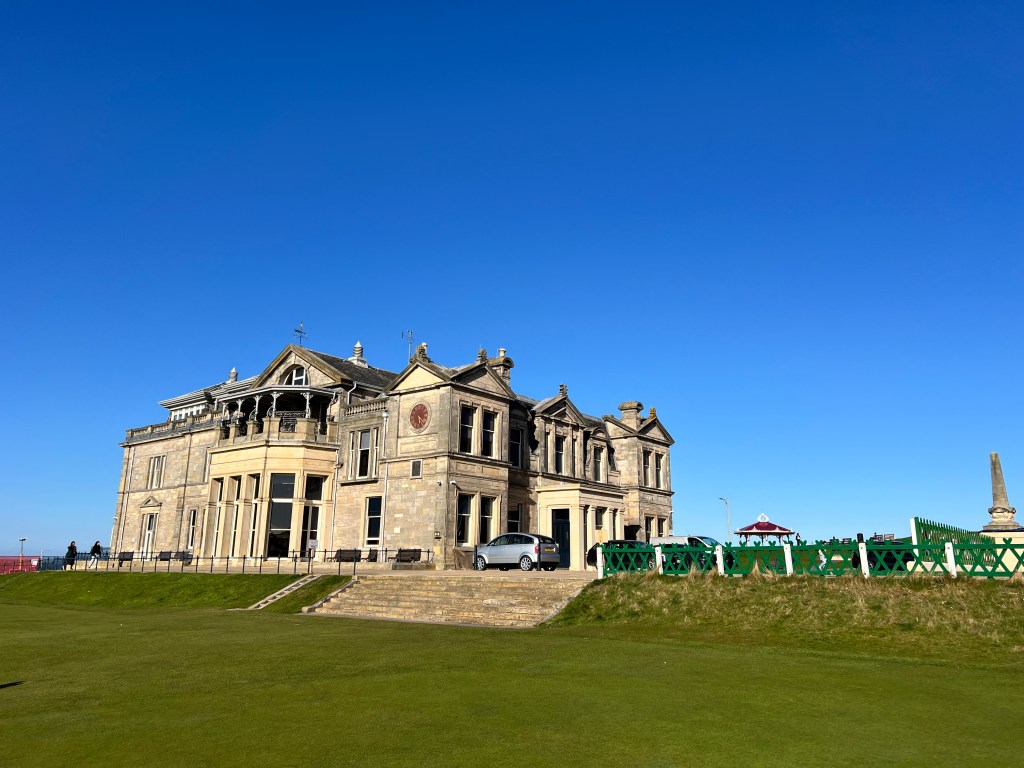
The back nine is memorable for how indifferent it is to fairways but serves as a wonderful reminder how irrelevant fairways can be some times for really good golf. While the front nine felt a little more orchestrated and strategic, the back presents more of a dogged challenge of demanding sheer experience in navigating its corridors. Blind shots abound and the approaches are much more about knowing the best lines in, along with the best areas for a chance at recovery. It was thrilling to play yet a bit sad, as the realization sets in you may never play anything so brilliant yet raw and random, as course design tenets simply wouldn’t allow it nowadays. My ranking of them is 14, 17, 11, 10, 18, 13, 12, 15, 16. Once again, however, I loved them all.
The wonders of the passage of time. There was a time when the left-handed routing was formed and cultivated, along with the right. The passage of time then saw that routing fade, bunkers forgotten and the greens utilized to some extent yet not fully explored from all sides, only then realizing their full potential. And the passage of time with my round there, from initially taking it in to thinking of it, then thinking about it some more. That passage of time cultivated appreciation yet understanding, there was so much there a single round is but a glimpse. If the Old with its right-sided routing is elegant and complex, the Reversed is more moody and manic in its cadence yet more of a driving course in the end. Indeed, the tee shots are contemplative and the recoveries, more cheeky. If the right-sided allows the greens to flourish with all the run up to them, the left-sided highlights the strategic value of the rough areas, gorse and bunkers in a much more zero sum context. I was fortunate to see the Reversed, see the Old in a light many have not. The passage of time continues and at some point, I will be the wandering old man. Who can say what thoughts or memories will pervade on that part of the journey but some where in the recesses, this day will come and go.
Clubhouse/Pro Shop: The Tom Morris grill is the clubhouse, which has a visitor’s center feel to it. It’s fine and there is a pro shop with apparel. The starter’s shack is next to the First and is more of a waiting station, yet has food and drinks with a few seating areas. There are a number of shops in St. Andrews that also sell whatever you can imagine, including the Old Course shop to the right of the Eighteenth. I found myself more of a Dunvegan and Rusack’s guy, both are almost on the course.

Practice area: There’s a driving range over at the Eden’s course and shuttle service from the Old over there. We never used it, just didn’t need any range time with all the holes we were playing. The putting green near the First, as well as the Himalayas putting course, are worth some time on before the round.




You must be logged in to post a comment.