6,627 yards, 142 slope from the Blues
This year we have been exploring greatness, in all its forms. Transformation for the pursuit of greatness, greatness through design devoid of fame and fortune, the potential for greatness, greatness achieved and preserved, and so on. One aspect of greatness is the sense of place the course exudes. Most often this sense of place is more of an intangible that complements the design, yet is interwoven with its distinct identity. Minimalism and naturalism do well to incorporate the terrain and elements, which largely defines a natural and geographical sense of place with respect to design character. This can lead to greatness for sure. Yet the sense of place that is often overlooked and is most challenging to either incorporate into the design character or even meaningfully express is the sense of culture and community the course finds itself in. Sand Hills has a symbiotic relationship with the land and community and this comes through in the design, largely reliant on its sense of place. Pine Valley essentially created its own sense of place which includes communal and cultural components. Probably one of the best examples in the United States is the Audubon Park in New Orleans. The golf course moves about a city park so that golfers are shoulder to shoulder with picnickers, joggers, those flying kites and so on, all while the surrounding antebellum mansions with their grand columns and ornate ironwork serve as the background. The sense of place extends from the golf course to the park to New Orleans in general. The golfer gets a better sense of all of them with his round at Audubon. A much much better sense than anything one can find on Bourbon Street.
The U.K. evokes this better than we do. This is mainly because the golf courses are considered just as an integral part of the town as the pub or post office. Americans view golf as a byproduct of luxury and privilege while those across the pond see the game as a way of life. Some prime examples of this from my recent trip to Scotland were St. Andrews, where one could finish their round, then walk into the town to a number of bars or restaurants. Walking paths are around and through the course. There was a holiday of some sort the day we played North Berwick, so the beach was alive with families and walkers, then the town close at hand. Then there was Lundin and Leven. A much quieter coastal scene that seemed comprised mostly of cottages with pubs and restaurants interspersed, mainly near Leven. Lundin seemed more residential. With all of them, the golf courses seemed to be part of the place, their designs beholden to them in one way or another.
The greatness of Sunningdale is the resplendence in which the design incorporates a sense of place. It is not near the sea and does not have a history of hosting major championships, yet Sunningdale manages to remain one of the most well regarded courses of England. It exemplifies ideal parkland attributes while radiating traditional London charm. It’s a wonderful walk in the park that incidentally offers excellent golf. Presentation and function go hand in hand, the golfer interacting with it in much more meaningful ways than most courses. The bunkers stay out of the limelight yet remain imminently effective at influencing play (even while some linger at the center line). The heave of the terrain is prominent, constantly moving the ball in an array of directions. It’s all very pleasant. A stroll in peaceful isolation among the heathland garden. Indeed, English gardens are meant to recreate idyllic pastoral landscapes and should be experienced on foot. Sunningdale captures this magnificently.
Bobby Jones famously quipped, “I wish I could take the course home with me.” Me too, Bobby.
Willie Park, Jr. designed the Old, which opened in 1901. The first Secretary was Harry Colt, who ended up making significant changes in 1911 to the Fourth, Eighth, Twelfth and Seventeenth. This work included touches of naturalism and placement of some of the green sites, including the Fourth to its current plateau position. Colt then made subsequent changes to the First, Seventeenth and Eighteenth in 1922 to accommodate the New Course, which he would design. Ultimately, Colt revamped four of the holes completely (4, 8,12 & 17), made changes to seven of the green sites, modified the bunker scheme and even reduced green size at 1, 6, 11, 12 & 15, some times even by half. Sunningdale was influential in popularizing heathland design, showcasing how remarkable these, “inland links” could actually be. An expansive routing that takes advantage of much of the land, it was considered a very long course upon opening. Park was a notable adept putter and this shows at the greens, which are immense, just as they are at St. Andrews Old. This was no coincidence, as Park also had the First and Seventeenth share a green in tribute to the Old (they are separate now). Park’s routing and structure of play with Colt’s work has resulted in a timeless charm, the course a champion of heathland style. All of this leads to one of the best parkland courses one could come across. This is mainly due to its routing and green sites. The course does well in defining the difference between engagement and challenge. Each shot is more engaging than challenging yet that doesn’t mean easy. It means there are strategic options while recovery is always close at hand. It means the variety and flow of the round are superb, which keeps the play spirited and lively. Beauty, strategy, worthwhile enjoyment; the Old achieves a wonderful balance that leaves the golfer no choice but to be in a good mood. It’s certainly a good walk unspoiled.
There’s this scene in The Royal Tennenbaums when Royal and Richie are walking in the cemetery and come upon a tombstone that reads, “Veteran of two wars, Father of nine children, Drowned in the Caspian Sea.” Royal remarks, “Hell of a damn grave. Wish it were mine.” That’s how I feel when I come upon wondrous writing. Wish it were mine. Pat Ward Thomas’ writing of Sunningdale Old in The World Atlas of Golf falls into that type of mesmerizing brilliance I wish were mine but will share here because of how well it captures the essence of Sunningdale – “The course is one of enchantment, rarely of menace; its challenge is one of subtlety rather than length. . . At no time is the Old overpowering and it offers an appealing variety of shots, not least at the short par 4’s. . . “Several tees command superb views and offer the exhilaration of driving from high places.” He characterizes the Fifteenth as a, “noble short hole which begins a sternly beautiful finish.” Finally, in comparing Sunningdale Old and New, “The New . . . is quite different from its elegant sister. Where the Old might be feminine in its grace and wiles the New is sterner, more masculine. It is more exposed to the winds and bleaker in prospect but it has the beauty in the emerald fairways curving through the heather, the broadness of the scene and the downs rolling away in the distance. And the challenge of the golf is undeniable.” Simply inspiring and better than anything I can come up with. When my tombstone reads, “Died tragically rescuing his family from the wreckage of a destroyed sinking battleship,” you will now know why.
Our last day of golf in England saw us at Sunningdale for two rounds. A handsome pair of Dobermanns (Captain and Higgs) joined us for the round at the Old, which is one of the other lovely things about golfing here. Dogs abound and one can feel the joy emanating from them as they gallop the fairways. I was right there with them.
The First is a 496 yard par 5 (from the Blues). An opening par 5 with a tree line running down the right side, downhill. Tufts of grass and the tree line are really the only worrisome while the downhill advances the tee shot forward, leaving most golfers with the decision whether to go for the green or set up an ideal approach. A spot of heather marks the fairway interruption, with the second fairway taking over a little to the right. The green likewise moves front to back and there is little room at the rear before the forest. A welcoming opener that gets us far into the property quickly.


The Second is a 487 yard par 4. The opening duo used to feature back to back par 5’s and this one is a little more challenging moving uphill and angling to the left once the fairway starts. Very much as Park designed, the tee shot gets into the heavily wooded heathland and is the golfer’s first foray into the opening and closing of the trees. A ditch crosses the starts of the fairway and is no where anyone wants to be, so the golfer must decide how far to the right he is willing to gamble to carry it. Ridgemount Road crosses the fairway further up but shouldn’t be too much of a bother. The bunker on the right coincides with the tree line beginning on the left, both of which the golfer must consider on the second shot. The fairway starts more in earnest down the hill after that right side bunker and like the First, the green moves from front to back. The tee shot dictates most of how the golfer will fare here while many will understate the downhill movement and find themselves behind the green, where the forest gets dense abruptly.


The Third is a 315 yard par 4. The first short par 4, very much true to its original design. The bunkering suggests the golfer stay to the left or at least cover the two closest bunkers to the tee. Indeed, confronting the bunkers rewards the golfer with the ideal approach angle in, as the green moves from left to right. Those that want to steer to the left of those bunkers are left on the high left side and must try and stay on that side on approach. Bunkers litter the right side through the green so the golfer should look to the left side and some movement back towards center with each shot.


The Fourth is a 152 yard par 3. Colt changed the green location to the plateau here and the tees were recently shifted more to the right, which puts the golfer squarely at the center line of the green. A trio of bunkers guard the front but the deep green provides plenty of room behind. A horrid tee shot led to my second shot uphill and in the heather but time amassed in the purple allowed me to recover to the green for a manageable par putt, which I promptly missed. That shot is an example of many showing the extraordinary recovery character heather provides. Of course, another inch or two in some other direction and I could have been completely blocked out.


The Fifth is a 420 yard par 4. An elevated tee with again hazards on the right and trees on the left. Bunkers and water on the right are very much in play off the tee and the golfer must think a bit before going on with his shot. Placement of the tee shot is critical and driver is not the only available club. The water feature is man made yet fits in well, like a random pond one would come across. A fescue mound just past the water further obscures a clear view or path to the green, complicating the approach and punctuating the need for a well placed tee shot.


The Sixth is a 429 yard par 4. The heather demands its due and starts to get it here. The tee shot must carry one swath of heather and stop before reaching a second swath. This commands a longer approach to the uphill green with left to right movement and bunkers mostly on the right. The heather becomes demanding while the challenge to the golfer more focused. Another hole very much in line with Park’s original.


The Seventh is a 405 yard par 4. The golfer is now met with a blind tee shot that must move uphill and carry the ridge before him. The fairway after the ridge moves downhill and to the left with a bunker on the right side the only hazard to avoid. The tee shot is subject tot he whims of the rolling land yet the fairway is interrupted at the bottom of the hill. It picks up again about sixty yards short of the green, the short grass continuing to roll to the green amidst intricate bunkering on both sides, all below grade. Colt revised the hole by shortening it considerably with the current green site. It’s a prime example of taking supreme advantage of the terrain movement functionally and visually.


The Eighth is a 188 yard par 3. Another green that Colt moved to higher ground, the tee shot must get up to the green and do well not to end up in the lower right bunkers that sit well below. Likewise, the fall off the front is significant but if one really feels the need to miss the green, is probably the best place to do so.


The Ninth is a 274 yard par 4. Another short par 4 and another blind tee shot for the most part, the green can be reached from the tee yet those with restraint will lay up short of the band of bunkers before the green. Those going for the green from the tee should not the drop offs to the rear and left of the green, either of which will leave precarious recoveries. The round was not going ideal for me but at least here I was able to get up and down from the right center bunker short of the green for birdie. Just enough to get a little more spring in my step and keep up with Captain and Higgs.


The front nine mainly moves about the hills in the forest before coming back out at the Seventh, which starts a remarkable streak of hole that continues through the back. The par 4’s are all world and the 5’s perfect for their place in the round. I would rank them 2, 7, 3, 9, 1, 6, 5, 4, 8.
The back nine starts with the 485 yard par 4 Tenth. This opener is at the highest point of the course and the tee shot is of exhilaration that Pat Ward Thomas writes of. The shot soars above the forest line and drops into a twisting valley, gently ascending to the green from there. After the stroll in the forest some what within, this wide open, inspiring shot continues that theme through the green. The second shot is faced with a series of bunkers that are strategically placed up to the green, with the fairway expanding and constricting based off of them. The largest green of the course abuts the forest on the right and the entry point falls off to the left, so a healthy approach into the center of the green is rarely a bad play. A roaringly wonderful hole.


The Eleventh is a 320 yard par 4. We come upon yet another all world short par 4. Another blind tee shot yet rest assured there is more than enough room on the other side. Just don’t go too far right, where a menacing tree line will block out a clear approach. From the largest green on the course to the smallest green here, the tee shot really must leave an advantageous approach with a shorter club. Any tee shot where one needs to recover will be struggling to get back in position and will be left needing to be sharp on a wily green.


The Twelfth is a 446 yard par 4. The routing continues to vary, now we have another longer par 4. Colt moved this green up and to the left on the hillside, making it a longer hole yet retaining its strategic merit. The tee shot must howl down the fairway in prime place for a long approach up the hill to the green. The diagonal series of bunkers crossing the fairway must be contended with at the tee and the approach, thinking of the consequences of a miss or an egressive roll out or curving too far to one side or the other. The diagonal bunker chain, however, must be avoided. While there is ample recovery character, those who end up it it are certain to lose a stroke. Yet another superb hole.


The Thirteenth is a 181 yard par 3. Originally designed as a short par 4 moving over the hillside upon which the Twelfth green and this tee were placed, this hole is likely the most altered from Park’s original design. That actually sounds like yet another very good short par 4. At present, however, is a drop shot par 3 to a wide green with Ridgemount Road running along the right rear of it. A refresher if anything else, the green is a large target so take advantage.


The Fourteenth is a 503 yard par 5. The next series of holes are more in line with Park’s original design and we get another marvelously placed diagonal series of bunkers. The tee shot must carry heather, fescue and bunker to reach the fairway and then the second shot contends with the diagonal. The fairway after the diagonal moves to the narrow, deep green with a gateway of bunkers before it. There are several ways to go about this hole with the cardinal principle once again being avoid the diagonal bunkers band.


The Fifteenth is a 247 yard par 3. Pat Ward Thomas called this a noble short hole, so at some point it must have been a par 4. It ends up being my favorite par 3 of the course, mainly how it manages its length so well. The short grass leading up to the green is slight askew to the left and plenary, leaving shorter shots a chance to get up and down. The green is a large target while the bunkering is manageable for recovery. Well hit shots are rewarded while those who hit in the vicinity are still left with opportunity.


The Sixteenth is a 431 yard par 4. Another hole in line with Park’s original, it’s uphill all the way to the green. We do get the best of both worlds with the grand width of the fairway that’s beset on both sides by the birch and pines. As we have grown accustomed, the tee shot is vital in setting up the approach as any opener that requires some modicum of recovery will be awfully behind. A ring of bunkers dances about the apron before the green, insisting on an aerial approach to the green. What is under discussed about this course is just how stern it is with shots going long of the green. Under no circumstances is that an option, as the gentility and elegance and graceful recoveries spoken about are MIA.


The Seventeenth is a 425 yard par 4. A dog leg right that moves downhill where the golfer runs out of fairway with a straight tee shot, it must turn right or move straight and carry the trees on the right. The strategy off the tee is utilizing the downhill movement as smartly as possible while avoiding running off the fairway or into the bunkers. The same applies at the approach. A hook bunker approximately fifty yards before the green means most approaches will need to be aerial unless over on the right. Accounting for the roll out on the downhill is at a premium to avoid rolling off the back. The green used to be further to the right and also connected to the First green but Colt re-positioned to make way for the New. An outstanding penultimate hole.


The Eighteenth is a 423 yard par 4. Like the Sixteenth, we move uphill to the green but it should be noted that any climb on the course is of a gentle variety that does little to tax the golfer. Even one who had played five courses in three days and this being his sixth in four. The tee shot has almost the same visual as the First with a rigid tree line up the right while the left is littered with assorted trouble. Playing to the bunker line at the center is is ideal although those looking for a shorter approach can move further right. A line of bunkers must be carried to reach the green, which is set at an angle with bunkers at either side. My approach ended up in the left front and I was urged to putt out of it. Try your luck if you find yourself in the same one. A wonderful closer that went through some re-positioning at the green and tee because of the New, as well as World War II. Yet is a pleasing finisher at present.


The back nine starts off brilliant stalls for a hole at the middle before a thrilling finish. The final three hole march towards the clubhouse caps off a grand walk, gently rising the whole way to the clock and oak getting ever closer with each step. My ranking is 10, 11, 12, 18, 17, 16, 14, 15, 13.
One is in store for much more than a round of golf here. Sunningdale Old evokes the English charm of a walk in forested heathland gardens where both the walk and golf put the golfer at ease in peaceful solitude. The sense of place is one of the most brilliant one can come across while the golf and walk indeed go hand in hand. Never harsh and always tones of elegance and grace at every step and shot, the round can only be described as substantial enjoyability. The par 4’s anchor the legendary design with their strategy and variety while the par 5’s are close at hand. The par 3’s trail a bit, even with Colt’s revisions to them, but are cohesive and don’t detract. For its pristine representation of just how exceptional heathland design can be, Sunningdale Old is one of the great courses in the world a golfer should make a point to visit.
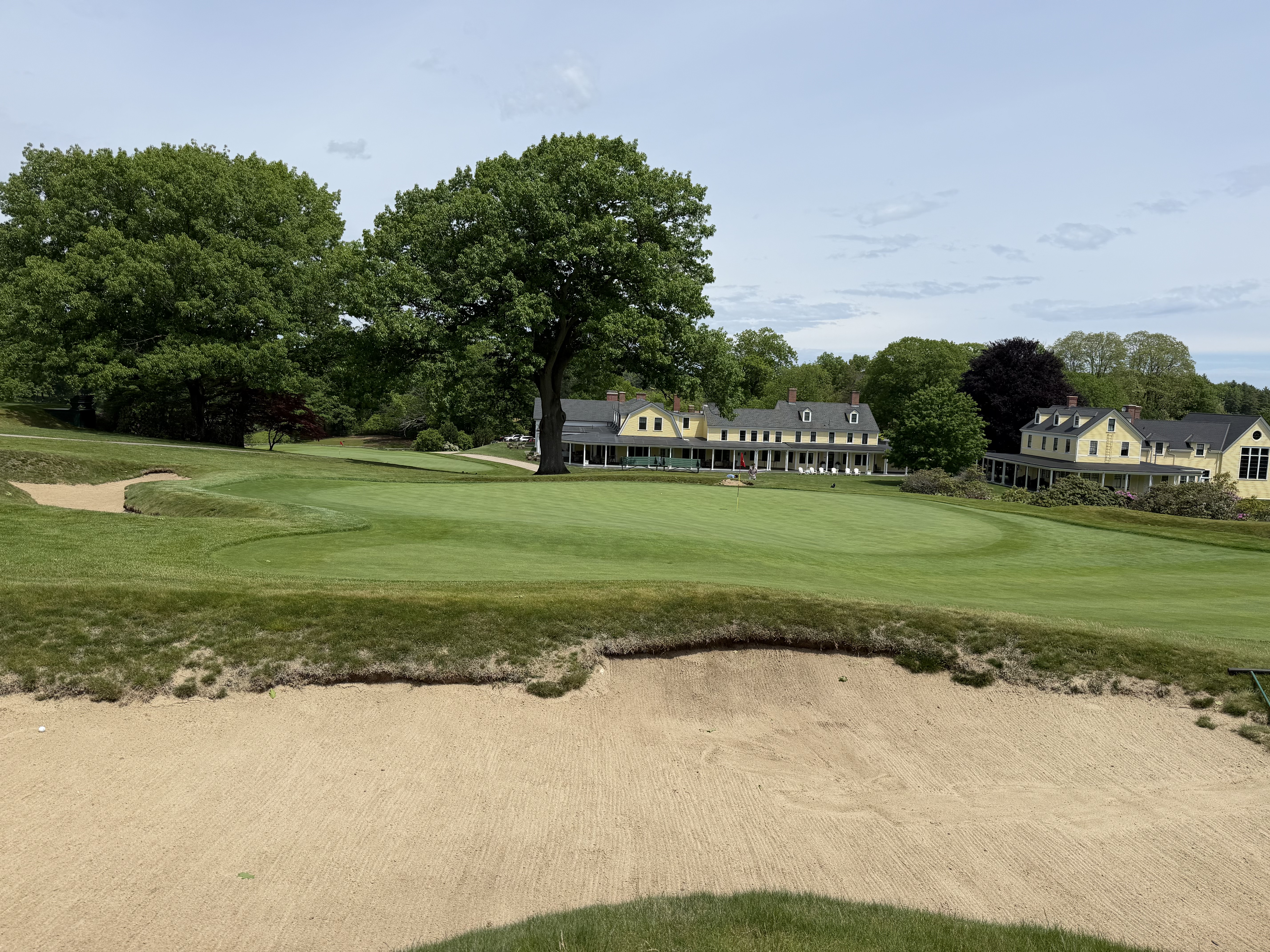
Clubhouse/Pro Shop: The pro shop is separate from the main clubhouse with the whole facility area set up almost as a small village. The putting green and driving range further down the hill, the First tee of the New on the way. The clubhouse is one of the more famous out there and certainly one should spend some time at as its views of the Old sprawl forth from the patio.


Practice area: A putting green just behind the First tee at the Old and a driving range a short walk from the clubhouse.


You must be logged in to post a comment.