6,586 yards, 136 slope from the Blues
Can a course be charming and murderous all at once? The golfer may show up here and look at the fun little hills and big greens thinking to himself he will turn in a scorecard so low it will need to climb to the ground. That feeling may not go away as he walks the hills and sees the fun knobs and rumples about as he shirks off the shaky start. The hills continue to lull him as he starts to wonder when the next par will come. Then the wind might start but he’s too busy looking at the bay and nautical views to think about it too much. The round eventually comes to an end and while he’s left in good spirits because of the surroundings, it is only then he realizes he needs a calculator to figure out his score. I haven’t looked up the proper translation but am certain Manasquan River means something to the effect of, “Killing You Softly with a Smile, River.” To be sure it’s a splendidly fun course but is quite challenging to score on, even when we encountered it in fairly soft conditions. The hills are indeed charming but present difficulties and speed the unsuspecting golfer will have to figure out quickly. What gives it such teeth is the recovery character. Once out of position, the golfer must become a tenfold better version of himself to properly get back to status quo. With the wind and firm and fast, it becomes immediately apparent all that width is sorely needed to keep the ball in play. All of this is presented on the friendliest terms possible. The course is smiling and hence the golfer is smiling, regardless of how aware he is of what is going on.
Manasquan River was established in 1922. The club retained Robert White to design nine holes near the river, which opened in 1924 for play (the “River” nine). White then designed the second nine within the hills above the river, which opened in 1927 for play (the “Ridge” nine). The character of each set of nines is distinct based on the topography and White reversed the nines for sequencing so that the Ridge nine is taken on first, followed by the River. Ron Pritchard and Tyler Rae developed a Master Plan for the club in 1996 and performed restorative work at that time, then Andrew Green instilled additional White character to the course from 2016-18, along with work to irrigation, bunkers, tees and a few of the greens. From the hills to the shore, the course is an adventure and an invigorating walk. It is a strong design and generally under the radar, yet emphasizes just how deep the New Jersey golf scene is. It is worth traveling to for those far away and for those nearer, they already know.
The First is a 318 yard par 4 (from the Blues). A short par 4 to start that frog legs to the left with a bunker at either side of the turn. The green is ahead, slightly pushed up from the fairway with two bunkers on each side guarding mostly the front. The golfer has lots of decisions off the tee to navigate around the first pair of bunkers and most approaches with have a wedge or short iron for the approach.


The Second is a 345 yard par 4. Climbing up the hill, the fairway is widest at the start, then narrows once it gets vertical. The right side sucks off the side while the left has a sneaky bunker running parallel with the fairway. The uphill fairway moves left to right as well and the golfer would do well to favor the left side off the tee, bringing that left bunker more into play. The green is at the top with the front greenside bunkers significantly below.


The Third is a 155 yard par 3. The tee shot must carry the ravine between tee and green, which is widest at the rear and a prevailing left to right movement.


The Fourth is a 352 yard par 4. Bunkers intimidate the tee shot while the one on the right denotes the fairway narrowing. There’s a greenside bunker on the right, again accounting for the left to right movement and hoping to collect those approaches that don’t account for it. The left side might be the first substantial off fairway area. Mostly, the strips of rough are all that’s available in these early holes.


The Fifth is a 471 yard par 5. A dog leg left with a large swale and no bunker to speak of until closer to the green. The fairway gets narrower at the climb out of the swale and the bunkers on the right are much deeper than those on the left. The fairway width is the biggest challenge here as there is not a lot of off fairway space, especially on the right.


The Sixth is a 202 yard par 3. Using the swale once again, the tee shot must carry to reach the green on the other side. There is plenty of room before the green and mind the bunker posted on either side. There’s also a good deal of width. Just don’t go long.


The Seventh is a 588 yard par 5. Another par 5 and switching back to use the swale once again off the tee. The tee fairway keeps climbing after the swale and then crests downhill to the green. Like the Fifth, there are no fairway bunkers and the fairway is rigidly narrow. It must said, however, that the narrowness we encounter on these par 5’s is not unforgiving (the exception being the right side of the Fifth). The trees are spaced out and beyond the rough strips, the ball might move into adjacent fairways. The approach here is clear of trees and the golfer is able to use the downhill to his advantage if he wants. The green is large, allowing an array of pin positions that will influence those approaches in.


The Eighth is a 361 yard par 4. Back up the hill. The last few holes have switched back and are straight, yet the design maintains lively variety with simple fluctuations to width and green size and position as well as relying on the contours. Here, the tee shot moves uphill for most of the hole, then shifts downwards. The green is set on a converging hillside, which gives it different movement than the fairway, a more back to front and left to right. This promotes an angled approach in and just like that, distinguishes itself from its predecessors.


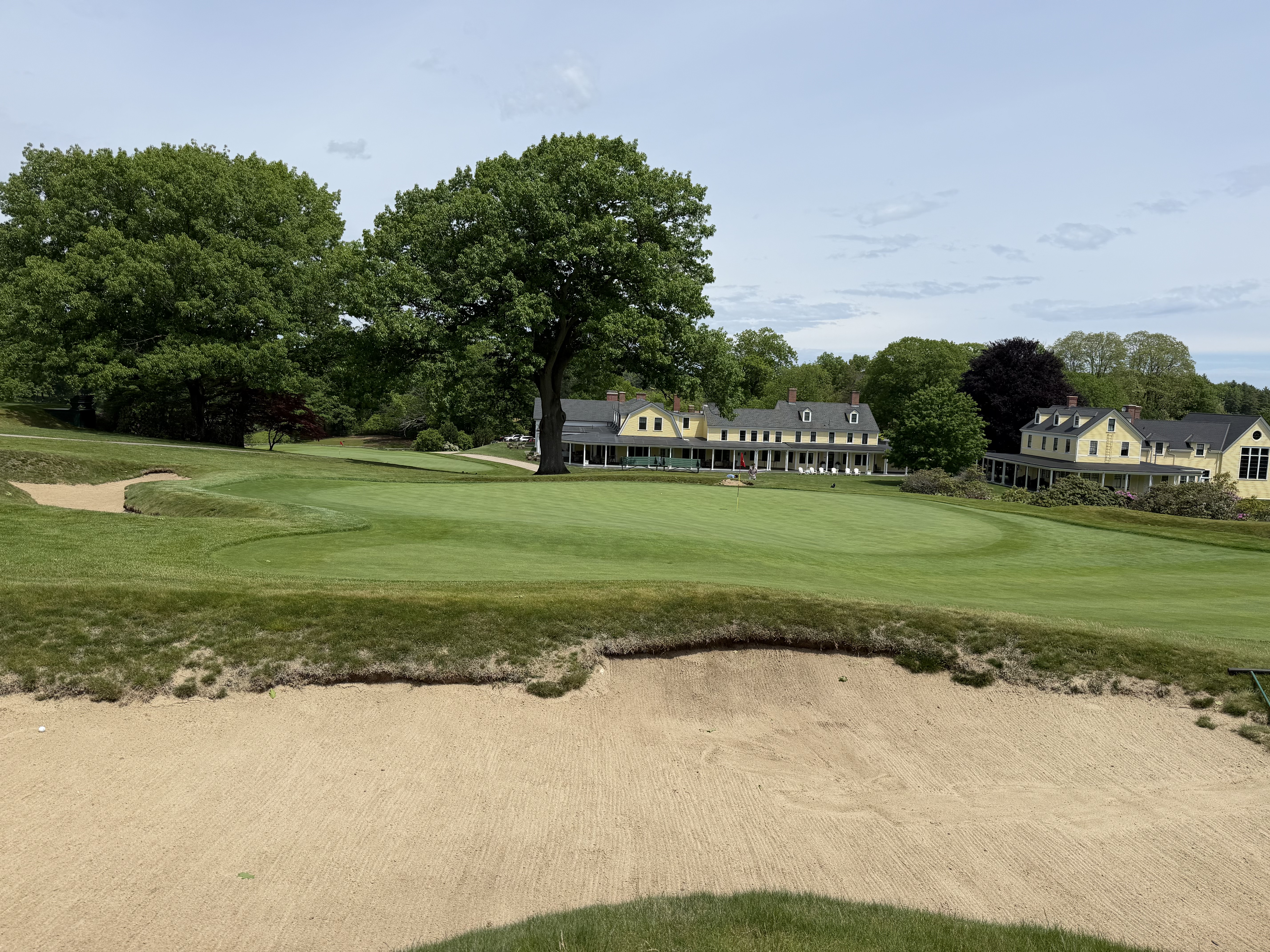
The Ninth is a 430 yard par 4. A slight bend to the right as we head back to the clubhouse. The tee shot is uphill and here, the fairway contours create a valley through the center. This can funnel the tee shot towards the center, or repel it off towards the edges, depending on the fortune of the bounce and roll. The green and bunkers are of a large scale and like the Seventh, the downhill is available for the golfer to use in conjunction with the green as he sees fit.


The front nine within the hills is indeed adventurous and ensures the undulations instills thrill to the round without ever becoming too severe. A fun yet challenging nine holes, I would rank them 2, 1, 4, 7, 6, 9, 8, 5, 3.
The back nine starts with the 408 yard par 4 Tenth. Back up the hill we go. The topography is more than enough to instill varied character into holes that more or less switch back. Here, the tee shot is completely blind and the ridge seen from the tee is the start of large swales that rumple to the green. The lone bunker is at the left of the green, the rest of the holes is simply the golfer against the contours.


The Eleventh is a 523 yard par 5. At the edge of the property, we head back down and on to the river. The tee shot is blind, this time due to the downhill. Strong enough tee shots enjoy the possibility of catching the downhill, in which case they can consider going for the green in two. There are larger bunkers guarding the area short of and at the green to emphasize the necessity of an accurate approach, which curbs the attractiveness of longer shots in. There’s enough width but those looking to score will need to impart thought and touch as they get closer to the green.


The Twelfth is a 352 yard par 4. Moving in the same direction, the holes now level out and must stir interest beyond the terrain. Wind certainly becomes more influential while trees are strategically placed while the configuration of bunkers to the contours stands out a good deal. The large green at the river’s edge slants towards it while some subtle ridges shift movement. The greenside bunker on the left happens to the the ideal approach line, so the golfer must do with that as he is able. While the river should be enough of a warning, going beyond the green invites a host of issues with its large built up bank. Stay short.


The Thirteenth is a 384 yard par 4. The fairway gets wider as it gets closer to the green while the green is on the smaller side and defended by encroaching bunkers. The hole is inviting, until one gets out of position.


The Fourteenth is a 321 yard par 4. An inlet to the river runs along the left while the golfer has decisions to make on the tee of this shorter par 4. Temptation will get most of us even though looking at the photo below, it’s as plain as day. For the love of God and all things holy, hit out just short of the bunkers and take the short approach in. But no, let’s try and get closer with the longest tee shot possible. If it gets into one of the bunkers, so be it. The green is much smaller than it looks although a little deep. Bunker shots may not be as straightforward as the golfer expects. Bunkers short of the green also complicate any tee shot trying to hedge the difference between driver and lay up. A fun hole and I promise you, I will be laying up off the tee my next round here.


The Fifteenth is a 196 yard par 3. It is all carry over the inlet to the green. The right side before the green provides some bail out room as well. The green is on the smaller side, so accounting for some of the short grass before it without going in the right greenside bunker is smart golf.


The Sixteenth is a 414 yard par 4. The next two holes take up the relatively same space and share a fairway. Heading towards the river, the fairway dog legs to the right after the tee shot. A large bunker complex stretches out on the right side while the left side comprises of the shared fairway but the more left one goes off the tee, the longer the approach. The approach carries the inlet once again and the green is pushed up, most of the movement back to front. It can be a tricky approach depending on the angle and wind so taking it on as short as possible helps a good deal.


The Seventeenth is a 433 yard par 4. The walk to the tee is along the river, getting the golfer as close to it as possible without actually going in. Heading away from the river, the tee shot needs to carry an elaborate bunker complex that is set up mostly for visuals. There is another such complex further up the left side that is very much in play and is treacherous enough to intend for the right, around it. The trouble mostly subsides close to the green, where there are a few bunkers on the sides and the fairway feeds directly in.


The Eighteenth is a 333 yard par 4. The tee shot must carry water but only comes into play if one tops their shot. Regardless, it’s a tough fairway to hit. Narrow with bunkers and trees close at hand, the golfer needs to have some semblance of placement so that he is clear for the approach. The approach is much more wide open and there is lots of room to work with so even if one is out of position off the tee, there is a good chance of scrambling. The tee shot is paramount.


The back nine comprise the original holes near the river and exude some links characteristics which facilitate ground game options and many of the holes. There is a lone par 3 and par 5, so the par 4’s dominate and differentiate themselves with bunker configuration, mounds and green placement. I would rank them 14, 12, 16, 13, 10, 11, 17, 18, 15.
Generally, Manasquan River is a great example of character coming from the natural surrounds so that there are two distinct structures of play on each nine holes. There is cohesiveness within, however, and the course expects creativity and smart recoveries. A classic design that relies on variety by the strategic decisions the golfer faces and the roll of the ball. While many of the holes are straight and switch back from each other, there is sufficient variety emphasized from the terrain and hazard placement. In all, it’s a splendid classic design allowing those who want to have fun to have fun while remaining stiff for those looking to go low while the recovery character can get harrowing in the best way possible. While the course enjoys a quieter profile, it should be discussed much more for the range of golf it conjures from the golfer.
Clubhouse/Pro Shop: Allowing the course to use the higher points of the hills, it still enjoys wonderful views of the water while there are a couple other separate structures for the pro shop and locker rooms.

Practice area: They managed room for a driving range, short game area and putting green, all near the First and Tenth tees.




You must be logged in to post a comment.