6,581 yards, 136 Slope from the White tees (Red/Blue)
An ode to the Pimm’s Cup. My first Pimm’s Cup was at the end of the round before we arrived at St. George’s Hill and my second was here at lunch. Actually, no; my first was at a bar in Philadelphia a week or two before the trip but it was more of a cocktail sheer imitation to the real thing. At any rate, I instantly found during the trip they were refreshing against the warm Summer days and all the walking and swinging. It was vacation and I didn’t feel like something basic as water or childish like soda or elderly like tea. Nor did I want to get bogged down with beer or boozy with a stiffer type of cocktail. Enter the Pimm’s Cup. It’s a wonderful balance of a drink perfectly acceptable in several degrees of casual or formal occasions while remaining light and delicious. There is little alcohol in them, so one could have a few and feel just the same. I’d equate the Pimm’s Cup to how many in the U.S. have embraced the whole hard seltzer thing, except the Pimm’s Cup is more respectable. It became my drink of choice during the trip and then when I came home, I found a bottle of Pimm’s and started making my own. There was an embarrassing moment. Just when I felt comfortable and at ease ordering the good old Pimm’s, a server threw me off when she asked what number I wanted. I had no idea there were numbers in my neophyte ignorance. There are and the server was doing right by asking. The number corresponds to your liquor of preference in the Pimm’s; number 1 is gin, 2 is scotch, 3 is brandy, 4 is rum, 5 is rye whisky, 6 is vodka, 7 is tequila, 8 is absinthe, 9 is Islay whisky, 10 is Irish whisky and 11 is shochu, a Japanese whisky. Since Pimm’s is a drink mix, some of these numbers have been discontinued but now you know the whole spectrum. Number 1 is most typical and what you will get most of the time if you don’t specify a number. I find it the perfect warm weather drink.
Sitting on the patio of the St. George’s Hill clubhouse with views of the clubhouse and horizon beyond with a Pimm’s at my side was just about one of the best moments of the trip I wanted to bottle up. There was little wind to speak of and the sun was warm without being unforgiving about it. It was then that I began contemplating a design theme we had seen at the three courses we had played up to this point. It has to do with one of my favorite subjects in course architecture; use of the land. There is no doubt that the English heathland courses we had seen used the terrain remarkably well but one of the key traits that elevates these courses to all world consideration is how the terrain dictates the personality of the course. Yes, this is what I’d declare above all else. Walton Heath had its subtle deceptive challenge and New Zealand had its tranquil, dignified strategic plotting and then there was St. George’s Hill, punctuating this point loudly with its adventurous and bold hills. The hills create thrill of roll, suspense and even some intimidation yet more in a lively measured rhythm than full throttle bellow. It’s symbiotic in how the personality of the course comes from the terrain since it’s woven into the structure of play. The hills are not simply used for their views and climbs; the runs in between, the sides of the tops and the slopes are all used for the sake of variation and strategy, which brings much more sophistication into the round than most hilly layouts. It is true that heather is probably not relied on as much here as many others in the area but there’s just so many areas where contours and terrain movement work with the bunkering that the efficacy of heather doesn’t seem to fit in many instances. As the trip wore on, a scale began to develop, with New Zealand on one side for its subtle stateliness and moderate terrain and St. George’s on the other with its emphatic undulations and outward expression. Swinley and Sunningdale fell some where in between those two, Walton Heath was more towards New Zealand and Hankley more towards St. George’s. It is no coincidence that the personalities of the courses ran parallel to their terrain.
The club started as the first known in history to incorporate luxury housing when the land was purchased by W.G. Tarrant, who smartly retained Harry Colt to design the course, which opened in 1913. The Green Nine opened in 1987, born from plans drawn up by member Peter Preston and re-designed by Donald Steel. The Green was on land from the second course Colt designed here that had been closed decades prior. Alas, the course is comprised of 27 holes with the Red/Blue nines the original eighteen holes. The course has been well preserved over the years, with a bit of work done when the practice area was re-worked in 2015. In an effort to move closer to Colt’s design, however, the club hired Brian Schneider to devise a master plan. His proposed work to each hole was on display when we were there and will further the effects of the contours and undulations, mainly by replacing areas of rough or heather with firm short grass. Colt actually drafted a plan to accommodate for the advent of steel shafts, so perhaps this is being used in part with the master plan. Schneider’s restorative and renovative portfolio to existing courses is impressive thus far and every indication the same would hold true here if it is decided to move forward with it. As it stands, however, St. George’s Hill is a prime example of Colt’s brilliance in course architecture. The routing upon such an exciting piece of land, the green sites upon it, the masterful bunkering and the variety he found is all particularly one of the finer works one can play. I had played aspects of Colt before the round here but St. George’s Hill was the first complete (and some would say his most original) design by him I was able to play. It was all it took for Colt to rise among my favorites.
With thoughts already brewing of sitting on that patio after the round with the Pimm, we set out for the hills on a just about perfect Summer afternoon.
RED
The First is a 387 yard par 4 (from the White tees). We start by confronting the hills directly by teeing off right into them. Fairway bunkers are staggered on both sides with the right side allowing more leeway for the tee shot. The green is at the top of the hill and blind from the fairway yet is deep and runs from back to front with runoff contours on either side. We get right to it here.


The Second is a 458 yard par 4. The First provides a nice preview of what’s to come with the topography. Never severe but substantial and demanding attention. The entire hole is before us on the tee, initially moving downhill with a right to left cant. A creek interrupts the fairway at the bottom of the hill and comes into play for the longest among us. After the creek, the fairway moves uphill to the green, zig-zagging around a couple bunkers and moving uphill. Once again, the large green invites an array of approaches but those with longer putts with be subject to the whims of the contouring.


The Third is a 198 yard par 3. The green complex bears a few similarities to the Redan, with the bunker positioning, right to left movement and drop off on the left side and contouring before the green moving balls forward. Alas, it plays in the same manner, encouraging shots to the higher right side or otherwise imparting a good amount of controlled finesse to go for those pins on the left.

The Fourth is a 272 yard par 4. A short par 4 with an enticing green that widens as it moves towards the rear with bunkering all along the front and sides. It’s an effective short par 4 in tempting just about everything to pull driver but an iron and wedge strategy is probably much smarter. It would have been for me as I watched my ball sail off to the next tee amidst lots of tree cover marring my recovery to the green.


The Fifth is a 388 yard par 4. The tee is set at an angle from the fairway, moving from a high to left diagonal. The golfer must decide how much of that left side to take on from the tee to stay on the fairway and there are a couple bunkers on the left to complicate that decision ever so slightly. A center line bunker straddles most of the fairway and needs to be carried with the green sitting above. Bunkers on either side site at the narrow throat entry point before the green. Without being all that assertive about it, both shots need to be pulled off nicely to score here, while one that only pulls off mediocrity on one shot will need the other to be extra special.


The Sixth is a 468 yard par 4. Yes, a 468 yard par 4. The next is a par 5 with an entire nine more yards. The downhill helps though, which starts with the elevated tee shot. A slight bend to the left and a bunker on the right with trees on either side are all that comprise the fairway while the dip before the green and surrounding contours keep the green complex interesting. Length of the second shot will challenge most shots into the green, which is meant to accept and/or complicate that shot with infinite degrees of variation.


The Seventh is a 476 yard par 5. Heading back up the hill with a lone fairway bunker on the left, the drop off on the right side is the main culprit intent on trapping the golfer. The bunker further ahead on the right is a good marker; anything to the right of it should be considered drop off territory. The green is on the smaller side with left to right movement, a bunker at each corner.


The Eighth is a 179 yard par 3. A brilliant par 3 for how it seems like it will spill off the hillside any moment. The inspired higher tee shot invigorates the golfer, who is already trying to reach the area of the green because he’s uncertain if the ball will actually stay on. The original green actually extended further down the front, which Schneider would like to restore and would likely bring many new levels of excitement to this green. As it stands, however, the hole is tremendous.


The Ninth is a 389 yard par 4. The clubhouse in the distance as we tee off to the fairway below, which dog legs left and moves up to the green. The riskier left side off the tee ensures a shorter approach if pulled off while most approaches will be blind. The green is on the larger side, however, and moves to the left in general. It’s a notable dog leg in how it rises to the green while the single bunker short right of the green seems to affect every shot into the green.


The front nine is loops around the hillside and does not include a weak hole. The par 3’s are very strong and there’s brilliant variety among all of them. I would rank them 4, 8, 2, 9, 3, 5, 6, 7, 1.
BLUE
The back nine starts with the 434 yard par 4 Tenth. We head out in the opposite direction of the First, along the base of the hillside upon which the clubhouse sits to the left. The fairway is obscured from the tee but there is plenty of room to work with, a left to right movement creeping in. The approach shot at the Tenth is primarily what I think of when reminiscing. For most, it will be on the longer side and once again, blind. First timers may get confused. The fairway bottlenecks at the small hill that must be carried and the primary inclination is the green is directly over the other side and of smaller size. Those are mistaken presumptions, as the green is almost a hundred yards further on and is rather large. Schneider’s plans include more slope, short grass and movement on the left side and short, promoting an exciting firm and fast proposition that the golfer will be able to use better as time and experience wear on. The green complex is remarkable and the hole easily one of my favorites.


The Eleventh is a 119 yard par 3. A short par 3. There should be more of these types of holes in golf. Short, with a generous green, yet terrifically dangerous if the golfer can’t get the shot right. The hillside on the right falls off into the abyss, as does the rear (although a bunker in the back shows mercy on the golfer, catching balls from moving all the way down on that side). One really wants to hit the green and stay on it, which should be an easy enough proposition, especially with all the room to the left unseen from the tee.


The Twelfth is a 348 yard par 4. The fairway is once again blind from the tee for the most part yet the golfer is still able to discern a prevailing left to right movement off the initial hillside. The fairway eventually flattens out before climbing back uphill and to the right, with a lower right bunker near the green earning the prime position to avoid. The green movs towards it strong enough to warrant favoring the left side on approach.


The Thirteenth is a 427 yard par 4. Still moving in the same direction away from the clubhouse, the fairway is in plain view from the tee and heads straight out. The left fairway bunker further up is the one to avoid here, which should be relatively easy if the approach is any where near the green. The green is above the fairway perched on the hillside with bunkers on either side more towards the front. Like many of the greens, the entry point consists of an apron that transitions fairway to green. This may entice the golfer to hedge a short miss and stay below the hole but this brings the bunkering more into play than they really should.


The Fourteenth is a 211 yard par 3. A grand par 3 with a slightly elevated tee shot. The green is quite large and moves towards its outer edges. Its size makes it receptive to the longer shots coming into it from the tee while bunkers are on either side. I wold rather be in the lower left bunker than the higher right but both are positioned so that it’s entirely possible to hit from one to another if the golfer doesn’t excise the correct amount of caution.


The Fifteenth is a 547 yard par 5. Heading straight out and relatively at grade, the fairway starts a gentle descent while the fairway bunkers present themselves in a left-right-left-right cadence. Rolling out into them is the paramount concern, although the lips are considerate enough to remain low so that the golfer has a nice chance at recovery. The green is slightly up again with bunkering towards the front, with the apron at the entry point. It must be said there is more room to miss at the front but those that strive for the center or rear assure themselves of remaining on the green. I’m partial to downhill putts over bunker shots but just personal preference.


The Sixteenth is a 438 yard par 4. Tee placement with respect to the tree lines and a gentle bend to the left make this feel more like a dog leg left, which comes into play off the tee. Those that navigate the tree lines and contours might enjoy much more roll towards the hole. The green is sitting on a ridge left of the fairway, three bunkers guarding it short in diagonal procession. The green is modestly sized, which further amplifies the challenge of the approach. There’s no way around it, a golf shot must be hit here and really, any where missed off green will make a nervy recovery. It is time to show up.


The Seventeenth is a 452/417 yard par 4, depending on which tee is used. It has to be one of the flattest holes on the course and while the fairway starts off wide, it narrows as it advances towards the green. The green is at grade, perhaps a little below the fairway actually, with contours and slopes sculpting all of the short grass around the green. There’s a swirling movement about this green and really, pin positions largely dictate how one can use the contours for an advantage. The subtle yet effective influence of the land movement here is a brilliant contrast to some of the more bolder, more noticeable movements. It was among my favorites of the course.


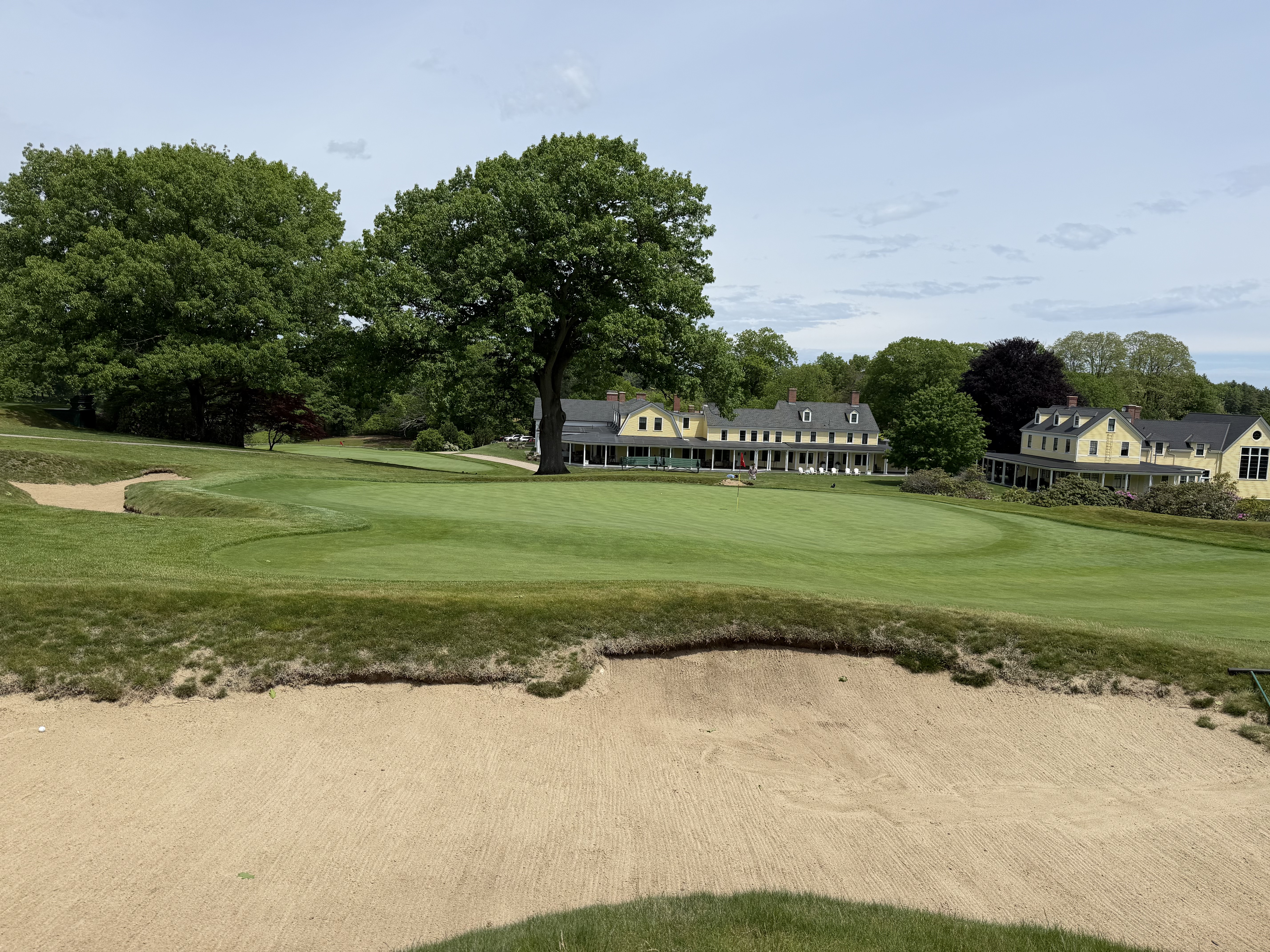
The Eighteenth is a 390 yard par 4. The last is a dog leg right where the closer one stays to the trees on the right, the shorter the approach will be. This stands to reason that those opting for a safer tee shot away from the trees will be left with a longer approach in. The approach is uphill as the stately clubhouse stands sentinel at the high right side. High right is a favorable approach point as well, though the green doesn’t move as aggressively down and to the left as it may seem from the approach. Bear in mind the bunkering lining the rear and left sides of the green, further motivating the approach for the high right.


The back nine is marvelous in how it selectively uses the bolder undulations and relies on contouring and bunkering to play similarly to the hillier front nine. Like the front, all of the holes are strong and I would rank them 10, 17, 16, 11, 18, 12, 15, 14, 13.
Generally, St. George’s Hill is a remarkable course that harnesses the land in brilliant fashion. The variation in structure of play is likewise impressive, which is the result of using the land in a spectrum of angles. All too often hilly land is routed so that there are frightfully speedy downhills and cardio defying climbs uphill but here, the steepness is mostly reserved around the edges of the structure of play while the fairways mostly have gradual or periodic elevation changes. This leads to a much more natural, flowing golf course that still captures the thrill and challenge within the hills. It is indeed a challenge as well where the golfer really needs to know where he can miss and where he must hit his shot or else. The historical significance of the course as it relates to Cole cannot be ignored as well, as his design character is well shown throughout. Colt’s balance of strategy to challenge and variety all through use of the land is quite distinct and perhaps fits my eye in some existential, inexplicable yet powerful, familiarity. To golf is to search for peace and that’s different for all of us. As I surveyed the land from the clubhouse terrace after the round as the sun teased its departure, I had found that peace once again. Masterful use of the land here allowed me an opportunity to once again find the peace I roam for. The sun dimmed its gaze as we bid adieu and continued on.
Clubhouse/Pro Shop: One of the more famous and easily recognizable, the regal structure stands on one of the higher points of the land. It was converted into a military hospital run by the Red Cross from 1914-1918 during World War I, its spacious halls and rooms allowing approximately 3,000 wounded to be housed and treated. A comprehensive refurbishment took place in 2007. The terraces and patios afford some of the best views of the course and horizon beyond while its rooms are worthy of study for their history. I consider it a landmark that was not to be missed on my first trek to the heathlands.


Practice area: There is a driving range a distance from the clubhouse while a putting green is near the First and Tenth tees.



You must be logged in to post a comment.