6,437 yards, 143 slope from the Black tees
The land speaks to you guys too, right? Some times it’s a conversation while other times it’s a whisper. Occasionally it suggests. When I was a distance runner, it usually cursed and laughed. Every so often, it will shout. Then there are times when it will hum. I listen intently. What it has to say and how it says it is most important of all. It’s one of the more enjoyable parts of this journey, walking about these pockets of beauty and waiting on what they have to say for themselves. Golf is very much about the spiritual connection between man and land. It is only fitting that every now and then, the golfer is indeed spoken to by the land on which it is interacting. An acknowledgment if you will, that there is much more going on than willing a little white ball into assorted little holes.
It was a house money round. On those days when you play more than one round and the earlier round met or exceeded all expectations, the latter rounds are playing with house money so to speak. The pressure is off the expectations because of the earlier round, putting the golfer in a more care free frame of mind. I had heard about Eastward Ho! but admittedly didn’t know much about its specifics as I bellowed my opening tee shot out into the hills. It was hillier than the round prior at Kittansett and the first few holes were seemingly inland but I was enjoying myself as the holes were solid. We then found ourselves closer to the water on the clifftops and the change of scenery with the breeze was a dose of invigoration. A gentle but spirited humming faded in and out. We then hit our tee shots at the Fifth, which had to carry a valley to reach the fairway on the other side. Walking down from the tee into the valley and climbing back up, I noticed that I had become subsumed by the land. It was above me on either side, just grass and hills and the distant sound of the water. Straight ahead was a wall of grass as well. It was then that it happened.
Like a majestic chorus at their crescendo, the land sung in booming and falsetto glory all at the same time. And really, I heard it the entirety of the round from that point on, until I finally stepped foot inside the clubhouse and went downstairs, the land out of sight, as well as hearing range.
The drama and inspiration of the Cape Cod cliffs is captured magnificently by the course design. In 1922, Herbert Fowler was responsible for that design, which opened in 1924. For those not familiar with Fowler, his course architecture legacy is extraordinary. An Englishman responsible for well known courses in the U.K. such as Walton Heath Old and New, Fowler first came to the U.S. in 1913, then returned in 1920 after World War I to engage in golf course development. His partner, Tom Simpson, remained to attend to their projects on that side of the pond. Fowler was primarily involved along the California coast and made his mark at such courses as Los Angeles County Club, Pebble Beach and Olympic Club. He also visited a site Willie Park, Jr. had initially surveyed in Cape Cod, which he ultimately designed and renamed, Eastward Ho! in contravention to his club back in England, Westward Ho! (a/k/a Royal North Devon). Speaking of Eastward Ho!, Fowler famously quipped, “I am quite certain that this course will compare favorably with the leading courses in the United Kingdom and will be second to none of them.”
Fowler is among those architects that wrote a good deal and in 1913, he set forth his five principles for an ideal course in the Illustrated London News. Fowler listed the following:
- The course must be by the seaside amongst dunes with fine turf.
- The clubhouse should allow two starting points.
- There should be no crossing of holes and the routing intuitive.
- There should be at least 4 one-shot holes of varying length.
- No two holes should play consecutively in the same direction.
It should be noted that Fowler freely admits Walton Heath Old, likely the course he is most famous for, is at odds with four of the five listed above. As for Eastward Ho!, Fowler managed to stay in line with four of them. Based on the geography, the routing needed to succumb to a modified out and back, so there some instances of consecutive holes playing in the same direction. I would even go so far as to state that Eastward is great only in part because of these ideals but more so because of its unadulterated adherence to the vagaries of the wild topography. Indeed, Bernard Darwin once wrote of Fowler is possibly the, “. . . most daring and original of all golfing architects.” The golf course is strong support for Darwin’s musing. The land shifts and heaves massively and suddenly. Instead of managing and softening such moodiness, Fowler confronted it rather directly and placed such responsibility on the golfer. The golfer must know where the ball will bounce and roll even if he can’t see where he is hitting. The golfer must scale the heights of the cliffs even if the steepness is such that he could lean ever so slightly forward and kiss the ground upon which he is climbing. The golfer must come to terms with the wind and how there will be times a 100 yard pitch shot needs to be hit with a hybrid or wood and other times when he will need to aim due left or right in order for a chance of his ball staying on the fairway. The immense scale of it all as well as the daring confrontation of the natural elements of land and air is nothing short of magnificent. The land was singing in grand chorus as it should. Fowler allowed it free rein to flourish in its natural state. Unapologetically. Gloriously. Adventure personified.
It’s hard to explain but there are rounds when the game becomes easy and I forget what all the fuss is about. Coincidentally, the pars start rattling off effortlessly yet ironically, score is the furthest thing from my mind. It’s a self-awareness of special surroundings, which I suppose wakes up some existentialist pocket of my subconscious. As tribute and homage, the golf game is an offering. I have no control of then where and when it happens but indeed, it’s why I’m always, in one way or another, listening.
The First is a 380 yard par 4 (from the Black tees). The opening tee shot clips uphill while the fairway follows the left to right movement of the hillside. The Ninth is off to the left so there’s more room to miss in that direction if one really feels the need, otherwise focus should be paid to the left center bunker. Getting to the right of it for the approach is ideal inasmuch as the golfer gets a bit of a view of the green from that spot. Whether in view or not, the approach should get to the healthy center of the green to clear all the bunkers at the front and the back to front movement of the green.


The Second is a 350 yard par 4. I mentioned above how the early holes are inland and that’s probably not entirely accurate. They’re fairly close to the coast as well but tree cover obscures views of the water, so they felt inland to me during the round when I had no clue where I was. At any rate, we continue uphill, the tee shot needing to carry an irrigation pond. The fairway dog legs to the right early on and the golfer really does need to figure out placement of the tee shot, as reckless lashing will not fare so well. Favoring the right side should do well but those too far to the right will find the group of bunkers on that side. The fairway crests a ridge and moves downhill to the green, a strong right to left movement dominating with a large bunker at the front lower left. The approach should once again favor the right side to some extent although putting from that lower left side isn’t the worst thing. Thus far, the opening duo uses the topography splendidly.


The Third is a 326 yard par 4. A short par 4 where the tee shot is the tougher shot, needing to carry the ravine on the left before the fairway. If the golfer is able to pull off the tee shot in whatever wind is coming through, then the approach is on the short side yet by no means a pushover. The green is essentially an isosceles triangle, the top of which is slightly tilted between 11 and 12 o’clock with a bunker at each front corner and rear left corner. The golfer needs to cajole the wind, contours and bunkers to get the shot in position for a scoring putt while the severity of miss is dealt with accordingly.


The Fourth is a 182 yard par 3. We make our first turn, the land between Crows Pond and Pleasant Bay is only so wide and so long. The water is now in full view as the tee shot needs to clear a bluff to the reach the cliffside upon which the green sits. I like coming in just right of the bunkers we see on the left. Anything dramatically short will be lost in the depths of the hillside, as will anything too far right or off the back. Refuge is mostly to the left. The green is of generous size, so use it wisely.


The Fifth is a 525 yard par 5. This is where the routing shines. Four different holes span this stretch of land and must all generally run up and back in the same direction. Using the hills and slight off angles, the holes work together for variety and distinct interest. Here, the par 5 runs through the interior of the land yet remains one of the more thrilling holes. The tee shot must carry the ravine we first encountered at the Third, then our sojourn up hill begins. The left to right movement of the fairway is drastic, making it obvious to belt the shots uphill and to the left, into the unknown. Then as the golfer watches in the distance, he will finally see his golf ball rolling within the hills down to the right. The hillside some what levels out closer to the green, which is the ideal area for the approach. The front half of the green likewise pulls down and to the right, so approaches into the green should once again focus to the center. It’s a great point of the course to admire the land, the sea and the holes the golfer has yet to encounter. Indeed, the choir had a lot to sing about.


The Sixth is a 455 yard par 4. Still within the interior yet it feels anything but. The tee shot is blind into the depths of the downslope. The unseen includes one of the strongest tilts on the property, a massive left to right with a gravitational pull strong enough to affect nearby flights. This means most tee shots will roll to the right and towards the green. The long grass encroaches from the sides to create some what of a choke point at the bottom of the hill but it’s within approach shot territory, with the green perched back uphill. It’s another thrilling hole with Pleasant Bay seemingly within reach.


The Seventh is a 181 yard par 3. The next three holes lead us back in the direction of the clubhouse with the coast on our right. The tee shot is steps away from the beach with the green high above, mostly in the blind. Getting up the hill on the green amidst the wind is half the issue. Staying on the green is the other. A lot of the front half is subject to pushing the ball back down the hill if one isn’t careful while the drop off the back is substantial so that any chip back on to the green is ill preferred. Keep it low and have it do some running would be my suggestion.


The Eighth is a 348 yard par 4. The trio of bunkers on the left are enough to adjust the tee shot to either lay up short of them or go for broke in going for the carry while the more accurate among us could sling it down the right side. Either way, those bunkers must be accounted for. The hole moves uphill and even more so after the bunkers, climbing to the green that is fairly deep with bunkers about the edges. Right to left movement as well. There is no where to hide from the wind, which is likely coming in full force swing and complicates things. Yet the design is flexible, playing well with or without wind, the full array of natural elements considered.


The Ninth is a 396 yard par 4. The topography now becomes the utmost consideration, as there are no bunkers to speak of until the golfer reaches the green. The fairway moves right to left and the tee shot will certainly follow that direction. The First fairway is almost a failsafe for shots moving too far to the left, so the extreme right is the only place no good. The green is inviting with a bunker on each side and the rear, behaving themselves and not getting too wild. The approach will likewise inevitably move to the left and once again, avoid the perilous right side. The golfer is presented with various natural conundrums from hole to hole, livening the round and keeping each shot and decision anew.


The front nine covers the north side of the property and does well with its climbs and dives, varying the excitement of the terrain within the structure of play. My ranking of the holes would be 5, 6, 8, 7, 3, 9, 4, 2, 1.

The back nine starts with the 208 yard par 3 Tenth. The longer par 3 needs to carry a small valley before it. The green is deep and the apron before the green is a fine landing area in its own right. This is not the time, however, to go sideways; it gets troubling very quickly.


The Eleventh is a 485 yard par 5. The back nine is mostly an out and back, taking on the hills and valleys as they come while ideal spots are used for the green sites. Here, the tee shot climbs uphill, right to left cant before the crest, which reverses on the other side. The contours are large and magnificent as the golfer makes his way to the green and it takes a lot of experience and knowledge to know the right places to seek out on the shots to take advantage of it all. For the rest of us, the bounce and roll of the ball is sheer blind luck. The green is perched above the fairway, climbing up to it. It is wide with bunkers at the lower front corners, dropping off on all sides. A master class in letting the land do as it pleases to brilliant acclaim.


The Twelfth is a 333 yard par 4. A shorter par 4 with a similar tee shot with the hole prior in that there’s an uphill crest with the fairway blind on the other side. The main difference here is that a large hollow on the right side should gather most tee shot that make it over the ridge. The fairway does have some hog’s back character to it in that balls are going to fall off to one side and will rarely remain in that center area. The green is set on an off right angle ‘and retains that hog’s back functionality. Approaches will eschew off to the sides from the center. A mischievous shorter par 4.


The Thirteenth is a 336 yard par 4. We start to turn directions here, the tee shot doing most of the turning to the right. Once again, we deal with a fairway swale that precludes us from seeing too much from the tee. The climb uphill is a little longer here but then moves downhill after the crest. Bunkering starts about 100 yards out from the green off to the sides. The green is of generous size except for anything long. Oh no, I would do what you can to never go long here.


The Fourteenth is a 371 yard par 4. Now with an about face, we head in the direction of the clubhouse. A dominant right to left takes the place of a dominant left to right, so favoring the right side off the tee is necessary. The green is downhill and the hillside cascades in swales down to it. With the approach, hedging to the right is likewise needed and on both shots, know the ball will do its best to roll into Pleasant Bay. The green is much tamer than the fairway, a rare occurrence in course design.


The Fifteenth is a 153 yard par 3. Now paces from the beach, a bit of a carry from tee to green is in order with most bunkers aggressively defending short and front of the green. Right to left movement washes over the green with a subtle ridge running through the center.


The Sixteenth is a 411 yard par 4. One more hole leading away from the clubhouse before the final turn back home. The hillside is rather large and while we played the lower half of it on the hole prior, we now play its upper reaches. Favor the high left side off the tee. The hillside seems to climb upwards forever but the green is up to the left a bit even if the approach is blind to it. The left to right pull is strong and constant throughout.


The Seventeenth is a 537 yard par 5. We now head back for good but are far from done. The tee shot is mostly blind although we can tell there is downhill ahead. And yes, the left to right movement is tremendously strong. As shown in the below photographs, however, those who are able to to remain on the left side end up on level ground for the approach and closer to the green, the fairway funnels some what, guiding balls accordingly. It’s just those who end up too far off to the right that will suffer, their ball constantly running the risk of running all the way down the far side of the adjacent holes and making things much much further away from home.


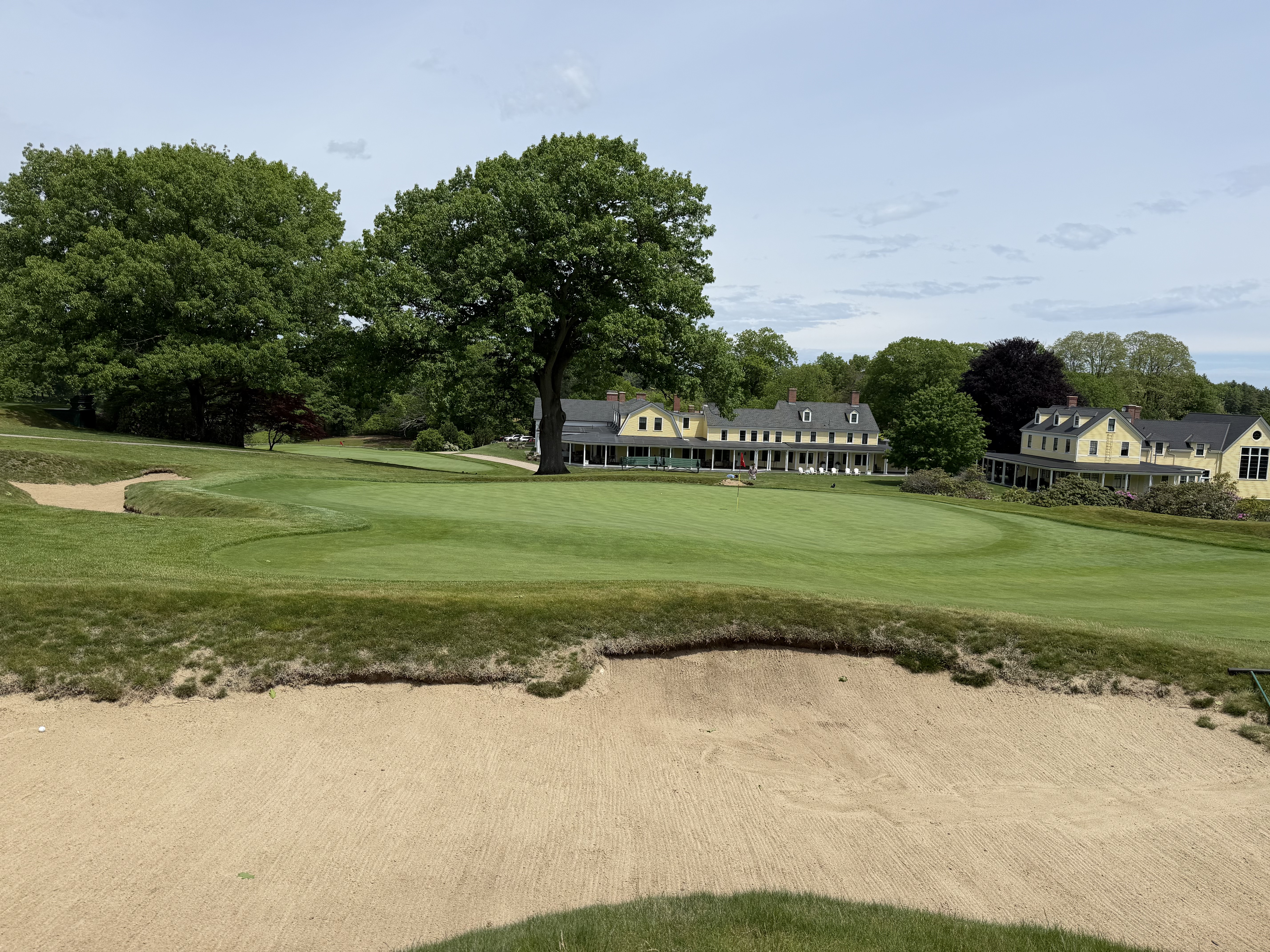
The Eighteenth is a 460 yard par 4. One last semi-blind tee shot yet the topography is enough to tell us favoring the right side is best. Once we walk to the fairway and the hill crests downward, we’re rewarded with a fitting view of the clubhouse resting nicely next to the bay while the fairway jumps and dives to the green. A couple fairway bunkers on the either side collect poorly hit approaches, which are always going to be interesting with the array of lies the contours provide, yet the green is long to accommodate the inevitable long and high shots coming in. As we have learned, there’s typically a bad side to these holes where one doesn’t want to tread and here it is the left. Views of Pleasant Bay from the patio away so after a proper adieu, the grand chorus fades as one makes his way into shelter.


The back nine covers the south side of the property, the clubhouse in between the nines. The par 5’s are spectacular while the par 4’s once again dazzle in jaw dropping variety from the fantastic booming personality of the terrain. I would rank them 17, 11, 18, 14, 16, 12, 13, 15, 10.
Generally, Eastward Ho! has a wonderful balanced dualism that made my heart swing. Among the inspirational views and majestic hills that make up a glorious scene, the golfer must rely on a healthy dose of grit and dogged determination to golf his ball about it. The climbs atop the hills where the wind does what it wants to the plummets into the unseen valleys below where the wind still finds a way to have at you as it pleases; it all means the golfer must traverse, and not just traverse, but golf his ball over it. The golfer must work to enjoy the beauty around him and for those looking to score, must work even harder. The greens are smartly tamer than the fairways, almost as a refuge to the wilderness of the course, yet their subtleties and discretions leave enough complexity for constant study. As written in the 2024 year in review, “. . . the course is boldness reimagined without any hint of gimmick. It’s a grand adventure. The wind with the majestic hills and smartly used width is supremely distinct.” It’s my kind of place for golf. A place I revel in soul signing satisfaction when I come across in my journeys, my life forever better from that point forward, knowing that such a place exists and thrives.
Clubhouse/Pro Shop: The main clubhouse sits at Pleasant Bay with unbridles views. The pro shop is a separate structure across from the clubhouse, well-sized and well-stocked with a notable club logo.

Practice area: A driving range is between the Tenth and Eighteenth and putting green in front of the clubhouse.


You must be logged in to post a comment.