He got the action, he got the motion
Oh yeah, the boy can play
Dedication, devotion
He turnin’ all the nighttime into the day
And after all the violence and double-talk
There’s just a song in all the trouble and strife
You do the walk, yeah. you do the walk of life
Hmm, you do the walk of life
– Dire Straits
Did you know Tom Simpson would impart features in his design that he knew would result in unfairness to get a reaction out of the golfer? Golf, very much like life, is not fair all of the time. How the golfer handles this reality is part of the game. Simpson made sure that this aspect of resolve could be found in his courses. That is admirable. It’s also a sophisticated element to incorporate into course design. I have only played one course designed by Simpson, which I played this year. New Zealand. No, it’s not in New Zealand. It’s in England, west of London. Like many things in the game, I have wanted to start playing courses by Simpson for quite some time. This year was the beginning of that adventure. Many of the English golfers we spoke to had mixed feelings about the course and I’ll eventually get into the reasons why that may be, but I found it brilliant. It encapsulated an old English character full of tradition and dignity. I think I remarked at the time that New Zealand does so well what Garden City GC gets at. Exudes a sense of history into a charm that prevails about. All while the course stays true to subtle yet intelligent design attributes that acknowledge the deeper, profound reaches of the game.

And so began a new chapter for Golfadelphia, at last. The U.K. There will be a lot more on that London trip but for now, I will only emphasize the refreshing wonder that settled in with respect to the design character and golf culture in general. It was just my style. Have a match but don’t take it very seriously, carry your bag and one or two drinks after before heading off. The courses are full of strategy and guile, always doing well not to feel too standard or quirky. Instead, the designs are just right. Memorable with an enjoyable variety and always a degree of elegance to them. The trip over was the highlight of the year and so it’s only fitting to start this review with it.
Simpson’s intentional designing of unfairness is a superbly interesting imparting of adversity into the structure of play. After all, golf, as in life, is full of adversity. Some of that adversity is based on fortune or randomness. And some of it is downright unlucky. Rub of the green if you will. How the golfer handles such adversity is indeed one of the unique aspects of the game. While most sports allow some form of athletic rage in dealing with misfortune, not so in golf. The golfer must learn how to move on from it and not let it affect him. Otherwise, such misfortune will fester and risk overcoming the golfer with a resentful, self-loathing sense of being. Such as in life.
Golf is indeed a test of character as much as it is a test of skill and thought. The quicker one realizes this, the better. How one handles the adversity presented to him, shaped by his skill yet also the natural surroundings and even pure chance, is just as part of the game as something like one’s greens in regulation. The character of the golfer matters. As in life. There is the integrity component in following the rules and self-calling penalties, but there is also the way in which the fortunes or misfortunes of the round are handled. This is one of the ways in which golf is a supremely profound game. This year was one of character, fine tuning my own, embracing those with it and staying away from those that just don’t have it. Certainly obvious but a realization that becomes more and more astute as the years tick by. Character matters. In golf, as in life.
Along with character, there was certainly adversity this year, most of it on the course. Work obligations came calling in droves most of the year but I was still able to figure out when to get out there. Oakmont and adversity are synonymous. Yet just like Simpson’s designing for misfortune, designing for adversity takes a good amount of talent and skill to get right. The adversity at Oakmont is ingenious. As I sat on the porch of our lodging drinking in the Eighteenth green, I realized how much I relish adversity. That makes sense. At dinner on the back porch, gazing at the Ninth as the sun went down, I vowed next day’s round would be better. I’d take that adversity and do something with it. As in life. Watching the ball drop in for par on the First the next day was a testament to that. Some other holes were the same. We won’t speak of the holes other than that. But never give up. In golf, as in life.
And anytime you feel the pain, hey Jude, refrain,
Don’t carry the world upon your shoulders.
For well you know that it’s a fool who plays it cool
By making his world a little colder
– The Beatles
A few new things this year. One of them found me in the Media Center of Newport Country Club during the U.S. Senior Open. I was covering the tournament and had been at the course all four days dawn ’till dusk. There were real reporters all around and then just me, trying to look like I fit in. And also trying not to eat too much of the food. Jumping from group to group, figuring out angles on what to write about, thinking about how the course design fits into it all. Sure there was plenty of adversity but I enjoyed it a lot. Watching some of the world’s best compete on such a classic design for so many days; the adversity almost enhanced everything. Newport’s design is indeed brilliant. For its versatility laid bare to the natural setting and its elasticity of various styles able to flourish upon it. The tournament showed both tenfold. Sunday afternoon started showings signs of inevitability of a winner and then the rain started. The tournament suspended until the next day, I had to leave and regrettably, watched the end and playoff from my living room. The inevitability changed rather quickly that Monday and an unexpected winner emerged. The drama of the unforeseen. Golf, as in life.

In the midst of life we are in death
– Gregorian chant (Media vita in morte sumus)
There’s adversity, perseverance and of course finality. We bow our heads to the loss of JC Melrose this year. A Mackenzie/Maxwell on finely undulating land interlaced with creeks, its demise began decades ago with the construction of the Tookany Creek Highway and some housing yet the course was able to remain private until the early 2010’s. Some original holes remained, as were some greens and it was a fun round jumping about the steepled hills that rumpled between each other. I would walk Melrose just as I walked Jeffersonville and Cobb’s Creek, thinking how splendid a revival would look. Jeffersonville just opened its new clubhouse and thrives as a destination public course while Cobb’s is slowly resuscitating. As of this writing, it is finally showing off its remarkable terrain, with the large ridge, plateau and valleys as one drives by. Reading Country Club was just purchased and word is the new owner has en eye to rightfully restore the course and club. Patience is in order. Rebirth and glory seem possible. Some are resurrected, some take their rest and live with us in spirit and memory. I would preach, Melrose would have been a splendid fourteen hole course, could have made its mark in different ways combined with its pedigree. Alas, not meant to be. Golf, as in life. Requiescat in pace.

Rebirth, revival, redeem. A few visits to old friends this year, the Redux Review was born. It was early Spring but just felt like a wet winter. It had been too long between for golf and I could wait no more. I trudged down to the Shore in my rain gear amidst the wet. I would swing my clubs, I would carry my bag. I would find my ball and hit it again. The land and air about me knew, yet stood in mostly quiet reverence as I passed through. The splashy steps in puddles and squishy strides in mud. The ball still sailed in the air and rolled about this way and that on the grass. There was laughter, there was indignation. The rain baptized then surged even more. There was redemption. The water kept on yet so did I until the last. Drove back in the rain but hardly noticed. Golf indeed, as in life, redeems. A few weeks later, I found myself at Pine Valley. It had been a while and coincidentally or ironically, it rained the entire round that last time. We skipped the Sixteenth and Seventeenth, finished up at the Eighteenth then found refuge in the clubhouse, that last time. I found myself once again at the First, changed. The reverence was still there but the fear was not. It was more intrigue with some fascination. The birdie putt just missed. And so it went. No longer survival but able to battle a bit, engage. Just like every other time here, I learned more about myself, about the game. Redemption, enlightenment, through adversity. As in life.

Some learn out there. Perhaps more than they bargained for or expected. Through the heartache, laughs, zen, good shots and bad, we learn the resolve we culminate, the grace under pressure and the strife serves us well more than just on the course. In turn, we take whatever it is from life beyond the fairways and use it on the course so that they regard each other. Indeed. Golf as the walk of life.
Do you know what the secret to life is? . . . One thing. Just one thing. You stick to that and the rest don’t mean shit.
But what’s the one thing?
That’s for you to find out
– Curly
Oh, it might be more than one thing but as one gets older, one realizes what’s important to them matters. And as one gets older, it becomes clearer what those important things are and the older are more willing to stick to those things and the rest really does stop meaning all that much. I might need subsets and a couple qualifiers but for me, it’s really three things. Family/Friends, Work and Golf. And they all regard each other so that one helps with the other two and so on. All of it leading to different kinds of happiness but happiness all the same. All of it seeming to lead to the kind of life I can get on board with. For their own reasons.
Enough inflection. Yet as we look to the past year and what it meant or what was learned, it’s something like this. Golf, as in life. Let it be so. I will continue to walk.
Aside from profound introspections of spirituality on the fairways, the following seemed to resonate a bit as I set about walking courses I was seeing for the first time and those I had walked before.
- I’ve been a Clippers fan since 1992. That’s when Larry Brown came in as coach, reunited with Danny Manning from their time in Kansas where they won the National Title in 1988. My Dad started taking me to the games and we watched firsthand as the team went from sub .500 to a winning record for the first time in history. They went to the playoffs and took the Houston Rockets to Game 5 (first round were five game series back then). The next season, they went to the playoffs and took the Jazz to Game 5. They have been much easier to watch nowadays but this season, were predicted not to be all that good. Thus far in the season, however, they’re outperforming those projections. They have done this in large part by embracing an identity. A gritty, defense-minded team that play like their life is on the line has served them well. Embracing that identity gives them a rudder, as well as a path to winning. Basketball teams with a playing style or identity are always more fun to watch. So it is as well with golf courses. This year, we focused a little on course identity, how it’s expressed, what does it consist of. Simply put, a course must have a distinct identity and do it well. That identity could be just about anything, which provides variety for the most part. A wily member’s course. An extremely challenging course capable of stirring the tour pros. Or maybe the course takes a little from pot A and pot B. We hear the refrain a lot recently, “We want the course to challenge the pros yet be fun for our members of every skill set.” It’s possible and this identity would amount to very adaptable course, so long as it was able to do it well. Yet that type of aspiration can be trying to do too much. There are courses that understand their identity and are fine flourishing within those confines. These courses are fine never hosting a professional tournament and so on, as long as their character thrives. I’ve always paid attention to course identity and this year especially has shown just how important it is to worthwhile design.
- Within course identity, the Beyond the Fairway https://golfadelphia.com/2024/11/26/beyond-the-fairway/ article addresses just how important off the fairway is. I’m also pretty sure I coined the term, “recovery character.” I even threw in some math and science with a bubble chart of all things to illustrate recovery character. Bunkers seem to dominate this type of discussion but there’s a lot more out there that should be considered in the course identity spectrum. If a course utilizes an abundance of trees or water, this almost automatically adopts a penal playing identity. A course with wide fairways with bunkers, mounds and wire grass beyond will allow a larger array of recovery scenarios, thereby defining its identity as more strategic and even fun. This kind of hit me sharply as I messed about the heather in the London courses we played. Each hazard or off fairway design feature has a degree of penalty and a degree of recovery, which directly impacts the playing style of the course. A lot of restorations/renovations are focusing on these off fairway areas, which helps demonstrate this concept.
- I already knew this but was able to see it up close for a few days. Part of memorable course architecture is the ability to allow a variety of playing styles to meaningfully engage on it. Newport Country Club did this fantastically well. The Champions Tour was almost the perfect field to see this unfold. Fujita’s brilliance with his irons was a sight to behold as he mastered the wind adroitly. The champion, Richard Bland, was streaky but finally managed to control his length and ability to extract out of trouble later in the tournament. My man Kenny Perry was out of contention and squirrelly off the tee yet kept things respectable finding birdies with an array of recoveries off the fairway (Newport’s recovery character is admirable). Estes finished T5 in large part from his masterful putting. The variety of playing styles, and how well the player excelled within it, made for a wonderful display of all kinds of golf working their way about the flexible design, which showed its multiple personalities like a chameleon as the weather would change from one climate to the next, almost on an hourly basis. Links courses seem to accomplish this most often but there are other course types that achieve it. It is virtually necessary for a golf course to be considered great.
- Pimm’s cups are refreshing. There are a variety of ways to make them, so be sure you know which number you want. 1 is the most common. I enjoyed them so much I started making them when I got back home. Yes, Pimm’s mix is widely available.
- I like to travel and am fine being a tourist but I don’t like to go where all the tourists go. That includes golf for the most part. Yes, some times it’s necessary but one of the key things about the London trip is we were able to golf on courses that mainly had its members on for the day. The area instantly won me over, as there is such sheer quantity of quality golf that is welcome to visitors without being overrun by them. Big game hunting list checkers may not find it as appealing but those looking for extremely good golf that love walking would find it heaven sent.
- I have only begun to scratch the surface.
Some random stories from the year.
- The year started strong after I left that Denny’s in January. I touched on it in the Preview article but the first new course of the year was Santa Ana Country Club. I then met my Dad for an afternoon round and broke 80 for the first time. At that Denny’s, I was wondering what the year had in store and turns out it started out hot. I then shot a 74 at Jeffersonville but it was winter golf. I kept playing well and had lofty goals when I went down to Calusa Pines late winter but was absolutely shelled. And that my friends, was my annual reckoning of real golf versus winter golf. Fool me once!
- There was a lot of walking in London. Seven rounds in 3.5 days to be exact. With all the work this year, staying in shape has fallen off and I showed up to London out of fighting shape. My legs were shot the last day and the day after I returned, was still feeling it. Alas, I was walking to 30th Street Station to meet my family in Manhattan when I jogged a few strides to cross a street in time and that was it. The familiar surge of pain ruptured through my right calf, rendering me unable to walk. I could only step about six inches at a time, creeping to the train, hoping I wouldn’t miss it. Any slight movement would result in a flood of pain. Once up in the city, I limped to a taxi, then had to limp all over. To Yankee Stadium, the Manchester City Pop Up store, some famous burger place. I couldn’t walk for a week. Yet it was worth it for all that glorious London golf. The lesson, don’t get old. The other lesson, get in walking shape before your trips.
- Blades Brown was in the finals of the Four-Ball so I was able to watch him golf a good amount. His swing seemed intuitive and I started messing around at the range mimicking it. I started hitting the ball pretty well with it, so of course put it in play immediately. Probably bad timing right before qualifying for the club championship. It didn’t go well. As Bill Simmons used to write, the answer, as always, is I’m an idiot.
- Running on 2 hours of sleep, maybe. At the rental car place, the worker is looming over us for some reason. I’m not sure whether it was supposed to be considered VIP service with all the looming or if we’re supposed to sign or acknowledge something to make him go away. I’m too tired to care but am curious if I’m missing some kind of custom. He just stands there as we get out golf clubs out of the travel bags and put the club heads back on. He finally leaves, perhaps satisfied that we seem ok with the car. I undervalued the fact that my friend had been here before. He drove. We left the airport and almost immediately I felt we were going to crash every time we reached a turnpike. Eventually getting into the English countryside, we went even faster. Trees now loomed in place of the rental car guy, towering on either side of the road. There was no where to look other than straight ahead at the road. Limbs from bushes and the like would occasionally lash at the car. I’d get a glimpse of the horizon every now and then but just a glimpse. We finally arrived. I had no idea where we were but saw the familiar confines of a clubhouse and putting green. The rest would take care of itself. It always does.
- And it did. Sitting on the patio at St. George’s Hill watching the sunset the next day, was the worth the price of admission on its own.
We’re here. The year in review.
States (and other countries) played in:
- California
- Connecticut
- Florida
- Delaware
- Maryland
- Massachusetts
- New Jersey
- New York
- Pennsylvania
- England (London)
From the courses I played for the first time this year:
Biggest Surprise
Eastward Ho! This is mainly because I’m clueless. Designed by Herbert Fowler in 1922 with work by Keith Foster and Kevin Hargrave this century, the course is boldness reimagined without any hint of gimmick. We played here after Kittansett and I simply didn’t know much about the course other than most everyone seemed to approve when we would tell them we were playing there. It wasn’t until the Fifth that I began to realize just how unique the course was set upon the terrain. I found myself enveloped in the hills on a massive tilt as I vertically climbed up to the green, then plummeted back down to Crows Pond only to rocket back up the hill once again. It’s a grand adventure. The wind with the majestic hills and smartly used width is supremely distinct. One of the highlights of the season.

Lebanon Country Club. Alex Findlay-designed courses are getting fewer and farther in between. Those that have remained intact are even fewer. Lebanon is one of them, a very well preserved one at that. Use of terrain is mentioned a lot in course architecture and this course, along with Eastward Ho, are two great examples of it yet are starkly different. Eastward Ho uses bold sweeping strokes that extend to the horizon while Lebanon uses sharp, abrupt features splendidly to create a game of angles, bounces and rolls. Lebanon showcases Findlay’s proclivity for moving from one extreme to the other even from hole to hole. One could play a sound classic hole with solid fundamentals and on the next is confronted with a sudden ninety degree dog leg. It seems as if at Lebanon, Findlay selected the best green sites and then dared himself to find a path to them. It’s literally a hidden gem, tucked away in the fields just outside Hershey.

Knoll West Country Club. While I really enjoy Banks and the aspects of what he emphasized and explored of the template holes, I occasionally get weary of a redundancy to them. Sharp deep bunkers, bumpy greens, some degree of sensationalism and geometry. Banks has a style and it’s one that I appreciate but it’s so distinct that it runs the risk of overwhelming everything else. The surprise at Knoll West was twofold. First, the greens are drop down magnificent. Yes there are templates and I include them but even beyond those, the movement and shaping is spectacular. Their scale also has a lot to do with it, which goes for the rest of the course. That was the second surprise here for me. It has to be one of the more expansive pieces of land Banks was able to use, which was nicely routed. The tee shots and approaches all had variety and interest while there was a good amount of deception in the bunker placement I had not seen so well since Forsgate.

Exceeded Expectations
Oakmont Country Club. Remember, the difference between a surprise course and one that exceeds expectations is that surprise courses are usually so far under the radar or there’s some aspect about them that leads to that pleasant surprise while one that exceeds expectations are those where there was a high bar of expectation beforehand and the course not only meets it but shatters it. Oakmont falls into this category for just how ingenious the challenge here actually is. It’s beyond subtle; it actually convinces the golfer he has a chance to score well, then starts working on them, slowly. An approach slides just over a few feet and they end up with a bogey. A downhill putt is hit slightly with too much vigor and falls off the green. And on and on it goes. The carrot is always just out of reach. Beyond that, the course is a joy to walk and its variety is substantially engaging. There’s a lot to like beyond whatever your score ends up being. The greens move very well yet require skill met with nerve. The tee and approach shots require thought yet provide options. There are not an overabundance of hazards. In all, it’s challenge perfected.

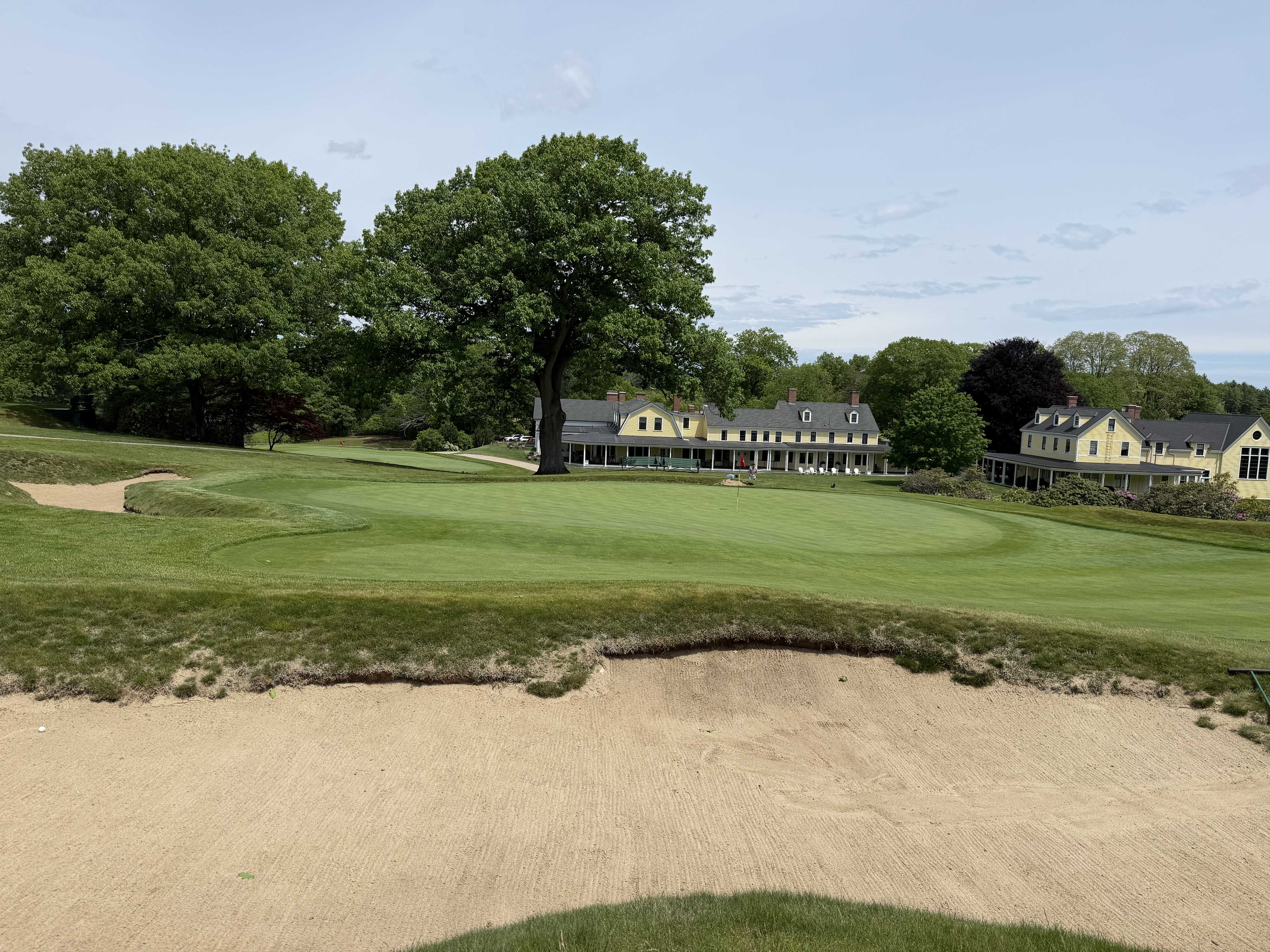
Kittansett Club. Flynn typically worked on hillier sites, at least in the Philadelphia area. Kittansett was by far the flattest site of his I played and it was textbook conjuring interesting and strategic golf on such terrain. I expected some nice seaside elements and yes they are there but what really impressed me was the strategy. Simple yet effective pushed up greens with access points at varying angles and effective bunker placement (the below photo is the most elaborate sand on the course). With the wind coming through and the dog legs, the course played almost like what I imagine a traditional links like Portmarnock would play. Lots of below ground features to account for the wind as well. The setting is wonderful but the structure of play here blew me away.

Sunningdale Golf Club – New Course. I’ve written before about 36 hole clubs and how the secondary course typically takes on different uses and meanings. This is no different in England, yet there seems to be a lot more emphasis on the other courses rivaling the playing experience of the primary. I was borderline dogged and my swing left me as the last round of the trip but I knew even then. The New Course has an identity all its own yet enjoys some similarities with the Old. The land and setting are along the rip roaring lines of the Old but there’s more width off the tee and is a bit more sporty. There were modern tones as well that initially bristled with me, yet its interlocking with the classic features ends up working well. It’s a bit more of an agile course with its vertical rises and drops, while some of the hazards are more on the penal side. Colt designed it in 1923 to alleviate the developing crowds on the Old, using similar terrain in his style yet while keeping the principles of Park’s Old in mind. The course exceeded expectations in just how well it measured up to the Old. I look forward to returning when my legs aren’t on the verge of falling off.

London Calling
A few words on each course we played. A lot more coming on all of them. In the order played. A special thanks to all who hosted us. You truly made the trip and one of the highlights was making a lot of new friends. The game connects all of us, even if there’s an ocean between. The people we met matched the brilliant courses we played in experience. Hope to see you again soon and get a rematch in (they almost all wanted to play Brits vs. Yanks and I’m not sure we ever won). I guess in line with the Ryder Cup guys.
Walton Heath Old. The first club we visited raised the bar significantly. We were able to get in a, “proper lunch” then headed out for an afternoon round. The course seemed inviting enough with most of it out in front of you and moderate rolling elevation. It’s deceiving at the outset how demanding the course actually is, strategically placing heather any where a missed shot may think of going. The greens were bold and heaving as well. I found it spectacular. One must show to the First tee ready to play and it’s really death by a thousand cuts if you allow it.
New Zealand. A very traditional club and course that was among those I pulled hard to check out and am glad we did. Charming and quiet, I’d characterize the course as formal parkland. Each locker has the name of each member who has used it and when they pass, their name is crossed off and the new occupant appears below until they pass and so on. Many of the holes are isolated from one another and the greens had some spiciness to them. Similar to Walton Heath Old, you must be straight and at some point, the driver stayed in the bag in favor of the 3 wood. The approach shots are a marvel and I am guessing the members have quite the short game. A very strategic, pondering course, demonstrating with a punctuation mark length means nothing. I hope it stays just the way it is, as it has.
St. George’s Hill. After two rounds and almost 24 hours in the country, it was time for the golf swing to settle in. The course retained Brian Schneider for restorative work, which the golf professional was able to point out to us as we played with him that afternoon. By far the hilliest course we would come across and the hills are used magnificently. There’s a lot of direct up and down, yet the accounting for roll out, mounding and bunkers kept it quite sophisticated. There was some heather but not as dominating as the first two courses and I sighed as my scorecard was much lighter this round. Smartly, the greens roll true but are not overdone amidst the hills while the inventiveness in the holes makes them quite memorable. The work Schneider has proposed would vastly enhance things, elevating an already very good course.
Swinley Forest. This and Sunningdale Old were my favorite courses played of the trip and they have a lot of similarities. Both designed by Colt (he re-designed Old), set on hilly wooded terrain with sandy soil with remarkable variety. Swinley has been able to preserve its design through the decades and shows so much unique strategic charm exuding from the land. A downhill par 4 with a green that runs from front to back followed by a bunkerless short par 4 to a green with diabolical right to left slope, followed by an uphill par 3 surrounded by heather and bunkering with a rear shelf; the intrigue never lets up. The holes each have individual personalities and play distinctly all within the same strategic challenge theme. For my limited rounds on the trip, it felt like it took the best of the other courses we played and combined them into one. The brilliant heather placement of Walton Heath Old, the dignified strategic charm of New Zealand and the thrilling use of hills of St. George’s Hill. I broke my personal best round here but there is no posting of scores. No matter. The experience here is worth much more.
Hankley Common. The most wide open course we played, or at least in line with Walton Heath Old, Hankley was the course those we spoke to over there got the most excited about when we discussed our line up. It was decidedly distinct with its horizon and felt like playing in an oak savanna. I felt some similarities with Prairie Dunes. It was also the most modern feeling course we played of the trip, likely from the current regrassing project. The course has a great rhythm and takes you about the hills and valleys circuitously but to conjure the best golf, which it does effectively. I also noted a lot of straight holes but because of the terrain, one hardly notices, which once again is a tribute to the merit of design. It’s a very good course and worth the visit to see great design with some modernity meshed in ever so slightly. I suspect the English really like it because its aura is so much different than others, or perhaps it doesn’t have the confines of a traditional parkland that’s the appeal, who can say. Either way, it is one to visit.
Sunningdale Old. In last year’s review, I mention John Sabino’s blog and how it keyed me in to courses I otherwise probably would not have learned about until much later on. Sunningdale Old was one of those courses that fascinated me even back then. It had so much “substantial beauty,” which is beauty that exists as functional parts of the golf course, as opposed to extraneous beauty, which is much more common. It seemed like it would be a wonderful walk in the park that incidentally offered excellent golf. And so it is. The presentation and function of the course go hand in hand, the golfer interacting with it in much more meaningful ways than a lot of courses. The bunkers do a great job of staying out of the limelight while being imminently effective at influencing play. The heave of the terrain is much more prominent, constantly moving the ball in an array of directions. It’s all very pleasant. Bobby Jones famously quipped, “I wish I could take the course home with me.”
Sunningdale New. The beauty and setting are similar to the Old with that engaging beauty but there’s much more challenge. The course is more exposed to the wind and a lot of the required shots simply demand a bit more of the golfer than they do on the Old. It’s an interesting Colt designed course. There is some gentility of the Old yet strategic challenge of St. George’s Hill and Hankley, with a stiffer recovery character. The New rounds out an extraordinary 36 hole collection for Sunningdale and I only wish we came upon it earlier in the trip. Until next time.
Best Restoration/Renovation
Hillcrest Country Club. Willie Watson designed the course, which opened in 1920 upon the hills of West Los Angeles. True to its namesake, the land is indeed hilly and the current routing does well to use them in thrilling fashion. Kyle Phillips finished what’s best called a reinvention in 2019, which transformed the course in many ways. A re-routing, installation of new practice facilities, work to the greens and tree work cleared a lot of its corridors and views while a fascinating ground game developed. This almost went into the Biggest Surprise category because it was just that. I was surprised with just how good it really was; I just didn’t know what to expect. The variety is exemplary and fun all at the same time. While Hillcrest is a well known course in Southern California, it should be discussed even more for how superbly it uses the prominent hillside in playfully strategic fashion. I just loved hitting the shots here.

The Apawamis Club. Originally designed by Willie Dunn, Jr, in the early 1900’s, the course saw work by Herbert Strong in 1911, Ross in 1930, Tull in 1962 and the Fazio team in the 1970’s, Gil Hanse did some restorative work in 2002 before Keith Foster came in 2020 for expansion of fairways and greens as well as bunker work. A storied history of evolution since its creation, Foster did well in bringing much of the historical character back to the course where expansion work made quite the difference. The holes are situated within the abrupt hills and rock outcroppings for a round with a lot of exciting character. It was fun yet the underpinning of challenge seemed like the tip of an iceberg miles and miles below the surface, starting with the wily greens that refuse to stand still. The randomness here is drawn out nicely so that if the golfer misses, the sky is the limit as to what to expect. A great member’s course with a lot of cool memorability that made me want to return to the First tee the next day with a Groucho Marx mask on and pretend I was one of the Underhills.

Santa Ana Country Club. Originally designed at its current location by Willie Watson in 1923, the course underwent drastic changes over the course of time, mainly from work by Ted Robinson in the 1980’s. In 2016, Jay Blasi began working extensively with membership in what became an almost complete re-design. The course was in need of deferred maintenance articles that were addressed while the practice facility was re-located and extended. Primarily, however, the project focused on opening up the wonderful land features and lowering the profile of the structure of play. The club sought to explore this transformation further by retaining Jackson Kahn in 2021, whom focused on the bunkering and greens. They returned last year for additional bunker work. The course embarked on a return to splendid classic golf all those years ago and as my first round of the year, it was easy to appreciate its Golden Age attributes. There are some template greens and the strategy instilled at the holes around the wash at the start of the back nine are a joy. More generally, however, the course has a nice flow whether the golfer decides to take things on by land or air.

Favorite Public
Public courses have always been integral to the fabric of the game. They’re where the majority of golfers are able to play and for many (including me) are the starting point, the introduction to the game if you will. Now more than ever, how these courses are managed is important. There is an increase in demand and no one wants to wait ten minutes between shots. The public rounds I played this year showed promise. Albeit a small subset, those rounds were at a reasonable pace and all were with golfers that had passion and knowledge for the game. Every single one.
Shennocossett Golf Course. Set in Groton, Connecticut, Donald Ross did a complete re-design of an older set up in 1916 then returned in 1919 to remodel three of his own holes. The routing starts on higher land before making its way down to the water, where the Long Island Sound and Thames River meet. The course grabbed my attention as early as the Second, where you need to carry the railroad tracks that front the green, then really kept its foot on the gas until the Eighth. The Fourth is a notable par 3, the green set on a hill. For those that like to associate Ross with turtleback greens, look no further as the entire hill operates the same way, even if visually it appears to be a gentler volcano green. The latter holes transform with the landscape as the course moves towards the water before a really good closing par 5. Angles, blind shots, fescue and deceptive greens; it’s all here and the course plays really well in conjunction with the terrain. A lot of the Ross design is still left, yet holes 8, 9, 15, 16 and 17 were re-designed after a land swap decades ago. There are efforts at restoration as they have aerial photos from the 1930’s and there is some strategic bunkering that could be re-installed but as it stands, it’s a pretty good muni with lots of Ross character and a pliable structure of play. All this at a reasonable green fee and you only have to root for places like Shenny thrive for the side of the game they highlight in the U.S.; affordable, accessible, meaningful golf.

Francis A. Byrne Golf Course. Mt. Pleasant is a prominent hill in the area and in the 1920’s, Essex County Country Club was comprised of 36 holes upon it, designed by Seth Raynor then constructed by Charles Banks. Byrne is the old West course of Essex County, ultimately sold to the township in the 1980’s and takes up most of the lower end of Mt. Pleasant. Stephen Kay recently finished a thorough renovation last year, so it was time to visit. The area is rich with classic design, all taking advantage of the hill in some fashion for the most part. At Byrne, the hills are taken on valiantly and there’s a nice mixture of template and original holes. The bunkering is done well and in the ideal strategic fashion Raynor and Banks learned from Macdonald. It’s every inch as good as some private Banks designed courses I have played and will only get better as the course continues to grow and settle in from the renovation. With Rock Spring, Hendricks Field and Weequahic nearby and all public as well, it’s undeniable the area should be regarded as a hotbed of substantial public golf in the country.

Recreation Park Golf Course 18. My Dad plays here regularly and he likes to play where he likes to play. So I play where he suggests, I don’t really care the course. The name didn’t really inspire confidence but after playing it, it was easy to realize this was more than a simple community placate build-up. It took some digging but the course has a lot of history. The site was the first for the Country Club of Long Beach but in 1909, reformed and became the first location for the Virginia Country Club. VCC signed a 10-year lease with the Alamitos Land Company, for land that was essentially a sheep grazing pasture on top of Reservoir Hill. Arthur Rigby of Carnoustie designed the first nine holes, who was a member of Los Angeles Country Club and involved in the design of Annandale with Watson. Rigby became Virginia’s first golf instructor and green supervisor. The course extended to eighteen holes by 1912. At the end of the 10 year lease, VCC moved locations and constructed their current course while the Rigby designed course became Rec Park. It should be noted this is some what at odds with the course website, which states the course was designed in 1910 by Billy Bell. Perhaps Bell, Jr. did some re-design work at some point but it’s highly unlikely Bell did anything here in 1910 and we can’t find anything supporting that. Based on my experience with Bell designed courses, however, I can see some of those tones throughout the round. The clubhouse has also been deemed a historical monument. I didn’t know any of this as I stepped on the First tee but as we played more holes, it became evident there was more here than I was expecting. Admittedly, I ended up scoring my lowest ever during that round but if anything, it just coms to show you how mental this game is. I thought we were playing some executive course the whole time and didn’t think much of it as the birdies and pars piled up. At any rate, the course is well designed and I liked it so much I returned in the Summer with my Dad for a second round. The hills and valleys are routed well and the roll of the ball matters a lot. Never judge a course by its name might be the moral of the story here. As one of the busiest municipal courses in Southern California, it doesn’t appear to be a secret what lies beneath that name. And both rounds were brisk enough. I’ll be back, as I need to finally take photos for a proper review.

Honorable Mention
Whiskey Creek Golf Club. Michael Poellot and Ernie Els collaborated on this in Maryland west of D.C. and Baltimore, not too far from Antietam, which opened in 2000. The wooded hills and streams provide a wonderful setting and like most projects at this time, was ambitious. Provide an upscale experience that would be known as one of the best golf courses around. The hills were used for dramatic tee shots and scenery while there are heroic carries and some strategy throughout to keep the golfer’s attention. It provides a nice playing experience. It reminded just a little of Four Streams, which is about half hour south. With its namesake, I was curious what its whiskey selection actually consisted of. It ended up being one of the more impressive things about it; the bar is stacked with excellent options. If you’re going to have whiskey in the name, you have to deliver and this place gets that.

Favorite Course Played
Oakmont Country Club. Simply put, there’s a lot more to the course than its fast greens and challenge. The golfer always seems to have a shot no matter he ends up, even if he doesn’t. It’s that false hope the course constantly whispers in the golfer’s ear, borne from what he sees before him. Such challenge with such width and such auspicious visuals is downright ingenious. A step further, the round is an enjoyable one. What’s being asked of the golfer isn’t unpleasant. The golfer will remember his good and bad rounds here, both fondly yet for entirely different reasons. Whatever the outcome, one comes off the Eighteenth and feels like a golfer, having spent a few hours in a true arena.

Swinley Forest Golf Club. Looking over the courses I placed in this category over the years, they all are very well designed and most well known but they all go beyond that for me. They deeply appeal to me personally for one reason or another and accentuate why it is I have a love for this game in the first place. And my game seems to intuitively rise to the occasion, realizing we’re in the company of greatness and to act accordingly. It all seems to come together. Swinley was one of my favorite rounds of the year. The distinct personalities of the holes were a joy to take on and the challenge always took a second to ponder. It struck just the right amount of sui generis that translated into an excellent sense of place during a round of strategy and wits. All of this while pleasantly tranquil notes seem to emanate from the forest throughout. These are the places I hope to find on the journey and am always elated when they reveal themselves.

The Kittansett Club. Relaxing at the end of the day with a Maine Lunch, I was genuinely content. We played Kittansett in the morning and Eastward Ho! in the afternoon and I couldn’t think of the last time I played 36 holes of such invigorating golf in one day. I really enjoyed them thoroughly and equally. What made it even better was how the courses compared and contrasted from each other. Eastward Ho was a thrill seeker with strategy below the surface for those who could temper the excitement long enough to look for it. Its fascination is palpable. Kittansett is mostly different in terrain, the flattish coastline and marsh. There was little in the way of rolling or elevated features to assist Flynn in the design, so he fashioned mounding and bunkering to drum up a remarkable strategic dance. Knowing where shots should end up, can end up, and under no circumstances should never end up is part of developing a relationship with the place and just as fun as figuring out how best to unlock the ways of each green. It felt very much like traditional links yet was engaging with or without the wind. As I wrote above but it’s about as apt of a thing as I can say about the place, the setting is wonderful but the structure of play here blew me away.

Honorable Mention
Sunningdale Golf Club – Old Course. One of the best parkland courses one could come across. This is mainly due to its routing and green sites, in my opinion. The course does well in defining the difference between engagement and challenge. Each shot is more engaging than challenging yet that doesn’t mean easy. It means there are strategic options while recovery is always close at hand. It means the variety and flow of the round are superb, which keeps the play spirited and lively. The setting is hard to beat, which does well to insert itself into the structure of play. Beauty, strategy, worthwhile enjoyment; the Old achieves a wonderful balance that leaves the golfer no choice but to be in a good mood. It’s certainly a good walk unspoiled.

Eastward Ho! I’d like to comment this year more than most any of the courses listed here could easily be my favorite. It was certainly a year of finding courses that seemed to call out to my innate sense of very good golf. Such is the case as I look back on my round at Eastward Ho! The exclamation mark in the course name is so appropriate, as the dramatic landscape smacks you over the head like one of those giant cartoon hammers. When the wind is up which is pretty much all the time, it’s entirely reasonable the golfer will become overwhelmed with his current state. And it’s absolutely glorious. I reveled in every minute and embraced the challenge of negotiating the bold land while the mischievous wind was always at hand. I just love when the entirety of the hillsides are at the golfer’s disposal to use as he sees fit to get the ball to bounce, roll or slow down and Eastward Ho might use hills in this way better than most any where else. If one has any doubt golf is an adventure, they need to make their way here post haste.

Lakeside Golf Club. There’s this restaurant my Mom loves to go to called The Smoke House. She used to work nearby for decades and went there a lot then but now that she’s retired, she takes us when I’m in town. The breakfast buffet is almost an entire day event. I laughed to myself as I turned on the small side street and past the Smoke House entrance, only to arrive at Lakeside mere steps away. A golf course I have pined to play for years was right under my nose this whole time. Max Behr designed it in 1924, draping the fairways in a fascinating array of directions over the romping hills along with an illustrative treatise on ideal use of bunkering. There is flow and subtlety here yet distinction from one hole to the next. The par 3’s and short par 4’s are incredibly fun while the golfer is best advised to show up with a sharp short game. An idyllic member’s course.

Notable Clubhouses
The end of the year reviews used to address clubhouses, so we’re bringing it back this year based on some remarkable ones I had the fortune of visiting. Ambiance, character, architecture, set up; it’s all fair game in evaluating where best to post up between rounds.
Oakmont. The back patio overlooking the First, Eighteenth and Ninth is one of those elite places to linger and gaze upon. The history within the clubhouse and locker room is equally fascinating. The mood was bustling when I was there in a very jovial way as local membership and those visiting from afar had no problem enjoying the place in unison. The pro shop is extensive with a lot of interesting apparel and keepsakes. A great place before even reaching the course.

Calusa Pines. One of the better men’s locker rooms I’ve been in full of leather couches and tables every where and enough seating for more than a few to grab a meal or drink. The showers are noteworthy. The back patio off the Eighteenth green is one of those places one could occupy for as long as they please. There’s a higher end relaxed charm here without overdoing it. Like the course, the club took lots of time to plan and get things right and it shows.

Overbrook. A local club down the road from my own, Overbrook boasts panoramic views of the surrounding hilly country side while the bars and dining areas are all well situated about it. Fairly expansive to make sure there’s enough room for everyone with things extending to a great pool and cabana area. The lively social scene takes advantage of it all.

Every club I visited in London. The English seem to focus on all the right things. The course and the Nineteenth hole. Everything else is superfluous. Every clubhouse we went to exuded a distinct personality. Loved them all.
Hillcrest gets the award for their comfort stations. Literally anything you could think of to eat or drink with a nice area to lounge and with lovely views to boot.
2024 Composite Course
Comprised only of courses played this year, each hole corresponds with the hole number. As always, would make one hell of a course.
- First – Calusa Pines (par 4)
- Second – Sunningdale Old (par 4)
- Third – Oakmont (par 4)
- Fourth – Apawamis (par 4)
- Fifth – Santa Ana (par 5)
- Sixth – Hankley Common (par 5)
- Seventh – Eastward Ho! (par 3)
- Eighth – St. George’s Hill (par 3)
- Ninth – Francis Byrne (par 4)
- Tenth – New Zealand (par 3)
- Eleventh – Hillcrest (par 4)
- Twelfth – Swinley Forest (par 4)
- Thirteenth – Walton Heath Old (par 5)
- Fourteenth – Sunningdale New (par 3)
- Fifteenth – Boston Golf (par 5)
- Sixteenth – North Jersey (par 4)
- Seventeenth – Kittansett (par 4)
- Eighteenth – Lakeside (par 4)
Now then, a few remarks about my game. We’re in a good place as I spent most of the year adjusting to the first whole season as a single digit index. Suffice to say I lost a lot of money. But things have shifted downward and I’ve realized a few things that really help. Like you can still score well when your swing is off and can play well with countless iterations of your swing, as opposed to waiting for the exact perfect swing to show up. I know where to save even more strokes so we shall see how it all shakes out next season. I’ll just keep swinging and chasing that ball.
Best shot
The birdie streak. 12 rounds in a row, I had one or more birdies. I never told anyone about it for fear it would ruin it. For a while, I hated the course where the streak was snapped. I now I forget where that was.
Fisher’s Island, 9. With the green well in view and a downhill lie, I coaxed a wedge and got the ball to stop a couple feet from the pin so it looked like I knew what I was doing. Birdie birdie.
Pine Valley, 1. A return after several years and while I knew I was a better golfer nowadays, I was hoping it would translate in how I played the course. A perfect tee shot to the turn gave me a clear approach shot, which I hit to 5-6 feet. I like to think it was the course giving me a hearty welcome back more than anything else.
The Bridge. I started out on fire and it looked like I would be able to finish the front nine under par, which would have been a first for me. The stupid Eighth had other plans. My caddie seemed upset. I then had a chance to break 80 and I blew that too. More disdain from the caddie. Who I loved by the way. And I loved he was invested in my silly endeavors.
Sunningdale Old, 8. A short par 4, I ended up in a bunker off the tee. The bunker shot was unusual for me in that it did what I wanted and checked up a foot from the pin for birdie.
There’s oh so many more but indeed, there’s so many bad ones as well.
Worst shot
Oakmont, 17. After a great drive to just off the green, all I needed to do was literally putt the ball 20 feet to the pin. Instead, the putt was weak and I watched in horror as it lost speed and veered into the right greenside bunker, 20 feet below.
Calusa Pines. A general shout out to my driver, which I think was mad it had to make the trip via Ship Sticks for the first time. The two way miss was there the whole time. Definitely not the course you want to show up with that kind of play.
Philadelphia Cricket – Wissahickon, 3. It’s a simple wedge shot from the tee yet I managed to top shank it trying to get too cute then had to do the walk of shame looking for it among the fescue. I could have hit putter off the tee and been in better shape.
Walton Heath Old. Coming off the red eye flight, a bottle of wine and a wonderfully decadent lunch, we headed out for the round and had a match going, International vs. U.S. We kept it respectable at least on the front but then I started finding every patch of heather out there and lost count of how everyone was playing. Around the Fifteenth I asked my partner how the match was going and he told me he thought we lost a while ago but the host was too nice to bring it up. I think I literally hit it into the heather yet again after that pep talk. All that experience hitting out of it would pay off in the latter rounds though.
Francis Byrne, 16. The tee shot disappeared. We didn’t hear it hit anything, impact felt normal enough but no one including me had any earthly idea where it went. Perhaps it was so bad it defied all sense of time and space and went to another dimension altogether.
I wish everyone fame and fortune as we head into the mid-point of the 2020’s. Let us all walk the fairways as we would the walk of life, the paths of which hopefully merge and lead us to glory. Never falter from the path. Always walking, no matter what.


You must be logged in to post a comment.