6,635 yards, 139 slope from the Black tees
I was sent a book. Through fortunate circumstances but for reasons entirely unrelated to said book, I had dinner with the author. We spoke of all things golf and golf courses and at some point, he mentioned Calusa Pines. I had of course heard of Calusa Pines but didn’t know too much about it. He spoke a little of how the course was conceived, designed and built. It was an intriguing story, really, and we spoke a little more of it before the affogato came out and the conversation veered to wherever it needed. We parted ways and a few weeks later sight unseen, a book arrived. It was John Strawn’s book on Calusa Pines, “Creating Calusa Pines.” John was nice enough to send me a copy and I began to read. I’m sure there are stories behind the conception and construction of every golf course but the story behind Calusa Pines was certainly book-writing worthy. I had no idea whether I would ever visit Calusa but it certainly would not be an opportunity I would pass up, as I hope will be evident below. As fate would have it, I would not have to wait long.
Some times the golf course chooses you. I kid, but that’s certainly how it felt. A week or two after I finished the book, a text came through. Would I be interested in a couple days at Calusa Pines? I don’t make this stuff up, I swear.
A couple weeks later, I find myself in the Calusa pro shop. The view through the windows down to the putting green and the First were beckoning but I needed some new shoes before we headed out. As I’m walking around in my own version of a new shoe bake off, it catches my eye. The book, sitting there prominently. Aye, it did its job.
The book goes into detail on how the course came to be and it’s too detailed of a story to get into here but a few key points resonated with me. There are thousands of golf courses in Florida and they are built for all types of reasons. Housing developments, resorts, gated communities, you name it. Calusa was founded for the sole purpose of being a really good golf course. An altar to the game. It was a quest for greatness. What really interested me was the recognition that most great golf courses enjoy blessed terrain suited for the task and despite that recognition, the club’s founder Gary Chesnoff was not deterred in his endeavor. Instead, he built the blessed terrain himself. To be fair, the land the course was built on was meticulously sought out for its sandy soil and drainage capabilities. Yet the premise of the course was anchored to classic design traits while relying on the benefits of modern design to bring it to life. While the course was intended to be challenging, the elaborate detailed design carried out that challenge in a striking spectrum of variety. The book mentions Bandon in comparison to Calusa and it’s very fitting to illustrate the sign of the times back then. Course developments were shifting to more of a craft and developers searched in earnest to distinguish themselves from the sea of sameness that began to plague many new projects. Bandon was part of the trailblazing model seeking wonderful natural yet remote terrain while Calusa sought to become a modern great while emphasizing a lot of the same design character as Bandon by creating it themselves. Both projects show passion, craft, vision, and a return to an emphasis on strategic golf. Not just simple strategy such as risk reward or opting for one fairway over another but honest to goodness strategy in layers. Both projects succeeded on similar grounds in part even if they are completely different playing experiences. I was intrigued to experience a meaningful modern course with substance and depth in a design style other than minimalism. A style grounded in solid fundamentals without trying too hard to mimic it. Instead, could such a course solidify its own unique modern identity while still playing similar to some of the classic greats.
If it could, it would be in elite company. In fact, there were only two golf courses before it that achieved such success. Which is to mean not relying on the natural surroundings and terrain for the playing structure but instead self-building and creating it. TPC Sawgrass and Shadow Creek.
It really didn’t take long. At first, the course reminded of some of the Jersey pines courses you found in the south part of the state. That makes sense since Hurdzan and Frye designed Sand Barrens down there and used some of that modeling here. Then I started noticing the little things. The fairway shaping and how it would rise and fall in various sections. The variety of routing, the greens and their contours and slopes swirling in certain directions. The golfer needs to decide on a shot and hit it, yet the recovery character is refined enough to allow redemption if the golfer is up for it. It is indeed substantial golf, set within beautiful naturalism that was constructed much more than discovered. It reminded me of Congaree in that sense. There’s always an entry point or run off or chipping area close to the green. Then the prominent hill, the tallest point in the county. It’s used enough but doesn’t dominate attention; most of its sides are used for various tees, greens and even a backboard. During that first round, I started noticing all of the different places me and my group were ending up and approaching the greens from with good shots and bad. And how many different shots I thought of as I stood over my ball. This became even more noticeable when a big group of us went out for a friendly wager. The groups were spread all over the course and weren’t bunched up in one particular spot or another. And as we continued playing, I realized just how different each hole played from the previous time. The course certainly has versatility. No it didn’t take long at all. Calusa certainly succeeded in finding a modern identity all its own while offering a level of sophistication in its structure of play uncommon for those others of its era.
It really does this while staying rather traditional. There are no outlandish features, there are no gimmicks, there are no ridiculous demands. And definitely no breakfast balls. The dog legs, bunker placement and pine straw are all placed in situational smartness. There are long and short of every par and around the green, the golfer is free to decide on whatever shot he thinks gives him the best chance. The pines abound as you wind and climb about, the water always close at hand, some where. It’s idyllic, surely close to the vision Chesnoff had in mind at the very beginning.

There was this movie when I was a kid called, “All Summer in a Day” based on the short story by Ray Bradbury of the same title. It’s about a group of kids who live on Venus, where it rains all the time and the sun only comes out for two hours every seven years because of the planetary climate conditions. That’s how I felt down in Calusa for those 24 hours. Sunshine and 60 holes was just right to deal with the final stretch of winter gray back home.
The First is a 389 yard par 4 (from the Black tees). The first stretch of holes occupy some of the more flatter terrain of the course. The opening tee shot is inviting enough with a tree line in the distance and a large waste bunker off to the left. The slope across the fairway does well to hide a lot of the space out there. Ron Whitten has regarded that waste bunker as the, “epitome of a perfectly placed strategic fairway bunker.” It’s a bunker he used to educate the Golf Digest panel on shot values. Those that properly flirt with the right edge of the bunker are rewarded with a kick forward towards the green. Those too far left are in the bunker, which is much deeper than it appears from the tee and makes for a tough recovery. Those too far right leave themselves a longer approach in or end up in a bunker on that side. Fry has declared the First the toughest driving hole of the course. Likewise, the green follows the same structure; bunkers on the left yet the more they are regarded on the approach, the better the shot ends up and away from the contouring away from the green on the right. Of course, weaker approach players may prefer the right and take their chances with an up and down from there. And on and on the decisions amidst skill and execution go.


The Second is a 551 yard par 5. A long arch to the right coming back towards the direction of the First tee. An expansive waste area continues down most of the left side and like the hole prior, is of a lower elevation than the fairway. While visuals suggest to the golfer to shy away from the right side, there’s some deception on the left with what lies in those hollows. The fairway bunker on the right does well to break up the hole, helping the golfer figure out where to place his second shot some point past it. Again, the subtle rises and falls of the fairway do well to provide deception, skewed visuals as well as bounce and roll points. For such a long and panoramic hole, the green is modest in comparison with entry point at about 4:00. Broad shouldered bunkering are on either side with short grass surrounding, complicating any chip shot needing to stay on the green.


The Third is a 135 yard par 3. We have started with a par 4, then 5, now a shorter 3. Dana Fry’s favorite hole of the course, the tee shot is intimidating and inviting all at the same time. The golfer can see plenty of grass yet cannot make out the entire green due to the rise and fall of waste areas crashing up from the left. Like the hole prior, recovery shots off green to the right are much tougher than they appear because they have to hold the green yet need to overpower the contours to get there in the first place. Missed shots to the left in the waste area are more direct in their challenge. The drop off the rear is abrupt.


The Fourth is a 409 yard par 4. Water runs along the right and I remember the caddie insisting on something less than driver off the tee to avoid something too far ending up in the water or waste area off to the left. After the right bunker, a slender grass area leads to the green, between water and sand. The approach is a great play on angles. The water, sand and elevation differences can disorient a little and even if one hits the green, there are no guarantees the shot stays on the green. There is some slack at the left rear of the green but not much. It’s a touch approach, no getting around it.


The Fifth is a 414 yard par 4. Completing the Y the first five holes make, this is the closest hole to a reprieve we get. Still strategic, however, as we need to get left to clear the tree line for the approach while avoiding the water area that runs the entire length on that side. There’s plenty of room near the green off to the left, with sand on the immediate right. The right to left movement keeps consistent with the contouring moving away from the green, yet risking recoveries with trouble on the opposite end.


The Sixth is a 513 yard par 5. This is one of the first times we encounter bunkers on both sides of the fairway at the same point. One can see them from the tee and obviously getting between them becomes paramount. The hole crooks to the right after them, water along the entire right side and pine straw with accompanying trees on the left. Bunkers are staggered at the point, first on the right and then later on to the left, before the hazards finally cede to the green. Staying relatively straight is the key here and that might be rather obvious but is meant to emphasize how imperative it is not to miss sideways.


The Seventh is a 226 yard par 3. A short par 3 followed by a much longer one. Ironically, I found this one to be easier. The waste bunkers near the front collapse at the center to crate the visual of less grass near the green than they’re really is so don’t mind all that and blast away. There is a lot of inviting room before the green to miss while the bunkers on either side of the green make for fine recoveries as well. There is strong movement from left to right that should be accounted for as well.


The Eighth is a 280 yard par 4. A short par 4 as we start to get close to the great mound. Short yet trouble abounds. Sand all along the left side, flashing at the golfer from the tee like a lighthouse. Deciding what to hit off the tee is a fair question and the answer is anything that gets you off to the right before the small bunker. That sets up a nice short approach in from a nice angle. The left side drops down from the fairway and green, amplifying the challenge from that side. The green is deep yet narrow and set off to the left at an angle. As an aside, I played this hole atrociously. One time, I plodded my way in the sand along the left side. During another round, I ended up in the trees on the left, which are quite elevated from the rest of the hole. I then hit it over the green into the hillside at the rear and the pine straw was knee deep there that we couldn’t find the ball. Oh why didn’t I sling an iron on to the fairway instead. These are the questions that keep the golfer up at night.


The Ninth is a 421 yard par 4. We tee off from atop the great mound, over the water on the left. The fairway starts to crest downhill to water, ending yet picking back up on the clubhouse side. This essentially means the tee shot must be fairly perfect to set up a manageable approach overt the water to a hillside green moving left to right a large bunker at the left rear and right front. The front half moves back to front, the rear half moves front to back. A tough finish to the front, the house understands if the golfer takes a lot more shots to finish up.


The front nine starts off showcasing its flatter strategic side before the closing duo starts with the elevation for an exciting yet challenging finish. The variety is calculatingly well done, providing an exceptional structure of play. I loved the par 3’s, adored the par 4’s and appreciated the par 5’s. I would rank them 1, 8, 3, 7, 9, 2, 4, 6, 5.
The back nine starts with the 376 yard par 4 Tenth. The tee shot must carry water that is shorter and not too much of a problem but hooks will all be wet. We’re heading towards the elevation, which comes in at first as a hillside on the right. Bunkers are further on that side but with the off fairway of the left side no good, they come into play more than the golfer might initially suspect. The green sits on that right to left hillside, a bunker on the front left but must of that lower left side allowed to continue its move away from the pin. For this reason, the massive bunker on the high right is actually more dangerous than the one off to the left.


The Eleventh is a 171 yard par 3. Water continues on the left and the hillside imparts a good amount of pull towards it. The bunker arrangement is similar to the hole prior with one on the lower front left and the other rear high right. And just like the Tenth, I would take the left bunker over the right any day of the week and twice on Sunday. There is some room to play with at the front before the green but there’s a lot of pull towards the water for those shots ending up grossly short. In short, just hit the green.


The Twelfth is a 419 yard par 4. There are a couple tee positions for this hole, one of the on the right and on the great mound and the other to the left next to the water. Yes, the water is still with us, running along the left through the green. I had a time with this tee shot but the fairway is wide and there’s room on the right save for the bunker, which is nicely placed and has to be accounted for. Just like the tee shot, the approach is much tougher than it looks. Anything too far to either side is no good and the deep narrow nature of the green reinforces this. The green is pushed up and in true turtleback fashion, pushes away in all directions the further one gets from center. This hole was my nemesis and just couldn’t crack the code. As I practice, take lessons and practice some more, I will think of this hole often, readying myself to see it at some point again and right past wrongs.


The Thirteenth is a 586 yard par 5. Tillinghast once wrote that if the golfer needs to clear the turn for an approach into the green, it’s a dog leg, and if the hole simply turns around a bunker, it’s an elbow. What if the hole does both? It does here as the tee shot moves straight out. Water is no longer on the left but in its place are lots and lots of trees, set below the fairway. The right side features a vast waste area that starts at the turn and continues well down the fairway. Like the left side, it falls considerably below fairway grade. The tee shot should clear the turn, at which point the second and third shots proceed to the green. It’s a bit downhill and a good deal of width, just don’t stray off to the sides. The green is at grade, moving left to right and front to back some. It was one of my favorite holes, mainly for how it provides definition yet allows a multitude of plays, especially near the green, all while massive trouble is always lurking ever so closely.


The Fourteenth is a 293 yard par 4. A shorter par 4 that bends to the left from the tee. There are bunkers on the inside left and outside right that come into play off the tee so the golfer must impart a good deal of control to their tee shot to set up the approach. Distance of the tee shot does not matter as much as that prized control. The green sits slight above the fairway with a sole bunker one the left while the left and far sides are enveloped in water, the slopes moving towards them. The contours move off the right side of the green and those in that area need to chip on to the green while staying on without continuing on to the water. Just like the tee shot, most every other shot here is about control, this hole is an examination of it.


The Fifteenth is a 414 yard par 4. Heading back to the ridge and slightly uphill the whole way, the waste area on the right is massive and continues through the green. The tee shot should fave the left side just account for some movement back to the right while approach shots on the left likely will benefit from a better approach angle. The contouring around the green moves off of the front and then right to left off of that side. Approaches will need to favor the high ride side while avoiding the waste area lurking nearby.


The Sixteenth is a 161 yard par 3. An elevated drop shots taking full advantage of the great mound. Water is on both sides, resting at angles beside the green while bunkers are at either front corner. The front rolls away from the green while the rear drops abruptly to the water. There’s room to miss short if you must but this is another hole that calls for the golfer to summon his best accuracy game.


The Seventeenth is a 390 yard par 4. Even though the clubhouse is in view straight from the Sixteenth green, we move around the water to get there. Tilly might have called this hole an elbow right but I’m still going with a dog leg. The hole dog legs to the right around a large bunker on the inside of the turn. There are similarities to the Thirteenth in how the inside of the turn is farmed with sunken sand as well as a slightly off center greenside bunker but here, water plagues the right side and almost has the same effect as a cape hole for those on the right. Left side all the way for the win in my opinion, as the approach in even works well with the green contours.


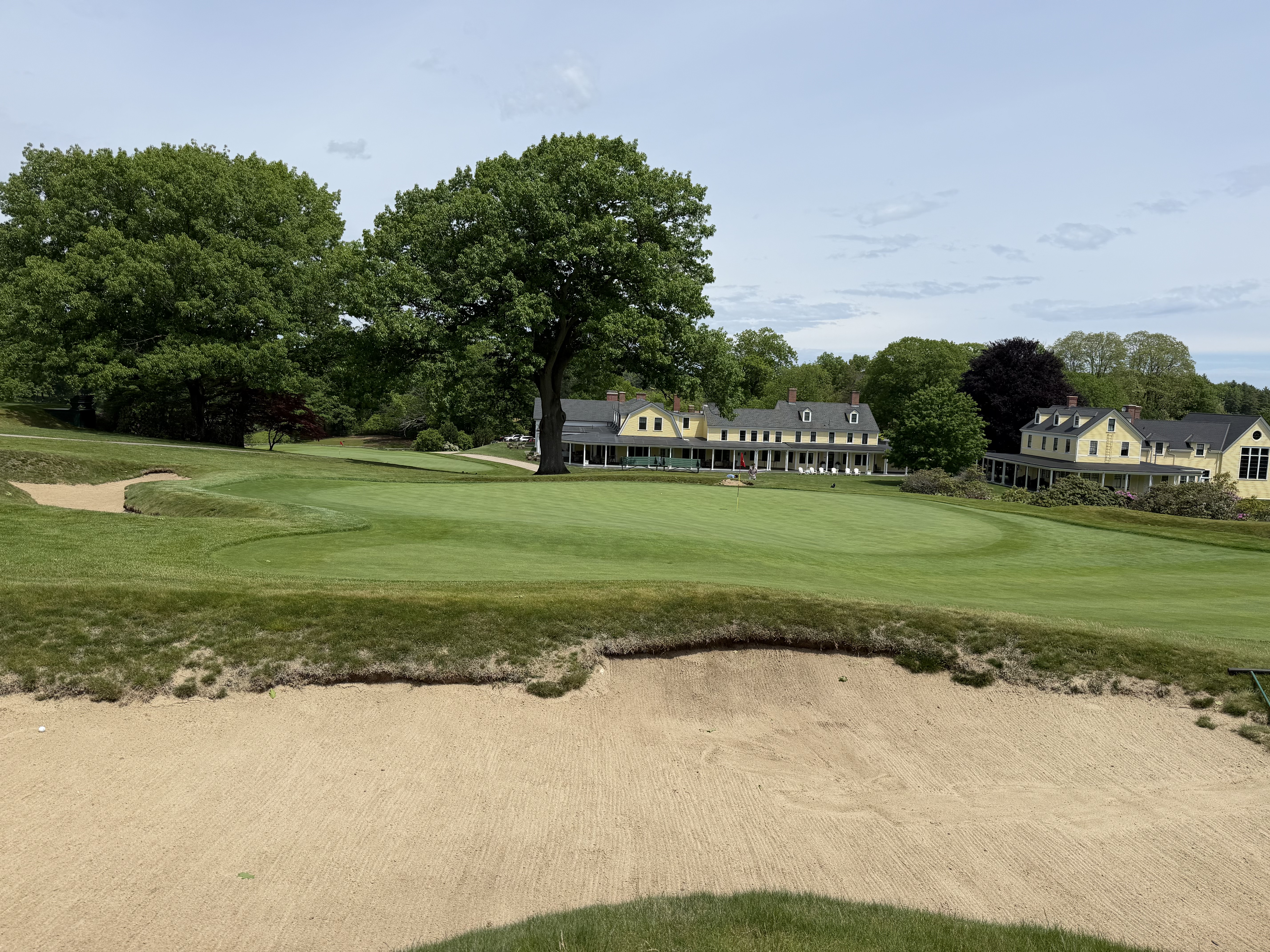
The Eighteenth is a 487 yard par 5. It amazed me at the time and again literally as I’m writing that this is a par 5 but it leaves an extra shot for the golfer to set up his approach, which is sorely needed to this elevated green. The tee shot is reminiscent of the First in that taking on the left waste area to some degree is advisable. The more you take it on successfully, the closer you are to that green. It’s also not as easy as bailing out right because the fairway cants in that direction and there’s not as much room as it seems, so tee shots over to the right run the very real risk of getting blocked out by the trees. Closer to the green, the fairway eschews away from center in either direction; off to the left on that side and off to the right over there. Again, not as easy as laying up short of the green; the golfer must know the terrain movement. A few bunkers stand sentinel around the front of the green and are effectively placed. The slope to the green is substantial, so the approach must have enough heft to carry the bunkers and get up the hill. The patio is literally just off the back of the green, so don’t be surprised if there are tables watching, judging.


The back nine utilizes the ridge a little more and has some variety with the terrain for that reason yet plays just as varied with strategic challenge as the front. The par 5’s did it for me here. I would rank them 13, 18, 14, 11, 16, 10, 12, 15, 17.
Generally, Calusa Pines is a lively round of golf with a good amount of sophisticated challenge to it. One thing impressed on me this year is while difficulty is rather easy to impart on a course, challenge is another matter altogether and how that challenge is doled out matters greatly to course identity. Here, the challenge is direct yet strategic but never absurd, contrived or aspirational. The challenge is in layers and along the full spectrum of skills. The structure of play is spirited as a result, amidst beautiful surrounds. Calusa went through painstaking detail to ensure the course provided a genuine, unique playing experience. It succeeded admirably. Beyond the structure of play, the course excels at other modern traits with the conditioning, scenery and amenities. In some ways, Calusa and those others like it forged the direction of modern design a bit with its focus on strategy within the challenge. This makes for a much more substantial, meaningful round, thereby elevating the course in the eyes of the genuine article golfers.
Clubhouse/Pro shop: The laid back casita feel was relaxing while the men’s locker room is all encompassing. Snaps to the club logo as well, subtle yet distinct. This is a high end club which exudes as much without a hint of ostentation.


Practice area: The full range, short game area and putting green are all behind the clubhouse, steps away from the First tee.




You must be logged in to post a comment.