6,451 yards, 128 slope from the II tees
Texas is trying to tell me something but I don’t know what. I had the good fortune of visiting Dallas a couple times last year. Mind you, it was a brilliant streak. For decades, my entire life really, I have successfully avoided getting stung by a bee. Wasp stings are a different story, as I was stung once in Hilton Head and then twice on my first trip to Dallas last year at Fields Ranch. But never a bee. Wasp stings don’t hurt all that much but are a pain afterwards with how itchy and swollen they get. I heard bee stings are worse. Little capsules of pain flying around, just waiting to get you. There has been a lot of swatting with my hat and unabashed running at full speed away from them. All of it successful in living a bee free life. Then it happened and there was nothing I could do about. As I took out a flagstick during my round at Brook Hollow, I felt a surge of pain in the palm of my right hand. I looked at it and saw a dark spot of some kind before dropping the flagstick. I was then more concerned about whether the green was ok and when I looked back at my hand, all I saw was the stinger, almost whispering to me, “we finally got you.” It wasn’t the trauma I was expecting. I sucked it up and kept playing. Stupid bee. But yes, every time I visit Texas, it seems the wildlife make it a point to assault me.
The assaults are worth it for the golf down there. I’ll keep visiting even if the bees and wasps and what have you double their efforts; the variety of golf is that good. The more notable classic design in Dallas is Brook Hollow, designed by A.W. Tillinghast and opening in 1922. One of the club’s founders, Cameron Braxton, was a Philadelphia cotton trader that had moved to Dallas after being involved in the founding of Pine Valley. Recognizing similar sandy soil at the Brook Hollow site, Braxton convinced Tilly to take on the project and build what was envisioned as the, “Pine Valley of the West.” Tilly ended up spending more time at Brook Hollow than any other site outside of the Northeast and arranged for Pine Valley similarities such as the Great Hazard at the Fifteenth and waste areas interspersed with native greenery between the holes and deep grass faced bunkers. Perry Maxwell was retained in 1940 to perform work, which resulted in transforming the original square greens to round. More pointed work by other architects took place thereafter, which drifted the design from where it was upon opening. In 2016, the club decided to undergo restorative efforts and retained Keith Foster. Foster’s Tillinghast restorations included the renown projects at Philadelphia Cricket Wissahickon and Baltimore East, and here, he was able to make a similar impression. Foster consulted with experts on what Tillinghast planned and constructed, as well as relied on aerial images from 1925. The project cleared over 300 trees and reestablished the sand pits and scrub areas throughout the property. Texas Sage and Coastal Bermuda were used for this native scrub, which sets the tone for character, most notably at the Tenth. Foster also reset the green pads, expanding them to original size, contours and squared them off. A hydronics system under each green was also installed, which circulates chilled water throughout the subsurface of the greens to assist in temperature control at the root level. Bunkers were also restored, with a more natural sand selected and changing to flat bottom with grass-faced walls on most. The project was completed in 2020. Similar to the rejuvenation of Tillinghast design character seen at Wissahickon and Baltimore after those Foster projects, Brook Hollow is now in that elite company of courses showcasing the utmost brilliance of his legendary talent.
The course plays spectacularly. With only two straight holes, the golfer learns early on that dealing with the twists and turns through placement or shot shape dominates play. Tilly once wrote, “dog leg holes have done much to improve the plan of modern courses.” Tilly embraced dog legs for their angular capabilities and saw them as a way to utilize trees. He would often use obstructions that were impossible or extremely difficult to drive over yet needed to move beyond for a clear look at the green. The stunning variety of dog legs here showcases Tillinghast’s forte in their design. Very firm and fast, the holes dart about the hills and there is strategy at every shot. The greens are fairly large, which expands the options for the golfer and versatility of the course. The off fairway areas indeed harken to Pine Valley, especially in their randomness of lie. There may be times you have a shot to the green to get back in position while other times, there will be a range of impossibility at your feet. The course achieves the rare balance of well measured width while maintaining strategy and challenge with trees, hazards and off fairway native areas. The golfer must know how to use the width as opposed to the width allowing unbridled lashing at the ball. Knowing the areas the ball absolutely must not go and how the ball will respond to the various contours and undulations is vital to navigating the course. The hybrid parkland/links playing structure Tillinghast excelled at is evident here, done at a high level. Each shot was different and while the holes did not seek out memorability or bold distinction, they all worked together for a meaningful and memorable round. A refined, smart round of golf accessible for just about anyone, Brook Hollow is a command round worth traveling for if the opportunity arises.
We teed off on a nice mid November morn that was free of any type of bee or insect. In fact, there was never anything like that in sight, making the incident of attack even more curious. Who can say how long they had this planned but their attack plan went just as intended. No matter. Courage under fire was in order and while the sting did its work, I persisted with a brave face. Never let them see you even wince.
The First is a 442 yard par 4 (from the II tees). The long, uphill par 4 was a short par 5 before the restoration and some what reminded me of the First at Wissahickon. In fact, thoughts of Wissahickon would arise often throughout the round for one reason or another, which seems to make sense. Foster was responsible for both projects and there was some Philadelphia flair that likely transposed itself here from Wiss and Pine Valley. Just small, oftentimes peripheral features that may resonate with me alone yet are noteworthy. Here, it is the uphill tee shot with the green blind from view. Moreover, the prevailing wind is against the golfer off the tee, just like at Wiss. The uphill continues while large, significant bunkers are on either side. Their flat bottoms provide a measured chance of recovery yet their depth and lie position will dictate just how much of a recovery the golfer has. The bunkers positioned short right of the green are of note, considering the prevailing headwind and long approaches, these likely get a lot of traffic. One of them is a candy cane shape, with the side closest to the green hooking back and around lengthwise to the fairway. The green is slightly pushed up, with the fairway feeding right in.


The Second is a 334 yard par 4. A shorter par 4 downwind most of the time where a large swale and trees on the left compel the golfer to confront the bunkers out on the right. Lay up to them, try to move next to them, carry them; the choice is yours, but the right side is the ideal tee line. The fairway slightly dog legs to the left while the entry point narrows to a slender neck with bunkers lurking. Accuracy and placement are at a premium here.


The Third is a 392 yard par 4. The unsuspecting golfer on the tee has no idea what is in store for him as his tee shot moves down the fairway and does his best to avoid the bunkers, first on the left, then the right. Upon reaching his tee shot, he still may not see the green, which is off to the left and well downhill. The golfer must manipulate his approach about the hillside to account for the inevitable bouncing, rolling and sliding that will occur, all of it with the intent of situating close to the pin. Longer hitters who know the terrain may try and reach the hill off the tee in hopes of a shorter pitch for their approach. A great hole using the natural undulations with excitement and suspense.


The Fourth is a 152 yard par 3. The first par 3 must is an uphill affair and the sandy bunker waste land must be carried to reach the green. Off in the distance is a reminder that the course is in its original location, very much within the bustle of downtown Dallas. Left is rigid and becomes out of bounds quickly while there are deeper bunkers lurking around the green on all sides. Uphill putts become a matter of survival.


The Fifth is a 554 yard par 5. The big long turn starts at the tee where it is evident we must get to the left side. There are a series of bunkers on that side but no matter; it is vital the trees on the right are cleared. Remaining on the left side for the second shot is likewise preferable, which results in the best angle into the green. Bunkers continue to barrage the hole, presenting themselves in staggered fashion as one proceeds to the green. Sure there is inviting width here but those who stray from the comfort of the fairway will likely find themselves in trouble by way of sand or native grass or tree.


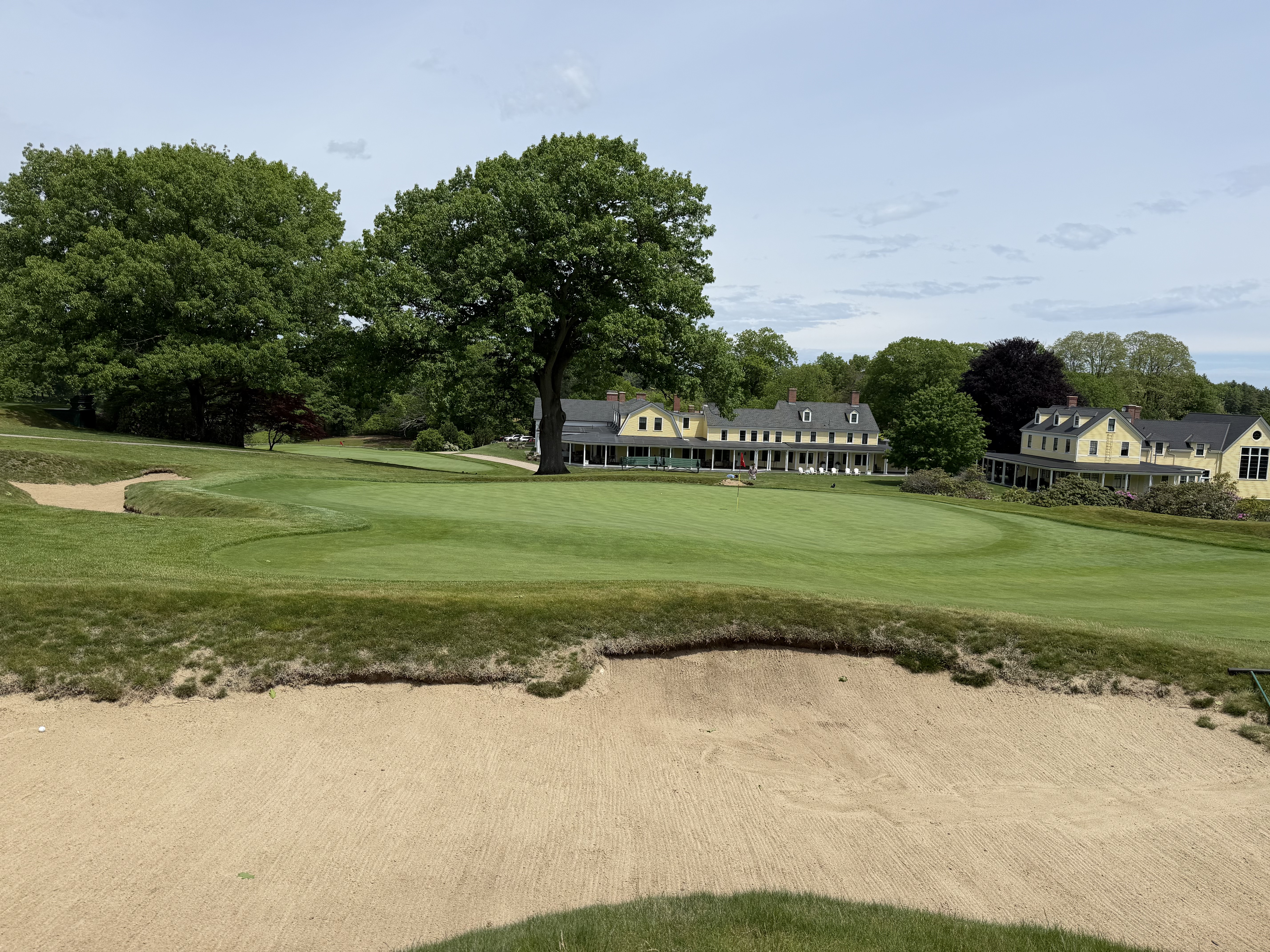
The Sixth is a 399 yard par 4. The bunkers on the right define the dog leg, which moves to the right. The tee should focus on avoiding those bunkers and strive for left center to get around them. As we have seen Tillinghast dog legs are wont to do, the fairway narrows after the turn and continues to do so up to the green, all of flowing downhill. The green is pushed up with bunkers on all sides save for the front, the front half rather severe with the proclivity to shove shots back down the hill. The clubhouse is just yonder, leaving members with a nice six hole loop and a shorter three hole loop, as the final three holes of the front return back to the clubhouse a few paces away.


The Seventh is a 445 yard par 4. A much more pronounced dog leg right, this one starting uphill. There may be some temptation to try and go over the tree on the right to cut the turn. To be successful, that drive must generally be over 300 yards, uphill. The fairway is widest at the turn, widening before it, then narrowing as it moves towards the green. The green is the largest on the course and is splendid with its interior contours, generally moving from left to right. Bunkers are on either side but the benefit of a large green is you really have to work at avoiding the green and into them. A longer par 4, longest of the course, actually, yet a good amount of freedom on the approach to rectify any misgivings.


The Eighth is a 169 yard par 3. Some times travel takes its toll. Maybe the hotel room wasn’t ideal or you need to put in late nights for business or pleasure. Every now and then, there’s a round or a specific shot that I come upon during my travels that I just know would likely turn out better back home but with the here and now, is going to be much more of a bear. That is what I remember about this hole. A creek before the green moving around the right side and a bunker no one wants any part of on the left. I was between clubs and knew the longer one was no good, it made more sense to step on the shorter one. Maybe back home. The shorter one was hit well but fell woefully short into the water. Just not at 100%, should have gone for the longer, yet we all know what would have happened. At any rate, it’s a great par 3 with a demanding tee shot to a green that moves a lot more than its general leaning towards the water.


The Ninth is a 347 yard par 4. The two clear options off the tee are to lay up off to the right or take a go at it over the trees on the left, which must likely clear the bunker on that side as well. The configuration of the tee to the fairway gets the golfer a bit off kilter as a straight shot doesn’t really benefit the golfer all that much. It is much better to try and take advantage of the hill off to the left in some fashion, so focusing on a shot that goes to the left of the bunkers straight out is a much better line. The approach must carry a small creek to the creek beyond and above it, with bunkers and trees about to complicate things. The tee shot really determines all.


The front nine consists of two loops, a larger six hole one followed by a smaller three hole one. The variety of par 4’s and dog legs is brilliant as the terrain is used remarkably well. I would rank them 3, 9, 2, 6, 1, 5, 7, 4, 8.
The back nine starts with the 144 yard par 3 Tenth. An elevated green with bunkers at the sides, the tee shot must carry native scrub and get well on to avoid rolling off and back down the hill. The green is yet another reminder that staying below the hole is a priority.


The Eleventh is a 431 yard par 4. The long par 4 featured a straightforward tee shot with hardwood and native scrub at the sides. There are two fairway bunkers in the distance, with the one on the right seemingly pulling balls into it that are near. The left center is ideal off the tee to set up the best approach. The green is deep yet bunkering runs the length on the right while a couple on the left cover a good amount of that side. The tilt of the green from the rear left corner to the front right influences the ideal approach angle along with pin position for one of the cooler green complexes of the course.


The Twelfth is a 442 yard par 4. Contours rule the day here with the fairway canting right to left, then rolling down to the green after moving past a ridge. The downhill fairway clashes with the green moving into it rear to front, yet the right front is pushed up and can be used as a springboard on to the green. The back to front movement of the green is significant and staying short of the hole is becoming a mantra to live by here.


The Thirteenth is a 345 yard par 4. Running parallel with the Third, the hill comes into play much more quickly and the tee shot is blind. The contours of the hill should be used to the golfer’s advantage from the tee yet takes some course knowledge to pull of in the right way. There’s a small entry point on the left but must approaches will be aerial, avoiding the bunkers hanging about the perimeter. It’s yet another hole using the terrain strategically and distinctly. While the Thirteenth and Third share the same path down the same hill, they play quite differently.


The Fourteenth is a 344 yard par 4. Contours continue to rule the day and will do so until further notice. The fairway tilts from left to right while slightly dog legging to the right. A trio of bunkers are nicely placed at both sides of the turn and with the tilt, the tee shot is almost forced to aim at the left fairway bunker unless a much shorter tee shot is preferred. The green is raised, perched above the fairway with perilous bunkers below. It really had a feel similar to the Eighth at Pine Valley with the fairway shaping and its configuration to the raised green, where any shot off green has the very real possibility of rifling off multiple strokes before resting in the hole, traumatized.


The Fifteenth is a 535 yard par 5. The longest par 5 of the course starts with the tee shot cozying up to the Great Hazard, which can be seen from the get go. How the Great Hazard presents itself and how it influences play are always intriguing to me because it’s different at every course. At Pine Valley, one notices it from the tee but cannot fathom the depths of its danger until they’re upon it. At Baltimore, it remains hidden, leaving the golfer to guess whether they have done enough to clear it. Here, similar to Wissahickon, it is visible and intends to intimidate. While Wissahickon is longer, the one here is much wider, covering the entirety of the fairway. The second shot must clear it, which then moves uphill to the green with a bunker at the lower left, then higher right. For those looking for memorability, look no further.


The Sixteenth is a 208 yard par 3. A long par 3 made even longer with the uphill and prevailing headwind. Bunkers are at the sides after one short center while the green runs back to front. And watch out for the pin, where surly bees take advantage of the weary golfer. Alas, will forever be the site of my first bee sting, dreams of a bee sting free life shattered.


The Seventeenth is a 373 yard par 4. The tee shot deceives with how inviting it seems while in reality it is rather vital to get to the left center of the fairway for an approach to an L shaped green that moves deliriously towards the bunkers. Yes, one can try for the right side, which opens up the narrow entry point, but there are a series of bunkers on that side with the fairway tilting towards them. Without realizing it all that bluntly, the course tightens the screws at about the Fourteenth on and here remains the same. Like the unsuspecting fellow walking through doors into progressively smaller rooms until he can no longer move, such are the demands of the course as we move closer to the denouement.


The Eighteenth is a 395 yard par 4. The fairway moves downhill to the green, which makes the tee shot semi-blind. Like the Seventeenth, the right side is rigid out of bounds and there are bunkers on that side as well. A large oak tree on the left tempers those who want to desperately avoid the troubles of the right. The fairway both narrows and plummets after the fairway bunkers on the right, leading to one of the larger greens of the course. The interior contours are significant, however, so the golfer’s work is not done upon landing on the green. He may only rest once the ball does, at the bottom of the cup.


The back nine is more of an outer loop covering the lower part of the property before looping around to a high side and coming down to the clubhouse. Yet another great set of dog legs with a remarkable pair of par 3’s and of course, the par 5 with Hell’s Half. I would rank them 15, 14, 13, 17, 18, 16, 11, 10, 12.
Generally, Brook Hollow is a strong Tillinghast design that succeeds in evoking feelings of Pine Valley. The variety of holes, the off fairway areas of native raw scrub and the affirmation of bunkers as penal elements are all similar, as are some areas where the golfer is downright stuck. Strategy interspersed with accuracy and deftness about the green, where wiliness of recovery is much more highly prized over sheer length are tied into the natural features. The greens tack on yet another layer to Tillinghast, as their squared off expansive tilted character are unlike most of his other sets, which vary wildly. The closest similarity I can come to are those at Spring Lake. The reliance on hardwoods is also notable, signifying that classic Golden Age design did in fact use trees situationally, mainly for strategy. Other examples include Prairie Dunes, Pine Valley and Kittansett, to name a few. Foster’s restoration work here is also to be commended and similar to Wissahickon and Baltimore, significantly resurrects Tillinghast’s design character for the benefit of us all recognizing just how legendary his talent really was.
Clubhouse/Pro Shop: Well placed within trees incognito, the shady respite provides long views of the fairways and nearby Tenth green. The interior is remarkably airy and modern, with historical homage throughout.


Practice area: The driving range, short game area and a putting green are behind the Eighteenth tee, a comprehensive practice area to take on before the round or on their own.




You must be logged in to post a comment.