6,520 yards, 138 slope from the Black tees
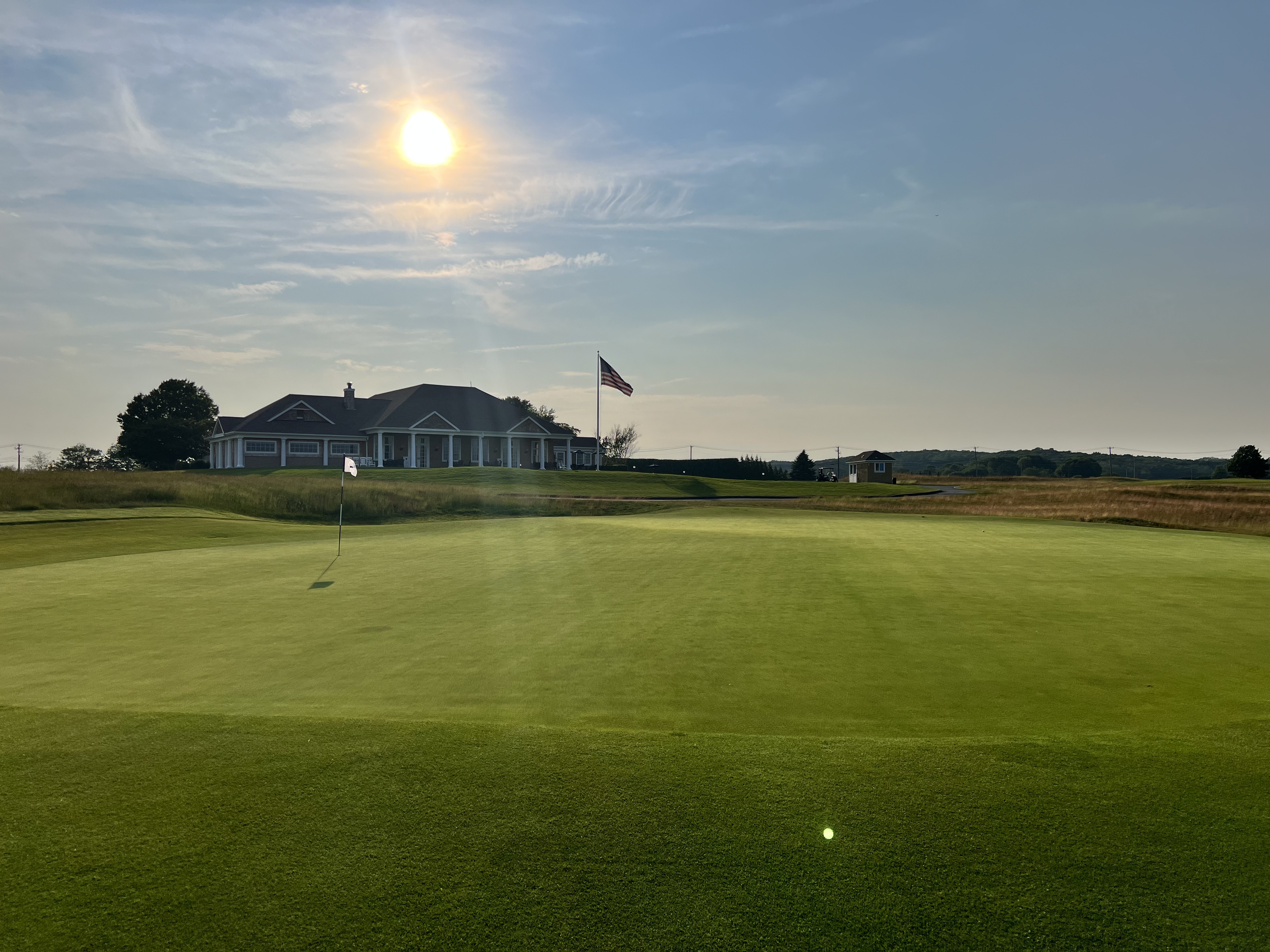
Designed by A.W. Tillinghast in 1927 in northwestern Long Island, Sands Point is a low profile course moving about rolling hills that relies on a lot of below grade bunkering and undulations to thrive in firm and fast conditions on fairways and greens. The result is a links feel in a parkland setting, something Tilly always accomplished well. The tee shots bounce and bound up or down the fairways and the driving game here was quite enjoyable. The clubhouse exudes a charm of wood with tones of Frank Lloyd Wright and Robert Frost. In all, Sands Point has a lot going for it and is largely heralded as an under appreciated Tillinghast design based on its location among the likes of Piping Rock, The Creek and Bethpage. It is indeed a well respected course in a high rent area and those with an opportunity to play here should seize upon it.
Swingers was a popular movie when I was in college. I’m sure I am dating myself but I’d wager it holds up even today and resonated a little more for us since we were in Southern California and could relate to things like that drive to Vegas from L.A. and such. There’s this part of the movie towards the end where Vince Vaughn’s character has some issue with a diner waitress. He can’t get her to smile and from the sound of it, has tried a bunch of times when he ends up there at the end of whatever night. His friends try to shut him up but he won’t, finally blurting out in just about perfect drunken philosophy, “I don’t have to be liked by everyone. Some don’t like me. I don’t like certain people.” I don’t know whether I’m the waitress and Sands Point is Vince Vaughn or vice versa but here we are.
Maybe the waitress was simply tired and wasn’t in the mood. Maybe she had seen way too many guys in their 20’s doing their best impression of a Beatnik Sinatra. Maybe it wasn’t a matter of like at all. And maybe that’s what Trent was getting at after all; some times, it just doesn’t click and it’s best to sail our separate shipping lanes. Who can tell.
Regardless of Trent, the waitress and Mikey all grown’s up, Sands Point was worked on by RTJ, Forse, Foster and Hargrave in the decades after Tilly, with a focused return to Tillinhast’s design concepts most recently. It is meticulously maintained and the dominance of below grade features really gives it a good amount of well earned character. Damn I really wanted to love this place. But I just couldn’t get there. Yet in the words of my old website, it’s just one man’s opinion. Many love this course. There are justifiable reasons for that to be so. And regardless of this man’s opinion, it is a course rich with history and design chops that we’ll go through. An opinion is just an opinion. We go back to the wisdom of Swingers. This time, we look to the answering machine as it’s counseling Mikey. “You have to put things in perspective. Life, after all . . .”
“Are you calling her?” Sorry, that line is just too good to pass up.
The design is a sound one with an enjoyable routing about the hills and variety in presentation. The two main issues that detracted from play, however, were the green speeds and approach shot character, which shift the structure of play too far over to the modern game. In short, the greens are way too fast here. As noted in my Year in Review of Sands Point, “[J]ust as greens can drive the quality of a course, so too can it dispositively detract. Such is the case at Sands Point, where I hit a fairway wood into a downhill green on a par 5, watched it run up to the pin, then kept watching as it changed directions, slowly at first, before gaining speed and moving off the front. Many clubs tout the speed of their greens as a source of pride, even when that speed makes no sense for the various contours and undulations. Whether it is membership or the green super making those decisions, some times it outright ruins the structure of play potential. I really liked the holes and routing but many of the angles and approach lines were of no use once we realized the ball wouldn’t hold. Maybe it was an anomaly of a day but the course has a reputation for its green speed so probably not.” Many of the greens are beset by bunkers far below ground, which give them a plateau feel and send any shots rolling off the green far into the depths below. With the speeds what they were, once really needed to get the ball to stop on itself on approach, or it would helplessly skirt off and down. This meant that green complexes that appeared receptive to an array of approaches were not; either high and soft landings or one with controlled backspin would do. Of course, this was one round on one day. Maybe the greens are usually of a speed that makes sense with the splendid contours, which would no doubt do much to unlock the potential of the notable classic design. But from my round, the maintenance practices shackle this potential, leaving the acceptable approaches fairly one dimensional. Sands Point is not alone with this issue; matching green speeds to contours and undulations is an art and as such, is subjective. Yet here, it is so noticeable because of its all encompassing effect on the entirety of the round. Regardless, it is indeed a course worthy of the respect it receives and should be played by those who are fortunate to get the opportunity.
The First is a 533 yard par 5 (from the Black tees). A dog leg left where a few impressive trees ensure the tee shot cannot cut the turn. Bunkering appears on each side at each elbow of the hole leading up to the green. The green is pushed up and runs back to front with sunken bunkers on each side. This green invites the ground game with its apron and was a welcome opening salvo that gets us right into the heart of the course.


The Second is a 160 yard par 3. Tilly had an iteration of the Short that was called Tiny Tim and this par 3 could qualify for its attributes. A shorter shot to a slightly elevated green with bunkers lurking below. The green is nicely sized but the shot must not have too much roll upon landing unless it goes in the hole. Otherwise, things gets sandy quickly.


The Third is a 401 yard par 4. The long bunker on the right then the bunker on the left both come into play off the tee. Something less than driver may work, as the hole is not known for its width and that doesn’t change even after the bunkers. In fact, the fairway narrows considerably getting closer to the green where sunken bunkers once again dominate the space adjacent to the greens and the narrow entry point assures an aerial approach that will need to sit down in a hurry. On the other hand, the wide open nature of the course invites the wind to influence play while the golfer is free to advance on the holes as he wishes.


The Fourth is a 170 yard par 3. The green site is fantastic, evoking wondering theatre for golf. Tucked away in a corner of the property with the surrounding sunken bunkers, the green moves from back to front. The hills all seem to lead and then fade at this corner and with the tee shot looking down on to it all some what, it creates quite a nice scene for our golf shot.


The Fifth is a 520 yard par 5. Moving back up the hill towards the Third and Fourth, there’s a lot more width than it seems although there are three well placed bunkers that can catch the tee shot. One is in the right center of the fairway as well so take heed. The fairway continues to turn, climb and terrace to the green, moving around a bunker on the left corner, then on the right just before the apron at the entry point. This is yet another green where the fairway feeding into it means the golfer has options as he gets closer to the flag, showing how the par 5’s at this point allow for some strategic flexibility.


The Sixth is a 400 yard par 4. Straight out, hitting the fairway is a good idea based on the subsequent demands of the approach. The green is separate from the fairway on its own island, moving towards the edges from the center. The approach is another that must land softly or else. It is a challenging green for both the approach and putting with the interior shifts in direction.


The Seventh is a 173 yard par 3. An uphill green hidden from view on the tee as some structures off to the right look on. It’s another nice scene for a golf shot where the green really must be hit or the golfer can only hope they have some chance at recovery. This green is deceptive, as it seems fairly flat but moves much more than that with a general sonic sashay to the front of the green and straight off of it.


The Eighth is a 416 yard par 4. A dog leg right with a bunker at the inside of the turn. The fairway starts to move gently downhill after the turn so the tee shot should focus at reaching that point. A prominent bunker on the left must be negotiated with most shots needing to carry it. The green is swift but with room before it, the golfer would do well to use the short grass a little to slow the ball down as it moves on to the green. The hole uses the terrain well and creates all different kinds of approach angles into it but the green speed neutralizes the variety of acceptable play.


The Ninth is a 416 yard par 4. Moving back towards the clubhouse that we spent the last few holes moving around, the fairway starts to bottleneck at the bunkers, leaving the latter part of the fairway much more challenging to land and remain on. A horseshoe bunker separates the fairway from the green while a bunker lines each side of it. Only an aerial approach will do and as we have encountered on several holes, high and soft or with sufficient backspin approaches are what must be done with the back to front movement.


The front nine is an orderly progression on the east and south sides with their various hills. The par 5’s are a solid pair and the par 3’s are well varied. I would rank them 5, 1, 4, 8, 2, 9, 3, 7, 6.
The back nine starts with the 395 yard par 4 Tenth. The fairway heads out in the same direction as the First did all that time ago with an overall right to left cant. The hills start their work at the bunkers. Just a few waves at first and then a brief yet stuff climb to the green with a center line bunker well before the green. The left side of the green falls off considerably while the movement is volatile with interior contours pushing and prodding the ball constantly.


The Eleventh is a 375 yard par 4. A slight dog leg right still moving to the far side of the property. Like the hole prior, bunkers signal a shift in the fairway dynamics as it narrows and starts to turn at that point. The green sits above the fairway while a trio of bunkers guard its front. The right to left movement prevails and with the speed encountered, the right side is really the best and possibly only chance of approaches assuring they stay on.


The Twelfth is a 201 yard par 3. At the front nine, we turned right when reaching this end of the property and for the back nine, we turn left and explore all the way to the boundary line on that side. The elevated tee shot shortens the length some what as long as wind isn’t a factor while a long bunker covers most of the left side of the green and another resides on the right. The green is a good size and deep, which again is necessary with the speeds and trajectory the longer tee shots take into it. A straightforward hole and room off the green to play with for those unfortunate misses.


The Thirteenth is a 442 yard par 4. Moving across the interior of the property, ,the tee shot must carry the irrigation pond and aspire to the fairway bunkers ahead, which once again signify a change in structure. Here, they narrow the fairway, which then bends to the left and runs to the green. The movement is left to right this time to the pushed up green with bunkers below so be sure to favor the left side on approach to account for the nervy speed.


The Fourteenth is a 605 yard par 5. Now on the opposite side of the property from the Third, we move back to the rear of the property by going up and over a prominent hill. Trees have a way of interfering on tee shots getting sideways and with the length of the hole, it can be said a well hit tee shot is almost vital to stay in scoring position. upon cresting the hill, we move quicker downhill to the green. This is where I hit a fairway wood which did everything I asked of it for once and boldly rolled on to the green. Watching as the ball thought about resting for a second, then inched before outright drifting off to the left was more amusing than anything else. In hindsight, perhaps the play was to play it to the short grass so it would hold, then play to the green. Who can say. It’s a nicely placed green complex, varied in that it is the first of the back nine to be at grade and looks receptive to running shots on to it. In the words of Ernie Els (on Wentworth), “. . . put some fn water on the greens. If they put some water on the damn green you at least have a chance to hold the fn green.” Slowing the greens here would make it a much better course in my opinion.


The Fifteenth is a 391 yard par 4. Moving back from whence we came, the tee shot is uphill with the fairway moving right to left. The further left you go, the further left your ball will go upon landing. A gang of bunkers are on the right so there is not free rein in trying to avoid the right to left cant. Bunkers then start further up on the left before getting to the green, which sits above the fairway with the obligatory bunkers surrounding it below. The name of the game is figuring out to hold the ball on approach.


The Sixteenth is a 415 yard par 4. A dog leg right that moves around a larger bunker complex on the inside of the turn. After the turn, the fairway climbs a bit to the green. The entry point here allows the low running shots yet all approaches should mind the furious right to left movement.


The Seventeenth is a 160 yard par 3. The final par 3 is to an elevated green with bunkers on its sides. Yet another straightforward par 3.


The Eighteenth is a 488 par 4. A beast of a closing par 4, the clubhouse is no where to be found from the tee. The fairway eventually dog legs right so clearing the trees on the left and ensuring a clear approach, no matter how far out, is the primary objective off the tee. The green is pushed up and its apron allows some modicum of shot to run on from it while the bunkers on the sides are well below as we’ve been accustomed to understanding are there even without looking. A house is behind the green but it’s not the clubhouse. But its presence has the same effect, signaling that the end of the round is upon us.


The back nine loops about the opposite side of the property than the front and has some interesting par 4’s. I would rank them 10, 11, 13, 15, 14, 16, 12, 17, 18.
Generally, Sands Point is a course with classic design roots with a more modern structure of play. The expanse is essentially wide open with occasional trees while most of the trouble typically resides below grade. This results in a varied landscape from other courses but can seem excessive at times. That excessiveness would reside with more reasonable green speeds, as the contours would become more relevant, there would be more freedom in play and the well placed bunkers would come into play in well doled out frequency, reserved for the more appropriate missed shots. Regardless, it’s a unique Tillinghast in how it uses the hills and has a handful of cool holes. As it stands, holding the greens takes luck and/or an uncanny amount of skill. Perhaps that is as intended, which is fine but certainly limits the strategic genius beneath the surface, just waiting to come out. By all means, however, it should be played and played again. There are those that surely find this playing structure to their liking.
Clubhouse/Pro Shop: Wonderful charm almost in the middle of the course, was a big fan.

Practice area: The driving range is off the road next to the Tenth tee, putting green a bit closer to the tee.



You must be logged in to post a comment.