7,024 yards, par 70 from the U.S. Senior Open tees
The PGA Tour just finished their U.S. Open at Pinehurst No. 2, where the firm and fast fairways did well in affirming to the players that everything within sight of the horizon was in play. The ball would bounce and tumble from the fairway into all kinds of unseemly places without any rough or bunkers to slow it down. This led to an inevitable rigidity that reverberated through the field. A defensiveness that a well hit ball didn’t necessarily mean where it landed was the end all as shots were exposed to the sleekness of seemingly infinite movement. This, of course, was before the players even reached the greens, where the putts darted and slid about. Rory McIlroy was no stranger to these devious greens, where his short putt on the 72nd hole was fraught with a lot more sordid movement than it appeared and he was left to to mull it over as an also-ran yet again.
The Seniors now have their U.S. Open, which will take place June 26 – 30. Newport Country Club in Newport, Rhode Island will serve as host. Similar to Pinehurst 2, Newport CC is a course with a wealth of architectural interest and historical significance. Newport is older than Pinehurst 2; in fact, it is older than almost every course in the U.S. It is one of the five founding member clubs of the USGA with its first nine holes created in 1894 by William Davis. Donald Ross then added nine holes in 1915 while A.W. Tillinghast performed re-design work in 1924. The course then underwent some restorative fairway/green expansion and bunkering work with Ron Forse and Jim Engle in 2005. Newport’s historical throne is indisputably in place, which includes having hosted the inaugural U.S. Open and U.S. Amateur.
The history and tradition of the club is also within the course, which still does not utilize fairway irrigation. This should be applauded, as it allows itself subject to the natural whims of weather and elements. Very much a links structure, the course invites the ball to run and roll as it may within its corridors, exposed to the wind coming off Narragansett Bay and Rhode Island Sound. Indeed, the golfer must negotiate these natural menaces along with the bumpy terrain, avoiding the pointedly cavernous greenside bunkers and ultimately facing the remarkable contrast between nimble and sweeping movement of the greens. The course is known for its strategic necessity, with the Fifth (the Fourteenth for the Open) called by some as one of the most strategic golf holes in existence.
The lack of fairway irrigation is intriguing, especially for professional (and highly skilled amateur) play. This will be the first USGA men’s (mostly) professional major on a course without such irrigation. In fact, the only other USGA event held in such conditions was here; the 2006 U.S. Women’s Open, which Annika Sorenstam won in a playoff against Patty Hurst. Those two were the only ones not to finish over par, as both were at even to move to the playoff. The weather conditions for that tournament ranged from blustery to fog and sog. The fairways are allowed to bake and rough is allowed to grow, or not, all of it an acute response to the natural surrounds. Harkening back to Pinehurst and its embrace of tones of golden brown about the fairways as the players were confronted with a much atypical challenge than their normal week to week, the commitment to sustainability results in a much more engaging, sophisticated style of play than the point and shoot variety that too often is the stuff of lush green conditions. There is something romantic about the fairways a true reflection of the environs and its recent moods, which reverberates all the way to the golfer on the tee contemplating how to go about it as the fickle wind whips around at various degrees of fury. Ah, the wind. That is one thing Pinehurst usually spares but not here.
The routing is reversed as well, with the back nine first and vice versa, as it was for the U.S. Women’s Open in 2006. World War I era was the the last time before that this routing was used. This puts the back to back par 3’s on the front and that strategic behemoth the Fifth/Fourteenth on the back. The long Ninth is now the last, a larger scale uphill finisher than the wily Eighteenth.
As it relates to the U.S. Senior Open field, wind is a heavy influence. While 7,000 yards is no pushover to players with driving distances from 260 – 300 yards, the wind will impact length one way or another significantly. The prevailing wind runs with or against much of the back nine (now only referring to the Senior Open routing) while mostly across the holes on the front, either way of which will bring the remarkable bunkers a lot more in play. Such bunkering typically allows the golfer a chance to get back in position from the fairway but as the golfer gets closer to the green, they get more treacherous. With some rain coming in a a few days before play tangentially and a lot of recent heat, the fairways should be running and bouncing well enough. Next to the wind, the greens should provide much consternated challenge. Many are of moderate size and are not shy showing plumes of wild movement, with turned up sides and corners, occasionally tilting one way or another. Rifts run across many of them, which shifts the directions they run mid-stream. Pin positions have the potential to change the entire playing dynamic. The greens will also put much more interest on the approaches and recoveries, as angles into them will matter even if most of the sand shots should come second nature to them. Tiger Woods won his second U.S. Amateur here against Philly native Buddy Marucci in 1995 and in watching video of the match, Tiger mostly used irons off the tee and spoke after the round of using the wind to his advantage a lot. One usually needs to wait for the Open on the other side of the pond to see major golf played along seaside links. As one of the first golf courses to be built in the U.S., its U.K. influence is obvious. Yet Newport relies on grace and thought provoking patience more than quirk, blind shots and a little less on random chance. In the end, our champion will likely have imparted finesse to the spectrum of natural conditions he faced, controlling his ball most often of times more than the old lash and wedge.
We will get to the contenders in future writings but for now, let us look at the course as the field will see it for the 44th rendition of the U.S. Senior Open.
The First will be a 568 yard par 5. The elevated tee shot looks down upon the fairway with its bunkers along the right side. The first left fairway bunker is out of view from the tee, showing how the fairway shifts a step to the left after crossing the road. These two first bunker are about 280-300 yards out so can come into play off the tee while those able to cover the right one is a decisive advantage in reaching the green on the second. A second set of bunkers on either side are about 185 yards out from the green. Those who opt for a safer third shot into the perilous green will likely want to get past these second set of bunkers, which will leave a wedge in. The green moves left to right and back to front green with a prominent mound at the front right. The movement will steer a lot of shots to the right rear quadrant. The green is guarded on the sides by bunkers and with its sides show tumultuous movement, should be a worthy last line of defense for the opener.


The Second will be a 321 yard par 4. A short par 4 that curves to the right, almost in a cape fashion with bunkers going up the right side between the tee and green. There is also a bunker on the left to collect those tee shots hit too straight. A favorable wind and tee position may bring the green into play off the tee yet the green position at the corner of the property makes out of bounds come into play with the wrong shot or bounce. Many will opt for something less off the tee to cover the right side bunkering, which will get them to the code part of the fairway and a wedge in. Off fairway here and throughout the course consists of light fescue with some tufts of rough grass, but nothing all that unmanageable. The green is narrow with a big rift in the middle running back to front as well as left to right.


The Third will be a 472 yard par 4. Now a longer par 4 with a rigid left side from the tee that eventually opens up. While there is a right side bunker visible off the tee, moving up that side is preferable, as it takes the left fairway bunker further up out of play. Yet those opting for the left have a nicer approach angle into the green, so long as they manage to stay out of the bunker. The green has an inviting entry point with a bunker on each side below it. The prevailing wind should be working against them and possibly even left to right, which should help temper expectations here.


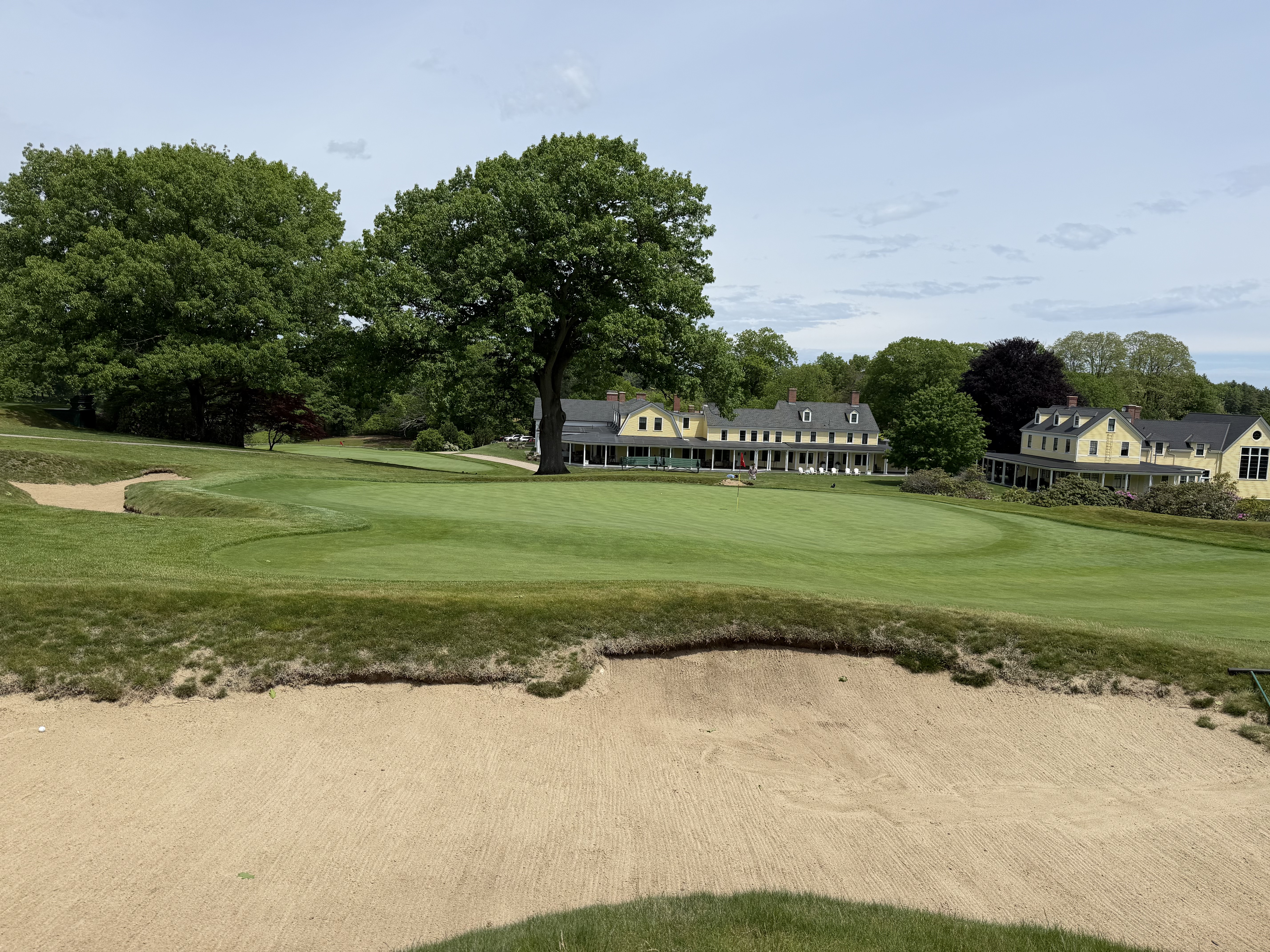
The Fourth will be a 184 yard par 3. The first of back to back par 3’s moves uphill towards the clubhouse and will likely play into the prevailing wind. The elevation and wind should make things a bit longer. Six bunkers surround the green, a couple before it, then at the sides, then at the rear corners. Pin positions and wind will bring them into more relevance, as the green is well sized after the short side bunkering yet off green recoveries could get interesting here.


The Fifth will be a 203 yard par 3. The next par 3 plays a bit downhill but into much stronger headwind. A Redan, the green has some right to left movement and depth, so a well hit tee shot will thread between the left short and right side bunkers, land and roll out to the left, preferably close to the pin. Those missing on the right will need to delicately deal with the movement away from them while those missing left will need to do so out of thicker rough and clear a steep back to get on the green.


The Sixth will be a 444 yard par 4. An elevated tee shot from the left will give the players a look all the way down the line, tempting them to give it their all to the fairway. With the wind likely against them, the fairway bunkers will likely come into play while those flanking it too far left off the tee will be in the grove of trees. Not much has been said thus far about the rumples fairways and their capacity to roll the shots out into unsavory areas. If the current heat persists and the fairways start to bask and quicken, this is certainly one of the holes where the left side off fairway could creep into play more often than contemplated and leave some challenging approaches in. The green is set on a small knob with bunkering covering the left side and short grass on the front right.


The Seventh will be a 357 yard par 4. Temptation awaits off the tee for those motivated to carry the right side rough to the neck of the fairway before the green, but this line is reserved for the longest of the field and even they will need help from the wind. It is a question though of how much the golfer wants to take on before his ball peels off to the left, minding the bunkers on the left. Those bunkers were not present during the 1995 U.S. Amateur but certainly stiffen the margin of error for the tee shot and compel the player to pay closer attention to the right side than he would prefer. Water makes a stealthy appearance on the left side of while the entry point is way off to the right. This configuration creates a swirling “S” starting at the top left elbow of the fairway, which then sweeps right around the narrow intrusion of water before pooling on the other side at the the green. An aerial approach is needed from the left while minding the bunker at the rear side while those on the right can make use of the entry point. This should be yet another interesting hole to watch, especially in how the players manage out of position from the tee.


The Eighth will be a 466 yard par 4. There are multiple tee positions here, with center and right the furthest back and the left a bit further up. Out of bounds is on the right side as the fairway eventually crooks in that direction. There is water that must be carried but should not be an issue for anyone in the field. The staggered succession of bunkers closer to the green could complicate things for the players, with the first on the left approximately 100 yards from the green, then the next on either side 20 yards after it, then the green about 40 yards after those. The short grass between these bunkers and the green needs to get firm while the green moves back to front with a rift on the right side. Once again, the nimble fairways can bring the bunkering more into play off the tee while the wind should be coming across.


The Ninth will be a 419 yard par 4. A slight dog leg left with the tee shot to a level fairway with bunkers on either side. Tee shot precision will be needed here, as the approach will be up the hill to a green that is just aching to send the ball back down to the fairway below. Some times a little too much back spin is imparted and this is certainly one of those greens that will send those types of shots all the way down. While the approach will likely range from 100 – 120 yards for the most part, accuracy will be needed through the wind to avoid the perils of the bunkering and devious movement of the green.


The front nine is more inland but the corridors are a bit more set as opposed to the back, where the holes are all placed in a collective space. These corridors see shifts in the wind while the placement of bunkers and grass lines are smartly intended to account for the deviations shots will suffer from both air and ground movement. The sequencing is nicely varied as well. The second shot at the First, tee shot at the Second, the Sixth through Eighth are all places on the front I would expect interesting play from the field with an array of different shots.
The back nine will start with the 455 yard par 4 Tenth. Heading out in the same direction as the Fifth and Sixth, the fairway leads downhill to the green slowly at first, then a bit quicker. The prevailing wind is against this hole, which should bring the left fairway bunkers into more relevance off the tee while the fairway adds to the cause by tilting towards them. Those that want to avoid those bunker altogether should stay on the right side off the tee. Fairway movement and their speed could get interesting with this tee shot, as those that can manage just over 300 yards (depending on tee position) could hit the downhill slope of the fairway and see their ball advance aggressively towards the green. The fairway ultimately ends at the hill upon which the green sits. Similar to the ninth, there is a lot of room at the front of the green for the ball to roll back down. The green is also turned up at the rear with a center hogsback-like ridge near the center that will push balls to the left or right side, amplifying the interest of pin positions.


The Eleventh will be a 412 yard par 4. The other side of Harrison Avenue is now in play, which is where Tillinghast did a lot of his work. The left side is rigid as it sets up against the road but the right side is fairly open. There’s a general lean to the left of the fairway while four fairway bunkers guard each corner before the green. Prevailing wind is still in the face of the golfer but there is a good amount of width to work with, even near the green. While wind always has the potential to wreak havoc, this is one of the scoring opportunities for the field with the amount of space there is to work around before the green.


The Twelfth will be a 348 yard par 4. A short par 4 that once again will rely on wind for a good amount of its challenge. There is some leeway with tee placement for length, which could bring the fairway bunker on the right side more into play. A firmer fairway could also push tee shots more to the left rough than the golfer expects as well. Otherwise, the fairway moves uphill after the bunkers with a fairly open entry point to the green. It seems preferable to approach the green from the left side, as this opens up the view of the green and provides a back to front movement to work with. Five bunkers surround the green but with its width, should be an easier target for the field.


The Thirteenth will be a 241 yard par 3. The ocean is now on the left of this long par 3 with the prevalent wind coming from there. The green is large, as is the area before it, with bunkers off to the sides staying that way through the green. The wind will be in full splendor here and with the quickness of the short grass, should tighten up the margins of well played shots here while putting should likewise continue the examination.


The Fourteenth will be a 449 yard par 4. The strategic respect this hole enjoys is largely due to its bunker placement, which forces the golfer to commit to fairway position that in turn correlates to their approach and possibilities to the green. After the first left fairway bunker that snakes up that corner, there are two bunkers left center that form a right angle, which creates a dead end of sorts in that area of the fairway. The golfer can carry the first snake bunker and reach this right angle, which then provides him a nice approach from the left. Otherwise, the golfer could opt for the right side of these bunkers, which then brings into play the right side bunkers near the green, which the golfer will need to carry, yet enjoys a backboard of sorts from the rear of the green. The wind could be helping their shots on what should otherwise be a longer par 4. The green is wide yet shallow, moving back to front with a rift through the middle pushing on the left or right. There will be days where the pin position will make the left side off the desirable and other days where it will be vice versa, all of which will showcase the versatility, interest and refined challenge of this hole.


The Fifteenth will be a 438 yard par 4. A well bunkered fairway awaits the tee shots that will hike well behind the green of the hole prior. Three back tee positions will provide some freedom to play with its length and account for wind and various pin positions. The fairway gets wider and moves a bit uphill as it gets closer to the green while it shows a right to left cant with a couple bunkers on the left low side. Eventually, the fairway crests and starts gently downward to the green, with a large bunker runs across the fairway and creates a good amount of separation between green and fairway. The entry point is on the far right side, all of it moving towards the green. The green is turned up at the right rear, and has another one of these rifts that will make balls settle in it, away from the pin positions close to edges. The width of the fairway is pretty generous but this is where firm and fast as well as the wind should complicate matters for them.


The Sixteenth will be a 595 yard par 5. The final par 5 provides a prevailing tailwind while a prominent bunker complex on the left side will come into play on the second shot. This complex starts to narrow the fairway towards the right side yet opens up again on the other side. Once past that bunker complex, the path to the green is fairway open yet the bunkers are below grade on either side of the green and push up its sides. The moderate size of the green, along with these tilted flanks about the sides, have the potential to send approaches to the opposite side and off the green altogether. On the other hand, those approaches with the right amount of finesse can use the flanks to move the ball towards the center of the green. Just short of the green is another option, where there is more than enough room and could provide the golfer with the full rig of the the green to work with at his discretion.


The Seventeenth will be a 186 yard par 3. The wind will likely be moving across from right to left and the green can aptly can described as a potato chip on steroids, in the best way possible. The edges turn and twist so that shots need to land with directional purpose. While the bunkers are certainly intimidating for the amateur, they will only bring some hesitation to the field if it presents a short-sided recovery, as the movement can take even the best intended shots to places of ill repute. There is a space at the rear where balls can fall behind, tempering the more overly ambitious of shots. Indeed, the penultimate hole relies on a well crafted green to do its bidding.


The Eighteenth will be a 466 yard par 4. The final hole is back on the other side of the road and makes its way back to the clubhouse in grand fashion. Uphill the whole way, the fairway starts as one of the widest of the course at about 80 yards. The left bunker in the distance from the tee will come into play for those who hit it too straight without regard for the crook to the right while most players will aim to cover the right bunker, which opens up the fairway to the green. The fairway narrows some what after the right bunker and all of it moves more dramatically uphill at this point. The green rests on the hilltop. It is about 200 yards to the green after the bunker on the right with plenty of room to work with until the bunker on the left. All of this with a tailwind more than anything else. The green is pretty well-sized with right to left movement and room to miss on the right front. The green has nice, sturdy yet subtle movement and is deeper more than it is wide. A fitting stage for the crowning of the champion.


The back nine is mostly on the collective land on the other side of Harrison Avenue, more exposed to the wind than the front. The Tenth sets the tone for challenge, then there is some let up before the final group of holes present a variety of natural skirmishes and strategic shot demands that should provide an intriguing contest down the home stretch. The Tenth, Fourteenth, Fifteenth tee, then from the Sixteenth to the finish are of particular interest in how the field will handle.
Generally, Newport Country Club is an engaging venue to host a professional tournament from an architectural perspective based on its strategic elements and guards against length for the most part with its greens. The character of the course changes right along with the weather and natural conditions, which will come in layers to the field depending on day and even their respective tee time. The routing and variety will also ensure that a full spectrum of golf is on display to the crowd, as well as an array of playing styles attacking the course. Such is the case with a multi-dimensional course recognizing the beauty of challenge is within allowing the golfers to forge their own paths and execute them accordingly, as opposed to forcing a singular result with razor thin margins of error that runs the almost certain risk of mind numbing redundancy. We can expect the former here. As the players begin to descend upon Newport to survey her idiosyncrasies and blessed natural surrounds, they will start their process of trying to unlock these levels of complexity and work what they learn onto the course, which will inure to the benefit of those of us watching in earnest.
On tap next is how the field handles the course the first couple rounds of competition.


You must be logged in to post a comment.