6,187 yards, 128 slope from the Blues
I noticed it a few years ago when I drove from Dallas into Oklahoma and up to Oklahoma City. I woke up early that day, then flew in and started driving so part of me thought I was hallucinating but I realized that wasn’t the case when I drove back and saw it again. I then forgot about it with the rest of the trip occupying my mind but then it all came rushing back as I drove to Dornick Hills. Overbook, Ardmore, Wynnewood . . . even Paoli. They all came in a line, one after another, just like I was on the R5. It was uncanny. So much so that I finally started asking about it. No one knew or cared enough to help out until someone finally took pity and let me know that when they built the railroads, they just used the same town names over and over. So while I’m used to seeing these town names up and down Main Line Philadelphia, Oklahomans see them lined up and down Interstate 35 (which I christened Main Line Oklahoma). The common bond was enough to feel a kinship to the entire area, even if the Oklahoma Ardmore is a much larger town with its own conference center and everything. Our Ardmore has Suburban Square and of course, Merion, making up for the whole conference center thing. Perhaps it’s a wash.
In fact, there was a time when Ardmore was a global center for cotton. With the land rush and the cotton, not one but two railroads were built to it from the east (hence the same town names from the Philadelphia rail roads). A banker named Perry Maxwell was able to help everyone with all that cotton money. In his spare time, he was adept at tennis but his wife was concerned about injuries, so showed him a magazine article on golf. Specifically, the article was about a golf course in Southampton, New York called National Golf Links of America. Intrigued, he had the means so why not; Perry went up to NGLA and met with Macdonald. Such was the start of Maxwell’s foray into golf. Oil thereafter supplanted cotton in Ardmore and the wealth of the area spiked. Maxwell’s interest in golf likewise spiked, especially with Francis Ouimet’s U.S. Open victory in 1913. Maxwell attended the U.S. Amateur in 1914, which Ouimet also won. He met Ouimet and they became fast friends. And that was it. Maxwell needed golf closer to home and since there were no courses nearby, he decided to build one in his backyard. Such was the birth of Dornick Hills.
The course started as four holes without any bunkers. Three of those original holes comprise the first three holes of the back nine. These original four were modeled after his study of NGLA, with his first hole showing components of the Sahara and Leven holes. Once these holes were completed, Maxwell began a tour of golf courses in the South. Maxwell was interested in implementing grass greens at Dornick (it was eventually the first golf course in Oklahoma to do so) yet was exposed to designs by other architects, Donald Ross in particular. With his newfound experiences, a full nine holes was ultimately built over the next five years. It would be close to a decade until another nine holes were built. During that span of years, Maxwell’s life endured tragedy and a bit of scandal that certainly profoundly impacted him yet also included a trip to Scotland, which directly influenced his design legacy. Design concepts such as incorporating the terrain into the holes and the use of swales resonated with him. He utilized these concepts with aplomb back at Dornick Hills.

The terrain upon which Dornick Hills rests can be characterized as an array of hills and valleys interspersed by a deep creek that randomly meanders about the grounds. Maxwell varied his use of these hills to create thrill, suspense and strategy while the creek is coyly incorporated off to the sides of fairways and greens, much smarter and devious than a series of forced carries over it. The greens are at natural sites for them at the base of or tops of the hills or along the banks of the creek. The land is ideal for rip roaring golf and Maxwell was able to unleash its potential. While Maxwell returned for some work in the 1930’s that including moving a couple greens, the course remained as designed until 1965 when a local architect was hired to renovate the greens. The membership felt the swales and undulations of the greens were too difficult to play or maintain. This eliminated the Redan green at the Eighth as well as the double fairway at the Twelfth. Dick Nugent was then hired in 1985 to install a driving range, which changed the first two opening holes. Nugent also did some bunker work, which actually included restoring bunkers to their original position, as well as a couple tee adjustments. Jeff Brauer then worked on the course in 1992, which consisted of bunker and green work, including installing an entire new green at the Fourteenth. Trees had also grown in over the decades and crowded what were meant to be playing corridors.

Tom Doak and his team (including lead shaper Blake Conant) submitted a master plan in 2020. The focus of his work was restoration; bringing the design back to how Maxwell had it, which included restoring fairways, drainage patterns and in particular, the greens. Bring back all of the marvelous Maxwell character that had evaporated over the years. Doak’s team also renovated the irrigation, as many of the changes over time were an effort to deal with drainage and flooding issues that would come up, and 007 bent grass was used for the greens. With the greens, Doak did some of his expert sleuthing to determine original contours and undulations. The opening two holes were returned to their original position, as was the Eleventh green. And yes, over 500 trees were removed. The restoration work is exactly the type most of us think of as ideal. The entire purpose was to ensure Maxwell’s brilliance was once again realized here at such a historically important course. The project didn’t receive as much publicity as Maxwell courses such as Southern Hills where Gil Hanse’s work focused on restoration components yet involved changes for the upcoming PGA Championship there, but with respect to recent restoration projects, it was just as if not more so important. Doak volunteered his time for this project, which is a testament to his passion for course architecture and the brilliance of its past.
The second course we examine with work that took place this decade, the project is a prime example of just how beneficial restorative work has been to the architectural landscape. Doak and his team faithfully restored this important design, which served dual purposes of utilizing today’s technology to ensure the drainage issues that originally plagued the course would not resurface, then examined any historical evidence out there to bring the course back to its as-built Maxwell iteration with no concern whatsoever for leaving any fingerprint of their own work. In many ways, this epitomizes today’s design environment. Historical reverence instead of hubris in improving it as long as it makes sense practically and in terms of an engaging structure of play. Such reverence can be seen in new designs as many anchor their concepts to the strategic and natural dominated themes of the Golden Age and can truly been seen clear as day in pure restoration projects like the one at Dornick Hills. The course re-opened in 2022. Perry Maxwell’s granddaughter Dora Horn was at the opening ceremony and was thrilled with the work.
In my overstimulated fascination with the whole town name parallel, I arrived at Dornick Hills on a sunny early winter day. There’s an indescribable familiarity I feel when I look upon and play courses designed by Perry Maxwell, I don’t know if it has something to do with the older lineages of my family coming from the Midwest or something else, but I now look forward to that feeling and it came upon me as I look down on the course from the upper reaches of the clubhouse. A family cemetery that includes Perry is on a hill opposite the clubhouse, where he looks over it all ad infinitum.
The First is a 392 yard par 4 (from the Blues). The restored First starts just down from the clubhouse and runs downhill to our first foray with the creek. After the creek, the fairway climbs back uphill to the green where a predominant right to left movement pervades. The left side actually drops off considerably and with water further down, those who really try to reach with their pulls and hooks will likely succeed. There’s a lot of room on the right to work with but the caveat is you’ll need to manage the movement towards the left side drop off, which becomes more challenging the further right you are.


The Second is a 165 yard par 3. The water becomes much more directly involved, as we must carry it to reach the green. The green location is a great one; at the lower end of a gently sloping hill to the water, the movement is suggestive rather than neck breaking towards the water while the more you flirt with the water off the tee, the more rewarding the ensuing putt will be.


The Third is a 400 yard par 4. Heading deeper into the valley, the fairway dog legs left as the right side banks uphill. There’s a hollow at the turn and some water off to the right, then the fairway narrows to the green. The green is pushed up from the fairway and runs from back to front, a sole bunker on the left.


The Fourth is a 157 yard par 3. We now climb up the hillside on the right, the green at the top. The green is deep and there’s room around it to work with misses while yet a single bunker is on the left. The shot is blind, however, something Maxwell uses effectively throughout the round.


The Fifth is a 390 yard par 4. The fairway straddles the hillside and eventually dog legs left downhill to the green. The tee shot needs to clear the tree on the left for a direct approach shot yet not go off the fairway on the right or through it. The approach may be blind, it all depends on the tee shot. The green is nicely sized and yet again has a sole bunker, this time on the right. A word about the greens. They are subtle and can accommodate speed yet the contours and hollows within them all influence the ball, so must be contemplated at each putt.


The Sixth is a 516 yard par 5. Masterful routing here through the tree lines and use of the creek. The creek makes its presence known just in front of the tee but becomes more relevant for play later on. The hole bends to the right while the intermittent trees pop up on either side at just right the moment in terms of strategic considerations. The fairway never stops bending until at the green, where a slight crook to the left takes place at the last moment. The green is just before the creek, which runs diagonally behind it, similar to the Road hole green. Trees also complicate the approach and make angles into it matter. Most will want their second shot to favor the right side but that means getting further into the narrow part of the fairway while those that opt for the wider fairway further away from the green will need to navigate the trees to reach the green. A great par 5 where again, a single bunker is used, this one to the left of the green.


The Seventh is a 348 yard par 4. The tee shot heads out to a larger hillside moving right to left with the green no where in sight. The fairway is signaling to favor the right side off the tee so it will moves back down towards center, which is a fine play. Some of the wily among us may try to stay to the left, knowing the green is over in that direction as a more direct path to the green. There are bunkers that complicate that decision, which would foil the original idea. The longer among us may try to overpower the hillside and get over it altogether. For them, they are free to try and there is nothing stopping them other than risking a wild miss. Regardless, a tee shot in the fairway has a clear approach yet some may be blind depending on their location on the hillside. The hillside likewise runs towards the green and can be used in an assortment of ways to run the ball on while other will be fine with an aerial approach even though the green is a bit smaller and is more dramatic in movement. A very cool par 4.


The Eighth is a 176 yard par 3. An unassuming looking hole that is anything but. We reverse course, which brings one of the bunkers from the hole prior into play for those misses left and short. The green is diagonal between the trees, a bunker hiding just under them on the right. Subtlety on the green reigns supreme and should not be taken for granted.


The Ninth is a 396 yard par 4. The tee shot is framed by trees on both sides, which obscure mush of the fairway out there. The fairway cants from left to right while the far right drops off into a dry creek bed. The green sits on the hillside, presenting an interesting approach. An oak tree on the right makes it necessary to carry or move around it to reach the green while the bunkers on either side compel more precision. Like the fairway, the green moves left to right and the possibility of moving off the right edge is very real.


The front nine moves excitedly about the land, ensuring the hills, creek and assorted undulations are all involved. The hole present a wide range of strategy, which is all dictated by how the land is used. I would rank them 7, 9, 6, 1, 3, 5, 2, 4, 8.
The back nine starts with the 381 yard par 4 Tenth. Starting with the original few holes Maxwell built on the property, we head down from the hill upon which the clubhouse is set. The Eighteenth fairway is to the right and provides even more room off the tee but makes for a much longer approach the further right one goes. There’s a grove of trees down yonder and the green is hidden within them. The creek crosses the fairway near the front of the green but otherwise the green rests unfettered of hazards. Elegant in its simplicity among the oak.


The Eleventh is a 347 yard par 4. Back up towards the clubhouse we go. The tee shot carries back over the creek with ease then climbs to the green in a slight bend to the right. Bunkers are staggered on the right leading to the green while the green itself is stationed on a terrace, wide and shallow. The approach needs to account for the hillside and movement of the ball once it lands and rolls while some approaches catching the front of the green risk rolling back down the hill.


The Twelfth is a 382 yard par 4. We move down the hill almost horizontally so that a left to right pull dominates the tee shot. A left to left center line off the tee takes full advantage of the hillside and leaves a shorter approach into the green, which is off to the left one again finding refuge within a group of trees. This type of framing of green with trees I found familiar with some of the greens at Prairie Dunes. And to the more extreme, Harbor Towne. Trees used for strategic points demonstrate their advantages when used in the right way. Here, the trees ensure the golfer comes in from the center or right instead of allowing a shortcut from the left unless the approach is able to climb fairly steeply then land soft as all get out. Similar to the Tenth, the green has no hazards to speak of, just the slopes and aforementioned trees.


The Thirteenth is a 429 yard par 4. Commerce Street runs along the left as the fairway moves some uphill from the tee. It crests after the tree on the right, a bit narrower than we’ve seen in fairways past. Terrain movement gets a little more volatile near the green, with a more pronounced left to right movement overall and the pushed up green moving back to front in conjunction with horizontally. There’s a bunker along the left side of the green that comes into play as those try to use the contours get overambitious but otherwise the golfer is free to use the land as he sees fit.


The Fourteenth is a 271 yard par 4. The green is perched on the hill with an assortment of bunkers and trees suggesting the approach should come in from the right. The bunkers lie at the base of the hill, serving double duty of collecting shots moving that way as well as when chips, pitches and putts are overdone and end up rolling down the hill. This leaves the instinct to keep right on the approach yet this means getting perilously close to the hillside running down away from the green. In all, the shot into the green must be fairly well played. The green sits diagonally on the hilltop and is deep, so hedging a little to the rear center makes some sense. It’s a great short par 4, once again conjuring the strategic mores of the terra firma.


The Fifteenth is a 418 yard par 4. That makes six par 4’s in a row for the back nine, yet each is well varied from the next that the par hardly matters or is something the golfer notices. Now on top of the hill we’ve seen throughout the round, the tee shot dives off in bounds of glory to the fairway below. Our fairway is on the right while the Sixteenth is on the left. Carrying the trees on the right off the tee is a nice line. Once down on the fairway, there’s a bend left to the green. Once again relying on the contours and undulations exclusively, there are no bunkers about the green. The slopes off the green send the ball in all kinds of areas, including the creek off to the left, so much so that some golfers may wish there were some bunkers around to keep things stay put.


The Sixteenth is a 496 yard par 5. Deep set in the corner across from the creek, we see the the rock hill off in the distance from the tee. When all is said and done, we will be taking our ball out of the hole on top of it. The journey there is rather direct. Trees frame the tee shot and the fairway gets wider as we get closer to the hill. There’s a fairway bunker completely perpendicular to the line of play coming in from the left, which needs to be considered at some point because it is within the line we will want on approach. Mind the left to right cant as well. The approach must soar back up the rock hill to the green above, which is blind from the golfer is below. The pin is at least visible and the trees give us some definition where to hit. Of course, the veterans of the course will have a much clearer picture of what needs to be done. The green is well sized up there and rests at an angle from the fairway. The way to put it is to envisions a rectangle that is tilted as a lengthwise diamond to the fairway with the right front corner peeking close to the edge. A great par 5 that continues the theme of relying on the land in splendid fashion.


The Seventeenth is a 152 yard par 3. Maxwell’s grave rests on top of this hill. A man should have such fortune as to rest in eternity upon the land he cradled such brilliance for those coming after him to enjoy. After a moment of well used reflection, we turn to the task at hand. A drop shot par 3 with a couple bunkers guarding the front corners. I hit into one and almost didn’t know what to do since it was the first of the round for me. It’s like getting struck by lighting or attacked by a shark, such are similar odds of ending up in a bunker at Dornick Hills. Fitting and rightly so, as the golfer is left to his devices in negotiating the terrain instead and when bunkers are used, they are used effectively. Such is the case here as the faces ramp up at the green and the golfer must land softly out of them. The green is a potato chip variety, a bit smaller in line with the accuracy it would like to see out of the shot.


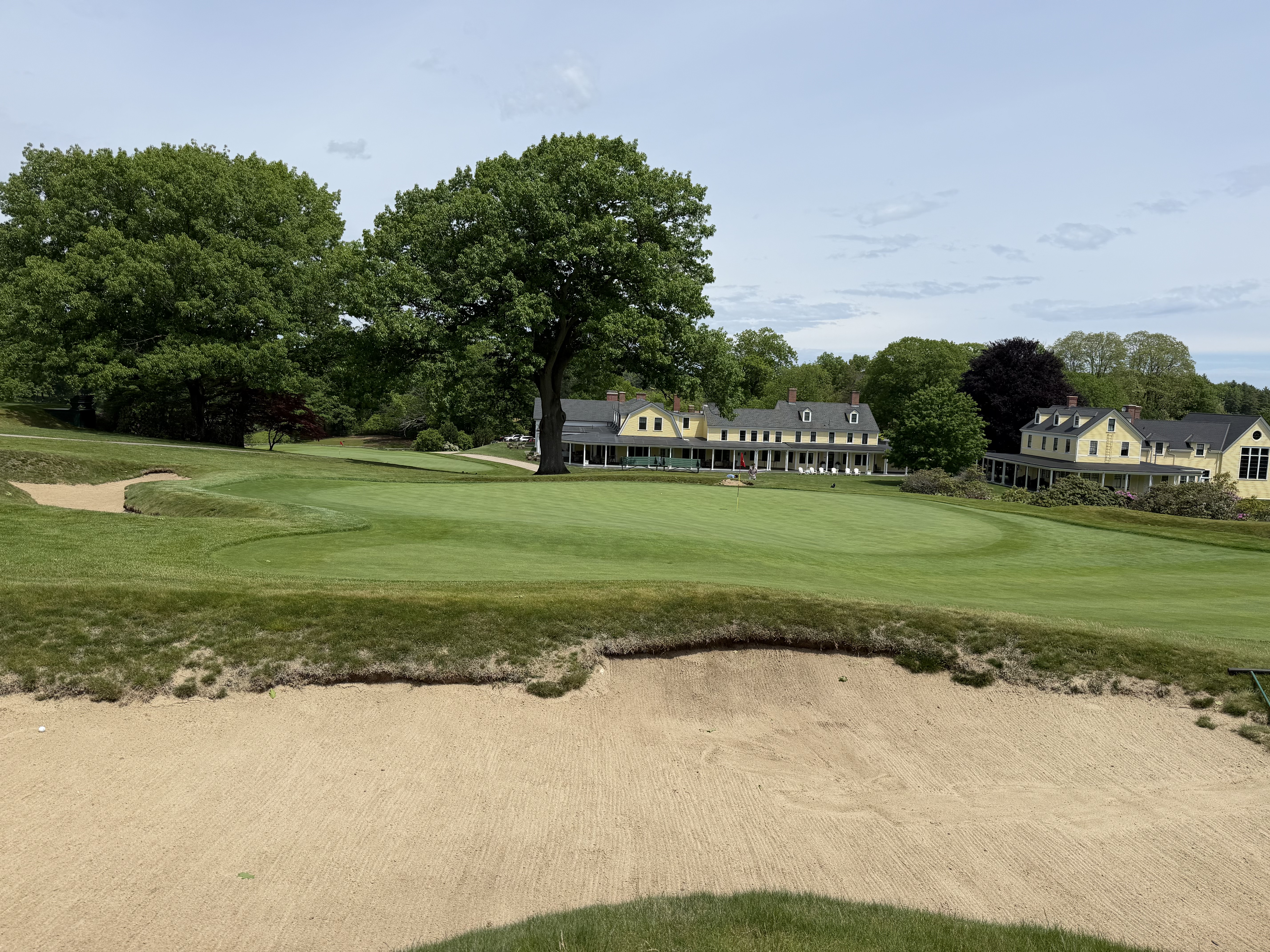
The Eighteenth is a 371 yard par 4. We come to the last with one last climb to the green and clubhouse beyond. The green is at the lede side of the clubhouse, between the trees. A couple bunkers are on the right, messaging to stay left but be sure not too far left where the creek resides. The approach is a field goal between the trees to a green that runs back to front in line with the hillside. Mind the movement, as it is there in spades even if it doesn’t look like it, and one must avoid the fate of the ball hurtling back down the hill to keep the round going a little longer.


The back nine gets a little more rambunctious with its use of the rock hill and trees are used nicely to add to the strategic tones of the round. The series of par 4’s are all distinct and one doesn’t even notice we come across a single par 3. I would rank them 16, 12, 14, 11, 15, 10, 18, 17, 13.
Generally, Dornick Hills is a timeless masterpiece where Maxwell relied on the natural topography to unearth a strategically exciting round. The scant use of bunkers is a welcome change for several reasons and here, emphasizes the golfer do as the architect; embrace the contours. Negotiate with them, ponder how to rely on your skill set to advance the ball upon each of its slopes, hollows, knolls and hillocks. Sand is rarely there to save your ball from that movement. The routing does well in meshing into the hills and creek in a random walkabout, adding to the organic feel of the round. The course seems to take the golfer back in time. Plenty of courses spend a lot of time and effort attempting a natural appearance but here, it just is. There’s restraint, which allows the natural features to determine the structure of play and the golfer to see those features as they were meant to be. The subtlety here is wonderful and unabashed. Playing it later last season, it was one of my favorite courses played last year.
Clubhouse/Pro Shop: On top of the hill looking down upon the course, the views never tire.

Practice area: There’s a range off to the right of the First and putting green just outside the clubhouse.




You must be logged in to post a comment.