“We are who we pretend to be, so we must be careful about what we pretend to be.” – Kurt Vonnegut
They’re really running with the whole slam thing. Scramble slams. Pancake slams. Omelette slams. My God. Everything is slammed; what does that even mean? It’s not making me hungrier. It’s confusing me and makes the menu look ridiculous. If anything, I’m getting unhungrier, the confusion and rage taking care of those hunger pains. But it was 5:00 a.m., pouring rain and I had no where to be for an hour an a half. So as the only one in some random Denny’s that early morn, the waiter patiently waiting for me to order since he quite honestly had nothing else to do, I looked up, cleared my throat, and ordered. ”I’ll have the Cinnamon Roll Pancake Slam, please.”
And so the 2024 golf season began. Alone, way too early, at a Denny’s, with cinnamon roll pancakes. It was getting bleak with respect to actual golf that day with all the rain, which I think spurred my grumpiness with the slam mania on the menu. I was expecting a cancellation text any second as I moved from the hash browns to the bacon and back to the cinnamon roll pancakes. It never came though and it was time to head to the course. When I arrived, it was just as I expected. An empty lot. Yet I went through the motions anyway and got my bag out, walking to the pro shop. Someone came out of no where and took it, told me my host was waiting for me in the locker room. Ok, he got here but realized we can’t go out and will tell me in person.
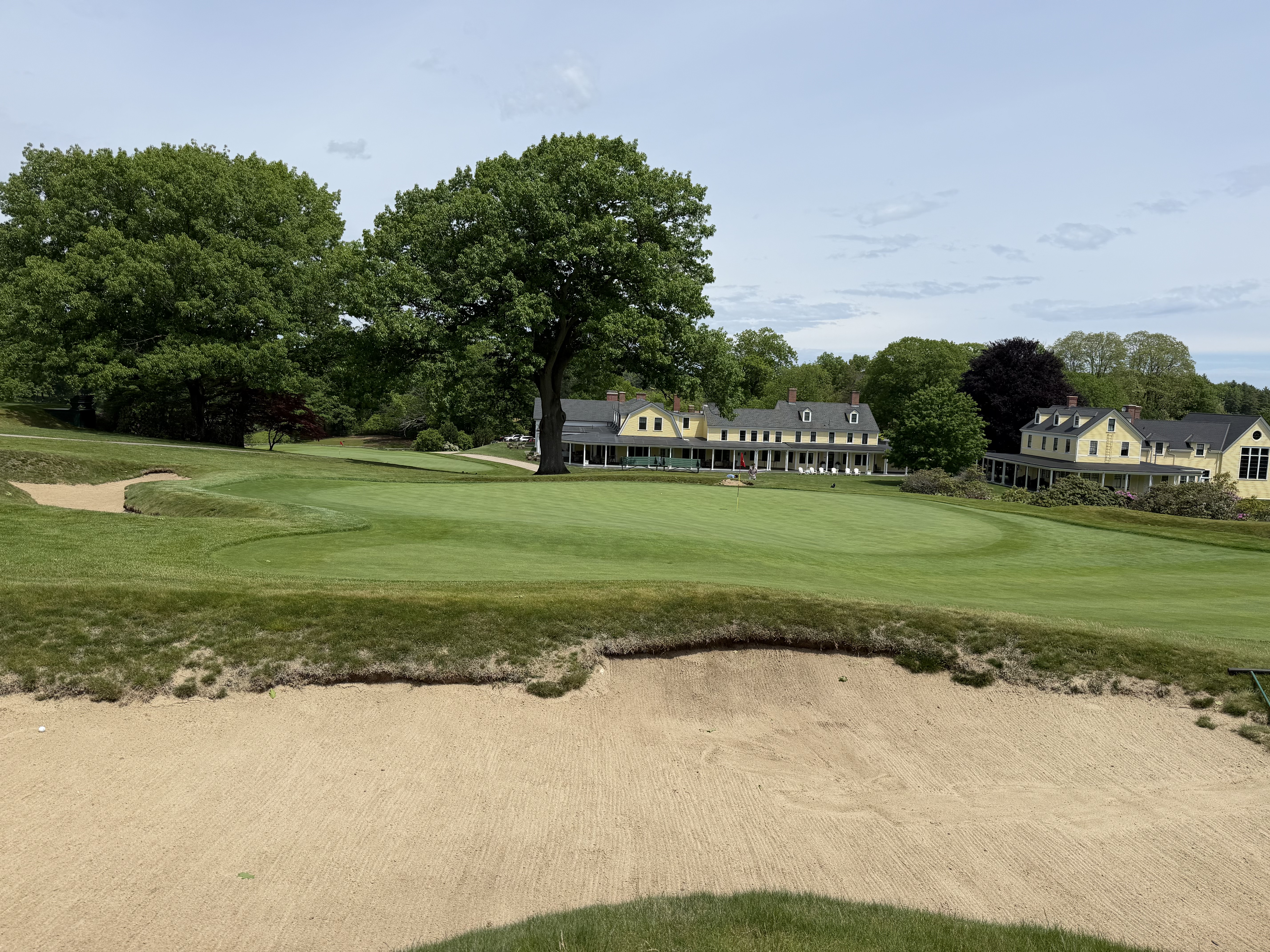
But he didn’t. He was ready to go out. And so we did. Then it happened. It stopped raining. And a few holes in, the sun came out. By the back nine, we were in short sleeves and sunglasses. The inaugural 2024 Golfadelphia round at Santa Ana Country Club started out with all the dismay of an early rainy morning Denny’s pancake slam and ended with a literal rainbow over the clubhouse as we holed our putts at the Eighteenth.

I swear I don’t make this stuff up.
Staying on this slam thing a bit longer, I suspect Denny’s has expanded on that theme because it evokes familiarity and identity. Those going to Denny’s all over the country expect those slams and know they will not be left hungry, with most if not all of them being open 24 hours. It was certainly why I was at a Denny’s; I knew it was one of the only places open at that unsightly hour. And I wanted pancakes. There’s no denying Denny’s knows what it is doing. It’s been around forever. It has found its niche. It’s fine but far from fancy, yet not the cafeteria/prison ambiance of a Waffle House or the kitchy spartan waiting room feel of an IHOP. Its food is substantial and decent at worst. It doesn’t try to be everything to everyone like one of those phone book type menus one can find at any diner in New Jersey. There’s a certain lower middle tier of quality Denny’s thrives in. In fact, one could say it’s the perfect place to go at 5:00 in the morning by yourself as you curse the rain.
Denny’s does not have aspirations to be more than it is. It doesn’t have plans to expand to a “Denny’s World” and host the 2056 Breakfast Slam Eating U.S. Open. It doesn’t want to reinvent itself. It doesn’t want to return to the “Danny’s Donuts” days either (although I wish it would return to its practice of giving a free meal to anyone on their birthday). Denny’s is fine with what it excels in and its limitations. In other words, Denny’s embraces its identity. In turn, so do we.

“The only true happiness lies in knowing who you are . . . and making peace with it.” – Laurell K. Hamilton
“Do you usually play 36 holes a day?” The father in our group seemed curious about my early day excursions. Sir, if you only knew. The second round that day was with my father. He doesn’t give a shit about other golf courses. Golf consists of the few courses he likes to play. He may like to play some where new every now and then but let’s not get carried away. We were playing at one on his rota, “Recreation Park Golf Course 18” in Long Beach. That’s it. That’s the name of the course. It is exactly what it purports to be. A recreation park for the public where golf can be played. The straightforward approach of its name carries on to the design. Most of the interest is at the greens, which move and tilt in one direction or another and make for stronger movement than they appear. It was nice. It was. What it purported to be. 18 holes of recreation. The father and son we played with had fun, I had fun with my dad. The other golfers looked like they were having levels of fun. The place seemed comfortable with its identity, and so did the golfers.
Moreover, in a Golfadelphia first, one of the year’s resolutions has already been accomplished. Looking at my score card from, “The Rec,” it added up to 78. Just like that, I had broken 80 for the first time. In front of my dad. This year is gonna be good but even if this is as good as it’s gonna get, I’ll take it.
Golf course identity is important, almost vital, for the course to properly flourish as much as it can. It’s often not an easy task figuring out that identity. Even if it can be figured out, it must then be agreed upon by the club. Even then, it must be carried out the right way. Then, even then, the club has to be comfortable with it and embrace it. It is only then that us collectively, will too.
Course identity is probably not talked about enough even though it’s a primary driver of course design. And something that many courses strive to emulate. The courses of old in the United Kingdom were richly distinct in their identity, with each emphasizing the unique land on which it sits while the local village wore such character as a badge of honor. This transferred to the Golden Age, which was so successful in extraordinary design because of the freedom in asserting identity through the design. RTJ actually reversed the notion of course identity to a brand. His courses shared a distinct similarity that let everyone know it was in fact an RTJ design, which the courses then boasted to lure the tour and drive memberships and house sales. Dye transformed this by injecting much more individualism into design yet remained consistent with RTJ in producing a brand connecting his courses, as did Fazio. Indeed, this brand materialized to the signature hole mentality, yet there’s no denying it elevated the stature of the course architect and his or her importance on the game. Difficulty was a necessity back then and if you didn’t enjoy the course, it’s because you weren’t a good enough golfer so get your ass back to the driving range. Nowadays, the prevailing course identity has some anchor to Golden Age design and naturalism while emphasizing accessibility and interest for all golfers.
“Well I try my best to be just like I am but everybody wants you to be just like them” – Bob Dylan
There’s a rising tide of sameness that jeopardizes individuality of course identity in each generation. Emulation of success by way of renovating or restoring erodes that individuality as the changes simply present the course like all the other new or newly renovated ones. On the other hand, the courses that know and embrace their identity and seek to strengthen it preserve and cultivate the character that breeds greatness. The identity of a course can of course change which usually is the point of renovation, so long as it’s distinct and grounded in the inherent nature of its terrain and free of imitation for the sheer pursuit of praise. By way of example, a parkland course changing to blown out bunkers because it’s the style du jour will more often than not lessen the quality of that course since that type of bunker would be out of place in most parkland settings. Yet changing the bunkering to increase strategy and thought provoking shots while remaining consistent with the natural setting strengthens the strategic identity of that course. Restoration projects are typically an attempt to return to or strengthen an identity that perhaps faded over time. Two notable examples, Pinehurst 2 and Los Angeles Country Club North. It bears mentioning both courses are the most recent hosts of the U.S. Open. Ah yes, the majors and the courses that host them. Many a course has suffered an identity crisis by chasing majors or even rankings in that rising tide of sameness. The LACC and Pinehurst 2 projects, however, accomplished what Rees set out to do with the restoration of Brookline and Oakmont’s tree removal restoration, both in the 1990’s; return to a strong course identity while maintaining a capability of hosting professional tournaments. Dual identities if you will. Coore and Crenshaw eased up on their restoration work after Pinehurst 2 while Gil continued instilling this dual identity theme, leaving a path of member-friendly courses that could host a major tomorrow if they wanted to in his wake, with notable projects including Oakland Hills South, Southern Hills and Baltusrol.
While these are the success stories, there are many courses that won’t be mentioned by name that don’t fare so well. It’s safe to say, however, that the aforementioned success stories include past issues that were corrected. I was watching Shell’s Wonderful World of Golf the other day, the one where Jack and Arnold compete at Pinehurst 2. The course looked very generic, with the bunkers in the same shape you’d see at any other course in the area, the fairways without character and a pronounced dome of the greens. Lush rough lined the fairways. The course was ranked in the top 13 at the time. It looked like a course disconnected from its setting and there was little that differentiated it from most any other courses except maybe the greens, which were never meant to be domed by Ross. These changes were the sign of the times and Pinehurst 2 continued to be ranked superbly while hosting majors and high end matches like the one I was watching on television. Yet moving further and further away from its true identity. Yes, it was successful in achieving and maintaining fame and fortune but at what cost?

There are also assorted subsets to the general identities above. Is it a driving course with interest off the tee. Is it a second shot course with an array of approach shot options. Is it more of a short game and greens type place, where the wedge and flatstick game is an entirely new and exciting universe from the tee and fairway. Is it a condition monster. Is it more of a pretty view place. Is it all of the above? Every course would like to think it’s all of the above, just as it tries to be all things to all people. And that my friends, is when the trouble starts. More more more rarely ever turns out for the better. An intimate, charming member’s match play course is not a tournament venue no matter how hard it tries. Some tough as nails, sprawling championship layouts are not one of the best in the state no matter how fast they get their greens. Indeed, a course focusing on the right things comes with knowing its identity. If one would like to add or change its identity, it must be done the right way as well.
Conversely, there are courses that are cognizant of their identity and are always intent on ensuring it is intact. Shinnecock, Chicago Golf Club, Fisher’s Island and Sand Hills all come to mind as the more well known examples. Yet there are countless lesser known courses that have been successful preserving their identity over the decades. Most have no aspirations of fame and fortune. Most are comfortable in their own skin, warts and all. Most know their strong suits and embrace their shortcomings as character. These. These are the easiest places to find the soul of golf. The game is distinct, the place remains special and the golfer holds it close to his chest. All because of identity.
There’s a sense of place that pervades at these courses. The jagged coast line of Fisher’s seeps into the fairway lines and wild movement of the fairways, eventually settling with the grace of the greens, which reflects the peace of the ocean. The Shinnecock hills are steadfast against the wind coming in from the sound, moving in all sorts of directions furtively, gradually and most of all with spirit, capturing the wonderful randomness of these elements in an American links feel unrivaled any where else. The holes at Pine Valley present themselves as behemoths of the game, one right after the other, in intense succession. The golfer laid bare and left to his skill set as he moves through the gauntlet, he learns something new about the game and himself every round. Harbour Town, with its winding corridors and mischievous trees, insists on the type of shot you take so that you’re forced to shape and smith swings throughout. Always intended to shift away from grandiose and width and heroism and instead, rely on guile and creativity and confidence. The community thrives around Audubon Park in New Orleans with their picnics, jogs and walks as the golf holes are in it all. Passerby stop to watch a tee shot or putt every now and then while other wave hi to those they see going this way and that. And so on. All going along under the age old adage, be yourself.

One of the most important elements of a golf course is its identity. Individuality of character leads to a more richly diverse golf landscape and in turn makes each place special for its own very specific set of reasons. Mind you, not every course has to brim with individualism. It can be a modern “championship” venue or a classic parkland with traditional characteristics, but then the question is how well does it excel in that template and why? These run more of a risk of falling into the many-just-like-it group yet those that rise to the top do so for setting themselves apart in some way. Perhaps the driving strategy is extraordinarily intriguing or the approach scenarios refreshingly abundant. Yes, even in those traditional spheres of identity, there are subsets of individuality that allow it to flourish in its own way apart from others. In whatever form, identity must be realized, strengthened then preserved.
This is what I seek in my journeys. What sets this course apart and how does it contribute to the golf universe. What’s that identity and how does it assert itself. Is it shining on that soul from one side or the other.
“No change, I can’t change, I can’t change, I can’t change,
But I’m here in my mold, I am here in my mold.
And I’m a million different people from one day to the next
I can’t change my mold, no, no, no, no, no, no, no.” – The Verve
If every course tries to assert the same identity, then every course is the same. If each finds its own distinct identity and embraces that, it becomes unique with more character and as it strives to be better, keeping that identity as the focal point and intact, it will truly become better in the best way possible.
That my friends, is another 2024 goal accomplished already. More bourbon chats.
What will the rest of 2024 bring. All 93% if it? Who can say. But on with the hopes and promises.
Quite honestly, the year is wide open. There is one trip with dates actually planned, some where below. Otherwise, it’ll all come into place one way or another at some point.
The Sand Hills of Nebraska was such a profoundly enjoyable place to visit, I may have to return. There’s a peace there I need to get back to.
New courses seem to be back at full steam. Almost 30 scheduled to open by my count. I suppose I should try and get to some of them.
Some new stuff to the site was outlined in the 2023 review. We’re gonna try and be the best site we can.
The Carolinas seem to have been largely ignored the last few years.
Vegas, I can’t stay away.
Could it be? The year of the first trip to the UK? Inquiries have already been made.
Just when I think I’m closing in on playing all of Philadelphia area’s courses, I am humbled realizing just how many I have to go. Time to get cracking.
O-hi-O. Way too rich of a golf state to not get there post haste.
Sitting on my couch in December, upset I didn’t do any of the above.
While I was certain when I was a kid we would all be living like the Jetsons by now, here we are in 2024 up to the same old things. That’s fine with me. You’ll find me on the course. And between rounds, always check the nearest Denny’s.


You must be logged in to post a comment.