6,588 yards, 132 slope from the Blues
In the early Golfadelphia days, resources weren’t what they are today with respect to figuring out noteworthy golf courses in other areas. This went double for those open to the public. Of course, resorts have always been easy to know about since marketing is a big part of their operation, but of the municipal courses not named Bethpage, Torrey Pines or Chambers Bay, it was a little more difficult finding out what was out there. That’s where rankings have a very useful purpose. One can have issues with which course is ranked where but there’s no denying some of the lists shed light on golf courses that normally would stay much less known. Indeed, all those years ago, I would study Golfweek’s state rankings, then research the courses on the lists, determining which I should visit. Such is how I came to learn about Triggs. And the more I learned, the more I set my sights on a road trip up north. While most every municipal course relies on its local community, they simply don’t have any budget for marketing beyond their region. One of the benefits of rankings is bringing attention to some of these courses. I mention it here because Triggs is an ideal example. Golf Magazine has since published a ranking of municipal courses, which underscores this point.
The trip to Triggs never happened. It came close; real close in fact (I had it planned and two days before had to cancel when I received an invitation to play some where closer I simply could not pass up). Finally last year, the opportunity arose and it was time to seize it. After waking up at some ungodly hour and spending hours in the car, I pulled into the off-road lot and spent the afternoon about the course. When all was said and done, it was the longest I had driven to visit a municipal course. I’m not counting Southern Pines since I was already down there for Pinehurst.
Ross would spend his summers in Rhode Island, so there’s a wonderful concentration of his designs that adhere to the craggy coastal classic charm of the area. While most are private, Triggs is one of the rare Ross public courses in Rhode Island, which was built on some of the higher points of Providence. It was designed in 1930 and opened in 1932, originally known as “Providence Muny.” The course is stern yet sporty, starting off as a gentle giant; long and wide yet on flatter terrain and without defiant hazards. The opening sequence then transitions to more turbulent terrain and with it more challenge where course knowledge becomes more and more valuable. The back nine gets right to it and delves into the more volatile terrain, all of which is used superbly without awkward forced carries or out of bounds.
Another intriguing characteristic of municipal courses is how some of them remain relatively unchanged despite their pedigree. Of course, some go the other way and lose their original design work from some public project or another, but here, it is the former. The course as Ross designed remains.
I spent the front nine with an older gentleman who plays nine holes here as much as he can. He knew the course and it showed as he tamed the intensity of the greens at will. I was then left to my own devices on the back, as foursomes of ladies let me through, then a couple groups of younger beer drinkers before the course opened up and I had it to myself. The relaxed aura among the vintage Ross was indeed a day well lived. Those who have Triggs within their normal reach are fortunate. Just as I realize my fortune with the proximity of Jeffersonville and at some point, Cobbs Creek. And we all have the obligation to do what we can in making sure they stick around for the generations after us. Triggs is one of the better classic courses open to the public so for those interested in such things, the arduous journey is well worth it.
The First is a 402 yard par 4. The fairway is wide but there are trees on the sides so the poorest of misses will find themselves in trouble early on. The green is ahead and seems to favor movement to the front right. The left side drops suddenly, so approaches need to find that balance of staying away from that left edge while considering the left to right movement.


The Second is a 425 yard par 4. The trees part just a bit as the hole bends a little to the left. Bunkers cover the right side leading to the green pretty well a trees come in closer on the left. Just like the First, off fairway is very unappetizing but staying in the fairway will always give you a nice chance to recover. The green is configured similar to the First as well with respect to its movement and the left edges, so plan the approach accordingly.


The Third is a 457 yard par 4. Rounding the corner and we find ourselves at a pretty long par 4. The course is taking us through some introductory paces at this point. The tree lines give the hole a little more bend than there really is. As with the prior holes, off fairway is some where to be avoided somewhat emphatically. It will likely take two healthy shots to reach the green and mind the drop off at the rear. The short miss is almost preferred at this opening trio while anything sideways is going to be tough.


The Fourth is a 200 yard par 3. A long par 3 made even longer going uphill. The bunker on the left draws the golfer’s attention but is well before the green and no where close to it, so it should be relatively ignored. In an about face, the short miss here brings a lot of misery. A good shot is more than likely going to land in the blind past the ridge, so strike true.


The Fifth is a 327 yard par 4. From a long par 4 to a short par 4, the course is starting to wake up. The green to tee walks are efficient and easy, which is good since the golfer will be covering a lot of ground with these larger sized holes. Here, just about anything off the tee will do, just clear the tree and mound on the right. The green on the other hand, is well fortified. Pushed up from the fairway, the bunkers at its base have faces that seem to hover over the sand. The green is narrow and undulating, demanding the kind of precision one would expect in a shorter hole. It’s all about the approach and getting on that green. Anything off green will take some skill to recover.


The Sixth is a 511 yard par 5. A sweeping turn to the right the entire time. The turn is both severe and gradual, not hitting you all at once yet must be factored in to every shot. The fairway starts straight out though, enough for the tee shot, but then there second and third shots must be mapped out carefully. Where to position the ball considering the turn and where it will run is of paramount consideration, especially since the green is well downhill. Many approaches will be blind because of the hill and the green is devious in how it moves left to right, so those lining up even down the center will find their shots well to the right and possibly short. It’s a great par 5 that covers a lot of different ground.


The Seventh is a 191 yard par 3. Another longer par 3 uphill but a lot more forgiveness up front. The bunkers are slightly off the green on either side, collecting those inevitable misses.


The Eighth is a 341 yard par 4. The green is positioned slightly askew to the left but the tee shot suggests the right side, which will then need to deal with the right to left movement of the green. It’s on the shorter side and the approach needs to be exact to avoid the bunkers, which are positioned slightly off the green once again. This type of positioning creates lots of variety in lies and short game situations. The greens move all over and that’s certainly true here as well.


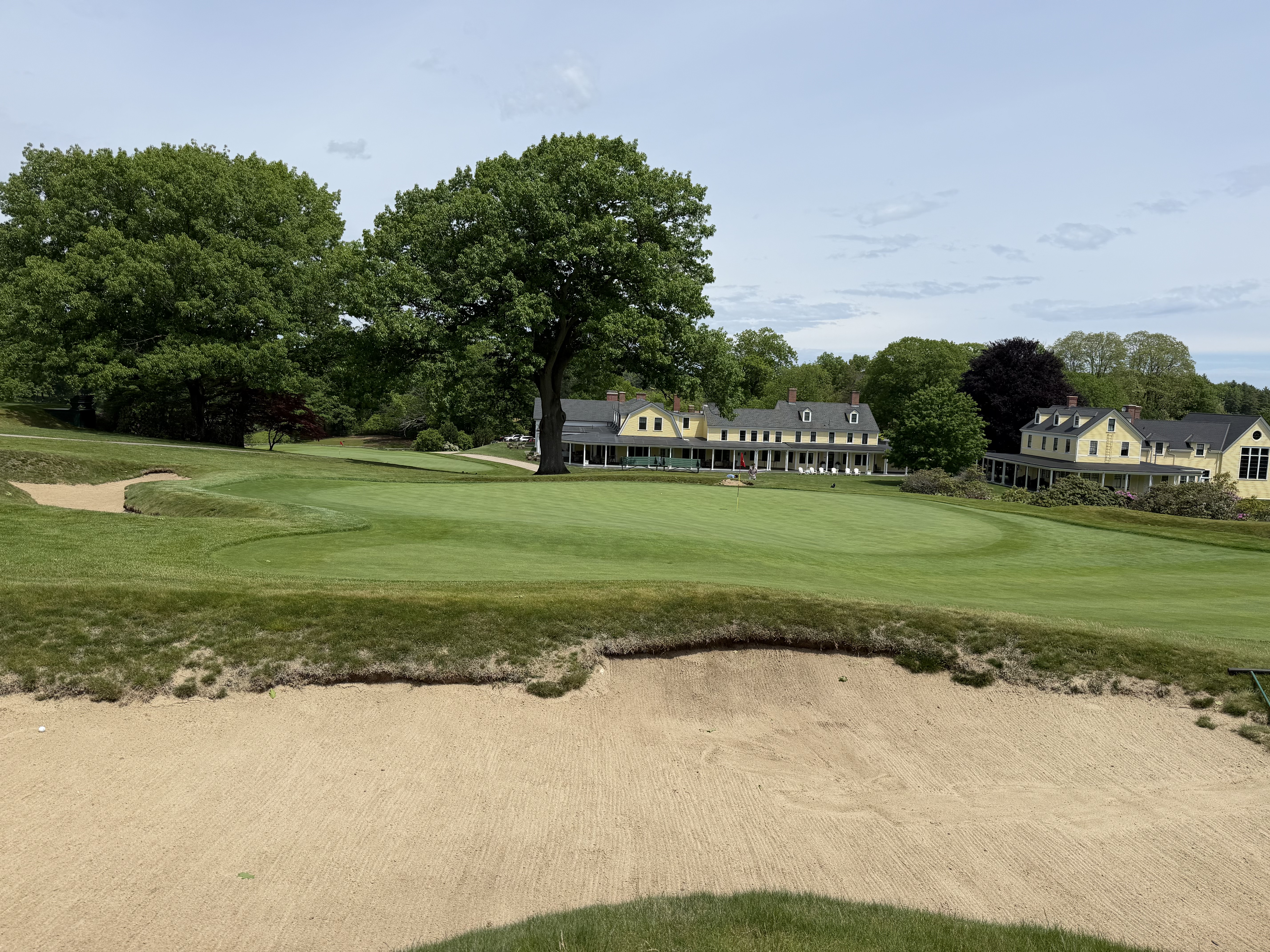
The Ninth is a 402 yard par 4. Neatly returning to the clubhouse, the hole feels a little more open and grand, the fairway a bit more wider than we saw most of this front nine. The trees and rough mounding off to the sides need to be managed up to the green, which has two well placed bunkers on either side. The green seems to funnel from the sides to the center as well.


The front nine goes about its work methodically and soundly. Bunkers are efficient, fairways are straightforward, yet the configurations to the greens, the offset positioning of the features and the movement of the greens provides all the strategy and engagement once could hope for. I would rank them 5, 6, 4, 8, 3, 2, 7, 9, 1.
The back nine starts with the 513 yard par 5 Tenth. A left to right tilt, the fairway is of only modest width. A center line bunker close to the green is well above ground and the undulations of the terrain make it an interesting space within which to play. The green is on the smaller side yet there’s not much defense to it either. The approach in tells us from the start this nine holes is going to play differently.


The Eleventh is a 350 yard par 4. The tee shot is elevated and must carry a dry creek bed to reach the fairway. As we have seen thus far, shots that drift too far sideways are no good in the trees. Bunkers pinch the entry to the green, which moves from left to right. The positioning of the bunkers around the green continued to fascinate me throughout the round. For example, the bunker to the right of the green appears to be greenside but it is not. There’s about 20 yards before it.


The Twelfth is a 200 yard par 3. The green is below the tee a bit and there’s a good amount of room before it if one feels the need to miss. Once again, the tolerance for sideways shots is not much. The green is well sized and can certainly handle the longer shots coming into it, at which point the golfer will need to manage its wonderful contours.


The Thirteenth is a 462 yard par 5. The par 5’s here were interesting in the sense that they consisted of a lot of the fairway movement on the course. The Sixth at Jeffersonville came to mind as I was climbing, plunging and twisting to the green. The fairway dog legs left off the tee, then moves uphill while the entire hole moves on a right to left hillside. The fairway crooks to the right a bit and uphill just before the green. All of this creates an array of angles for each shot where the contours and movement can be used to position the ball for the next shot. It’s a little different than the other holes and requires a good amount of accuracy and plotting.


The Fourteenth is a 158 yard par 3. The green is pushed up from the ground level, a row of bunkers moving across the front of the green. Over the green is no good. If you must miss the green, miss into one of the bunkers.


The Fifteenth is a 508 yard par 5. This nine is certainly not lacking of par 5’s, as three of the last six holes have seen them. The same hillside composition in the last par 5 is now seen in reverse for the most part, yet the tee shot is still blind and uphill before cresting down. The downhill after the crest faces the right side, so well hit shot that hit that slope will likely find themselves far in the rough on the right. The green sits at the end of the fairway before it moves downhill to the next tee.


The Sixteenth is a 319 yard par 4. A shorter dog leg left were a couple big trees on the left frame the turn and defend against a direct line to the green. The tee shot must carry water as well but shouldn’t be too problematic for most. The green is at the top of the hill and moves right to left. With a nice amount of room on the right as well, hedging in that direction is fine. There may be some that feel like gambling and hitting their tee shot near the two trees, then handle whatever wedge shot they’re left with. There’s not a whole lot of room near the trees if the ball some how hits one of them, so proceed at your peril.


The Seventeenth is a 412 yard par 4. We now run the length of the course back to the clubhouse. Getting as far up the fairway as possible is the main objective off the tee, with the right side clearing the slope first. The green is pushed up a little from the fairway, with a cool looking tree remnant on the left just before it. A bunker at each front corner as well.


The Eighteenth is a 410 yard par 4. The last couple holes are fairly straight and the final one is maybe one of the straightest on the course. Lots of room to run the ball up on the green and bunkers are off to the sides. Nothing flashy about the last couple holes, but after a busy stretch of holes, the course is coming to a nice gradual fading finish.


The back nine uses some of the more tumultuous lower land and has an unconventional routing that works well. I would rank them 10, 17, 15, 16, 13, 12, 11, 18, 14.
Generally, Triggs Memorial is s a fantastic public course and display of Ross with a few really good holes. The practical routing and features still yields excitingly strategic golf because of how the slopes and green undulations move the ball once it lands. The par 3’s are on the longer side and the bevy of par 5’s on the back make length a significant consideration in the structure of play. The greens, however, steal the show in how simplistic they are in presentation yet are much more complex in movement. The course would benefit from more attention to the fairways and bunkers but there’s always room for improvement at most places. In terms of municipal Ross courses out there, this is one of the better ones.
Clubhouse/Pro Shop: There’s a grill and a pro shop but they weren’t allowing the public in the pro shop at the time of my round.

Practice Area: Driving range and putting green near the First.




You must be logged in to post a comment.