6,375 – 6,434 yards from the Square tees
I loved that the time changed between the clubhouse and golf course. You don’t know whether to believe your phone or not, which also loses coverage for the most part. The golf cart continues on in the hills, becoming a vessel transporting the golfer to a Shangri-La. The transition starts taking effect and one finally sees some semblance of man; a wooden structure in the distance. More than a transition though, a kindling of breaking free from the cell phone and whatever daily technology many of us rely on takes place. The cell phone stops vying for our constant attention with its ringing and beeps. With no one to call and never sure exactly what time it is, surrealism overtakes the golfer as he raises his head and starts looking out to the horizon. It’s immense and majestic but the expanse makes it difficult at first to adjust one’s perspective. That’s when the golf course finally sharpens into view. Aye, the golf course. It’s the central feature in every way possible. The golfer’s attention turns to it intensely as the round progresses, eventually realizing that it’s actually an extension of the landscape. It is then that the full beauty of the place comes into proper focus. It is then that one realizes time is irrelevant because of how it stands still out there. What we see has been there for thousands of years and God willing, will be there thousands more just as it was when we laid eyes on it.
Sand Hills was the golf course I wanted to play most in this world. It has been that way for a long time. In fact, it fueled my stirring enthusiasm for course architecture early on. In a region typically known for its vast flatness after the Rocky Mountains, discovering there’s an area with incredible undulation composed of thousand and thousands of miles of sand absolutely ideal for golf was fascinating. Such a place existed and was relatively unperturbed. The way Sand Hills came about was fitting and done the right way. Recognizing the sacrosanct land, the golf course was more discovered than built. Then everything was sparsely placed about it and when all was said and done, it’s a homage to that land and region. The course is pure minimalism and some would say showcases golf in its most unadulterated form. There are no distant sounds of cars or sirens or construction or planes overhead. There are no buildings or houses or stores nearby. No distractions, it is simply man and nature interacting in a marvelous untouched setting. Even more, the golf course as designed is a masterpiece. These characteristics of purity and sagacity in design with such a light touch is extraordinary and I was certain led to an extraordinary experience. That was more than a decade ago and my desire to visit never wavered.
Brief History of Sand Hills
The Sand Hills region of Nebraska is about 20,000 square miles and comprises about 25% of the state. For comparison sake, that is larger than Delaware, New Jersey, Connecticut and Rhode Island, combined. Formed at the end of an Ice Age when winds blew the sand into large dunes during a drawn out draught period, the area remained for thousands of years. The dunes are indeed enormous and as one finds himself in the area, can see some of the best land in the world for golf stretched out as far as the eye can see. I was able to experience that for the first time years ago when I visited Dismal River. For this trip we had the option of driving to the club at night but I opted for staying in North Platte overnight and driving in the morning, just to see that riveting sight once again.


While the land is indeed suitable, there are many logistical issues that likely raised doubts on the success of a golf club in the area. The remoteness and sparse population meant most anything needed for construction would have to go through extensive shipping and trucking. And even once it was built, there would need to be management and staff and if they did not live nearby, lodging would have to be set up for them. Even after all that, you would need actual golfers to make their way to the course. Not just once, but again and again, in order to sustain it. Dick Youngscap is a Lincoln developer who felt he could form a course and club in the right way that would make it remarkable, sustainable and revolutionary. Youngscap had land near Mullen, Nebraska, which is a town with a population of about 500 people and four hours away from Denver and five hours from Omaha. The land was composed of sandier soil than many other areas, which made it less suitable for cattle grazing and more ideal for golf. Youngscap purchased the parcel of 8,000 acres in 1990. A month later, Youngscap hired Coore and Crenshaw to survey the land, which they ended up doing repeatedly for a number of years. At some point in this process, Crenshaw happened to look at land over one of the property boundaries and felt that land should be included, so it was acquired through a land swap. That land houses the Twelfth through Fifteenth holes. This surveying resulted in Coore and Crenshaw discovering or envisioning approximately 136 holes on the property. Famously, those 136 were then reduced to the 18 best. These 18 best accounted for a natural and flowing routing that was able to incorporate the volatile wind while ensuring it could be walked, remained varied and the green sites were well guarded strategically. Coore and Crenshaw’s talents include a patient study of the land and how it best reveals itself for the game. Here, it can be argued this was done better than any where else.

The course was the most naturally built since World War I. Total construction cost was approximately $1.2M, a far cry from the eight and nine figure budgets used on other venues. Most of the expenses are directed towards the irrigation system. The sand on the property was found to be perfectly round, which is in line with the USGA specifications for drainage and obviated the need for any type of greens mix. Indeed, the course was discovered more than anything else. The Fourth green was worked on the most based on its location on the side of a large dune and the greenside bunker at the Twelfth was installed after opening. Otherwise, the Sand Hills remain as is.
The Influence of Sand Hills
The course opened in 1995. At the time, the mega resort luxury treatment was popular and expected for most golfers. A popular golf trip consisted of traveling some where convenient to an airport that would ideally shuttle with complimentary daiquiris where upon arrival, the golf bag would not be seen again until on a full bore cart with miles of smoothly paved cart paths, interrupted only by comfort stations where the golfer could refresh himself with tacos, smoothies and beers for the road. Convenience and luxury were spruced with pristine conditions and “we could host the U.S. Open tomorrow if we wanted to” championship features. That is, at least in the U.S. In the U.K., there was a set of golfers that were willing to journey to more remote locations in search of golf courses that did one thing very well: conjured extraordinarily interesting golf. Most of these golfers did not pay much attention to the accoutrement as their search was for a different purpose than mere leisure. It remained to be seen, however, if a newer course in a fairly remote location could garner enough interest year in and year out. Sand Hills was quickly revered and its impact on golf course design revolutionary. Golfers in the U.S. were indeed willing to travel for profound golf without regard for the VIP resort treatment. Four years after Sand Hills opened and as a direct result of its success, Bandon Dunes opened to test this concept in the public golf venue. We continue to see variations of this golf model but Sand Hills is where it originated. Unlike these others, however, they have no plans to build additional courses.
From a design perspective, Sand Hills is the premier example of the heights minimalist design is capable of. For decades, modern technology had influenced a more manufactured design style that had its advantages and disadvantages. One of its disadvantages was a heavy influence on the aerial game while mostly ignored just how dynamic the ground game could get. Sand Hills spurred a return to the terrain, using the natural features as wisely as possible. Of course, this movement coincided on a number of fronts, including Tom Doak, but the meteoric rise of Sand Hills was a shining example of what could be and its shift from the prevailing design trends of the time inspired more and more such shifts.
Impressions of Course and Club
The drive certainly sets the tone. It becomes quickly self evident that the endless expanse of hills and dunes is a unique landscape incredibly ideal for golf. As the course reveals itself as you walk on to Ben’s porch for the first time, it’s likewise self evident that Sand Hills is the ideal rendition of golf on the most ideal terrain for the game in North America. It is the golf course one envisions when standing before those hundreds of miles of hills.
The course is excellent. The routing is a careful and meticulous plotting by Coore and Crenshaw. There is no prevailing wind; it essentially blows a bunch of different directions, so the holes are versatile in playing several different ways based on the disposition of the wind. Alas, the course plays so many different ways, which allows for all kinds of strategic shots that the golfer is likely creating and attempting to pull off for the first time. The off fairway areas are native greenery, wild flowers and wire grass that make it manageable to find and recover from those areas. That is a heavily underrated feature here. Mainly for me though, the course stands out for just how extraordinary it presents on scale. The dunes are massive and serve as bunkers and the holes make their way about them splendidly. The golfer is tempted to take them on in many instances and if they end up in them, could have to take a ladder down into their depths I’d gather as deep as 50 feet or more on some occasions. The horizon is always at hand, always adding to the scale beyond. There are no houses, no planes, no roads, no buildings in the distance. Instead, there are the hills, dunes, millions of yellow dots of wildflowers and an occasional tree or two. That in itself is rare nowadays. Finally, the restraint Coore and Crenshaw had here is genius. Fully aware of the naturally gifted site, there may have been temptation to try and do more in pursuit of a course that measured up to the eliteness of the site. Instead, they embraced the site and kept as light of a touch as possible, at least in some respects. The routing of it all, in both selecting the final holes from so many and then ensuring those selected were the best in all respects, deserves study and attention for ages to come.
The closing stretch is one of if not the best in the game. It starts as early as the par 5 Fourteenth but one could start at the Sixteenth as well, depending on how one wants to define what a closing stretch actually is. Both holes are par 5’s and that is no coincidence. There are are three par 5’s here and they are among the best collection I have come across. yes are interspersed by an extremely strong set of par 4’s that shine with their individual character. There are a good amount of shorter par 4’s that present with varied challenge and strategy. To wit, despite playing it over 5 times, the best score I could muster on the Seventh was a bogey. It vexes me to this day. The structure of play is marvelous in how it rises and falls in drama, pleasantry and toil. Yet above it all, Coore and Crenshaw managed to bring that structure to the same scale as its immense natural features. This may be their crowning achievement. Many courses have views of the ocean or some nearby geographical feature that’s wonderful to take in but isn’t related to the actual play. There are also courses that provide views of the course yet are some how out of scale, playing much shorter than it looks or more commonly, the play just doesn’t measure up to the views. At Sand Hills, the course plays in the same grandeur it looks when one is taking in its sites from high atop the ridge or down below one of the valleys. It is one of the rare instances where one can take in a glorious view of the landscape, then continue that very same experience within it.
Beyond the course, the club was in many ways perfect. The time change fits in so nicely with the step back in time many of us feel we’re taking as we drive through the small towns on the way to the course. Do yourself a favor and stop at one of them, get some lunch. The beauty of the Midwest and prairies is distinct American character, which goes for its towns and people as well. The same goes for the club. The course is the main attraction and everything is set up to complement it in an understated manner. Ben’s Porch is the halfway house with views of the course and hills beyond. There is no music or t.v.’s blaring. Instead, there’s a mesmerizing quietude that’s only broken up every now and then by conversation or a golf swing off the First/Tenth tees. The clubhouse and lodging follow a similar theme. It is about the area and enjoying it. One other thing that deserves mention are the people out there. This is their place, not just some where they work. Everyone takes care of you yet sticks around to get to know you. We took caddies on our morning rounds, who were all local kids and we were all especially impressed by them. Professional, friendly and knowledgeable about the course; there is hope for the future!
We’re constantly in search of fixed points that can be held on to in a universe of chaos. I suspected and anticipated but am now sure of it. Sand Hills is one of those fixed points for me. Glimpses of memory remain. Looking out from the porch with sunlight flashing rays around the support beams as various holes came in and out of focus. The valley of wildflowers off the Second green, trying to guess how many miles it stretched from end to end. The tee shot at the Sixteenth, the wind whipping while the bunkers as large as canyons puffed their chest and watching the ball soar into it all before rolling down the hills of the fairway. Sitting on the back porch of the room as Dismal River quietly moved by, a wild storm off in the distance flashing like someone turning the lights on and off. They come to me often. A reminder of just how beautiful and peaceful life can get some times.
George T. Stagg. Fitting. A survey of the bar that first night revealed they had a bottle, a bourbon I looked forward to trying for years and years. After a full day at a course I had been longing to see, I relaxed at the bar with it and breathed out for the first time in a long while.
The First is a 521 yard par 5 (from the Square tees). The elevated tee shot is to a fairway running at a right to left angle with a ribbon of a bunker running just before it, which must be carried to reach the fairway. The golfer must decide how much of the ribbon to cut off, which needs to keep in mind the bunker on the far right side, which can come into play off the tee as well. The fairway rises and falls, which can be used to the golfer’s advantage as he proceeds. The movement becomes right to left closer to the green. The green sits above the fairway, a bunker off to the right residing deeply in the hillside and no where anyone would like to be. It’s a deep green, sitting on the hill top and moving back to front. One should look across the valley back at Ben’s porch to get some bearings on the land just traversed.


The Second is a 368 yard par 4. The fairway yet again runs at an angle from the tee, this time left to right. The tee shot must carry a ravine and just like at the First, need to decide how much of the ravine to take on to reach the fairway. The approach is a great one. Ascending to the green, it seems as if we’re moving straight to the sky. The fairway bottlenecks closer to the green where there’s a bunker on the right, then spills out just before and around the green. All the room around the green promotes the wonderful ground game strategy here, which is abundant and occasionally, a necessity depending on the wind. A significant right to left hillside is what the green is situated on that will roll off the left more often than one anticipates. The view off the rear of the green were among my favorite, thousands of wild flowers dot the landscape and exude the pristine remoteness of the area.


The Third is a 216 yard par 3. Most of the par 3’s here are on the longer side, the shortest being the last. Here, the tee is elevated and the bunker we see is well before the green, visually creating a false front of sorts. The green is immense and while the dune on the left creates some left to right movement, there are areas of the green that move in different directions. Left to right is still a good guiding light and this might be the first green that teaches us just because you’re on the green doesn’t mean the hole is over.


The Fourth is a 409 yard par 4. Coore and Crenshaw like to rely on a rigid left side of the hole at times. While trees usually define this rigid side, here it’s the contrast between fairway and native scrub from the elevated tee that does it. The fairway has a left to right cant as well, forcing the golfer to pay attention to that left side while simultaneously avoiding it. This theme continues at the green. The enormous bunker on the left of the green was built, the fill of which was used to build up the green, one of the rare instances here of a little land shaping. The right side of the green falls down to a short grass area, providing an area to miss on the approach while remaining a challenging recovery back up to the green. It’s a great hole and with views of the wilderness close at hand since the hole is at a corner of the course, the spirits of the golfer start to draw on the setting.


The Fifth is a 387 yard par 4. Tee positioning is a huge influence here, as back tees come in more from the right while the middle tees take on that first bunker from the center, forcing the golfer to commit to one side or the other. Otherwise, you end up hitting a spectacular tee shot that goes into the center line bunker from those middle tees and ends up settling at the very top of the lip. No one said golf should be fair and I took the lie as a reminder that one side of the hole or the other must be the play. The green crooks off to the right, so those on the right of the fairway have a better look on the approach while those on the left will need to cover a bunker near the green and the approach is blind for the most part. Another great green site that is much more complex than it appears.


The Sixth is a 198 yard par 3. Another long par 3 with an elevated tee shot yet as we have learned, wind comes into play more than elevation. The dune on the left running across the tee line is well short of the green and obscures the view of the green on that side yet there’s enough of it in view to figure out what needs to be done. The bunkers we can see on the right are the only hazards around the green; the rest of it is short grass among undulations. The back to front pull of the green is deceiving, however, so those above the hole will have their work cut out for them more than they may think at first glance.


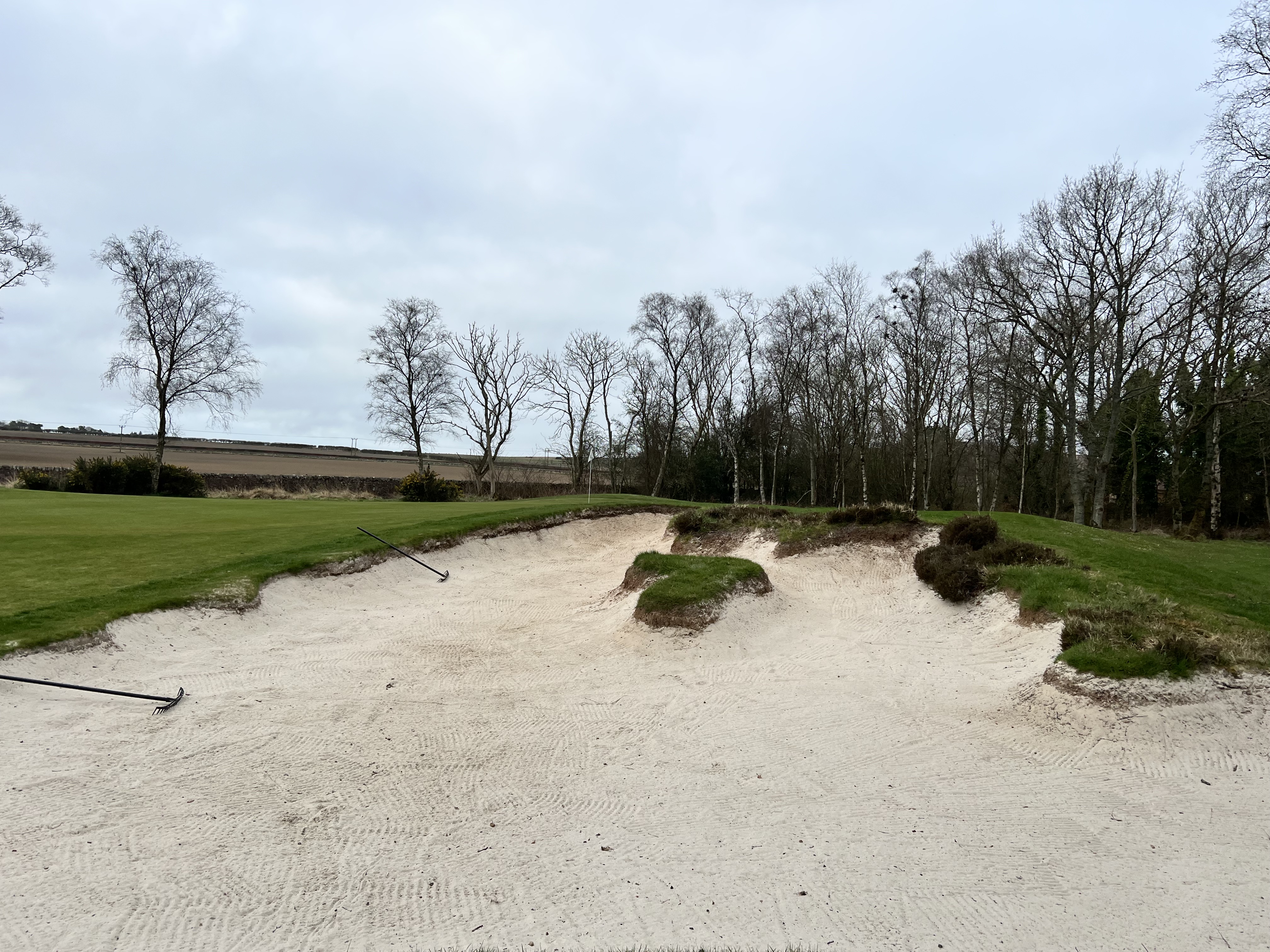
The Seventh is a 283 yard par 4. An endless loop of this hole and the next all day every day would provide exciting, fulfilling golf on every shot. They also show just how great this course is; its ability to excel in every cate for of hole one can think of. Here, we begin a duo of all world short par 4’s. It starts with the tee shot. Driver could be too much but even more than that, the acceptable landing area considerably shrinks the longer one goes off the tee. The hole goads a shorter tee shot into the safe underbelly of the start of the fairway but that means a tough approach into a well guarded green, tucked off to the left. The ideal tee shot certainly drives and remains on the green and other than that, lands short of the green on the right, clearing the sunken bunker on the left. This leaves a nice approach where the green moves back to front for the golfer. This was one of the few holes I could never muster a par on during my time here. I could never get the combination of tee, approach and/or recovery shot correct and as a result, found myself in just about every part of the photograph below. Regardless, I love this hole. For how it makes the golfer think and for how many ways it plays.


The Eighth is a 326 yard par 4. The contrast with the Seventh is refreshing. The golfer can still hit a variety of clubs off the tee but the decision is reduced to just how far down the fairway he would like to get for the approach. Likewise on the approach, the golfer gets to decide just how he would like to coax the ball closer to the pin whether by air or land. There is a bunker front and center before the green to account for but otherwise, there are countless options depending on how the terrain is used with the style of play. While the Seventh is strategic challenge, the Eighth is strategic pleasantry.


The Ninth is a 371 yard par 4. There’s a bunker off the tee on the right that cannot be seen, like most of the fairway. I ended up in that bunker just about every time I played this hole. We even started calling the bunker by my last name. I started to enjoy ending up in it. I would get out, then have a challenging opportunity for an up and down par, which seemed to focus my game for whatever reason. That to me typifies Sand Hills. It’s absurdly versatile and accommodates just about every style of play and recovery shot that each golfer is able to take his time in figuring out what may work for them. Most every other golfer should opt for the left to left center off the tee, however. The left side of the fairway does move downhill from the green, so those on the right remain level with it. The green is similar to the hole prior in that there is plenty of ground to work with and remaining below the pin is recommended.


The front nine is strong throughout. The par 4’s are so distinct and lovely while the opening par 5 is excellent. The par 3’s are both on the long side yet vary in structure. I love them all but a ranking of them would be 2, 8, 7, 1, 4, 9, 5, 3, 6.
The back nine starts with the 426 yard par 4 Tenth. The left to right movement prevails through the green and the larger bunker on the right serves as a reminder of not paying enough attention to it. The swale before the green also makes it possible to bounce the approach short and have it roll on. Both shots need to start off to the left and avoid the trouble lurking at the lower right side. And the back nine starts with the reminder, embrace the terrain and revel in it.


The Eleventh is a 348 yard par 4. The left to right terrain movement continues at the tee shot, which must carry the native grass a bit. While the play is to favor the left side, too far left could mean ending up in one of the larger bunkers. Blind to the hole once in it, the flat expansive bottom has plenty of room to work with in getting out. There are bunkers on the right of the fairway as well and they come in play for those moving down that side. The green is well above the fairway and runs off on all sides with bunkers on the left down the hillside. It’s a marvelous hole with a great hazard and a fun yet mischievous green.


The Twelfth is a 354 yard par 4. The fairway is a bit obscured but the green is straight out. The base of the hill where the green is placed can be reached from the tee, so the golfer can try for that area that leaves him a short approach in. Or the golfer can play shorter off the tee and remain level with the green, before the fairway dips down. What the golfer should never do, however, is hit a tee shot off to the sides. There are contours that take those shots to unspeakable places, complicating the approach tenfold. Straight, stay straight. This is another corner of the property I enjoyed immensely. The landscape off to the left and hills beyond give a closer glimpse of just how remarkable a place we find ourselves in.


The Thirteenth is a 185 yard par 3. After an opening trio of shorter, fun par 4’s with a little bite, the bite becomes a bit more direct here. The green is uphill and pretty much blind from the tee. I felt the wind was working against the shot most times we played it. The bunkers before and around the green make for pretty tough recoveries and the left to right movement of the green is strong, so those vying for that left side need to do so just right in order for the ball to stay on the playing surface. So a longer shot is required, with finesse.


The Fourteenth is a 475 yard par 5. A shorter par 5 where a longer tee shot is rewarded with a consideration of getting to the green in two shots. Those with looser tee shots will have some room to recover with the fairway bending a couple times as it rises and falls. The green is on a hillside above the fairway. It is the smallest green on the course, sandwiched between bunkers on the front and back while sloping back to front and right to left. The golfer could spend countless hours trying his approaches from various angles into the green and from various distances, yet precision with the flat stick is what matters above all here when all is said and done.


The Fifteenth is a 422 yard par 4. We come upon what I found to be the toughest hole on the course. Switching back in the direction of the hole prior, the same hills are used. A large bunker on the right is in play off the tee and is a virtual certain lost stroke if one wanders in. Beyond the hillside on the left is where the green is but it’s a long approach, made longer by the uphill and wind when it’s against. Other than the large crater bunker that’s before the green on the left, there’s no hazards near the green; just the short grass contour that glides from left to right. It’s a testy approach that even a well hit tee shot doesn’t do much to tame. I came to using the bottom of the hill off to the right when out of position off the tee, instead of trying to take on that crater bunker. Yet even relying on one’s short game means getting the speed of the rolls down and with all the space, I found it a tough task to dial in.


The Sixteenth is a 565 yard par 5. The hole is well below the tee. A sweeping dune is on the left, crashing against the left fairway hillside. The fairway comes in from the right and there’s plenty of room for those that want to play it safe. For everyone else, taking on or flirting with that gargantuan on the left is the play, with those playing it right hitting the downhill and picking up over 50 yards of roll. The fairway moves downhill before dog legging left as the dunes crash the fairway on both sides at the turn. After the turn is the green complex, which like the hole prior, is free from hazards. It is just the green and the undulations and the left to right movement, all of it a bit calmer than what was encountered from tee to green. The views at every position, the flow, the interaction amongst sand and fairway and hills; it’s all perfect. It’s my favorite hole and probably my favorite par 5 played.


The Seventeenth is a 150 yard par 3. The shortest par 3 of the course comes at the right time. The back nine rolls out a series of behemoths and this hole now narrows the focus and allows the finesse of the short shot to shine. It is not without its challenge as three bunkers hug tight to the green on all sides. A small apron at the front allows some short shots to remain at green level while the only bunker I would wish anyone in is the one on the left. Once on the green, the Eighteenth and Ben’s Porch reveal themselves in the distance. We see the end of our journey even if it still appears a long way to go.


The Eighteenth is a 432 yard par 4. We start at the bottom of the hill and similar to the Sixteenth, magnificent arrangements of sand await on the left while the right side is clear for the most part. Taking on the sand gets the approach closer but the main goal is to reach the hill so that the tee shot can be sent down it. The largest bunker we encounter is on the left just short of the green and going in it means you’re probably going to need at least a cursory understanding of mountaineering to extract yourself in and out of it. The green is at the top, moving back to front and right to left. Hitting into the heart of the green is advisable to make sure it stays up there. The golfer is able to see much of the back nine from that viewpoint, his journey about the legendary sand hills now at an end.


The back nine is the more undulating and uses the terrain impeccably. It’s one of if not the best set of nine holes I can think of, with every hole remarkably strong and all of it conspiring for a lively, inspirational play. My ranking of them is 16, 14, 18, 11, 12, 17, 15, 10, 13.
The land pervades a state of mind that comes over us all out there. The golf course is a wonderfully natural extension of that feeling the land gives. So many times golf courses feel like an entirely different world from the surroundings yet it’s nice to look at and hit out of eventually. Here, Sand Hills is the near perfect iteration of the land for the game. And that land in how it remains so untouched and remote and, preserved, will become more and more rare as the years go by. Then it’s the beauty of the land in its untouched state and this place is rare and special on a variety of levels. One feels all of that, senses it and eventually, embraces it. Indeed, Sand Hills is a special place. The land and artistry of the design unite so beautifully that the experience elevates beyond anything that can be captured on a scorecard. The club seems to recognize this, as there is no course rating and you can’t post your scores here. It’s one of many ways Sand Hills stands for a soulful purity of the game, setting aside so many of the things that tend to detract from the peaceful inspiration this game can provide.
Clubhouse/Pro Shop: Let’s start with Ben’s Porch. It’s likely more time will be spent there when not golfing, or at least it should be. The porch gifts views of the course and horizon from its spot on the hillside and one is able to spend as much time as desirable since the porch is manned with a grill, snacks, sandwiches and full bar service. Coming in after a morning round, then spending some time for lunch before going out again, then coming back to enjoy the sunset is one of the most enjoyable rituals the golfer can come into.


As for the clubhouse facilities, they are simplistic yet never leaving you wanting for anything. The facilities are practical and remain with the theme of directing homage to the land. Plenty of windows looking out yonder, the food is excellent and the beds comfortable. The whiskey and wine selections notable. And yes, the pro shop has plenty to choose from.


Practice area: There’s a range more for warming up than anything and a larger putting green near Ben’s Porch that is worth spending some time on. You’ll want to spend most of your time on the course, where there will be lots and lots of practice.


You must be logged in to post a comment.