6,429 yards, 136 slope from the White tees
The greats are great for a reason. Figuring out the reason is what I’m mainly interested in. When one cuts through the famous championships it may have hosted, its exclusivity, its history, its ranking, its “hang;” what is left, if anything. After all of that has been shucked away, is the design of the course, in fact, great. Time after time, I prepare myself for disappointment as I visit the more heralded venues of the game, so sure that their fame is bound up in all kinds of other factors than the structure of play. Yet time and again, I end up discovering then appreciating that greatness. Why Winged Foot is great has always been a peculiar question for me. After hearing a barrage of opinions over the years, it seemed the greens were undoubtedly some of the best one could find. And if that is the core reason for its greatness, is it really enough to win the day. And to believe it is, what does that say about the importance of all the other design features. In that way, I was always curious whether greens really had that kind of influence on the overall design criteria of a course. So in a sense, playing Winged Foot essentially meant confronting this fairly heady question. Kind of.
I had never visited the grounds before that early Summer day I found myself driving up to the clubhouse. I would not be playing the more famous West course, however; I would playing the East. It is said that guests play the West while members play the East yet there I was as a guest about to play the East with a member. Winged Foot is indeed a 36 hole course and there’s something about the courses that distinguish them from any other 36 hole club in the world. Both courses opened on the very same day: September 8, 1923. All too often the second course plays second fiddle to the first, or carries a much different course identity for balance or to compensate a need for the membership but here, all 36 holes were built and opened at the same time. The New York Athletic Club sought a golf club and the winged foot logo originates there. The 36 holes opening at once means both courses are regularly discussed in the same breath. One may have their preference but the two courses share many more similarities than distinction.
Tillinghast was at the helm of the design in Mamaroneck, a suburb of Westchester County, a county referred to by Hebert Warren Wind as, “that vast Manhattan bedroom.” James Fenimore Cooper lived very close by and Fenimore Road was the site of a battlefield during the Indian wars and a campground during the Revolutionary War. Tilly used the battle worn ground for a litany of brawny, stout holes. In his own words, “. . . it was impressed upon me that the course for the most part would be played by athletes, men of strength, for most of them as members of the New York Athletic Club have been prominent in various branches of sports.” Tilly also explained of Winged Foot, “[I]n planning holes there are thousands of combinations, each offering a mute appeal for recognition. It is necessary to decide on the collection which will work out economically and satisfactorily from many angles. But this is sure: every hole must have individuality and must be sound. Often it is necessary to get from one section to another over ground which is not suited to easy construction, but that troublesome hole must be made to stand right up with the others. If it has got anything about it that might make it respectable, it has got to have quality knocked into it until it can hold its head up in polite society.” Then of the greens, “As the various holes came to life, they were of a sturdy breed. The contouring of the greens places a premium on the placement of the drives, but never is there the necessity of facing a prodigious carry of the sink-or-swim sort. It is only the knowledge that the next shot must be played with rifle accuracy that brings the realization that the drive must be placed. The holes are like men, all rather similar from foot to neck, but with the greens showing the same varying characters as human faces.”
Tilly was an exceptional writer and his description of the holes at Winged Foot is of course apt. Most of the holes bear similar resemblance from tee to green. On mostly flatter terrain, wide fairways with all kinds of length for the most part (the result of substantial tree clearing at the onset), with the East turning and twisting a little more than the West, no rough or sand directly in front of the greens while the bunkering on the sides ranges in severity. The compact routing of all thirty-six are within the acreage of National Golf Links’ eighteen holes. The greens are indeed where the holes shine and can indeed hold their head high. The variety is stunning as the movement, size and shape of each are distinctly complex. I firmly believe I hit more greens in regulation than normal just so I could spend more time on them. And yes, as Tillinghast explained, their arching contours and pin placements dictate approach positions that harken all the way back to the tee.
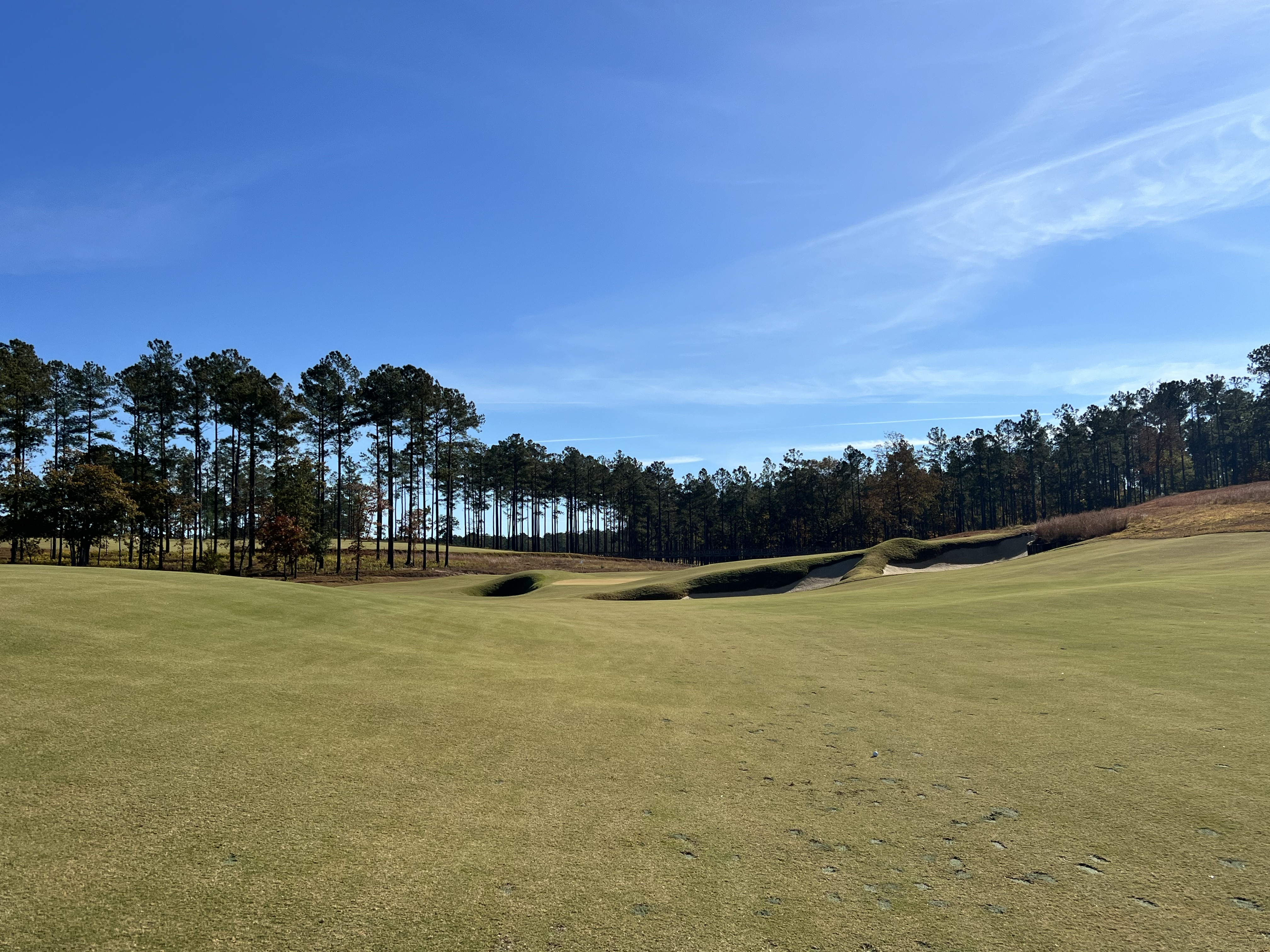
The East showed character and variety at the fairway as well. There were cants and turns past tree lines as well as dips, dives and a few carries over water. It is true that most every green is pushed up, rising from the ground in all their immortal spirit, but this only stresses their greatness. They demand attention, the golfer and anyone else forced to literally look up to the them. Incidentally, the cardinal rule is while you can get away with going in the water, or sand, or rough, or even against the occasional tree, do not do not do not do not, go above the hole.
The answer is yes, greens can have a rather dispositive influence on the greatness of a course. The rest matters, however. There is lead up and strategy and all the rest that helps make the greens what they are. The character of Winged Foot’s fairways, particularly at the East, ensures the appropriate balance for the greens to shine while instilling interest in the course and meticulous hazard placement, all of which contributes instead of overwhelms. This is the individuality Tillinghast was rigid in applying. The concept that all holes were designed at the same time, of the same character and all exceptional is just as impressive as the greens. The golfer could go out to those holes, play them in any order he sees fit and find cohesion, cadence and rhythm. One of these days hopefully fortune will shine on me and I will get to the West, completing the walkabout I started earlier this Summer and seeing the rest of those holes that have surely found their place in polite society as Tilly intended.
Tilly was always clear that he considered Winged Foot among his best creations. Geget.
The First is a 373 yard par 4 (from the White tees). “Reville.” A shortish par 4 with a generous opening fairway yet the rigid right and left side bunker are worth accounting for. The approach should be on the shorter side, all for the better as the golfer needs to become acquainted with the fascinating, flummoxing greens. This one allows some degree of putting from above the hole with its more moderate push up yet the intricacies of the left to right movement are likely what needs to be studied most of all.


The Second is a 466 yard par 5. “Man “O War.” The East removes all doubt that interesting fairways reside here with this hole. Straightaway but the left to right movement is significant, especially closer to the green where it’s an outright free fall to the right. The right side is once again defined by a tree line while the golfer needs to favor the higher left on each shot. The pin position has a large effect on the approach with such sweeping lateral movement, which is actually right to left. Add in the back to front of the green and it’s mandatory the golfer consider the roll out of the approach. An excellent par 5, made so with the fairway contour in conjunction with the splendid green.


The Third is a 141 yard par 3. “Cave.” The first par 3 relies on the hillside for its back to front movement, which extends to an apron before it. The prevailing movement is now right to left, which makes the lower left bunker much more manageable than the higher right. In a bit of a twist, the rear quarter of the green actually moves well to the back side, those aggressively going for pins from center to rear beware.


The Fourth is a 538 yard par 5. “Old Soak.” I adore the 5-3-5 sequencing in routings and we have one here starting with the forced carry tee shot. An unusual double dog leg in that it dog legs to the right twice; once at the tee and again before the green. While the presentation at the tee encourages the golfer to cut the turn a bit, careful how much you go for. Much better to hit the downhill of the fairway and get the ball rolling forward while any catch in the rough will make the next couple shots much longer. The second shot must deal with a center line bunker but once clear of that, the approach must travel substantially uphill to the green, which moves back to front furiously.


The Fifth is a 388 yard par 4. “Bootleg.” One might look up from address and notice golf holes abound in almost every direction. In the interior of the course, this spot demonstrates that the East and West really are a collection of cohesive golf holes there for the taking. All bred of the same character with fascinating distinctions, such a scene shows how Winged Foot sets itself apart from other 36 hole clubs. Once we return our attention to the hole, we realize it’s a dog leg right with a mostly blind tee shot. It is evident, however, that the trees on the right need to be cleared for a green light approach. Now it’s bunkers who want some attention and stand sentinel on either side of the green. Based on the tee shot placement with the dog leg, they will come into play much more prominently since most will not be playing straight down the center. The lateral movement of the greens continues to complicate matters and here, it is left to right.


The Sixth is a 174 yard par 3. “Trouble.” If we thought bunkers wanted attention at the hole prior, they are now screaming for it. The green seems to be floating on sand as the golfer is asked to find grass on the strand in between. There’s some room to bail out short and no one would mock those who decide on that route. In a rare shot, I managed to land my tee shot pin high on the left side, which seemed to be one of the flatter parts of the green. I’m now fond of that spot and recommend it to all of you.


The Seventh is a 437 yard par 4. “Quaker.” A longer par 4 that is straight with a fairway that is of modest width, the right side is more favorable off the tee. Some how the fairway widens back up near the green then feeds right into it. Bunkers line both sides of the green, which is very deep while the back right has a menacing thumbprint which ensures it’s not as simple as calculating for a back to front movement.


The Eighth is a 441 yard par 5. “The Hook.” Why yes, this hole is only four yards longer than the Seventh, yet is a par 5. A dog leg left where the tee shot needs to take some off the turn in order to stay in the fairway. While a short par 5, the twists of the fairway and the green itself are plenty reason for the strokes to amass while the rough and bunkers bring the golfer to a screeching halt most of the time. The front half of the green is liable to send shots back to the fairway and the right to left movement is much more pronounced than it seems at first glance. Who needs length with this type of playing structure.


The Ninth is a 386 yard par 4. “Mercury.” The loop is now complete and we come back to parallel with the Second. A slighter dog leg to the left than the hole prior where favoring the outside of the turn could be in order. The green is on the smaller side and has a swale just after the front ridge; a slight variation to the back to front we have come across thus far. As we have grown accustomed, the lateral movement actually rues the day most often as it does here, the left to right after the front swale prevailing. Once again, the green defines the hole brilliantly.


The front nine is sublime in so many ways, for its compact and efficient variety that still boasts a wealth of variety, intelligent hazard placement used sparingly and yes, the otherworldly greens. All of the holes are excellent. I would rank them 2, 4, 1, 8, 6, 3, 5, 7, 9.
The back nine starts with the 342 yard par 4 Tenth. “Parade.” The clubhouse is in the background as the golfer tries to maneuver about the bunkers that start on the left, then shift to the right further down the fairway. A tougher tee shot calling upon a stricter measure of exactness. The green is straight ahead but it is easy to feel otherwise. The bunkers guard it closely and play with visuals from the fairway, so that if the golfer is off to one side or the other, it seems as if the entire green has completely shifted. It’s a shorter hole and the longest among us may have a chance at reaching it from the green while everyone else will likely have a shorter club for the approach. The green is large but deceptive in its movement, requiring study and time to figure out at all.


The Eleventh is a 355 yard par 4. “Broadway.” One must go through the clubhouse to reach the next tee. This allows any halfway house trappings before confronting the remaining holes on the other side of the clubhouse.A slight bend to the right with the sole fairway bunker on that side. Another shorter par 4 gives the golfer more discretion on a course of action for the approach with the cardinal rule being don’t let the trees block out the shot. The green is incredibly deep with bunkers on either side that pinch in and cause some narrowness at the sides. This leaves room to miss short or long but anything sideways will end up in the bunkers. Another very good shorter par 4 where the green complex ensures a welsh of variety in play.


The Twelfth is a 538 yard par 5. “Long John.” The only par 5 on the back insists on a bit of right to left movement off the tee unless the golfer wants to take on the bunker and rough on the left side. The fairway continues to arch to the left all the way to the green and while some may have a second shot chance, the bunkers and green make for a touch recovery more likely than not. The second setting up the approach should focus on the downhill all the way to short of the green. The green is a grand pushed up back to front with three tiers, one where staying below the hole is almost better than getting close to it. One should just think of the green here and the one on the last hole to get a sense of the remarkable variety encountered from hole to hole.


The Thirteenth is a 141 yard par 3. “Cameo.” The variety in greens is punctuated here at this superb par 3 that runs at an angle from the tee. The fronting bunker on the right complicates things perfectly while the flat left bunker is a much tougher shot than it looks considering the movement of the green. It is a hole that expects precision and even landing on the green is not precise enough. A back to front, right to left movement pervades, all of moving like the world is going to end to that little front left corner. A handsome par 3 that mesmerizes, all those hours at the driving range need to pay off some where.


The Fourteenth is a 385 yard par 4. “Hell Bent.” The hole does indeed hellishly bend to the right off the tee, insisting on a left to right ball flight or a shorter shot over the bunker straight ahead. The driving game at the East is under discussed but full of interest and challenge in its own right. This might be the only hole where the tee shot could be seen as more challenging than the green. After the turn, the fairway straightens out to the green, which is pretty deep. The left side is now out of bounds while the right is interspersed with trees so play within the width provided, which should be manageable. The green complex accommodates, and I believe wants, the ground game. Feeding balls up through the entry point to the pin location is not a lost art and with trouble lurking here, is a wise decision.


The Fifteenth is a 324 yard par 4. “Shrine.” Water interrupts the fairway right around where many tee shots with driver would end up, so the golfer really needs to think whether to lay off short of the water or commit to belting across it. Laying off provides a flat surface with a short approach in while any shot looking to carry the water will need to do so convincingly with the hill on the other side leading back down towards the creek. The approach is surprisingly challenging considering how large the green is and short the shot. But the front half signals it will send the shot off the front if hit too weak while one is not sure what is all the way in the rear. Off right of the green is absolute hell, or at least drops down to the depths of it. It is to be avoided at all costs and by any means. Another glorious short par 4.


The Sixteenth is a 434 yard par 4. “Hope.” Standing at this tee, our host shrewdly turned to us with a grin and proclaimed, “now things start to get tough.” A squirrel summer wind had started up at some point as well and I realized we were in for a stout closing scene. There is width at this tee shot but the tree lines make it clear we are better off hitting right down the middle. The hole also plays uphill to the green, adding to its length. The approach will likely be on the longer side and one must understand that the green’s right to left movement, especially towards the front, should be accounted for at the approach especially with the inevitable roll out. A ridge runs right through the middle of the green and while it is one of the largest of the course, the perilous movement is such that getting on the correct side of the pin shrinks the proper landing area considerably.


The Seventeenth is a 185 yard par 3. “Lightnin.’” The name of the hole came from a bunker that used to reside at this hole and was the largest of the course. It was said the only way to get out of it was with a bolt of lighting, hence the name. The bunker was removed because of drainage issues and has not been reinstalled. Quite honestly, I’m not sure it’s needed. I haven’t come across, or at least can’t think of, a tougher par 3 without a forced carry and without any hazards. It is all at the green, which moves back to front and feverishly right to left, that does all of the damage. This leaves the left strip of the green as the preferred landing area. A miss to the right is at least salvageable while a miss to the left is pure purgatory. Off the rear is likewise without hope. The hole makes sure the golfer understands the importance of the terrain and how it moves, there is no other way to get the ball in the hole. I could play this hole all day and be happy as a clam.


The Eighteenth is a 381 yard par 4. “Taps.” The closer demands a good amount of accuracy off the tee, which leaves a manageable approach distance in. Every yard closer to the green is needed with the bunker placement around the green, which is elaborate. Still, the green is larger and there is plenty of room at the front. Make it about the green and rely on the flat sick, which is much more sensible than any up and down faced in the sand.


The back nine has a tremendously exciting pair of par 3’s while the variety of par 4’s is outstanding, as is the lone par 5. The collection of short par 4’s and how they are spread out is worthy of the highest note. I would rank them 13, 17, 10, 11, 15, 12, 18, 16, 14.
Winged Foot East boasts a hauntingly impeccable set of greens with infinite complexity, a variety of holes that differ in length, shape and structure of play, a set of par 3’s rivaling any other course and is a wonderful walk. This was all done on flatter terrain in compact confines. If one were take the name, clubhouse, history and the rest of it away and have any golfer step up to the First tee, they would come away delirious with acclaim if they had any sense. The course is exceptional and the fact that it is Winged Foot does indeed help explain how greatness is great for a reason. The driving game is lively while many of the fairways intrigue to the green, using bunkering intelligently yet sparingly. The greens are wonderful, requiring careful thought and touch. The challenge in scrambling here cannot be overstated, which makes the approaches all that more crucial. The challenge is as it should be. Hearty yet not soul crushing. Strategy and execution meld nicely and if the shot is missed, the recovery character pushes and pulls in degrees of even heartier challenge. Even with all the challenge, the course manages to provide an array of options on how to go about it, giving it a great match play feel. In short, this is the ideal sporty golf course. This is no surprise, as Tillinghast was charged with making it so. Even though that closing stretch tamped down my hopes and dreams, I finished the round reinvigorated, the game and its strapping points coursing through my veins. My time with nature had done its job, the world now at my fingertips. That is what exuberant battle does to the golfer and one can find that rare balance in spades at Winged Foot. It was one of my most favorite courses played this season.
This could be where I make some closing remark about “walking on air” but I digress.
Gil Hanse’s restoration of the East in 2014 needs to be mentioned, as he and his team were able to bring back the greens and the rest of it as Tillinghast intended. Yet another masterful project that allows those fortunate to play here to experience it in splendid fashion.
Clubhouse/Pro Shop: Clifford Wendehack designed the clubhouse, which was built with stone from the property acquired during construction of the courses. Wendehack and Tillinghast collaborated to make sure the clubhouse aligned with the holes in proper fashion for the sight lines. One of the more famous in the game, its grand prominence can be felt from most any where on the property. The pro shop is plenary with one of the most recognizable logos in the game.


Practice area: The driving range is modest, understandably so with the confines of the property. It is enough. In fact quite honestly, take five swings than go immediately to the chipping and putting green for the majority of any warm up time. This is where you will need it out there.



You must be logged in to post a comment.