6,730 yards, 138 slope from the Blues
Standing on the bluff overlooking the course before the round, there was a majestic stillness among the pines. It was morning and a splash of rain at dawn cooled things for a bit but now the sun was shining on the hills and valleys. It warmed quickly. A few years ago it was much colder here when some snow came in and covered the land. A blank canvas reset of sorts as Bill Coore watched the course features disappear. It was then he was able to reimagine and a new course would rise from the that canvas. This land started as the nine-hole Runaway Brook Golf Course way back when in 1901. Then in 1953 became Suprenant National Golf and Country Club, designed by Geoffrey Cornish with consultation by none other than Francis Ouimet and Paul Harney. The land showed its vastness by stretching to over 8,000 yards, the longest in the world at the time. International Telephone and Telegraph purchased the land in 1961, changing the club name to the International in 1967. RTJ lengthened the course even further in 1972, the land accommodating the demands placed on it at over 8,300 yards. Escalante Golf purchased the club in 2021, who asked Coore and Crenshaw to explore the possibility of a re-design. While we’re currently in an era of fervent restorations and renovations, many may be surprised how many of the classic greats are re-designs of original work. These include Shinnecock, Sunningdale Old, Los Angeles Country Club’s North Course and even Essex County Club. The Golden Age transformed existing courses to exude the more engaging, thoughtful and naturalistic character of the enlightened era of design. Such principles have returned and as Coore gazed upon the snow blanking what had come before, it’s very likely the visions of his craft spurred into motion. I now stood before it all as the naturescape began to awaken with the newfound warmth.

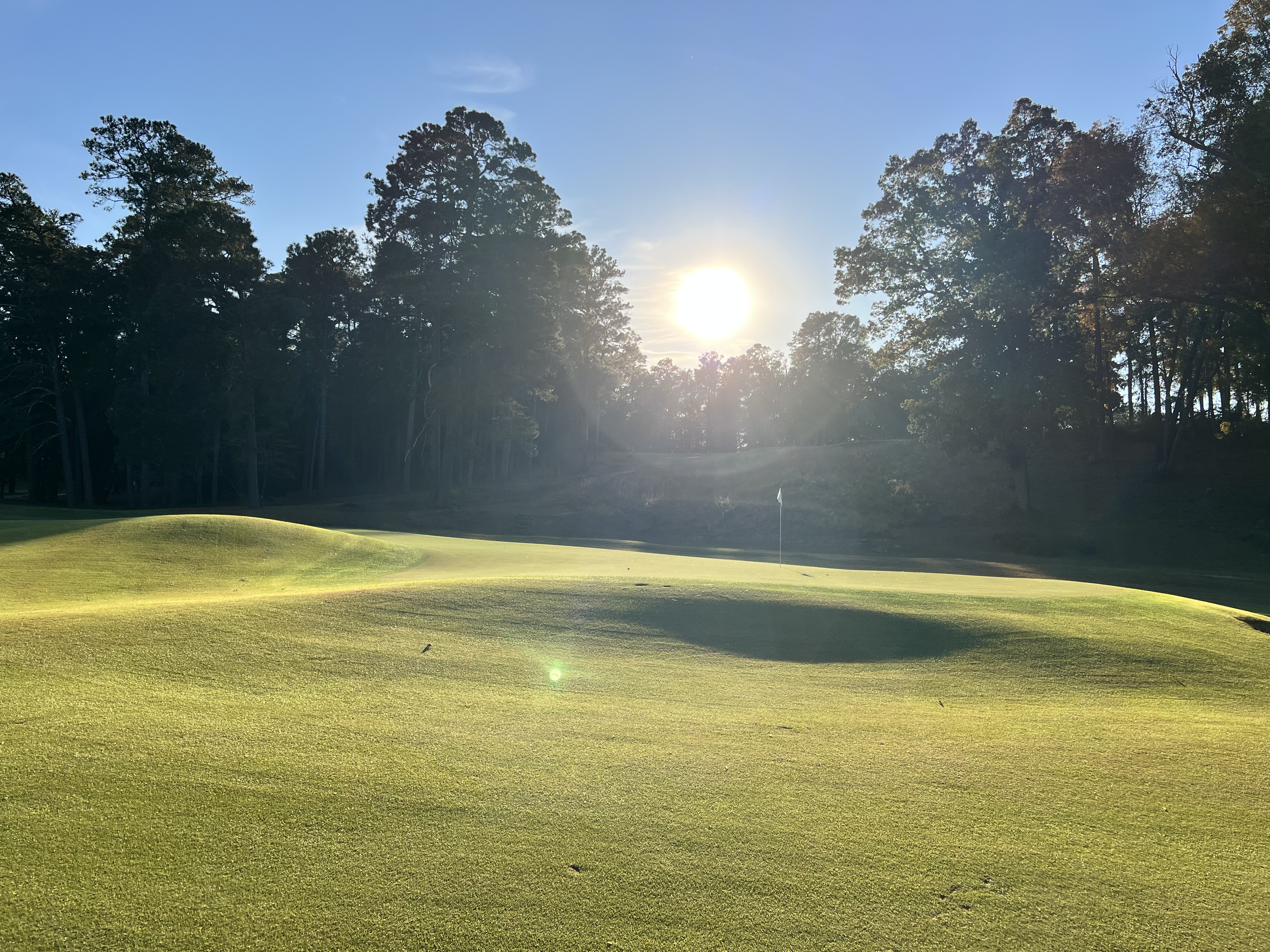
The setting is indeed special and Coore/Crenshaw have shown a legendary proclivity to realize the potential of any great site. That was a main focus of their project here; instead of the land straining to support such monstrous length, use its blessed natural character in a much more flowing and rhythmic cadence. Coore, Crenshaw, as well as shapers Ryan Farrow and Zach Varty, completely re-routed and constructed new greens and bunkers. They also uncovered a large natural sand deposit that further freed up the land. The quarry feature is at the Thirteenth and supplied sand throughout the rest of the site. Then there is the firm and fast. Fescue fairways are some what rare in North America and rarer in the Northeast but accommodate a fantastic bounce and roll that reside at courses such as Ballyneal, Bandon, Chambers Bay, Gamble Sands and Kingsley Club. The greens are comprised of supercharged Bentgrass 007XL cultivar, which allows for seamless fairway/green transitions. The smoothness of the roll on the greens is evident, which extends to the fairways and green surrounds for the golfer considering a ground game approach. All of this conspires for a unique Coore/Crenshaw design. The course accommodates fast fairways and fast greens, ensuring that such speed is unable to render any contour, undulation or feature irrelevant. It all stays in play and must be considered no matter how fast (or slow) the mode of the terrain. The symbiotic relationship between course and natural surrounds is intriguing. The golfer must situate himself within the sublime grand calm of the setting against the energetic speed of the terrain, figuring out how to harness the conditions by looking to the larger overall natural landscape. One rarely pays attention to the pin on any given shot or putt even if it’s intended to eventually end up there. I learned this as early as the putting green before the round. Whatever I felt the putt might do, I then chopped that in half and yielded to the terrain taking over at that halfway mark of my line.
In this way, Coore and Crenshaw uncovered the rich natural surrounds while providing a classic structure of play that is capable of accommodating modern game speed. One has no choice but to look to the land as he moves through the holes and it is only after playing it again and again does one start to learn its strategic nuances. This subtle sophistication is within surface level features more easily noticeable yet just as effective. The expanse of the holes also allows for immense versatility. Pin positions have the capacity to change the dynamics of a hole all the way back to the tee. In such manner the course can be as challenging or inviting as it wants. During the round, there were traces of Hidden Creek and Bandon Trails with a bit of the playing structure of Trinity Forest. Yet the Pines does well in carving out its own identity. The rhythmic flow of the routing, crescendoing in a culmination of boldness the last half of the back nine, its setting and the intriguing use of firm and fast amalgamate in fascinating character.
The International is a 36 hole club. The Oaks was originally designed by Tom Fazio in 2000 and recently renovated by Tripp Davis in 2021. It sits alongside the Pines, born again and the first golf course opening in over ten years in Massachusetts. Yes, it is shorter than its previous iteration but much more importantly, is finally in tune with that exceptional land.
The First is a 410 yard par 4 (from the II tees). We tee off a few paces from the back porch of the clubhouse with the fairway below us, meandering amongst the pines to the green. There’s more width than it may appear at first, just as that right fairway bunker runs along the right side longer than it looks from the tee. The green is slightly above and to the left, falling off on all sides. The right side of the green is a short grass slope while the left side is comprised of surly bunkers the golfer will need to elevate his ball quickly to extract from. Those who want to use the slope on approach and rely on the short game are more than able to do so while those looking for the pin will need to contend with the much sterner drop off at the front and left bunkers.


The Second is a 406 yard par 4. Much more width here and without the worry of fairway bunkers, the golfer’s main concern off the tee is the grove of trees straight out. Further up, there’s a an expansive sand pit that only comes into play for those off on the hard left side on their approach. The fairway moves right to left, so the golfer would do well to favor the right side as it is. The green is fathomless with its depth, stretching back much further than most would think. Such is the challenge with the flat stick here. While the hole is inviting as far as shots landing on the green, the golfer still needs to endeavor for the pin to alleviate the challenge that awaits with the putting.


The Third is a 208 yard par 3. The sand pit from the prior hole now demands much more direct attention and needs to be carried to reach the green. It also obscures a complete view of the green. It’s the only sand found on the hole, however, as the green is pushed up with a surrounding slope, gentler on the right and severer on the left. Lots of room to work with depth wise while if one really feels the need to hit sidewise, right is best.


The Fourth is a 502 yard par 5. The tree lines play with the golfer at the tee. The right side looks more inviting but another sand chasm must be carried while the left side is visible yet the tree line looks like it might confine the next shot. There’s a good amount of width despite its visual ruse at the tee and as the golfer has probably already learned, there is a lot more depth than can be discerned from a distance. Admittedly, the tee shot is more challenging than the second, which allows a good amount of freedom. The green is slightly left and moves towards the back left corner. Those making a go of it on the second shot need to account for the front to back movement, as shots coming in hot will keep moving. The right and rear slopes off while the left side includes bunkers of the cavernous sort. Those using the second shot for a shorter, manageable approach they can control will look like geniuses.


The Fifth is a 403 yard par 4. A good time to mention the seamless transitions from green to tee. The course is eminently walkable and these transitions facilitate the overall flow of the round. The tee shot is slightly blind to the fairway with a right to left cant. Those shying away from the tree line on the right are liable to land on a depression that will push their shot even further to the left, which is further from the green. The fairway opens up after the tee shot near the green. A series of mounding us before the green complex, which gently rises a bit to the green. Situated diagonally with a bunker on either side and a row of slender pines on the right. The approach needs to be more precise here than we have mostly come across at this point but the mounding and run offs allow for a good measure of recovery as needed.


The Sixth is a 165 yard par 3. A forced carry over water with a couple substantial bunkers inset to the hillside guarding the front. The golfer must carry both the water and the bunker to reach the green but mind the bunker at the rear left as well. The green is large so the golfer should take advantage.


The Seventh is a 521 yard par 5. The fairway gently bends to the right, so the tee shot must maneuver around the trees on the right for a clear line to the green. There are a number of fairway undulations that subtly push the ball in untoward directions. One of them is here, which will shift tee shots to the right if not fully committed to the left center line. It’s not the end of the world but the left side opens up view of the green while the right side needs to contend with a series of bunkers and an unfavorable through line into the hillside. Bunkers are at the sides of the green except for the rear right, which slopes down into short grass. While longer than the first par 5, there is more of an opportunity to attack the green on the second shot so long as the golfer properly accounts for the inevitable roll out.


The Eighth is a 304 yard par 4. Most anything is in play at this short par 4. I was gravely warned at the pro shop before the round, however, not to go for the green. It was sage advice, as I watched one of the others opt for driver. His tee shot hit a nearby tree about a hundred yards out and bounced right back to him, at which point he casually caught it. The things you see on the golf course. Staying relatively straight is the guiding principle here to set up an ideal approach. Those going for the green off the tee should favor the left side and even consider the left front to allow for terrain movement taking over. The greenside bunkering is at front and back right while the left side simply moves towards it.


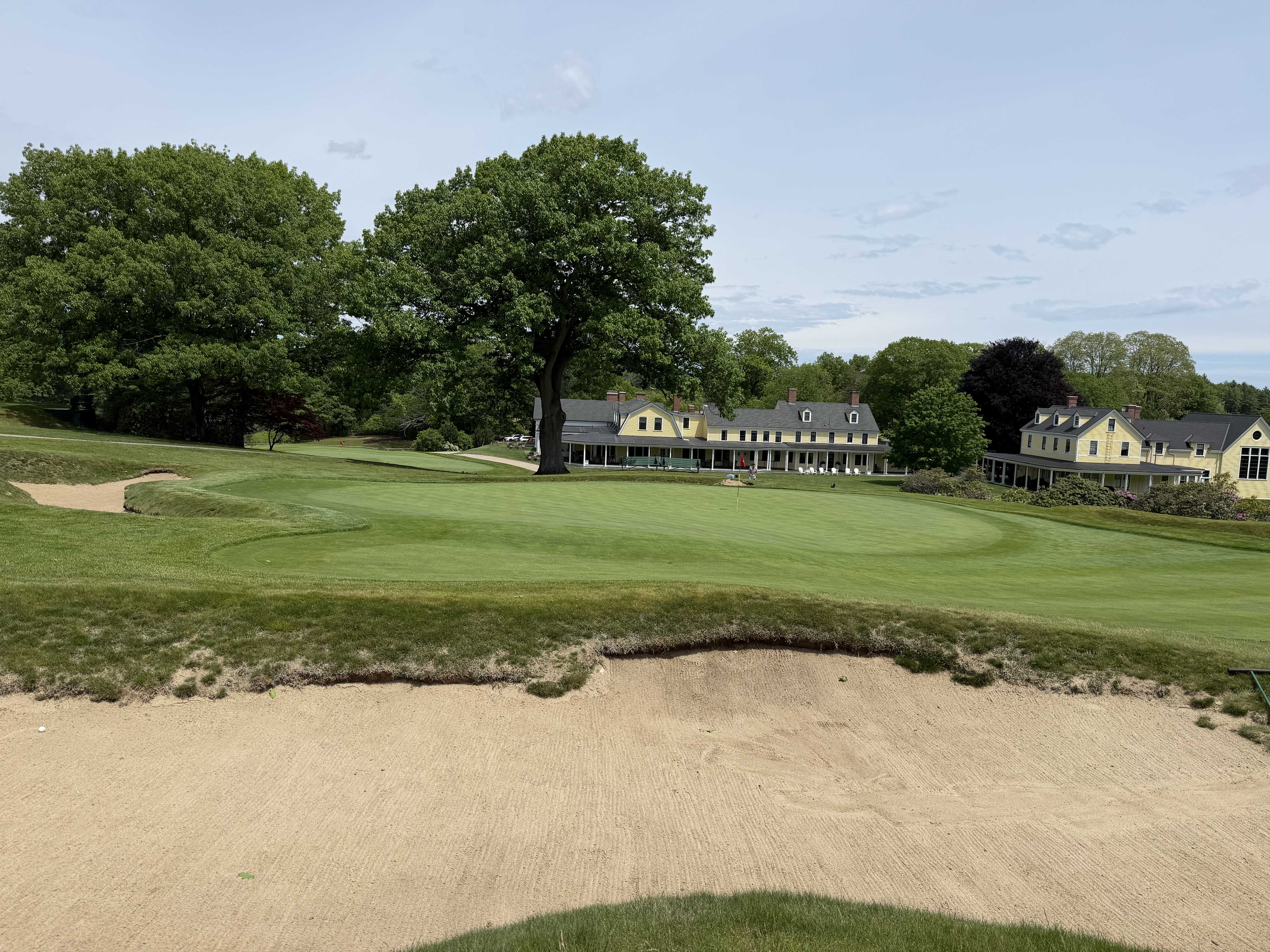
The Ninth is a 436 yard par 4. A dog leg left where the primary objective off the tee is to get the shot far enough into the fairway for a clear approach into the green. The green is on the same hillside as the clubhouse, resting on a diagonal to the fairway. The rear ramps up and acts as a back board of sorts while bunkers are below on both sides, the left side higher and right side lower. It’s not as large as most of the greens we have come across and moves back to front, off its edge and into the fairway. A tougher recovery awaits those whose approach is off the green but it’s the close of the front nine, it’s only fitting to have a bit of fight. A harbinger of things to come.


The front nine modestly rolls on the gentler beauty of the land with a strong set of par 4’s and 5’s, all showing a good amount of strategic consideration and variety. I would rank them 7, 8, 2, 1, 5, 4, 9, 3, 6.
The back nine starts with the 221 yard par 3 Tenth. A long par 3 that’s designed to accommodate the types of speed the course is capable of. There’s a broad hillside on the right that moves down towards the green and moves very much like a Redan in pushing shots short and right on to the green surface and down towards the lower left side. Bunkers are along that left side while mounding becomes more prominent at the right rear, presenting issues to the golfer regardless of what side of the mounding he is on. The heft of the green makes gauging the speed paramount. Getting on the green was not much of an issue but getting in the hole was an entirely different matter.


The Eleventh is a 614 yard par 5. An atypical penal forced carry over the water from the tee gets us to the fairway with bunkers at the through line. There are bunkers ahead past those seen from the tee, all of them immediately residing on the left but then short and around the green. It’s one of the most bunkered holes on the course. The next two shots need to advance a good amount of distance while minding the bunkers, which means knowing their location and the terrain directions upon landing. There’s a lot of green but a bit narrower than we’ve grown accustomed. The golfer begins to notice the winds of change in the air as challenge becomes more and more evident.


The Twelfth is a 387 yard par 4. Some mounding before the fairway muddles a complete view of the fairway. This is noted because there’s s subtle depression towards the right side that’s difficult to make out but those who try to hug the tree line on the right in an effort to shorten their approach will see their ball kick to the right and most likely behind the trees, the green out of sight. The fairway dog legs to the right just before the green and with its shorter distance, favoring the left for clear albeit longer approach is likely a smarter play. There’s lots of room at the entry point with the only bunker at the rear and a fescue mound at the right front. The interior contours of the green are worthy of note and getting close to the pin is more important than it seems at first blush to avoid the complexities of putting.


The Thirteenth is a 463 yard par 4. The quarry is before us from the tee and its imposing size isn’t realized until one walks through it. There is fairway running behind it so the golfer can figure out how much carry to take on but the more carry means more advancement towards the hole. Similar to Hell’s Half Acre at Pine Valley, those who find themselves in the sand chasm will have a chance to hit out of it with waves of intimidation washing over them. A crook to the right before the green and the trees on that side make it necessary to favor the left, yet another benefit of taking on more carry from the tee. The green is pushed up from the fairway and the bunker before it creates a false front of sorts. A back to front movement and multiple tiers, putting continues the journey of this behemoth par 4. We are in it now.


The Fourteenth is a 197 yard par 3. While the Tenth may have traces of one, this hole is an actual Redan. Tremendous movement from right to left while the tee is perched above. The golfer wants to hit that right side so that the shot falls down to the left. Right pin positions are near impossible to get close from the tee and putting back up to it will be the order of the day. The left bunkers are deep below the green but are more inviting than having to putt from above the hole. It’s a gorgeous hole and ball movement on the green is thrilling.


The Fifteenth is a 448 yard par 4. The fairway narrows at the dog leg further down, which moves to the right. Getting a good beat on the tee shot is a challenge, yet vital to pull off for those looking to score. Must be long enough to clear the trees yet not wander into them and those on the left side will face a blind approach from mounding at the end of the fairway. Right center is a good line and allows some room to take advantage of the terrain. There is an interruption between fairway and green requiring an aerial approach. The green boomerangs around and behind some mounding for one of the bolder shaping of the round. Pin positions dramatically change the composition of the hole and those needing to putt from front to back or vice versa will face just as much challenge as the tee shot. The front end is the high point, which turns down the hill and to the left to the lower rear right corner. Showing similarities to the Ninth green at Sweetens Cove, the approach really needs to mind the wild terrain movement of the green or become subject to the vagaries that come along with the flat stick.


The Sixteenth is a 134 yard par 3. The routing creates a few mini-loops for the members, mainly by returning to the clubhouse before the end of the round, then going out and back again to close out each nine. This happens after the Seventh and Fifteenth. This leaves the golfer with the following loops to play, all starting and returning from the clubhouse (if in sequence and not jumping around): 1-7, 8-9, 10-15, 16-18. Heck, the golfer could come out of the clubhouse and have at it at one of the par 3’s close at hand. Those are the Tenth and this one, the Sixteenth. Coore and Crenshaw love their short uphill par 3 holes. Off the top of my head, they can be found at Sand Hills, Hidden Creek, Bandon Trails and Dormie Club. Here, the green is set on top of a knob with a massive bunker within its left side. The right side slopes downhill and there’s a small bunker in the middle of it for those shying away from the bunker and missing the green. The green narrows at the rear, then drops off unceremoniously. The golfer must show capability with the short iron and if the green is missed, the golfer should expect some stiff recovery character requiring an array of touch.


The Seventeenth is a 382 yard par 4. A dog leg left heading uphill to the green. The water on the left needs to be cleared but of more relevant concern is ensuring the tee shot doesn’t move through the fairway on the right. A small center line bunker just before the green probably gets a lot more attention than it seems it should at first. Approaches not accounting for the substantial climb will likely find it while those on the green may be shocked when their ball continues moving and falls in. Indeed, the green is on the smaller side compared to others we have come across yet was certainly one of the quickest on the course. One will rue the day he is found putting downhill on this green, the slightest of nudges on the ball is strongly suggested.


The Eighteenth is a 529 yard par 5. Moving back downhill to the clubhouse, the tee shot must negotiate the tree lines ahead while figuring out how to turn right with the fairway tilting down and left. The inside of the turn is the high point, ensuring the ball will move towards the center of the fairway as well as closer to the green. Deciding where to place the second shot is next, with most any shot needing to favor the high right side so that it falls down the terrain properly. The green is set above the fairway, the entry point on the right in line with the hillside and bunkers pretty much every where else. The green is another fast one and those vying for the front half on their approach do so at their peril. The golfer will do much better embracing the terrain and taking advantage of the right side to temper the speed of the roll about the green.


The back nine is set on hillier terrain than the front and gradually crescendos into a bold, engaging finish. There are no weak holes. I would rank them 15, 13, 14, 16, 17, 18, 12, 10, 11.
An overarching benefit of the current direction of course architecture is an emphasis on nature. No longer is it the norm to force design on to a setting but rather, course design seeks to ingratiate with the natural setting and have the holes settle within. This emphasis inevitably results in producing the best playing structure possible, instead of trying to impose a similar structure across a variety of settings as was done in eras past. The Pines is finally in tune with the land, which is idyllic for golf in several respects. The sandy soil, assortment of hillocks and hollows as well as the gradual rise and fall of the larger slopes are a complete orchestra set for a symphony of awe-inspiring golf. Coore and Crenshaw have proven masters of artistically highlighting the natural surrounds upon which their courses are set and if that is all they accomplished here, it would be seen as a resounding success. Yet they go further in how the classic structure is steeped in strategy among characteristically modern speed at the fairways and greens. This is no small feat, especially about hilly terrain. The design insists the golfer look at the immediate natural features before him as well as the larger backdrop with most every shot. Each mound, depression, slope and hillside matter. In most instances, the golfer is encouraged to use these natural features to their advantage.
There are a number of courses out there set upon achingly gifted land for golf but fall well short of fully realizing their potential from past design issues. The Pines is a prime example of how important a complete re-design can be. Instead of trying to seek untouched or yet to be discovered land sites that are likely in remote locales, there are plenty of existing courses ripe for re-design. It does mean moving away from what has come before but for those with the vision of what could rise in its place, time has shown such a path can lead to greatness.
Clubhouse/Pro Shop: Set upon a bluff with views of the golf course, the clubhouse is simple in structure with a nicely adorned interior. The pro shop comprises the front half of the entrance floor and is worth a stroll or two to take in.

Practice area: The driving range serves both courses and is dual-sided, a short cart drive from the clubhouse. Short game area there as well. The putting green on the right side of the clubhouse is time well spent and served me tremendously out there.



You must be logged in to post a comment.